
 Ilan Asseo
AI SDR: Automate Conversations, Qualify Faster, Book More
See how an AI SDR automates LinkedIn conversations, qualifies prospects in-thread, and helps teams book more meetings at scale.

Buyers do not want another blast. They want a relevant, timely conversation that respects their context and gets to value quickly. An AI SDR built for LinkedIn makes that possible at scale, turning cold outreach into warm, two-way threads that qualify prospects in the moment and book meetings without waiting on manual follow up.
With Kakiyo, your team can run autonomous, personalized LinkedIn conversations from first touch to qualification to meeting booking, so SDRs focus on high-value opportunities rather than repetitive steps.
Industry evidence: Salesforce Research reports that sales reps spend only 28% of their week actually selling, with the rest consumed by deal management, data entry, and other non-selling work.
Source: Salesforce State of Sales
What is an AI SDR?
An AI SDR is a conversational system that engages prospects on LinkedIn, asks the right discovery questions, scores intent, and secures the next step when there is fit. Instead of pushing sequences and hoping for a reply, it holds natural back-and-forth conversations that reflect each prospect’s profile, recent activity, and responses.
The outcome is the same goal your team already has, more qualified meetings, delivered faster and with better consistency, while humans stay focused on strategy and deals that need a personal touch.

Why LinkedIn is the right home for your AI SDR
- Identity and intent are richer. Profiles, activity, mutual connections, and content provide context that improves personalization and qualification.
- Conversations are native. Prospects expect chat style exchanges on LinkedIn, which makes two-way messaging more natural than email back-and-forth.
- Signals are visible. Job changes, posts, and comments reveal timing and priorities that your AI can use to adapt prompts and questions.
How an AI SDR automates conversations, qualification, and booking
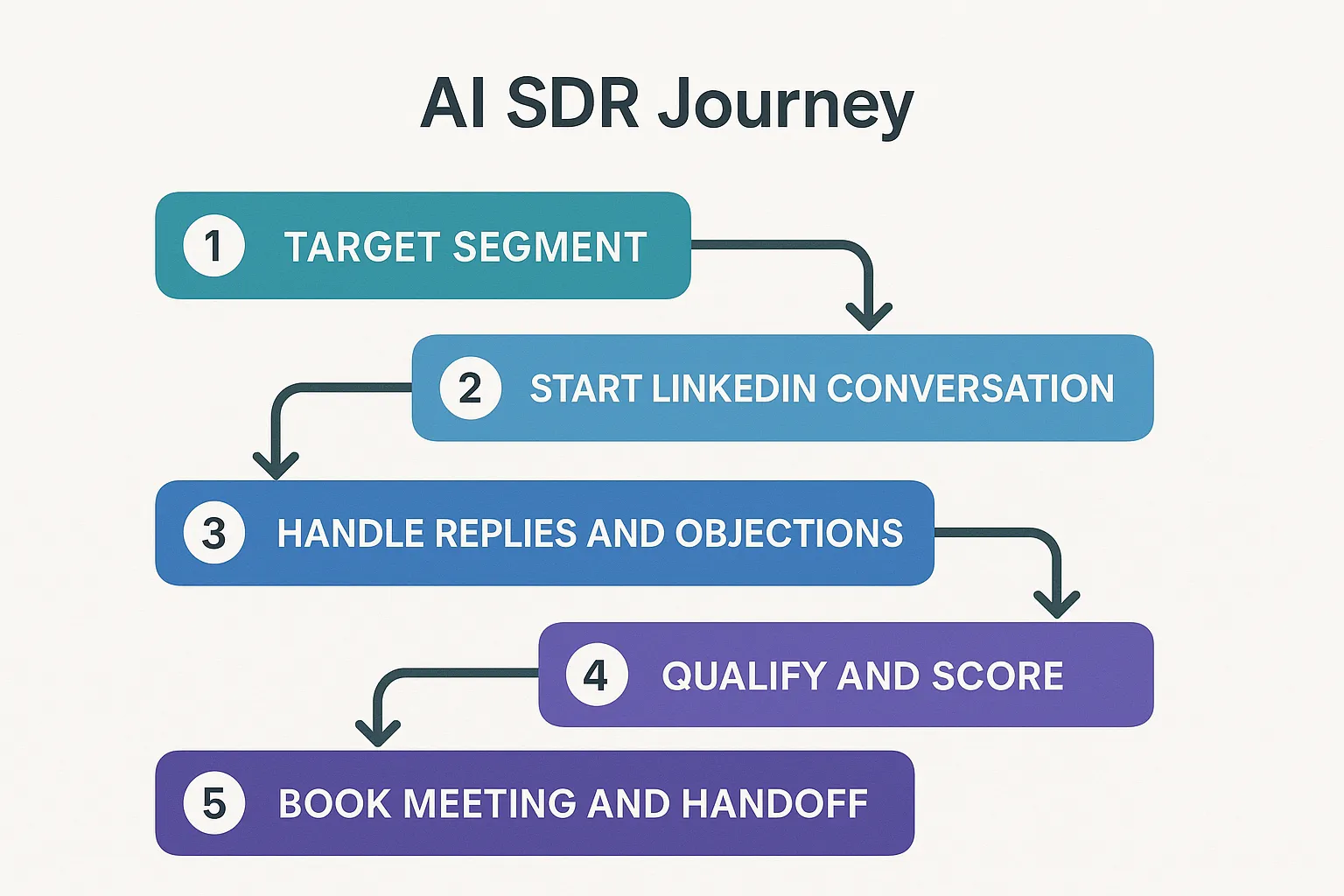
A well designed AI SDR does not just send messages. It manages the full conversational journey.
-
Target and personalize: It uses industry, persona, and trigger-based playbooks to start relevant conversations, then adapts language to the individual’s profile and activity.
-
Engage and handle replies: It recognizes objections and questions, responds accurately, and nudges toward discovery when interest appears.
-
Qualify in-thread: It asks crisp, non-invasive questions to confirm pain, authority, need, timing, and potential value, then scores the prospect in real time.
-
Book the meeting: When criteria are met, it proposes next steps and books time according to your process, so your calendar fills while your team works on higher impact tasks.
A closer look at Kakiyo capabilities
Kakiyo is built to manage LinkedIn conversations end to end, with the guardrails and control revenue teams need.
- Autonomous LinkedIn conversations: Run thousands of 1 to 1 threads that feel personal, not scripted.
- AI-driven lead qualification: Ask smart follow ups, confirm fit, and surface the right next action.
- Customizable prompt creation: Control tone, positioning, discovery questions, and objection handling.
- A/B prompt testing: Experiment with hooks, angles, and calls to action, then keep what works.
- Industry-specific templates: Start faster with playbooks tuned to your verticals and personas.
- Intelligent scoring system: See interest and fit scores in real time to prioritize follow up.
- Simultaneous conversation management: Keep dozens or hundreds of threads active without delays.
- Conversation override control: Step in, adjust tone, or take over any thread when you want.
- Centralized real-time dashboard: Monitor conversations, statuses, and meeting progression in one place.
- Advanced analytics and reporting: Track reply quality, qualification rates, and meetings booked to optimize your funnel.
Proven playbooks you can launch this quarter
-
Event momentum: Reach registrants, attendees, and no-shows with context-specific outreach that offers summaries, relevant content, and light discovery.
-
Persona pain messaging: Use industry templates that anchor on a concrete pain, then ask one thoughtful question that invites a short response.
-
Use case vignettes: Share a one sentence customer story, attach a quantified outcome when available, and ask a yes or no question to gauge relevance.
-
Competitive displacement: Position a complementary or replacement approach in one sentence, then ask about current gaps to surface urgency.
-
Trigger-based timing: Engage people who recently changed roles, posted on related topics, or joined target accounts, and tailor your opener to that signal.
What to measure, and how to optimize
Clarity on metrics turns AI outreach into a controllable, compounding growth engine. Start with these core definitions.
| Metric | Definition | Optimization lever |
|---|---|---|
| Connection accept rate | Percentage of connection requests accepted | Persona fit, opener relevance |
| First reply rate | Percentage of connected prospects who respond at least once | Hook strength, timing, profile context |
| Positive reply rate | Percentage of replies that indicate interest or fit | Value proposition clarity, objection handling |
| Qualified rate | Percentage of conversations that meet your qualification criteria | Discovery questions, scoring thresholds |
| Meetings booked | Total meetings secured from AI-led conversations | Call to action clarity, frictionless handoff |
| Time to first response | Minutes or hours to first AI reply | Simultaneous conversation management |
| Human override rate | Percentage of threads needing human takeover | Prompt quality, template precision |
Simple ROI snapshot
Use a quick model to align expectations and targets.
- Conversations started per month: X
- Connection accept rate: A
- First reply rate: B
- Qualified rate: C
- Meeting conversion from qualified: D
- Cost per conversation: E
Estimated meetings per month = X × A × B × C × D
Cost per meeting = (X × E) ÷ Estimated meetings
Example scenario (illustrative only):
| Input | Value |
|---|---|
| Conversations started | 2,000 |
| Accept rate (A) | 35% |
| First reply rate (B) | 20% |
| Qualified rate (C) | 25% |
| Meeting from qualified (D) | 60% |
| Cost per conversation (E) | $0.30 |
Computed outputs:
- Estimated meetings = 2,000 × 0.35 × 0.20 × 0.25 × 0.60 = 21
- Cost per meeting = (2,000 × $0.30) ÷ 21 ≈ $28.57
Your actuals will vary by market, persona, and offer. The value of Kakiyo’s testing, scoring, and analytics is that you can iterate your way to better inputs quickly.
Governance, privacy, and compliance
Enterprise adoption of AI outreach works best with policy and controls from day one.
- Write clear do and do not guidelines for tone, claims, and data usage.
- Store and handle prospect data according to your privacy commitments and the platform’s terms.
- Maintain a clean opt out process and respect suppression lists across all outreach.
- Review conversation samples weekly to ensure adherence to brand and regulatory guidance.
If you operate in a regulated industry, pair your go to market with an AI compliance layer. Platforms like AI for compliance teams can streamline regulatory risk assessment, policy enforcement, and compliance workflow automation, which helps your sales and legal teams move faster together.
14 day implementation checklist
Day 1 to 2, Target and goals: Define personas, verticals, triggers, and success metrics.
Day 3 to 4, Prompts and templates: Create or adapt industry templates and customize tone and discovery flows.
Day 5 to 6, Scoring and qualification: Set scoring thresholds and the questions your AI can ask to confirm fit.
Day 7, A/B test setup: Identify two to three variations for openers and follow ups.
Day 8 to 9, Guardrails and override: Document escalation rules and who owns conversation overrides.
Day 10, Launch pilot: Start with a controlled segment and enable simultaneous conversation management.
Day 11 to 12, Analyze: Use the real-time dashboard and analytics to review replies, scores, and early meetings.
Day 13, Iterate: Promote winning prompts, pause underperformers, and tune scoring weights.
Day 14, Scale: Expand to the next persona or region with proven templates.
What stays human
AI lifts the ceiling on your team’s productivity, and it also makes room for the parts of selling that require judgment and empathy.
| Workflow area | AI SDR covers | Humans focus on |
|---|---|---|
| Prospecting | Personalized openers, reply handling, objections | Account strategy, segmentation choices |
| Qualification | Smart questions, live scoring | Complex discovery, multi stakeholder mapping |
| Booking | Suggesting times, confirming next steps | Tailored agendas, preparation for high value calls |
| Optimization | A/B testing, analytics feedback loops | Message market fit, new playbook design |
Frequently Asked Questions
What is an AI SDR and how is it different from traditional automation? An AI SDR runs two-way, context aware conversations that adapt to each reply, rather than pushing fixed, one way sequences. It engages, qualifies, and books meetings through natural dialogue.
Will an AI SDR replace my SDR team? No, it augments your team by handling repetitive conversations at scale. Humans spend more time on strategy, complex discovery, and deals that benefit from their judgment.
How do I keep messages on brand and accurate? Use customizable prompts, industry templates, and conversation guardrails. Review threads in the dashboard, use A/B testing to learn, and rely on override control when a human touch is needed.
Does this comply with LinkedIn’s rules and privacy expectations? Follow platform terms, be transparent in your outreach, honor opt outs, and handle data responsibly. Establish internal policies and periodic content reviews to ensure alignment.
What should I measure first when launching? Start with connection accept rate, first reply rate, positive reply rate, qualified rate, and meetings booked. Optimize one variable at a time using analytics and testing.
Ready to qualify faster and book more meetings?
If you want conversations that feel personal, qualify in-thread, and convert to booked meetings at scale, see how Kakiyo can help. Explore how autonomous LinkedIn conversations, real-time scoring, and a centralized dashboard work together to drive pipeline while your SDRs focus on high value opportunities.
Get started with Kakiyo.