
 Ilan Asseo
Business Development Rep: AI Tactics for LinkedIn Outreach
Practical AI tactics for business development reps to personalize LinkedIn outreach at scale, qualify prospects in-thread, and book meetings without.

If you are a business development rep, LinkedIn is still the most targetable place to spark first conversations. The hard part in 2025 is cutting through noise without burning your network. AI makes that balance possible, helping you personalize at scale, qualify in the thread, and book meetings faster while keeping your tone human and helpful.
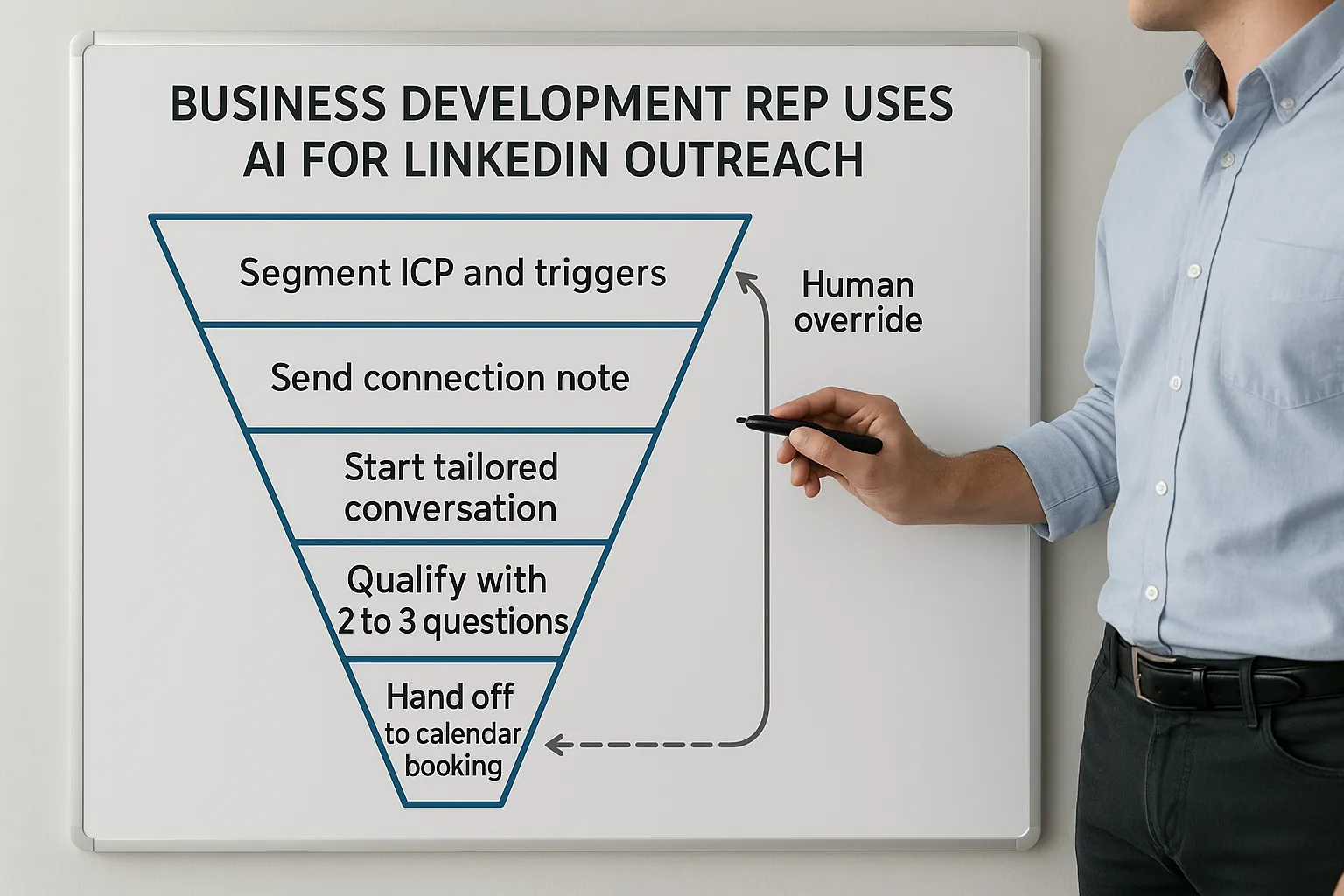
Industry evidence: “As customers increasingly learn and buy digitally, sales reps become just one of many possible sales channels.” — Cristina Gomez, Managing Vice President, Gartner.
Source: Gartner
Why LinkedIn outreach needs an AI upgrade in 2025
Prospects are more selective, and generic cadences do not get replies. Gartner has highlighted the shift toward digital, self-directed buying, and the implication is clear, sellers must add value inside the channel, not just push for the call. On LinkedIn that means referencing real context, moving at prospect speed, and transitioning to qualification naturally.
AI can now do this reliably if you give it the right inputs, prompts, and guardrails. It can turn public profile data, recency signals, and your value hypotheses into concise, relevant messages, then keep the thread moving until a meeting is the obvious next step.
For the business development rep, the win is leverage. You can run more conversations, with better personalization, and spend your human energy on the highest intent replies.
Set the foundation before you automate
Success with AI on LinkedIn starts with clarity, not clever copy.
- Define your ICP by firmographics, seniority, responsibilities, and common pains.
- Write specific value hypotheses that map pains to outcomes you can deliver.
- List trigger events that make timing right, for example, new role, fresh funding, open roles you impact, technology stack change, or recent thought leadership post.
- Decide two or three CTAs you will use, for example, a quick reply question, a 15 minute intro, or a resource share.
Use this simple mapping to guide your prompts and message logic:
| Trigger signal | Personalization anchor | Message angle | CTA |
|---|---|---|---|
| New role in last 90 days | Congratulate, reference mandate | Low lift win they can show early | Ask 1 short diagnostic question |
| Recent post on a relevant topic | Quote or idea from post | Insight add-on, respectful challenge | Share 60 second example, then ask for permission to send case |
| Funding announcement | Growth priority | Efficiency or scale outcome | Offer brief audit or 15 minute fit check |
| Hiring for a role you help | Job link or snippet | How you reduce ramp or workload | Ask if they want a quick walkthrough |
AI tactics every business development rep can deploy on LinkedIn
1) Profile-first personalization with a prompt blueprint
Your AI needs clear instructions and a compact input bundle. Keep it structured and repeatable.
Prompt template you can adapt:
Goal: Write a 280 character LinkedIn connection note and a 2 message follow-up sequence that references the prospect’s real context and earns a reply.

Inputs:
- Prospect: {name}, {title}, {company}, {industry}
- Highlights from profile: {last post topic}, {notable project}, {tenure or new role}, {recent activity}
- ICP pain hypotheses: {pain_1}, {pain_2}
- Value outcomes: {outcome_1}, {outcome_2}
- Tone: concise, respectful, no pressure
- CTA options: {question}, {15-minute intro}, {resource offer}

Constraints:
- No fluff, no emojis, no claims we cannot prove
- Reference only what is in inputs
- One specific observation, one outcome, one question
Example outputs the AI should produce:
-
Connection note, 280 characters: “Congrats on the Director role at Northridge. Your post on cutting cycle time was spot on. We have helped similar ops teams remove handoffs that slow first response. Would it be useful if I shared a 60 second before and after?”
-
Follow-up 1, if accepted but no reply: “Appreciate the connect. Quick question, where does LinkedIn sit in your outbound mix today, mostly prospecting or also mid-funnel conversations?”
-
Follow-up 2, 3 to 5 days later: “If LinkedIn is mostly top of funnel, we have seen short gains from qualifying in-thread, fewer back-and-forth emails. Happy to show a real example, want me to send the snapshot?”
Why this works, it leads with a real observation, then links to an outcome, then asks one easy question.
For deeper control, borrow best practices from prompt engineering, such as role assignment, explicit constraints, and concrete examples in your prompt. See these principles in OpenAI’s prompt engineering guide.
2) Behavior-aware sequencing that feels natural
Timing and cadence should reflect real activity, not a fixed schedule.
- After a profile visit or content like, reply the same day with a single-sentence acknowledgement and a relevant question.
- After a new role change, lead with a low lift win they can show in their first quarter.
- After they post an opinion, respond in comments first, then DM with a thought that adds value, not a pitch.
Keep each step lightweight. Let AI propose the next message based on their last action, but require it to cite the signal it used, for example, “trigger, new role on 11-28.” That makes review and compliance simpler.
3) Qualify in the thread with 2 to 3 questions
You do not need a discovery call to confirm basic fit. Guide the AI to ask one question at a time, then summarize. Use familiar frameworks like BANT or MEDDICC lightly, so you gather budget or authority hints without turning the chat into an interrogation. For a refresher on MEDDICC, see the MEDDICC overview.
Useful qualification prompts the AI can use after a positive reply:
- “Happy to share the example. Before I do, where does LinkedIn fit in your outbound right now, prospecting only or also qualification?”
- “When you book first meetings from LinkedIn, who typically joins from your side, SDR or AE?”
- “If this worked, what metric would you want to move first, positive reply rate, qualified meetings, or speed to first response?”
Escalation rule of thumb, if they confirm channel use case and express a measurable outcome, propose time options and offer a calendar link. If they are not a fit, provide a helpful resource and exit gracefully.
4) A/B test prompts and calls to action
Even strong prompts get stale. Test message ingredients like observation type, CTA, and proof element.
- Hypothesis, “Referencing a recent post beats general company value by 15 percent in positive replies.”
- Variables, Observation line A vs B, CTA question vs 15 minute intro.
- Sample size, at least 100 sends per variant before judging.
- Guardrails, same segment, same send window.
Record not only reply rate, but also percent of replies that move to qualification and booked meetings. Positive replies that stall do not help your pipeline.
5) Score intent and prioritize human attention
Ask your AI to produce a simple, transparent score for each conversation. Weight actual behavior, not just keywords.
| Signal | Points |
|---|---|
| Accepts connection within 24 hours | +10 |
| Replies with a question or problem statement | +20 |
| Confirms role relevance or authority | +15 |
| Provides timeframe or metric | +15 |
| Shares blocker or pushes to colleague | +5 |
| No response for 7 days | −10 |
- Escalate to human when score hits 35 or more, or when the message mentions timing, budget, pilot, or competitor.
- Decay scores over time to keep the queue current.
This focuses your day on deals that are warming up now.
6) Run many conversations without losing brand voice
When you manage dozens of simultaneous threads, tone control matters.
- Give the AI a “voice card,” a one page style guide with do’s and don’ts, examples of concise messages, words to avoid, and how you acknowledge or challenge respectfully.
- Require short reasoning notes in each AI message, for example, “using new role trigger, offering audit, asking 1 question,” so a manager can spot check quickly.
- Set override rules, if a strategic account replies or asks technical details, pause automation and hand control to the rep.
7) Analytics that actually improve outcomes
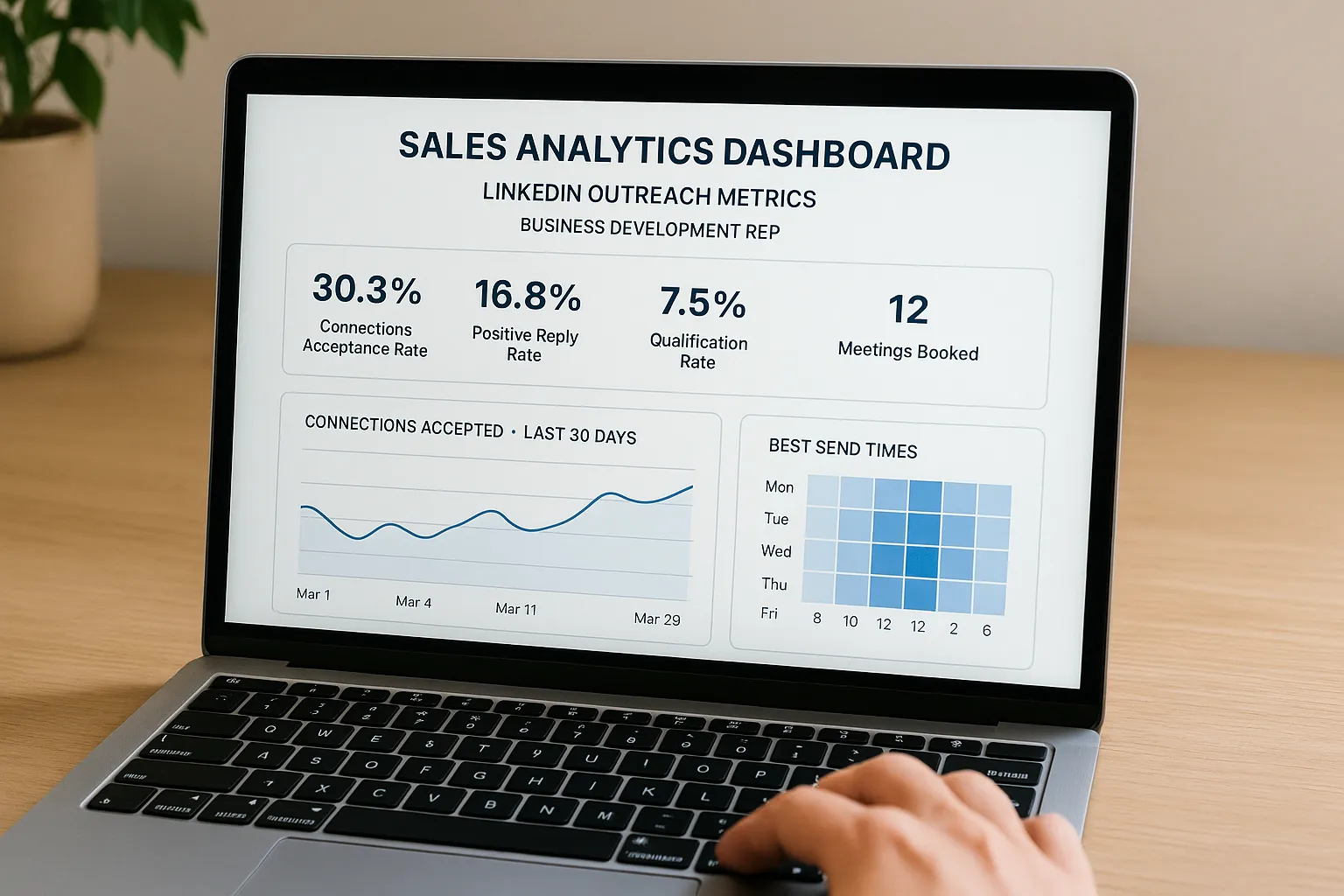
Track the full path from first touch to meeting, not just surface metrics.
- Leading indicators, connection accept rate, response time to first reply, positive reply rate.
- Mid-funnel, percent of replies that answer one or more qualifying questions, average messages to book.
- Outcomes, qualified meetings per 100 targets, time to meeting, win rate of AI-sourced meetings vs baseline.
Use cohort analysis by segment, role, industry, and trigger type. This tells you where your prompts resonate and where to rework your value hypothesis.
Compliance, deliverability, and trust
AI outreach must respect the channel and community norms.
- Follow LinkedIn’s Professional Community Policies. Keep volume reasonable and content relevant.
- Reference only public or provided information. Do not imply endorsements.
- Keep opt outs simple. If someone declines, stop messaging and thank them.
- Avoid sensitive data and regulated claims. When in doubt, route to a human.
Trust compounds. Helpful, context-aware messages today make warmer conversations next quarter.
A 30 day rollout plan for your team
Week 1, design
- Define ICP, triggers, and value hypotheses.
- Draft your voice card and three prompt blueprints.
- Create segments of 300 to 500 targets per ICP slice.
Week 2, pilot
- Launch to a small cohort. Cap daily sends to maintain quality.
- Review conversations daily, tune prompts, adjust CTAs.
- Begin simple A/B tests on the observation line.
Week 3, qualify and score
- Introduce two question qualification flow and the scoring rubric.
- Add escalation rules and override thresholds.
- Expand to additional segments.
Week 4, scale and report
- Roll out the winning prompts. Keep one test running.
- Publish a dashboard view for leadership, from touch to booked meetings.
- Document learnings and update the playbook for next month.
Where Kakiyo helps business development reps win on LinkedIn
If you want the mechanics above handled reliably, Kakiyo was built for this exact motion. Instead of juggling manual scripts and spreadsheets, you can orchestrate the whole conversation lifecycle inside one system.
- Autonomous LinkedIn conversations, Kakiyo runs personalized, context-aware threads from first touch through qualification and into meeting booking, so you focus on higher value chats.
- AI-driven lead qualification, guide the AI with your frameworks, then let it ask concise questions, summarize fit, and move qualified prospects forward.
- Customizable prompt creation and A/B prompt testing, encode your voice, ICP hypotheses, and CTAs, then experiment to keep performance improving.
- Industry-specific templates, accelerate setup with patterns that match your vertical, then tailor them to your product.
- Intelligent scoring system, surface the warmest threads so reps jump in at the right moment.
- Simultaneous conversation management with conversation override control, stay consistent across many chats and take over instantly when a strategic account replies.
- Centralized real-time dashboard and advanced analytics and reporting, see what is working across segments, triggers, and prompts, from response rates to meetings booked.
If you are ready to scale thoughtful LinkedIn outreach, see how Kakiyo manages conversations that qualify and book meetings while keeping your brand voice intact.
Key takeaways
- AI helps a business development rep personalize at scale, qualify inside the thread, and convert more first touches into meetings.
- Strong inputs, a clear prompt blueprint, and human guardrails beat generic automation.
- Measure the whole path, from trigger to booked meeting, and keep testing message ingredients.
- Use scoring and override rules to focus human time where intent is highest.
Digital buying is only getting noisier. The teams that pair empathy with well-governed AI will keep earning replies, and keep winning meetings.
FAQ
What makes a LinkedIn or cold outreach sequence effective?
An effective outbound sequence matches the buyer's context, uses short messages, and measures reply quality rather than raw volume. Cadence, targeting, and stop rules matter as much as copy.
How many touches should I use before stopping?
Most teams should stop once intent is clearly absent or once the sequence becomes repetitive. The right stop rule protects deliverability, reply quality, and brand perception.
Should I automate all outreach?
No. Automation should remove repetitive work, not replace judgment. The best systems automate targeting, timing, and admin while keeping messaging and qualification grounded in context.
How do I know whether outreach is working?
Track positive reply rate, meeting quality, and downstream conversion instead of open rates alone. If meetings do not progress, the issue is usually targeting or qualification, not activity volume.