
 Ilan Asseo
Conversational AI for Sales: Real-World Use Cases
A practical playbook for using conversational AI on LinkedIn to run 1-to-1 outreach, qualify prospects in-thread, multi-thread accounts, and book more.

Most sales teams are already seeing the shift. Buyers prefer short, useful conversations in the channels where they already work, and they expect fast, relevant replies. Conversational AI for sales meets buyers in that flow, holds natural exchanges, and moves qualified prospects to a booked meeting without bloated cadences or manual triage. As more B2B interactions move into digital channels, the teams that operationalize conversation, not just content, will win.
Industry evidence: “Our research suggests that a fifth of current sales-team functions could be automated.” — McKinsey & Company.
Source: McKinsey
What conversational AI for sales means in 2025
At its core, conversational AI for sales uses large language models and guardrails to run or assist human-like, 1-to-1 exchanges with prospects. It does not spam. It listens, references context, asks clarifying questions, and proposes next steps when the buyer shows intent. On LinkedIn, that means turning brief profile signals and public activity into targeted outreach, continuing the thread to qualify, and offering a meeting at the right moment.
On Kakiyo, this looks like autonomous LinkedIn conversations that are governed by your prompts and templates, scored in real time, and visible in a centralized dashboard. SDRs or managers can A/B test prompts, review analytics, and override any conversation when human judgment is needed. The aim is simple, more qualified meetings with less manual effort.
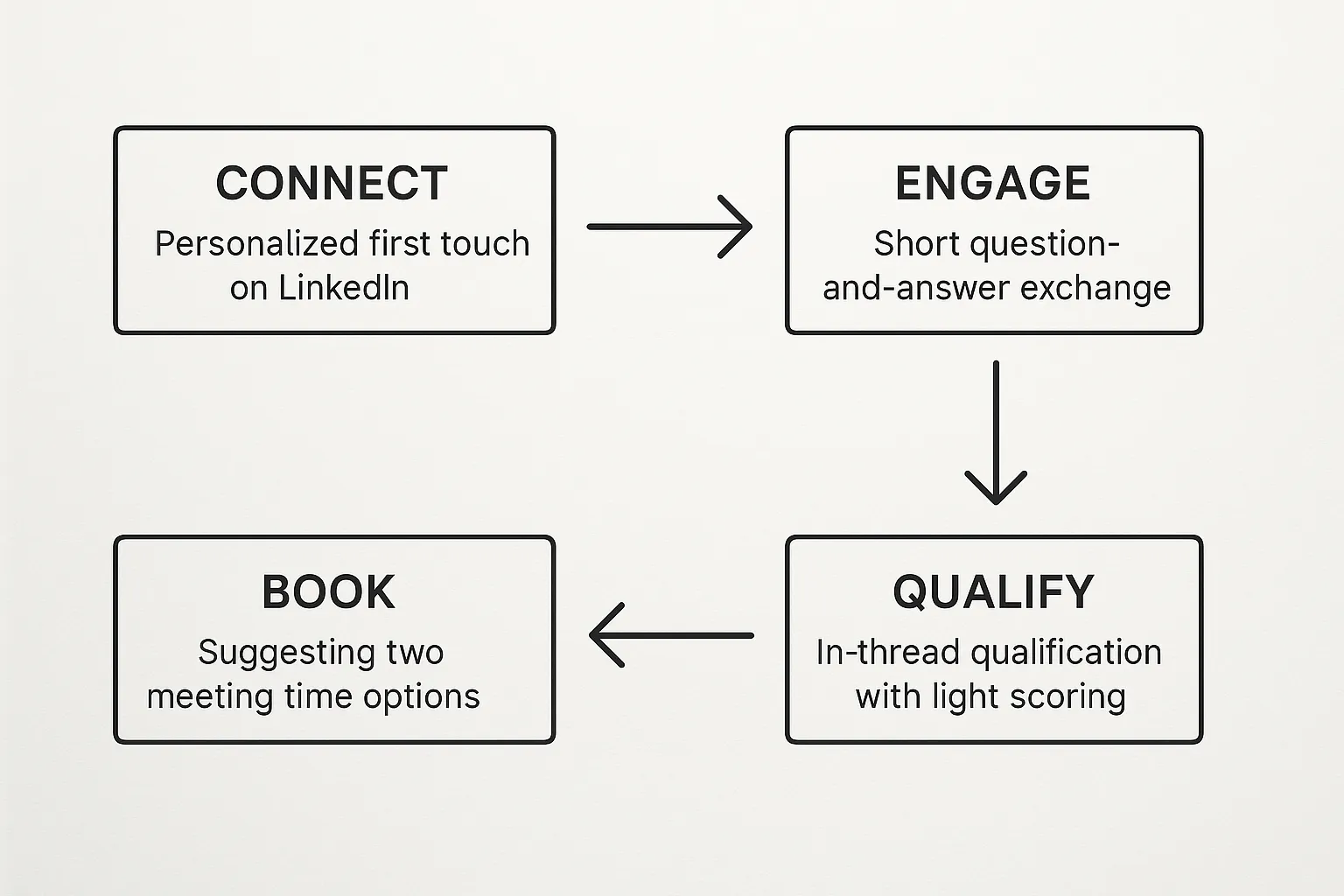
Real-world use cases that drive pipeline
Below are proven patterns we see revenue teams adopt on LinkedIn with conversational AI. Each use case includes the motion, why it works, and the sales metrics that matter.
1) Cold outbound that feels genuinely 1-to-1
Motion: The AI references a clear trigger from a prospect’s profile or recent activity, opens with a micro-yes, and proposes a quick compare, not a pitch. If the prospect engages, the AI continues with short, relevant questions to uncover fit.
Why it works: Relevance beats volume. Message-level personalization anchored to buyer signals improves reply quality. Short, respectful asks reduce friction.
What this looks like in practice: A revenue leader posts about manual lead triage. The AI opens with a single-sentence observation tied to that post, then asks how their team prioritizes social-sourced inquiries today. If the prospect responds, the AI probes for team size and current workflow before offering two time options.
KPI focus: Connection acceptance, first-response rate, qualified conversation rate, meetings booked per 100 new connections.
How Kakiyo supports it: Industry-specific templates to start, customizable prompts to match your voice, A/B testing to find your best openers, and an intelligent scoring system to prioritize high-signal replies.
2) In-thread qualification and fast handoff to a meeting
Motion: Once a prospect replies, the AI asks 2 to 3 targeted discovery questions, summarizes what it heard, and proposes a short call using a two-slot CTA.
Why it works: Buyers do not want a long discovery survey in DMs. Two or three smart questions demonstrate expertise and protect the AE’s calendar. A concise summary shows listening, which increases meeting acceptance.
What this looks like in practice: Prospect says, “We are exploring options next quarter.” The AI asks about the workflow, stakeholders, and desired outcome, then replies, “Sounds like you prioritize reducing manual routing, marketing ops is the co-owner, and timing is early Q2. If helpful, we can share how teams your size handle this. Does Tue 10:30 am PT or Thu 2:00 pm PT work?”
KPI focus: Time to first qualified response, qualified-to-meeting conversion, no-show rate.
How Kakiyo supports it: Conversation guardrails through prompt creation, live scoring of intent, and conversation override control so reps can jump in when needed.
3) Account-based multi-threading inside target logos
Motion: The AI opens separate, role-specific threads with multiple stakeholders at the same account, aligning value to each function. It references public context consistently so nothing feels canned.
Why it works: Complex deals rarely hinge on one person. Reaching ops, finance, and a technical evaluator increases the odds of a champion and compresses time to consensus.
What this looks like in practice: Message to a VP Sales references quota efficiency, to a RevOps leader references routing accuracy and reporting, to an SDR Manager references time saved per rep on manual follow-ups. Each thread progresses independently until one stakeholder agrees to meet and invites others.
KPI focus: Meetings per target account, unique stakeholder replies, cycle time from first reply to meeting.
How Kakiyo supports it: Simultaneous conversation management plus analytics to see which personas respond and which prompts resonate.
4) Event and webinar workflows, before and after
Motion: About two weeks before an event, the AI invites likely attendees to a quick on-site chat or virtual debrief. Post-event, it segments follow-up by talk attended or topic of interest, acknowledges any notes from the interaction, and proposes next steps.
Why it works: Timely, specific messages tied to an agenda outperform generic recaps. Post-event follow-up within 24 to 72 hours captures attention while interest is still high.
What this looks like in practice: “Saw you are heading to SaaStr. We are comparing notes with RevOps leaders on qualifying social-sourced leads in less than 2 minutes. Want a 10-minute coffee near the venue, or a virtual follow-up next week?”
KPI focus: Pre-event acceptance and reply rates, post-event meeting rate, pipeline sourced from event lists.
How Kakiyo supports it: Industry templates to accelerate message creation and A/B testing to optimize timing and call to action.
5) Pipeline rescue for stalled opportunities
Motion: For opportunities that have gone quiet, the AI re-engages with a value-forward nudge, offers a new angle, and checks timing with empathy.
Why it works: Stalled deals often lack a fresh reason to re-engage. A short message that reframes the problem or shares a concise proof point can restart momentum without pressure.
What this looks like in practice: “You mentioned manual handoffs were the blocker. Two teams your size solved it by qualifying in-thread on LinkedIn, then offering two calendar slots. If that is still relevant, happy to compare notes. If not, want me to circle back in January?”
KPI focus: Re-engagement rate, revived-to-meeting conversion.
How Kakiyo supports it: Prompt libraries that encode best-practice re-engagement patterns, plus analytics and reporting to see which angle performs.
6) Expansion and cross-sell with buyer-adjacent stakeholders
Motion: In customer accounts, the AI reaches adjacent departments that feel the friction your product solves, and it references the outcome the current team achieved without claiming confidential details.
Why it works: Social proof within the same logo is powerful, and LinkedIn is the easiest place to reach neighboring teams without long email introductions.
What this looks like in practice: “We have seen sales ops at companies your size reduce manual lead routing through in-thread qualification on LinkedIn. If that is on your radar for next quarter, happy to share how peers approached it and pitfalls to avoid.”
KPI focus: Expansion conversations started, meetings with new departments, expansion pipeline added.
How Kakiyo supports it: Scoring highlights replies that mention adjacent teams, and conversation override allows the CSM or AE to step in immediately.
7) Partner and channel recruitment
Motion: The AI identifies service providers or agencies that serve your ICP, opens with a value exchange, and quickly qualifies fit.
Why it works: Partners scan for clear, mutual upside. A conversational probe that clarifies ideal client profile, territory, and delivery capability saves time.
What this looks like in practice: “We help SDR teams qualify and book meetings directly in LinkedIn. Do you work with B2B sales orgs who ask for that outcome, and do you have capacity this quarter to co-market or co-sell?”
KPI focus: Qualified partner conversations, partner-sourced meetings.
How Kakiyo supports it: Templates tailored to partner outreach and centralized dashboards to track partner pipeline separately from direct.
8) Founder-led selling with limited bandwidth
Motion: For early-stage companies, the AI drafts on the founder’s voice, handles most back-and-forth, and flags only high-signal replies for human follow-up.
Why it works: Founders need leverage, and prospects respond to a clear vision backed by crisp, respectful conversations.
What this looks like in practice: Messages stay short, founder-authored prompts set tone and boundaries, and the AI proposes specific times only after fit is confirmed.
KPI focus: Time saved per opportunity, founder meetings per week, reply quality score.
How Kakiyo supports it: Customizable prompt creation to encode voice, intelligent scoring, and conversation override for personal touches when it matters.
Building your motion, from pilot to scale
Start focused: choose one ICP, one offer, and two to three use cases above. Encode your voice in prompts, set clear guardrails, and pick success metrics before launch. Run a two-week pilot, then expand.
A pragmatic rollout plan:
- Week 1, define ICP, triggers, and acceptance criteria for a qualified meeting. Write two opening prompts and two follow-up prompts for each use case. Set scoring thresholds that trigger a meeting offer versus a clarifying question.
- Week 2, activate a small test list. Monitor conversations in the centralized dashboard. Use conversation override when nuance is required. Promote winning prompts through A/B testing.
- Weeks 3 to 4, scale volume, add one new persona, and expand multi-threading within top accounts. Review analytics weekly, especially meetings booked per 100 new connections and qualified-to-meeting conversion.
Governance matters. Keep messages short and buyer-first, do not over-automate, and ensure someone owns ethics and compliance reviews. Conversation quality is the brand.

Integration notes for technical teams
Most go-to-market teams can run a complete LinkedIn conversation motion without building custom infrastructure. If your roadmap includes in-house integrations across multiple social networks or centralized analytics, be mindful of authentication, data normalization, and frequent API changes. For a clear overview of these tradeoffs and patterns, this well explained social media API guide covers multi-platform integration, engagement tracking, and reliability considerations.
How to measure success, by use case
Use the right leading indicators so you can optimize in days, not quarters.
| Use case | Primary KPI | Leading indicator | Risk to manage |
|---|---|---|---|
| Cold outbound | Meetings booked per 100 new connections | First-response rate, positive-sentiment replies | Over-personalizing trivial details instead of buyer value |
| In-thread qualification | Qualified-to-meeting conversion | Time to first qualified response | Asking too many questions before proposing next steps |
| ABM multi-threading | Meetings per target account | Unique stakeholders engaged | Inconsistent messaging across personas |
| Event workflows | Post-event meeting rate | Reply rate within 72 hours | Generic recaps that add no value |
| Pipeline rescue | Revived-to-meeting conversion | Re-engagement rate | Tone-deaf nudges that pressure the buyer |
| Expansion and cross-sell | Expansion pipeline created | Replies mentioning adjacent teams | Breaching confidentiality or oversharing customer details |
| Partner recruitment | Qualified partner conversations | Positive-fit signals on scope and capacity | Vague value exchange |
| Founder-led selling | Founder meetings per week | Reply quality score | Losing the founder’s authentic voice |
Why LinkedIn conversations are the highest-leverage starting point
- Public signals are rich enough to personalize without guesswork, and the context is inherently professional.
- Short, asynchronous exchanges allow quick discovery and painless scheduling.
- Modern buyers often prefer to talk before they fill a long form, and conversational AI honors that preference while protecting your team’s time.
Where Kakiyo fits
Kakiyo manages personalized LinkedIn conversations at scale from first touch to qualification to meeting booking so SDRs focus on high-value opportunities. You get:
- Autonomous LinkedIn conversations guided by customizable prompts and industry templates.
- AI-driven lead qualification with intelligent scoring and real-time dashboards.
- A/B prompt testing to continuously lift acceptance and reply rates.
- Conversation override control so humans can take the wheel instantly.
- Advanced analytics and reporting to see what actually drives meetings.
If you want to turn message-level relevance into a repeatable, measurable pipeline engine, start with one of the use cases above. Run a two-week pilot, keep messages short and specific, and let the results guide your next iteration. When conversations feel handcrafted and meetings book themselves, you will know you have the motion right.
FAQ
Where does AI actually help in sales?
AI helps most when it reduces repetitive work, surfaces better signals, and improves execution speed. It is strongest in research, qualification support, follow-up, and workflow automation.
What are the limits of AI in sales?
AI still depends on clean inputs, good process design, and human oversight. It can accelerate bad workflows just as easily as good ones.
How should teams evaluate AI sales tools?
Evaluate tools by workflow fit, data quality, implementation friction, and measurable business outcomes. A feature-rich tool is not automatically the right tool for your motion.
Does AI replace SDRs or sales reps?
Usually no. In most teams, AI reshapes the role by taking over repetitive execution while humans stay responsible for judgment, positioning, and relationship depth.