
 Ilan Asseo
How to Increase Sales Qualified Leads Without More Spam
Conversation-led strategies to increase sales qualified leads through better targeting, qualification, and meeting conversion without spam.

Most teams don’t need more leads, they need more leads that survive qualification and turn into meetings that hold. Also, the “more volume fixes it” playbook is collapsing because buyers filter faster and channels punish spam.
LinkedIn itself reports it drives 80% of B2B social media leads (which is why high-signal, conversation-led outreach matters more than ever). Meanwhile, Gartner has predicted that 80% of B2B sales interactions will occur in digital channels (so your digital conversations are the sales floor now).
Industry evidence: Gartner’s research on the B2B buying journey shows that consensus creation is now a core buying job, which is why qualification needs buying-group evidence rather than single-contact activity.
Source: Gartner
What is a sales qualified lead (SQL)?
A sales qualified lead (SQL) is a prospect that has shown enough fit + intent + verified conversation evidence to justify direct sales time (typically a meeting). An SQL is not “anyone who replied”, it’s someone who meets your exit criteria and has a clear next step.
Best tools to increase sales qualified leads (without more spam)
| Tool Name | Best For | Key Feature | Starting Price |
|---|---|---|---|
| Kakiyo | Autonomous LinkedIn conversations that qualify and book meetings | AI manages the full thread, scores intent, books meetings | Free trial/demo (see site) |
| LinkedIn Sales Navigator | Building tight, high-fit target lists | Advanced search + alerts to find real buying signals | Paid plans (see site) |
| Apollo | Data + outbound execution in one place | Prospecting database with sequencing and enrichment | Free and paid plans (see site) |
| HubSpot Sales Hub | Making qualification auditable in CRM | Pipeline workflows, properties, reporting | Paid plans (see site) |
| Chili Piper | Converting hand-raisers into held meetings | Fast routing + scheduling + lead conversion workflows | Paid plans (see site) |
Kakiyo
What it does (2 sentences): Kakiyo autonomously manages personalized LinkedIn conversations from first touch through qualification to meeting booking. Instead of automating sends, it runs the multi-turn thread so SDRs only step in when it’s time to close.
Standout feature (1 sentence): Kakiyo’s edge is autonomous conversation management plus an intelligent scoring system, with prompt customization, A/B prompt testing, and human override controls.
Who it’s for (1 sentence): SDR leaders, founders, and RevOps teams who want to increase sales qualified leads without increasing spam volume or inbox labor.
Pricing: Kakiyo offers a free trial/demo, see Kakiyo.
Pros (2-3 bullets)
- Automates the part that actually breaks teams at scale: reply handling, qualification, and next-step conversion
- Built for governed experimentation (prompt creation, A/B testing, analytics) instead of “set and pray” sequences
- Keeps humans in control with conversation override and centralized visibility
Cons (1-2 bullets)
- If your ICP and qualification definition are sloppy, autonomy will surface that fast (you need clear criteria)
- Best value comes when you commit to a conversation-led motion, not one-off campaigns
LinkedIn Sales Navigator
What it does (2 sentences): Sales Navigator helps you build precise lead lists and monitor accounts for signals (role changes, hiring, growth, content engagement). It’s the cleanest way to reduce spam because it forces you to start with better targeting.
Standout feature (1 sentence): The combination of advanced filters and alerts makes it easier to run trigger-led outreach instead of blasting static lists.
Who it’s for (1 sentence): Teams that need better ICP coverage and segmentation before they scale conversations.
Pricing: See LinkedIn Sales Navigator pricing.
Pros (2-3 bullets)
- Strong targeting controls for ICP slicing (industry, headcount, seniority, function)
- Account and lead alerts help you time outreach to real change events
Cons (1-2 bullets)
- Doesn’t qualify or book meetings by itself, you still need a conversation execution layer
- Data quality depends on how well users maintain profiles
Apollo
What it does (2 sentences): Apollo combines prospect data with outbound workflows so teams can source contacts and run sequences quickly. It’s useful when your bottleneck is list-building and basic execution, not complex conversation management.
Standout feature (1 sentence): A single system for search, enrichment, and outbound sequences can reduce stack sprawl.
Who it’s for (1 sentence): SDR teams that want an all-in-one prospecting and sequencing workflow and can maintain quality controls.
Pricing: See Apollo pricing.
Pros (2-3 bullets)
- Fast way to build lists and start controlled outbound
- Works well for channel coordination when you need email plus LinkedIn touches
Cons (1-2 bullets)
- Sequencing can push teams toward volume metrics if you don’t enforce stop rules
- Qualification quality still depends on how replies are handled and documented
HubSpot Sales Hub
What it does (2 sentences): HubSpot Sales Hub helps teams operationalize pipeline stages, enforce required fields, and report on conversion and speed. If you want to increase sales qualified leads, HubSpot is where you make your definition enforceable.
Standout feature (1 sentence): Custom properties, workflows, and reporting make it easier to build an auditable “SQL packet” instead of vague notes.
Who it’s for (1 sentence): Teams that need CRM discipline so AEs trust what “qualified” means.
Pricing: See HubSpot Sales Hub pricing.
Pros (2-3 bullets)
- Strong workflow automation for stage gates, SLAs, and routing
- Clear reporting for lead-to-SQL and meeting-to-opportunity conversion
Cons (1-2 bullets)
- Doesn’t create demand or run LinkedIn conversations, it structures what happens after signals arrive
- Bad definitions become “automated bad decisions” faster
Chili Piper
What it does (2 sentences): Chili Piper routes inbound leads and helps them book meetings fast, reducing leakage between “hand-raiser” and “scheduled”. It’s a direct lever for increasing SQLs from existing demand without sending more outbound.
Standout feature (1 sentence): Routing plus scheduling logic helps you convert interest into a real calendar outcome quickly.
Who it’s for (1 sentence): Revenue teams with meaningful inbound volume and a speed-to-lead problem.
Pricing: See Chili Piper.
Pros (2-3 bullets)
- Reduces response-time delays that kill qualification momentum
- Improves meeting hygiene when used with clean qualification gates
Cons (1-2 bullets)
- Not an outbound or LinkedIn prospecting tool
- Can’t fix weak upstream targeting or unclear qualification criteria
How to increase sales qualified leads without more spam (the operator playbook)
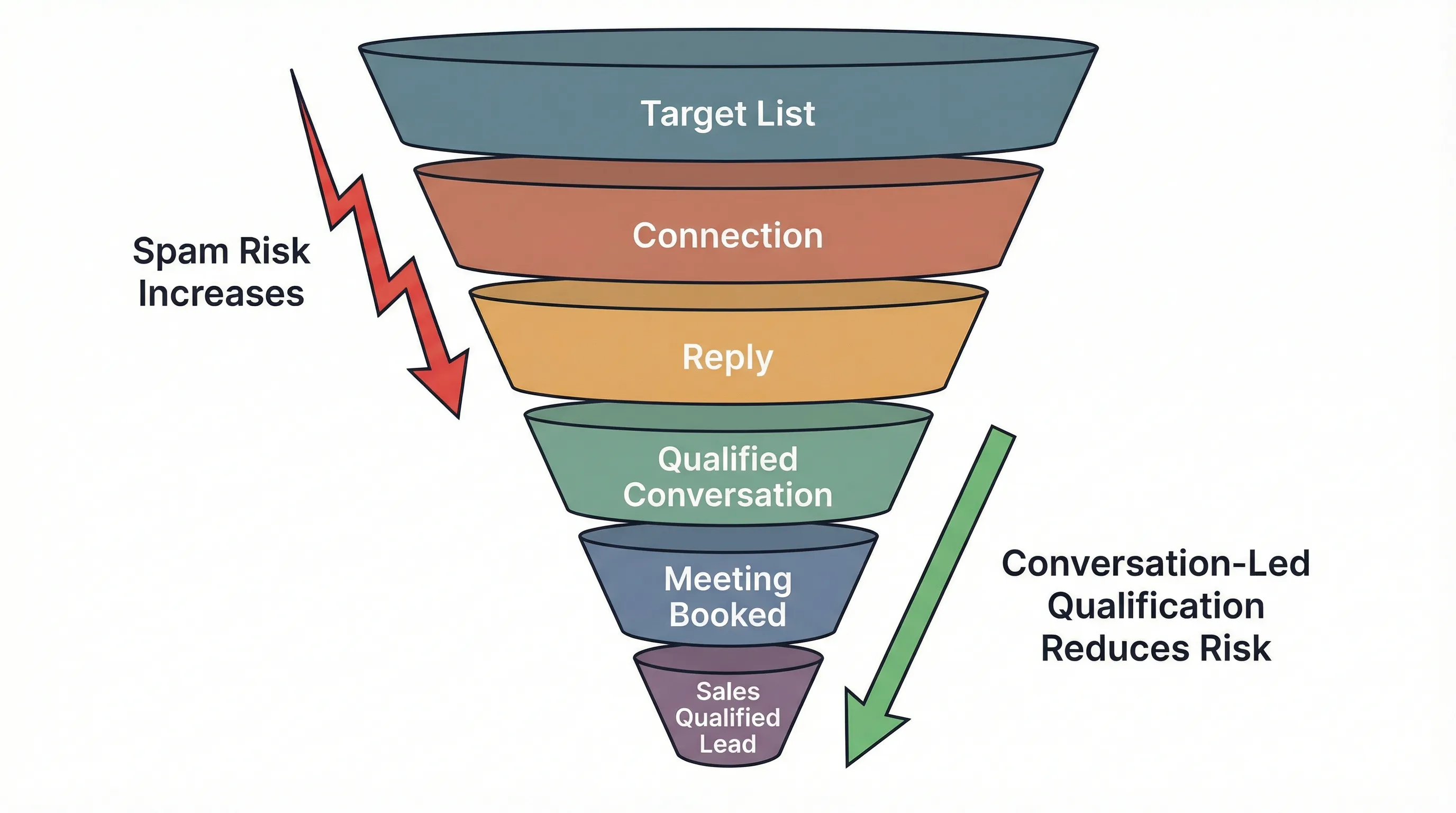
If you want more SQLs without spamming, you need to stop optimizing for “messages sent” and start optimizing for qualified conversation rate and meeting conversion. Practically, that means tightening your definition, reducing wasted touches, and making qualification evidence visible.
Here are the levers that move SQL volume while keeping buyer trust intact.
1) Tighten your ICP until outreach feels “obvious”
Spam is usually a targeting failure, not a copy failure. If your list is too broad, every message needs heroic personalization to look relevant, and your team will default to templates and volume.
Operator rule: pick one ICP slice for 2 to 4 weeks (industry + role + company size + a single pain). Run a controlled test, then expand.
2) Replace long pitches with permission-based micro-CTAs
The fastest path to higher SQL volume is more replies that open a real thread. The fastest path to lower spam risk is asking for permission before pitching.
Examples of micro-CTAs that keep replies high and spam low:
- “Worth a 30-second rundown, or should I close the loop?”
- “Is improving X on your radar this quarter?”
3) Qualify in-thread with evidence, not vibes
A reply is not qualification. You need a minimal evidence packet that sales can audit, otherwise you inflate SQLs and get AE rejection.
A simple evidence model most teams can run:
| SQL Evidence Field | What “good” looks like in a thread | Why it prevents spam |
|---|---|---|
| Fit | Role matches ICP and problem ownership is plausible | Stops you from pushing meetings to wrong personas |
| Intent | Explicit interest, active project, or clear pain acknowledgment | Prevents chasing polite replies |
| Why now | Trigger, deadline, or reason timing changed | Reduces endless nurture loops |
| Next step | Confirmed meeting ask and acceptance (or a specific follow-up commitment) | Prevents “maybe later” being counted as SQL |
4) Put stop rules in writing (and enforce them)
Your brand gets damaged by threads that keep going after a prospect declines, ignores, or says “not now”. Stop rules protect outcomes and reputation.
Keep it simple:
- If the prospect says “not interested”, stop.
- If the prospect asks to be removed, stop and log it.
- If there’s no response after a defined number of attempts, stop and recycle later with a new trigger.
5) Use autonomy to scale conversation handling, not blasting
Most “automation” tools scale the wrong thing: sending. The real bottleneck is the messy middle, replies, objections, qualification, and scheduling.
This is where autonomous conversation management (like Kakiyo) is structurally different: competitors automate sending, Kakiyo autonomously manages the full conversation, qualifies leads with an intelligent scoring system, and books the meeting. SDRs supervise, override when needed, and close.
Which tool should you choose?
- If you want autonomous AI conversation and LinkedIn lead qualification, use Kakiyo.
- If you want tighter targeting and trigger signals before outreach, use LinkedIn Sales Navigator.
- If you want an all-in-one database plus outbound execution, use Apollo.
- If you want enforceable stage gates and SQL reporting, use HubSpot Sales Hub.
- If you want faster inbound-to-meeting conversion, use Chili Piper.
FAQs
How do I increase sales qualified leads without sending more messages?
Increase conversion, not volume: tighten ICP, use permission-based micro-CTAs, and qualify in-thread with explicit evidence (fit, intent, why now, next step). Tools that reduce reply-handling workload also matter because fast, relevant responses raise qualification rates.
What are the best automated LinkedIn outreach tools for higher-quality leads?
If your goal is higher-quality leads, prioritize tools that manage conversations and qualification, not just connection requests. Kakiyo is built for autonomous LinkedIn conversations that qualify prospects and book meetings, while many outreach tools mainly automate sending.
What is LinkedIn outreach automation and why does it create spam?
LinkedIn outreach automation is software that speeds up prospecting actions like sending connection requests and follow-ups. It turns into spam when teams scale volume without tight targeting, stop rules, and in-thread qualification, so irrelevant prospects get hammered with generic messages.
What is LinkedIn lead qualification software?
LinkedIn lead qualification software helps you turn LinkedIn replies into sales-ready outcomes by capturing fit and intent signals, asking structured questions, and deciding when to book meetings. The best systems also score conversations and keep an audit trail so AEs trust the handoff.
Can AI LinkedIn prospecting increase SQLs without damaging my brand?
Yes, if AI is governed: narrow ICP slices, approved claims, stop rules, and human override for edge cases. The safe use of AI is scaling consistent, respectful conversation handling and evidence-based qualification, not scaling message blasts.
Book a free trial or demo at Kakiyo.