
 Ilan Asseo
LinkedIn Outreach That Converts: Proven Templates and Tips
Proven, copy-and-paste LinkedIn templates, a practical cadence, and optimization tips to help SDRs and founders turn more conversations into qualified.

If your LinkedIn outreach is not converting, the issue is rarely the channel. It is the message, the timing, and the ask. This guide gives you proven, copy-and-paste templates, a practical cadence, and optimization tips that help SDRs and founders turn more conversations into qualified meetings.
Industry evidence: “As customers increasingly learn and buy digitally, sales reps become just one of many possible sales channels.” — Cristina Gomez, Managing Vice President, Gartner.
Source: Gartner
What “conversion” really means on LinkedIn
On LinkedIn, conversion is a sequence, not a single event. Track these micro conversions to improve the macro result, which is a qualified meeting.
- Connection acceptance rate, how many connection requests become first conversations
- Response rate, how many accepted connections reply to a first or follow-up message
- Qualified conversation rate, how many replies move into a pain or project discussion
- Meeting booked rate, how many qualified conversations result in a calendar event
Focusing on each step exposes where to fix copy, sequencing, or targeting. LinkedIn’s own Sales Solutions team emphasizes brevity, relevance, and clear next steps as consistent drivers of response. You can explore their guidance on the LinkedIn Sales Solutions blog.
The anatomy of a high-converting LinkedIn message
Short, relevant, and easy to answer. That is the bar. Use this structure:
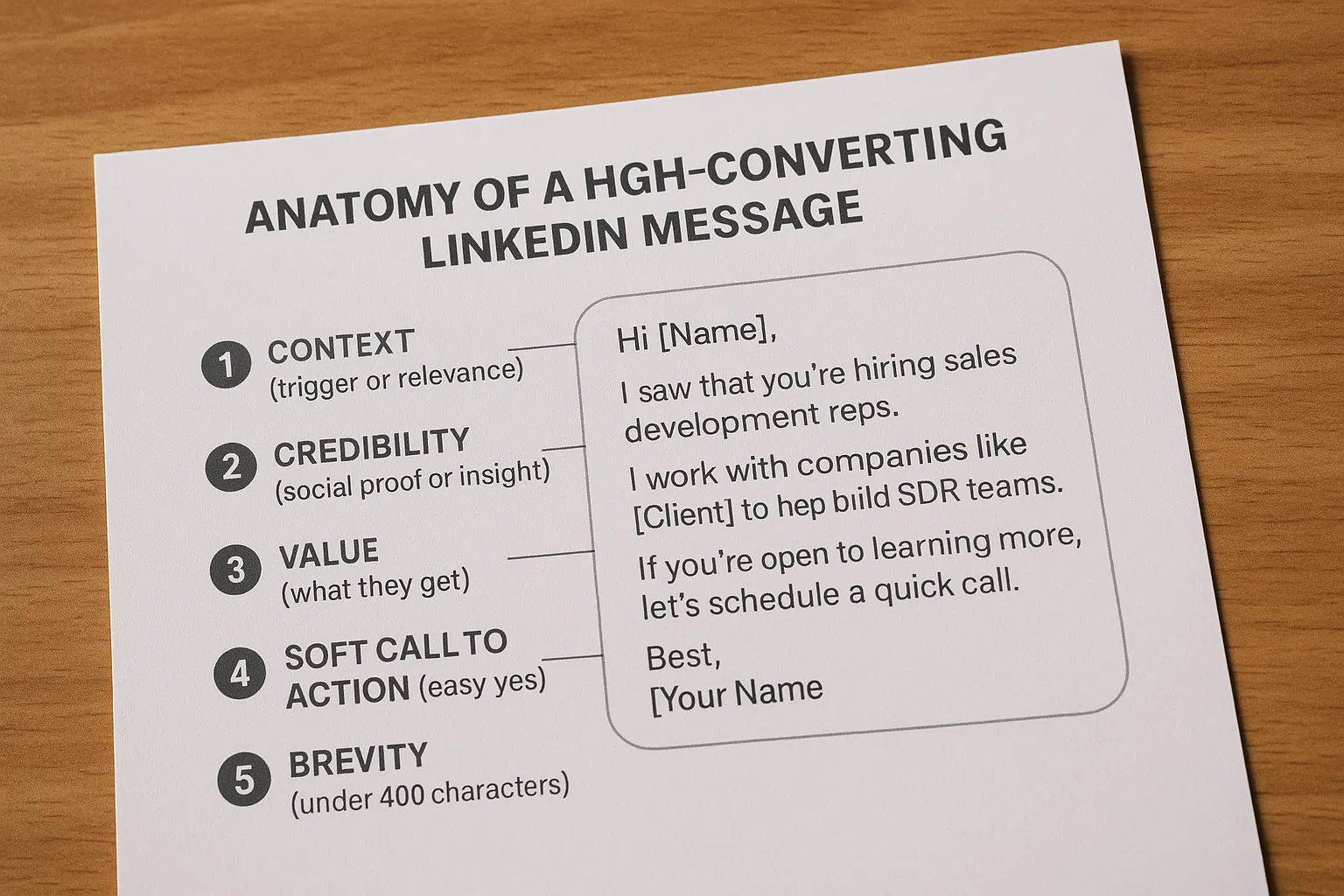
- Context, reference a trigger, role, or recent activity
- Credibility, one line of proof or insight
- Value, what they gain from replying
- Soft CTA, an easy micro ask that respects their time
- Brevity, aim for 1 to 4 lines, scannable on mobile
Quick reference table
| Message Type | Intent | Ideal Length | Best CTA |
|---|---|---|---|
| Connection request | Spark relevance and get accepted | Under 300 characters | Permission to connect |
| First message | Start a conversation, not a pitch | 1 to 3 lines | Soft yes or quick question |
| Follow-up | Add value and reduce friction | 1 to 3 lines | Alternative yes options |
| InMail | Reach non-connections with senior titles | 2 to 5 lines | Direct, specific ask |
| Breakup | Close the loop with respect | 1 to 2 lines | Leave door open |
Proven LinkedIn outreach templates you can copy
Personalize the placeholders, keep the tone natural, and adapt the CTA to your motion. All templates are built for brevity and clarity.
1) Cold connection request, no prior relationship
Hi {FirstName}, I work with {ICP} teams on improving reply rates from LinkedIn. Saw {Trigger, post, role change, hiring}. Open to connect, and if useful I can share a 2 line opener that is working in {Industry}.
Why it works, relevance first, value promise second, no pitch.
2) Connection request with a warm trigger
Congrats on the new role at {Company}. I have a short playbook on ramping SDR LinkedIn conversations in the first 90 days, happy to send the summary after we connect.
Why it works, connects to a personal milestone and previews value.
3) First message after they accept
Thanks for connecting, {FirstName}. Quick one, are LinkedIn replies a focus for your team this quarter, or is email the main lane right now
Why it works, closed question that is easy to answer, reveals channel preference.
4) First message with value-forward approach
Sharing a quick idea for {ICP}, use recent {Trigger, funding, hiring, new tool} to open, then ask for permission to share specifics. If helpful, I can paste a 3 line template here.
Why it works, offers a practical next step and invites consent.
5) Follow-up after no reply, deliver the promised value
As promised, here is the 3 line opener: “Hi {Name}, noticed {Trigger}. Teams like {Peer} cut time to first convo by pairing LinkedIn with {Tactic}. Worth a 10 minute swap next week” Want the checklist that explains the tactic
Why it works, you give before you ask, CTA remains soft.
6) Pain-based follow-up when there is light interest
If reply rates or no shows are the headache, we can share what moved the needle for {PeerCompany}. Would it be crazy to compare notes for 10 minutes next week
Why it works, aligns to a common pain and asks for a small commitment.
7) Direct InMail to a senior leader
{FirstName}, brief ask. We helped {PeerCompany in same space} qualify more LinkedIn conversations without adding headcount. If increasing qualified meetings is on your Q1 plan, open to a quick chat, or should I loop in {Relevant Lead}
Why it works, senior people want specificity, proof, and a clear next step.
8) Referral inside the account
{FirstName}, who owns SDR LinkedIn outreach on your side I can keep this short and send them a 5 point checklist.
Why it works, low effort for the recipient, clear handoff.
9) Breakup message
Closing the loop in case this is not a priority. If things change, send “revisit” and I will share the playbook.
Why it works, respectful close that keeps the door open.
10) Voice note script
“Hey {FirstName}, quick 20 second note. I saw you are hiring SDRs. We are seeing teams get more replies on LinkedIn by changing the opener and the ask. If you want, I will send you two lines that are working. No rush.”
Why it works, human, short, and value led.
11) Short video DM script
“Hi {FirstName}, I made this quick video for you. It shows a before and after of a LinkedIn opener and the reply rate impact for a team like yours. If you want the template, happy to send it.”
Why it works, visual proof and a simple next step.
A practical, low-friction LinkedIn outreach cadence
Blend connection requests, messages, and light engagements. Aim for 5 to 7 touches over 10 to 14 days, then park and revisit later if there is no response.
Day 1
- Send personalized connection request.
Day 2 to 3
- If accepted, send the first message, either the quick question or value-forward variant. If not accepted, engage with a recent post or leave a thoughtful comment.
Day 5
- Follow-up with value, paste a short template or insight, include a soft CTA.
Day 8
- Share a relevant customer story in one line, propose two time windows or offer to share a checklist instead.
Day 12
- Breakup message, keep it respectful.
This cadence respects people, it gives value, and it avoids spamming. For InMail, limit yourself to one focused attempt per contact, and shift the cadence accordingly.
Personalization that actually moves replies
Skip vanity personalization like “saw you went to {School}.” Use signal based relevance instead.
- Role or team change, congrats plus a playbook that fits the new scope
- Company level triggers, funding, hiring, new locations, new tech in their stack
- Public priorities, statements in posts, earnings calls, job descriptions
- Peer proof, one line comparing to a similar company or motion
Tie your message to one of these signals and you earn attention without writing a novel.
What to A/B test on LinkedIn outreach
- The opening line, trigger first versus problem first
- The CTA, “open to a quick chat” versus “want me to send the template”
- Social proof format, named peer versus anonymized outcome
- Value framing, efficiency outcome versus pipeline outcome
- Message length, 1 line versus 3 lines
- Timing, morning versus late afternoon for your ICP
Track acceptance rate, reply rate, qualified conversation rate, and meetings booked. Keep winners and rotate in one new test at a time so you isolate impact. Use analytics to see where prospects stall, then adjust the copy at that exact step.
Common mistakes that kill conversion
- Pitching in the connection request, earn the right to ask by being useful first
- Overlinking, links can feel like homework, lead with a short copy preview instead
- Asking for 30 to 45 minutes, start with a light ask or offer to paste value in-chat
- Over personalizing with trivia, focus on business relevance and triggers
- Sending long blocks of text, aim for skimmable lines that fit a phone screen
Compliance, etiquette, and platform fit
LinkedIn rewards relevant conversations. Stay aligned with platform rules and community expectations.
- Be transparent about who you are and why you are reaching out
- Do not scrape or spam, keep outreach targeted and useful
- Respect limits on invitations and messaging, quality beats volume
- Earn consent before adding someone to other channels
Review the Professional Community Policies to keep your approach compliant and long term.
Advanced tips for teams scaling LinkedIn outreach
- Warm the path before messaging, react to a post, add a comment with a genuine point of view
- Use permission first language, “want me to paste the template here” invites micro yeses
- Multi thread in strategic accounts, connect with adjacent stakeholders and ask for internal direction
- Meet people where they are, some will prefer email, ask and pivot when needed
- Document what works by segment, industry, title, maturity, then replicate the pattern
Use AI to scale what works without losing the human touch
When your messaging patterns are working, AI can help you scale them while staying personal.
With Kakiyo, revenue teams can:
- Run autonomous LinkedIn conversations that stay on message with your guidelines
- Qualify leads with AI that scores intent and surfaces high value replies
- Create and test prompts, compare openers and CTAs with A/B prompt testing
- Start from industry specific templates, then adapt for your ICP
- Manage many simultaneous conversations while keeping full override control
- Monitor a centralized real time dashboard with advanced analytics and reporting
Keep humans in the loop for nuance, escalation, and final booking. Let AI handle the repetitive parts so SDRs spend time where it matters, in qualified conversations.
Learn more about how Kakiyo manages personalized LinkedIn conversations from first touch to qualification to meeting booking at kakiyo.com.
The swipe file, all in one place
Use these as a starting point and tailor to your motion.
Connection requests
- “Hi {FirstName}, saw {Trigger}. I help {ICP} lift LinkedIn replies. Open to connect, I can share a 2 line opener that is working in {Industry}.”
- “Congrats on the new role at {Company}. Happy to share a short SDR outreach playbook for your first 90 days after we connect.”
First messages
- “Thanks for connecting, {FirstName}. Are LinkedIn replies a priority this quarter, or is email your main lane”
- “I can paste a 3 line template that lifted replies for {PeerCompany}. Want it”
Follow-ups
- “Here is the opener: ‘Hi {Name}, noticed {Trigger}. Two quick ideas to improve replies. Worth a quick swap next week’ Want the checklist that explains it”
- “If reply rates or no shows are the pain, we just helped {PeerCompany}. Open to compare notes for 10 minutes”
Breakup
- “Closing the loop in case this is not a priority. If I should revisit later, just say ‘revisit’ and I will circle back.”
Final thought
LinkedIn outreach converts when you make it easy to say yes to a next step. Keep it short, anchor in a real trigger, offer value before you ask, and measure each micro conversion. Do that consistently, and your pipeline grows without turning your inbox into noise.
If you want help turning these principles into hundreds of personalized conversations at scale, see how Kakiyo can support your team at kakiyo.com.
FAQ
What makes a LinkedIn or cold outreach sequence effective?
An effective outbound sequence matches the buyer's context, uses short messages, and measures reply quality rather than raw volume. Cadence, targeting, and stop rules matter as much as copy.
How many touches should I use before stopping?
Most teams should stop once intent is clearly absent or once the sequence becomes repetitive. The right stop rule protects deliverability, reply quality, and brand perception.
Should I automate all outreach?
No. Automation should remove repetitive work, not replace judgment. The best systems automate targeting, timing, and admin while keeping messaging and qualification grounded in context.
How do I know whether outreach is working?
Track positive reply rate, meeting quality, and downstream conversion instead of open rates alone. If meetings do not progress, the issue is usually targeting or qualification, not activity volume.