
 Ilan Asseo
LinkedIn Prospecting Playbook: From First Touch to Demo
LinkedIn remains the highest-signal B2B social channel. This playbook provides a field-tested path from first touch to a booked demo, including cadences.

LinkedIn is still the highest-signal social channel for B2B pipeline, but the winners in 2025 are not blasting pitches. They orchestrate permission-based conversations, they qualify fast without interrogations, and they make booking a demo feel like the natural next step. This playbook gives your team a field-tested path from first touch to a confirmed calendar invite, plus ways to scale the workflow with AI while staying compliant and in control.
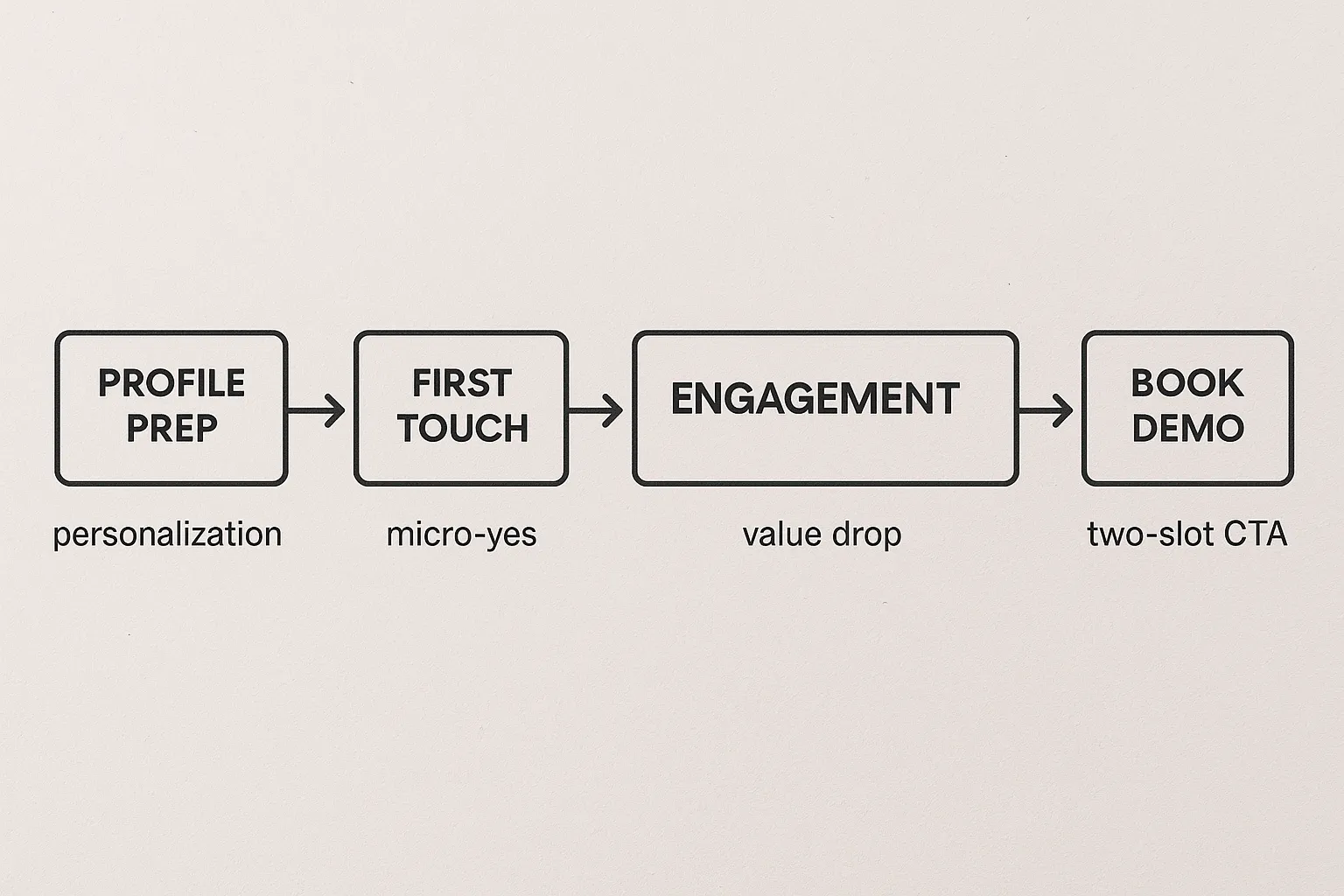
Industry evidence: “As customers increasingly learn and buy digitally, sales reps become just one of many possible sales channels.” — Cristina Gomez, Managing Vice President, Gartner.
Source: Gartner
Step 0: Set up to win before your first touch
Great LinkedIn prospecting starts long before you hit Connect.
- Tighten your ICP and persona signals. Map job titles, seniority, industry, segment, tech stack, hiring velocity, and change events like funding or leadership moves. Focus your value hypothesis on two or three urgent pains, not a laundry list.
- Tune your profile for buyer confidence. Headline that states your category and outcome, banner with proof points, About section that frames problems solved, Featured section with a concise one-pager or customer story. Your profile is the landing page for every connection invite.
- Decide your single conversational objective. First touch aims for a micro-yes, not a demo. Clarity on the micro-yes keeps messages short and relevant.
Step 1: Build a high-signal list
Volume without signal creates noise. Pull lists that combine ICP with triggers that increase reply intent:
- Role relevance and responsibility scope
- Recent activity on LinkedIn, posting or commenting indicates they are reachable
- Company change events, funding, hiring, new leadership, expansion into new regions
- Tool or process hints from public posts or job descriptions
If you use LinkedIn Sales Navigator, stack filters to isolate people who meet your ICP and show recent activity. Then tier the list so SDRs spend more time on Tier 1, the most promising.
Step 2: First touch that earns the right to talk
Your goal is a small commitment, a micro-yes to continue the conversation. Test both with and without a note. When you use a note, keep it specific and short.
Examples you can copy:
-
Context micro-yes “Noticed you are expanding the partner motion at Acme. Open to connect if a 30-second idea on faster partner sourced pipeline would be useful?”
-
Trigger micro-yes “Congrats on the Series B. If ramping SDR headcount is on your plate, worth comparing notes on how teams de-risk ramp on LinkedIn?”
-
Peer relevance “I work with revenue leaders in industrial SaaS on shortening time to first meeting from LinkedIn. Open to connect?”
Guidelines that consistently improve acceptance:
- Do not pitch in the invite
- Reference one proof of relevance, not three
- Ask for permission, not time
- Avoid jargon and superlatives
Step 3: From acceptance to conversation, not a pitch
Once they accept, reply the same day. Use one of these openers, then follow with a crisp value drop.
Openers:
-
Thank you plus relevance “Thanks for connecting. Your post on partner enablement caught my eye. Curious how you are enabling new partners in their first 60 days.”
-
Insight plus question “Across 40 RevOps orgs we see first meetings from LinkedIn jump when the CTA is two time slots, not a link. How are you approaching CTAs on social right now?”
-
Problem framing “Lots of teams are seeing reply decay on InMail but better engagement in comments and DMs. Is that true for your team?”
Value drop messages you can send 1 to 2 days later if they do not reply:
-
Content nugget “Here is a 4-sentence teardown of a LinkedIn opener that booked 18 meetings last quarter, and why it worked. If helpful, happy to share the full swipe file.”
-
Micro case “A robotics SaaS doubled positive replies after switching from product claims to a one-line metric hypothesis. If you want, I can send the before and after lines.”
Keep the thread human. Use short paragraphs, one question at a time, and end with a clear micro-yes.
Step 4: Qualify without interrogating
You need to learn enough to justify a meeting, and you need to do it conversationally. Use this lightweight framework.
-
Context, what they do today “How is your team tackling first-touch prospecting on LinkedIn today?”
-
Pain, what slows them down or risks results “Where does it break, volume, personalization, or booking?”
-
Impact, what it costs “When that happens, is it missed quota, rep burnout, or pipeline gaps?”
-
Timing and ownership “Who typically champions fixes here, SDR leadership or RevOps?”
If they are outside ICP or not ready, ask for a referral or a time-bound next step.
-
Referral “Sounds like this sits with RevOps. Would it be a bad idea for me to loop in your RevOps lead for context?”
-
Deferral with value “Appreciate the context. I will send you the swipe file now. If Q2 is a better time to evaluate, want me to circle back in May?”
Step 5: Book the demo with low-friction CTAs
Make booking the obvious next step by stating an outcome and offering two precise times.
-
Outcome plus two-slot CTA “If a 15-minute run-through of the conversation flow and reporting would help, I can do Tue 10:30 am PT or Wed 2 pm PT. Either work?”
-
Multi-attendee nudge “If your RevOps counterpart should join, I can include a quick metrics view, acceptance, positive reply, qualified, and booked. Tue 10:30 am PT or Wed 2 pm PT?”
Once they choose a time, confirm details in-thread, then send the calendar invite with a one-sentence agenda and the expected attendees.
Objection handling in two lines
Keep it respectful and brief. Always end with a micro-yes.
-
Not a priority “Makes sense. Before I close the loop, is it mostly bandwidth or relevance? If timing, I can set a note for next quarter.”
-
Already have a tool “Totally understand. Many teams we work with keep their current stack, they just shift the conversation layer. Worth 10 minutes to compare approaches?”
-
Send me info “Happy to. What would help you evaluate in 2 minutes, message examples, analytics view, or qualification flow?”
-
No budget “Understood. Teams often start by proving lift on one segment. If I show a 30-day pilot plan, would that be useful to review when budget opens?”
A practical cadence from first touch to demo
Below is a simple timeline you can implement immediately. Adjust spacing by persona and region.
- Day 0, Connection request, with or without note
- Day 1, Thank you opener if accepted
- Day 3, Value drop message if no reply
- Day 7, Second value or question that unlocks a different path
- Day 12, Break-up with open offer, “Happy to send the swipe file even if now is not the time”
- On positive interest, Qualify in-thread with 2 to 3 questions, then book with two-slot CTA the same day
What great personalization looks like at scale
Personalization is not a first name token. Use layers you can source reliably.
- Firmographic layer, industry, segment, motion, outbound or PLG, partner or direct
- Role layer, what this person cares about, team productivity, pipeline quality, reporting, enablement
- Trigger layer, recent activity, hiring, product launch, content topic, event attendance
Example:
“Hiring 8 SDRs during a product launch is a lot at once. The teams we see win on LinkedIn keep first touches narrow and let AI qualify in-thread so reps only step in on high-intent replies. If useful, I can share the two prompts that doubled our positive replies for PLG companies.”
Metrics that matter and how to improve them
Track a few core metrics across steps. Use them to decide what to test next.
| Funnel step | Primary metric | Example target you can iterate toward | What to test next |
|---|---|---|---|
| Connection | Acceptance rate | 30 to 50 percent, varies by ICP and trigger | Note vs no note, trigger relevance, profile headline |
| First reply | Reply rate | 15 to 30 percent, depends on persona | Opening line length, question-first vs insight-first |
| Positive intent | Positive reply rate | 25 to 45 percent of replies | Problem framing, social proof placement |
| Qualification | Qualified rate | 40 to 60 percent of positives | Question sequence, objection handling |
| Meeting | Booked rate | 50 to 70 percent of qualified | Two-slot vs link, timing windows, agenda clarity |
| Attendance | Show rate | 80 to 90 percent | Confirmation message, day-before reminder |
These ranges are directional. The right targets depend on your market, list quality, and offer.
Compliance and buyer respect
LinkedIn is a professional network, and trust is your currency. Follow platform rules and ethical outreach practices.
- Avoid mass-blasting identical messages
- Space touches reasonably and stop on explicit no
- Keep content relevant and non-deceptive
- Review the LinkedIn User Agreement and automation policies before running any workflow
You can find the User Agreement on LinkedIn’s legal site, see the section on permissible automation and scraping in the LinkedIn User Agreement.
How to scale this playbook with AI, without losing control
You can run the entire workflow manually, or you can let AI take the repetitive load while you keep the judgment calls.
Kakiyo helps revenue teams run this playbook at scale on LinkedIn:
- Autonomous LinkedIn conversations that carry threads from first touch to booked meeting
- AI-driven lead qualification that asks context, pain, and timing conversationally
- Customizable prompt creation so your voice and ICP nuances are preserved
- A/B prompt testing to learn which openers, CTAs, and value drops work for each persona
- Industry-specific templates that give SDRs a proven starting point
- An intelligent scoring system that prioritizes high-intent replies and accounts
- Simultaneous conversation management so one rep can handle many live threads without delays
- Conversation override control for human intervention whenever needed
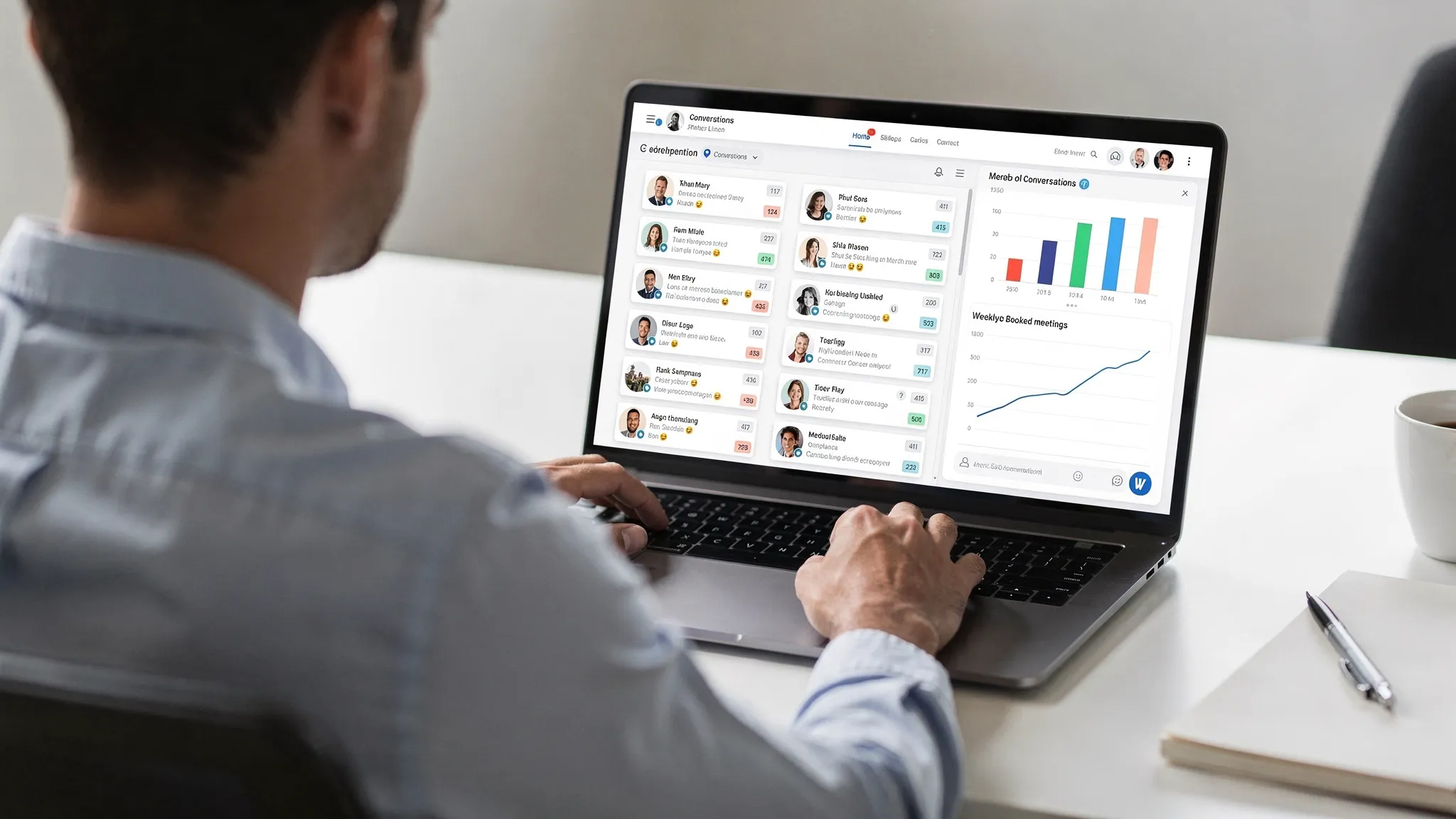
- A centralized real-time dashboard for team-level visibility
- Advanced analytics and reporting to monitor acceptance, replies, positive intent, qualified, and booked
If you want to see how this looks in practice, you can explore Kakiyo at kakiyo.com.
Ready-to-use swipe file, three short sequences
Use these as written, then test one variable at a time.
Sequence A, net-new ICP
-
Invite note “Saw you are leading RevOps at Nimbus. Open to connect if a 30-second idea on improving LinkedIn-sourced meetings would be useful?”
-
Acceptance opener “Thanks for connecting. Curious, what is working best for your team on LinkedIn prospecting right now?”
-
Value drop “We saw reply lift by swapping calendar links for two specific time options. If helpful, I can share the exact lines teams are using.”
-
Qualify and book “If a 15-minute run-through of the flow and analytics helps, I can do Tue 10:30 am PT or Wed 2 pm PT. Either work?”
Sequence B, event follow-up
-
Invite note “Enjoyed your comment on the GTM panel about SDR focus. Open to connect and trade notes on LinkedIn workflows that reduce busywork?”
-
Acceptance opener “On your event point about focus, where does LinkedIn fit in your pipeline mix this quarter?”
-
Value drop “Here is a one-page outline of a 30-day LinkedIn sprint that booked 22 meetings for a mid-market team. Happy to send the file.”
-
Book with stakeholder nudge “If it makes sense to review, I can walk you through it with a 15-minute screen share. Would it help to include your SDR lead, Tue 10:30 am PT or Wed 2 pm PT?”
Sequence C, content engagement to DM
-
Comment on their post “Loved your point about quality over volume. We saw the same when we stopped pitching in invites and asked a smaller micro-yes.”
-
DM opener “Following up on your post, how are you measuring quality on LinkedIn, reply intent, qualified, or booked?”
-
Value drop “Quick teardown of a message that moved a Technical Buyer from ‘send info’ to a booked discovery in two replies. Want the two lines?”
-
Book “If helpful, I can share a short walkthrough and we can see if it fits your motion. Tue 10:30 am PT or Wed 2 pm PT?”
Implementation checklist for team leads
- Define ICP tiers and triggers, publish to the team
- Rewrite rep profiles for relevance and trust
- Build first three lists, Tier 1, Tier 2, Tier 3
- Select one sequence and one CTA style to start
- Stand up a reporting view for acceptance, replies, positive intent, qualified, booked, and show rate
- Start weekly experiments, one variable at a time, and document learnings
Bring it together
Top teams treat LinkedIn prospecting as a conversation system, not a message blast. The system starts with relevance, moves through micro-yes moments, qualifies with empathy, and offers a low-friction next step. When you add AI to automate the busywork and keep humans focused on high-value interactions, you compound results.
If you want to run this playbook at scale, see how Kakiyo manages personalized LinkedIn conversations from first touch to qualification to booked meetings, while giving your team clear controls and visibility. Explore the platform at kakiyo.com.
FAQ
What makes a LinkedIn or cold outreach sequence effective?
An effective outbound sequence matches the buyer's context, uses short messages, and measures reply quality rather than raw volume. Cadence, targeting, and stop rules matter as much as copy.
How many touches should I use before stopping?
Most teams should stop once intent is clearly absent or once the sequence becomes repetitive. The right stop rule protects deliverability, reply quality, and brand perception.
Should I automate all outreach?
No. Automation should remove repetitive work, not replace judgment. The best systems automate targeting, timing, and admin while keeping messaging and qualification grounded in context.
How do I know whether outreach is working?
Track positive reply rate, meeting quality, and downstream conversion instead of open rates alone. If meetings do not progress, the issue is usually targeting or qualification, not activity volume.