
 Ilan Asseo
MQLs and SQLs: Align Definitions, Boost Pipeline Health
Guide to aligning MQL and SQL definitions, scoring, and handoffs to improve pipeline health and sales-marketing accountability.

Most teams say they align on MQLs and SQLs, yet pipeline tells a different story. Leads bounce between systems, SDRs dispute lead quality, and marketing cannot defend budget when conversion drops. In 2025, with buying committees researching off-site and more intent signals living inside conversations, the only reliable fix is to make definitions operational and measurable across every channel, including LinkedIn.
This guide shows how to align definitions, instrument handoffs, and turn conversational intent into qualified pipeline, so you improve predictability without throttling volume.
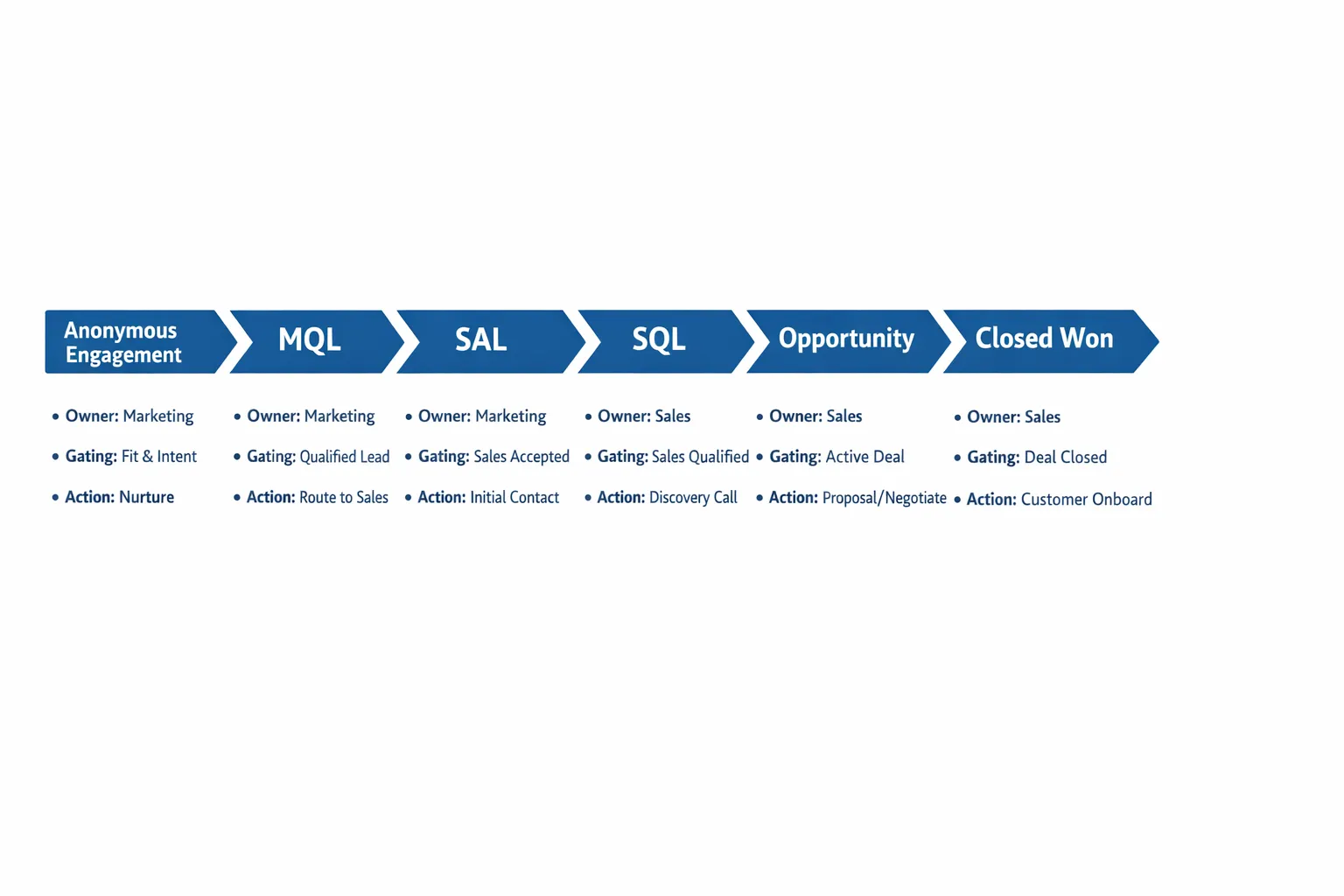
Industry evidence: Gartner’s research on the B2B buying journey shows that consensus creation is now a core buying job, which is why qualification needs buying-group evidence rather than single-contact activity.
Source: Gartner
First, get crisp on what good looks like
There are many models, but the job to be done is simple: minimum stage criteria must be unambiguous so that routing, SLAs, and reporting work without interpretation. Two resources worth reading for context are HBR’s classic on sales–marketing alignment and HubSpot’s primer on MQL vs SQL. Use them for vocabulary, then tailor to your motion.
Working definitions you can operationalize
| Stage | Owner | Minimum entry criteria | Exit criteria | Examples of qualifying signals |
|---|---|---|---|---|
| Inquiry | Marketing | Identified person tied to a relevant asset or touch | Routed or nurtured | Newsletter signup, webinar reg, ad form fill |
| MQL | Marketing | ICP-fit person or buying unit, with intent above baseline | Accepted by sales (SAL) or recycled | Multiple high-intent behaviors, reply in LinkedIn showing interest, pricing page repeat visits |
| SAL | Sales | Sales acknowledges receipt and agrees it is worth working | Dispositioned within SLA | SDR books first call attempt and logs outcome |
| SQL | Sales | Confirmed need or project, access to a relevant stakeholder, agreement to discuss solution live | Opportunity created | Prospect shares pain and agrees to a meeting time, asks for demo, confirms evaluation criteria |
| Opportunity | Sales | Validated business pain and next step with mutual plan | Closed Won or Lost | Discovery complete, stakeholders identified |
Notes:
- SAL, sales accepted lead, is the guardrail that stops MQLs from dying in a queue. Keep it.
- SQL requires explicit qualification in conversation, not just a score. Tying SQL to a booked meeting with the right persona removes ambiguity.
Translate definitions into criteria you can score and route
Your definitions should combine three pillars.
- Fit, is this person or account in your ICP?
- Role, seniority, function
- Firmographics, company size, industry, geo
- Technographics, must-have tools or platforms
- Intent, is this person showing buying behavior?
- High-intent web pages, pricing, integrations, comparison
- Repeated direct-response engagement, webinar attendance, return visits
- Conversational signals, replies on LinkedIn or email that acknowledge a problem or ask for next steps
- Qualification, is there a real need and next step?
- Frameworks like BANT, MEDDICC or SPICED are useful guardrails
- Minimal viable qualification for SQL, pain confirmed plus agreement to meet with a relevant stakeholder
Operational disqualification matters as much as qualification
Create clear criteria for fast no’s. Examples include out-of-ICP company size, student or consultant personas, competitor employees, or “research only, no project this year.” Quick and respectful recycling boosts SDR productivity and keeps reporting clean.
SLAs that protect pipeline health
SLAs make definitions real. They should be simple, visible, and owned.
- MQL to SAL, assignment within 5 minutes during business hours, first-touch attempt within 15 minutes, 3 distinct touches within 24 hours. Outside hours, start next business morning.
- SAL disposition codes, accepted, recycled to nurture with reason, duplicate, invalid. No open SALs beyond 48 hours.
- SQL creation, create an opportunity only when the minimum SQL criteria are met. If not, recycle with a reason.
- Feedback loop, rejected MQLs must map to a specific reason so marketing can tune targeting and content.
Post the SLA where everyone sees it, and add alerts for breach conditions in your CRM or RevOps stack.
Make conversation intent first-class data
A growing share of buying signals live inside threads, especially on LinkedIn. If you are not capturing those signals, your MQL and SQL math will always be incomplete.
Examples of conversational intent that should change stage or score:
- “We are evaluating tools for LinkedIn outreach next quarter,” adds explicit project timing and should increase score significantly.
- “Can you send pricing and a case study?” implies solution interest, likely SAL and near SQL once a meeting is accepted.
- “Not relevant, we do not prospect on LinkedIn,” is a clear disqualification, recycle with reason.
Kakiyo is built for this reality. The platform runs autonomous, personalized LinkedIn conversations, applies AI-driven lead qualification and intelligent scoring, and books meetings while keeping humans in the loop with conversation override control. Its centralized dashboard and advanced analytics make it easier to turn thread-level signals into lifecycle stages you can trust. Learn how this works in practice in our guide on conversational AI for sales use cases.
A simple scoring blueprint aligned to MQL and SQL
Tie your scores to your definitions. Resist the urge to gamify; the purpose is routing and prioritization.
- Fit score, A to D tiers or 0 to 100. Derive from ICP criteria you actually win, not aspirational accounts. Consider using your CRM’s predictive scoring if available. If you use Salesforce, see our setup guide for Einstein Lead Scoring.
- Intent score, additive points for high-intent pages, responses, form answers, and conversation signals. Cap contributions from low-intent actions like generic blog visits so they do not inflate.
- Stage gates, MQL requires Fit B or better and Intent above a defined threshold, SQL requires confirmed need plus meeting acceptance. Never allow a high intent score to bypass missing fit.
The metrics that actually improve pipeline health
Measure the stages you own and the transitions between them. Define calculation formulas so there is no debate later.
| Metric | Definition | Owner | Why it matters |
|---|---|---|---|
| MQL volume | Count of leads meeting MQL criteria in period | Marketing | Capacity planning, targeting quality |
| MQL to SAL rate | SAL divided by MQLs in cohort | Shared | Acceptance validates MQL usefulness |
| SAL to SQL rate | SQL divided by SALs in cohort | Sales | Shows qualification quality and message–market fit |
| SQL to Opportunity rate | Opps created divided by SQLs | Sales | Confirms that your SQL definition is tight and actionable |
| Speed to first touch | Median minutes from MQL creation to first SDR attempt | Sales | Strong predictor of connect and meeting rate |
| Speed to meeting | Median days from MQL to booked meeting | Shared | Identifies routing or engagement friction |
| Recycle rate and reasons | Share of SALs recycled by reason code | Shared | Directs targeting and content fix work |
Track by cohort, the week the lead became MQL, not by the week the later stage occurred. This eliminates survivorship bias and creates a clean funnel view.
LinkedIn conversation cues, how to stage and what to do next
Use consistent language patterns so AI and humans agree on what each reply means. Here are examples you can codify in your playbook:
| Example prospect reply | Stage classification | Next action |
|---|---|---|
| “Sounds interesting, what do you do?” | MQL, interest present but no confirmed pain | Share 1–2 sentence value prop, ask a soft question to elicit pain |
| “We are trying to increase meetings from LinkedIn in Q1.” | SAL candidate, explicit goal | Acknowledge, ask a short qualification question, attempt to book |
| “Can you do multi-threaded conversations and scoring?” | SAL to SQL trigger, capability check | Confirm capability, propose 2 times for a demo with the right stakeholder |
| “Not a priority this year.” | Disqualified or recycle | Mark reason, hand to nurture with relevant content |
| “Let’s chat Thursday 10 am ET.” | SQL, meeting accepted | Create meeting, convert to opportunity after discovery |
Kakiyo’s AI-driven lead qualification and scoring allow you to tag these cues consistently at scale, and its A/B prompt testing helps you learn which phrasing produces more SAL and SQL outcomes. For practical message frameworks and cadences, see our playbook on LinkedIn outreach that converts.
30-day alignment plan you can run now
Week 1, audit and baseline
- Export last 90 days, MQLs, SALs, SQLs, Opps. Compute stage rates by cohort. Sample 50 records per stage to assess fit and reason codes.
- Document current field names and picklists. Identify duplicates and free-text fields that should be standardized.
Week 2, definitions and SLAs
- Workshop with marketing, SDR, AE, RevOps. Finalize minimum criteria for MQL, SAL, SQL. Decide disqualification reasons and recycling rules.
- Publish a one-page definition and SLA card. Add to your team’s wiki and pin in SDR channels.
Week 3, instrumentation and routing
- Update CRM fields, lead statuses, and dispositions to exactly match the one-pager. Remove deprecated options.
- Implement routing based on fit and territory. Add alerts for SLA breaches. Ensure conversational tags from LinkedIn threads are captured and visible on the lead.
Week 4, enablement and measurement
- Train SDRs on new definitions using real examples from recent threads. Shadow and QA the first week.
- Launch dashboards for the metrics table above. Set weekly reviews with marketing and sales to inspect MQL to SAL to SQL flow and agree on fixes.
Keep the plan narrow. Start with one ICP and one primary use case, for instance outbound to VPs of Sales at 100 to 1,000 employee SaaS companies. Expand only after two consecutive weeks of clean flow.
Avoid the five classic pitfalls
- Score inflation, too many points for low-intent actions makes every lead look hot, which collapses trust.
- Definition creep, adding one-off exceptions reintroduces ambiguity. Update the one-pager quarterly, not ad hoc.
- No SAL step, MQLs without acceptance go stale and distort marketing performance.
- Channel silos, ignoring conversational intent on LinkedIn or chat means your picture of the buyer journey is incomplete.
- Vanity reporting, reporting by activity count rather than stage conversion hides the real bottlenecks.
Bringing AI into the MQL to SQL handoff, safely
AI should help you capture and standardize signals, not rewrite your process. A practical approach:
- Use customizable prompt libraries to elicit qualification in short, conversational exchanges, without pressure.
- Run A/B testing on phrasing that drives more SAL and SQL, not just replies. Stop tests at statistical confidence tied to stage outcomes.
- Keep conversation override control so SDRs can step in when senior stakeholders or complex accounts engage.
- Centralize analytics so leadership can see end-to-end impact, from first touch to booked meeting. For a practical, staged rollout of AI on LinkedIn, read our guide on the AI SDR workflow and our broader prospecting playbook.
Governance and buyer respect
Short, value-first messages, accurate targeting, and clear opt-out handling protect your brand and increase conversion. Codify policies that ban spammy volume, prohibit aggressive follow-ups after a clear no, and require accurate representation of capabilities. Your qualification job is to help, not to trap.
The payoff, healthier pipeline and better budgets
When MQLs and SQLs are aligned to objective criteria, and when conversational intent is captured alongside web and form data, three things happen fast:
- Rejection reasons become diagnostic, not political.
- SDR time shifts to accounts with the highest probability of a meeting and a deal.
- Marketing can defend spend with stage-by-stage conversion and speed metrics.
That is pipeline health. If you want to see how autonomous, personalized LinkedIn conversations can produce cleaner MQLs and more reliable SQLs, explore how Kakiyo’s AI manages conversations end to end with intelligent scoring, A/B prompt testing, and analytics that your RevOps team can trust.
FAQ
What is the difference between a lead and a qualified prospect?
A lead is simply a potential contact or account. A qualified prospect has enough verified fit, intent, and context to justify a next sales step.
What makes qualification trustworthy?
Qualification is trustworthy when it relies on auditable signals, not labels alone. The more evidence a team can verify, the easier it is to align sales, marketing, and RevOps.
Should qualification be based on one score?
Not by itself. Scores are useful summaries, but teams still need explicit criteria around fit, buying signals, and next-step readiness.
How do I implement proof-based qualification in my team?
Start by defining what evidence is required at each stage, then make those signals visible in your workflows. The goal is consistency across inbound, outbound, and partner-sourced leads.