
 Ilan Asseo
Qualified Insurance Leads: What Counts as Qualified
How to define and operationalize qualified insurance leads — practical stages, the five pillars (fit, intent, access, data quality, permission).

“Qualified insurance leads” sounds straightforward until you try to operationalize it. One team calls any form-fill qualified. Another only counts people who want a quote this week. Agents complain about junk. Marketing complains about “no follow-up.” The result is predictable: wasted time, higher acquisition costs, and a pipeline you can’t forecast.
In insurance, qualification is not a vibe. It is a set of observable criteria you can apply consistently across channels (web, phone, referrals, LinkedIn) and tie to outcomes (quotes issued, policies bound, retained).
Industry evidence: Gartner’s research on the B2B buying journey shows that consensus creation is now a core buying job, which is why qualification needs buying-group evidence rather than single-contact activity.
Source: Gartner
What “qualified” means in insurance (and why the definition changes)
A lead is “qualified” only relative to a next step.
- If your next step is “have a short discovery call,” the bar is lower.
- If your next step is “start underwriting,” the bar is higher.
- If your next step is “send a quote,” the bar is higher still.
That’s why high-performing teams define qualification in stages, not as a single moment.
Here’s a practical way to frame it:
| Stage (plain English) | Insurance meaning | Proof you have it | Typical next step |
|---|---|---|---|
| Contactable lead | You can legally and realistically reach them | Valid phone/email, time window, preferred channel, consent where required | First meaningful touch |
| Marketing-qualified (MQL) | Early interest and basic fit | Product match, geography/licensing match, minimal risk info | Discovery or pre-quote questions |
| Sales-qualified (SQL) | Clear buying intent and enough details to proceed | Timeframe, current carrier situation, coverage need, decision process | Appointment, quote intake |
| Quote-ready | Underwriting-relevant data is complete | Required fields (drivers, vehicles, payroll, loss runs, property details, etc.) | Submit to carrier/underwriter |
| Bind-ready | Terms acceptable and buyer can execute | Final decision-maker engaged, payment method, documents ready | Bind and issue |
If your CRM only has one bucket called “qualified,” you are forcing wildly different realities into one label.
The 5 pillars of qualified insurance leads
A lead is qualified when it has enough evidence across five pillars to justify the next action.
1) Fit (eligibility and appetite)
Fit answers: Should we pursue this risk at all?
In insurance, fit is more than ICP. It includes underwriting eligibility and operational constraints:
- Product match (auto, home, life, health, commercial lines, benefits)
- Geography and licensing (state or country)
- Basic risk profile (industry class, property type, claims history, driving record, etc.)
- Minimum premium or policy size (especially for commercial)
A lead can be eager and still unqualified if the risk is clearly outside your appetite.
2) Intent (why now)
Intent answers: Are they actively moving toward a decision?
Look for concrete signals:
- Renewal date or “shopping window”
- Trigger event (new vehicle, new home, hiring, contract requirement, funding round)
- Quote request versus general research
- Willingness to share underwriting details (loss runs, driver list, COI requirements)
Intent is often the difference between “interested someday” and “worth an agent’s time today.”
3) Access (ability to progress the deal)
Access answers: Can this person get the process unstuck?
In personal lines, that might be the household decision-maker.
In commercial insurance, access often means:
- You’re speaking to someone who owns the program (CFO, HR/Benefits leader, Ops, Risk Manager)
- They can introduce the broker decision-maker, procurement, or the current broker relationship holder
- They can provide required documents (loss runs, schedules, payroll, safety program details)
A lead without access can still be nurtured, but it should not be labeled “sales qualified.”
4) Data quality (completeness and correctness)
Data quality answers: Do we have what we need to act?
Insurance workflows are data-hungry. A lead becomes expensive when it repeatedly stalls because information is missing or wrong.
High-value data traits:
- Complete enough to route correctly (line of business, location, estimated premium size)
- Verifiable (business name exists, address is real, phone works)
- Structured (captured in fields, not buried in notes)
5) Permission and compliance (can you engage)
Permission answers: Are we allowed to contact and market to them the way we plan to?
Rules vary by channel and jurisdiction, and you should always validate with counsel. But operationally, your “qualified” definition should include basic checks such as:
- Consent captured where required (especially for phone and SMS)
- Clear source and provenance (how did we get this lead?)
- Suppression lists applied (do-not-contact, prior opt-outs)
A lead that would create compliance risk is not qualified, even if it looks “hot.”
A quick reference table (what to capture, what to avoid)
| Pillar | What to capture as evidence | Common ways teams get it wrong |
|---|---|---|
| Fit | Product, geography/licensing, basic eligibility, segment (personal vs commercial) | Treating everyone as eligible, relying on vague personas only |
| Intent | Renewal date, trigger event, quote request, urgency | Confusing curiosity with buying, counting clicks as intent |
| Access | Role, buying group, document access, ability to schedule | Calling non-decision-makers “qualified” because they replied |
| Data quality | Required fields for next step, verified contact | Passing incomplete leads to agents “to figure out” |
| Permission | Consent, opt-out status, source, channel preference | Ignoring opt-outs, mixing channels without governance |
Examples: what counts as qualified (and what doesn’t)
Qualification is easiest to align on when you show examples.
| Scenario | Qualified? | Why |
|---|---|---|
| “Shopping auto insurance, my policy renews in 2 weeks, here’s my VIN and driving history.” | Yes | Fit and intent are clear, data supports quote-ready motion |
| “Just curious what life insurance costs, maybe later this year.” | Not yet | Intent is weak, nurture instead of treating as SQL |
| Commercial prospect: “Our GL renews in 60 days, we need additional insured language for a new contract, can you review?” | Yes | Strong trigger, clear next step, access to requirements |
| “I own a small business, send me a quote” but no industry, payroll, locations, or loss history provided | Not yet | Intent exists, but data quality is insufficient for underwriting |
| Lead has mismatched state/licensing for the requested product | No | Fails fit gate, route elsewhere or disqualify |
The goal is not to be strict for the sake of strictness. The goal is to protect agent time and increase quote and bind rates.
A simple, repeatable qualification checklist (insurance-specific)
Instead of asking 20 questions up front, structure your qualification as a sequence of small confirmations. You are trying to reach the next action with minimal friction.
Step 1: Confirm fit in one line
Use a single, buyer-friendly check.
Examples:
- “Is this for personal coverage (auto/home/life) or for a business policy?”
- “Which state is the policy for?”
- “Roughly when does your current policy renew?”
These questions are fast, reduce misrouting, and immediately raise lead quality.
Step 2: Capture intent with a “why now” prompt
You want a specific reason.
Examples:
- “What changed that made you start looking now?”
- “Is this tied to renewal, a new purchase, or a contract requirement?”
Step 3: Ask for the minimum underwriting inputs
This is where many teams over-qualify (too many questions) or under-qualify (none).
A practical approach is to define a quote-ready minimum set by line of business, then request only what you need to start.
Examples:
- Personal auto: vehicles, drivers, current insurer (or lapse), any major incidents
- Commercial: locations, operations summary, estimated revenue/payroll, loss runs availability, renewal date
Step 4: Secure the next commitment
A “qualified” lead should reliably progress to a scheduled step.
Examples:
- “If I can get you options, are you open to a 15-minute call tomorrow to confirm details?”
- “Can you share loss runs (last 3 to 5 years) or tell me who can provide them?”
Scoring qualified insurance leads (without overengineering)
Many insurance teams fail at scoring because they score everything. Instead, score only what you can defend and act on.
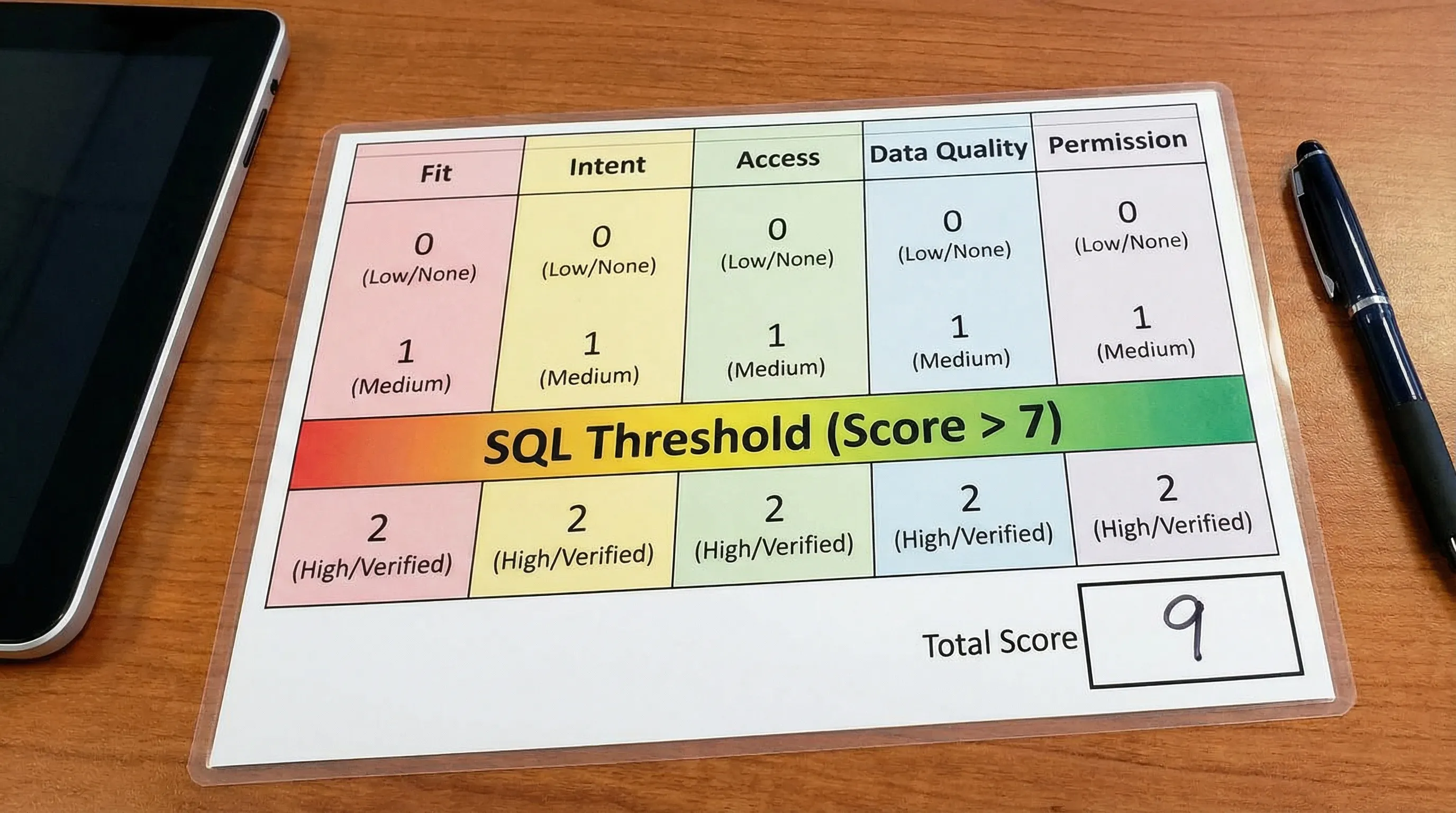
A lightweight model is a 0 to 2 score across the five pillars (max 10), with hard “no” gates for licensing and permission.
| Pillar | 0 (not present) | 1 (some evidence) | 2 (strong evidence) |
|---|---|---|---|
| Fit | Wrong product, wrong location, obvious ineligible | Basic match but unclear eligibility | Clear match, eligible, within appetite |
| Intent | No timeframe, browsing | Some timeline, mild trigger | Clear timeline (renewal/trigger), wants next step |
| Access | Unknown role, cannot progress | Influencer, can introduce decision-maker | Decision-maker or direct process owner |
| Data quality | Missing key fields | Partial data, needs follow-up | Minimum fields complete and verified |
| Permission | Unclear consent/source | Some channel permission | Clear consent, clean source, no opt-out |
Operational thresholds (example):
- 0 to 4: Nurture or disqualify
- 5 to 7: Sales-accepted, needs qualification call
- 8 to 10: Sales-qualified, proceed to quote intake or appointment
The exact cutoffs should be tuned using your historical conversions (quote rate, bind rate, retention), but the structure stays stable.
How to make “qualified” real inside your CRM (and stop definition drift)
A definition that lives in a slide deck will drift within weeks. To keep it stable, you need fields, routing rules, and a feedback loop.
Use fields that map to evidence (not opinions)
Instead of “Qualified: Yes/No,” capture evidence you can audit:
- Line of business (LOB)
- State/region
- Renewal date (or shopping window)
- Trigger event (controlled picklist)
- Role (commercial) or household decision-maker (personal)
- Required docs status (for commercial, loss runs available: yes/no)
- Consent status and preferred channel
Define stage-entry rules
Write explicit stage-entry rules like:
- “SQL requires: renewal date within 90 days, correct state, confirmed product, contactable, and either decision-maker engaged or decision path identified.”
When someone wants to change the rule, that’s fine, but it becomes a deliberate change, not silent drift.
Track the metrics that reveal lead quality (not just lead volume)
Lead quality shows up in downstream conversion and agent efficiency.
| Metric | What it tells you | How it prevents bad qualification |
|---|---|---|
| Contact rate | Are leads real and reachable? | Exposes poor sources and bad data |
| Quote-start rate | Do “qualified” leads have enough info to act? | Flags under-qualification |
| Quote-to-bind rate | Are you attracting the right risks? | Flags fit issues and misrouting |
| Time-to-first-meaningful-touch | Are you responding fast enough? | Prevents “we never spoke” leakage |
| Agent minutes per bound policy | Is your process efficient? | Prevents high-effort low-yield leads |
Where LinkedIn fits for qualified insurance leads (especially commercial)
For commercial insurance, employee benefits, and B2B insurtech, LinkedIn can be a high-signal channel because:
- Job titles provide immediate context for access (CFO, HR, Risk)
- Trigger events are visible (funding, expansion, hiring, new facility)
- Conversations can collect qualification evidence in-thread
The challenge is consistency: high-quality conversation at scale is hard for human teams alone.
This is where conversation automation can help when it is designed around qualification evidence, not spam volume. Kakiyo, for example, is built to manage personalized LinkedIn conversations from first touch through qualification to meeting booking, so SDRs focus on the highest-value opportunities. The practical win for insurance teams is simple: structured prompts that ask the right micro-questions, A/B testing to improve conversion, and a scoring system that flags which threads are actually becoming quote-worthy.
Don’t ignore inbound content quality (it determines how “qualified” your leads start)
If your inbound traffic is vague, your leads will be vague. If your content attracts buyers with specific problems (renewal timelines, compliance requirements, coverage gaps), qualification becomes easier.
If you want to scale insurance-focused content without adding a huge writing burden, an autopublishing platform like BlogSEO can help generate and publish SEO articles consistently, which is often the difference between “some leads” and “predictable, high-intent leads.”
The bottom line
Qualified insurance leads are not “people who responded.” They are leads with fit, intent, access, data quality, and permission strong enough to justify a specific next step.
When you:
- define qualification by stage,
- capture auditable evidence,
- score simply,
- and enforce the definition through routing and metrics,
you stop arguing about lead quality and start improving it. That is how you get more quotes issued, more policies bound, and a pipeline you can actually trust.
FAQ
What is the difference between a lead and a qualified prospect?
A lead is simply a potential contact or account. A qualified prospect has enough verified fit, intent, and context to justify a next sales step.
What makes qualification trustworthy?
Qualification is trustworthy when it relies on auditable signals, not labels alone. The more evidence a team can verify, the easier it is to align sales, marketing, and RevOps.
Should qualification be based on one score?
Not by itself. Scores are useful summaries, but teams still need explicit criteria around fit, buying signals, and next-step readiness.
How do I implement proof-based qualification in my team?
Start by defining what evidence is required at each stage, then make those signals visible in your workflows. The goal is consistency across inbound, outbound, and partner-sourced leads.