
 Ilan Asseo
Salesforce Einstein Forecasting: Setup, Accuracy, Limits
A practical guide to setting up, evaluating accuracy, and understanding the limits of Salesforce Einstein Forecasting

Gartner says poor data quality costs organizations an average of $15 million per year. If your forecast is built on inconsistent stages and fantasy close dates, Salesforce Einstein Forecasting will simply automate the wrong answer faster.
Industry evidence: McKinsey estimates that generative AI could increase sales productivity by approximately 3 to 5 percent of current global sales expenditures, but only when teams pair models with strong data and operating discipline.
Source: McKinsey
What is Salesforce Einstein Forecasting?
Salesforce Einstein Forecasting is an AI feature in Salesforce that uses your historical CRM opportunity data to predict expected outcomes and improve forecast rollups (for example, projecting likely revenue for a period). It augments traditional rep judgments and forecast categories with machine learning predictions, so leaders can spot risk earlier and coach deals more consistently.
Quick comparison: Einstein Forecasting and the tools teams pair with it
| Tool Name | Best For | Key Feature | Starting Price |
|---|---|---|---|
| Salesforce Einstein Forecasting | Salesforce-native AI forecasting | Predictive opportunity outcomes inside Salesforce | Contact sales |
| Kakiyo | Turning LinkedIn outreach into qualified pipeline (that forecasts better) | Autonomous LinkedIn conversations that qualify and book meetings | Book a demo |
| Clari | Forecast calls and pipeline inspection at scale | Rollups + risk inspection workflows | Contact sales |
| Gong | Forecasting with conversation context | Call-based deal signals and risk flags | Contact sales |
| HubSpot Forecasting | SMB teams forecasting in HubSpot | Simple forecasting + CRM-native rollups | Contact sales |
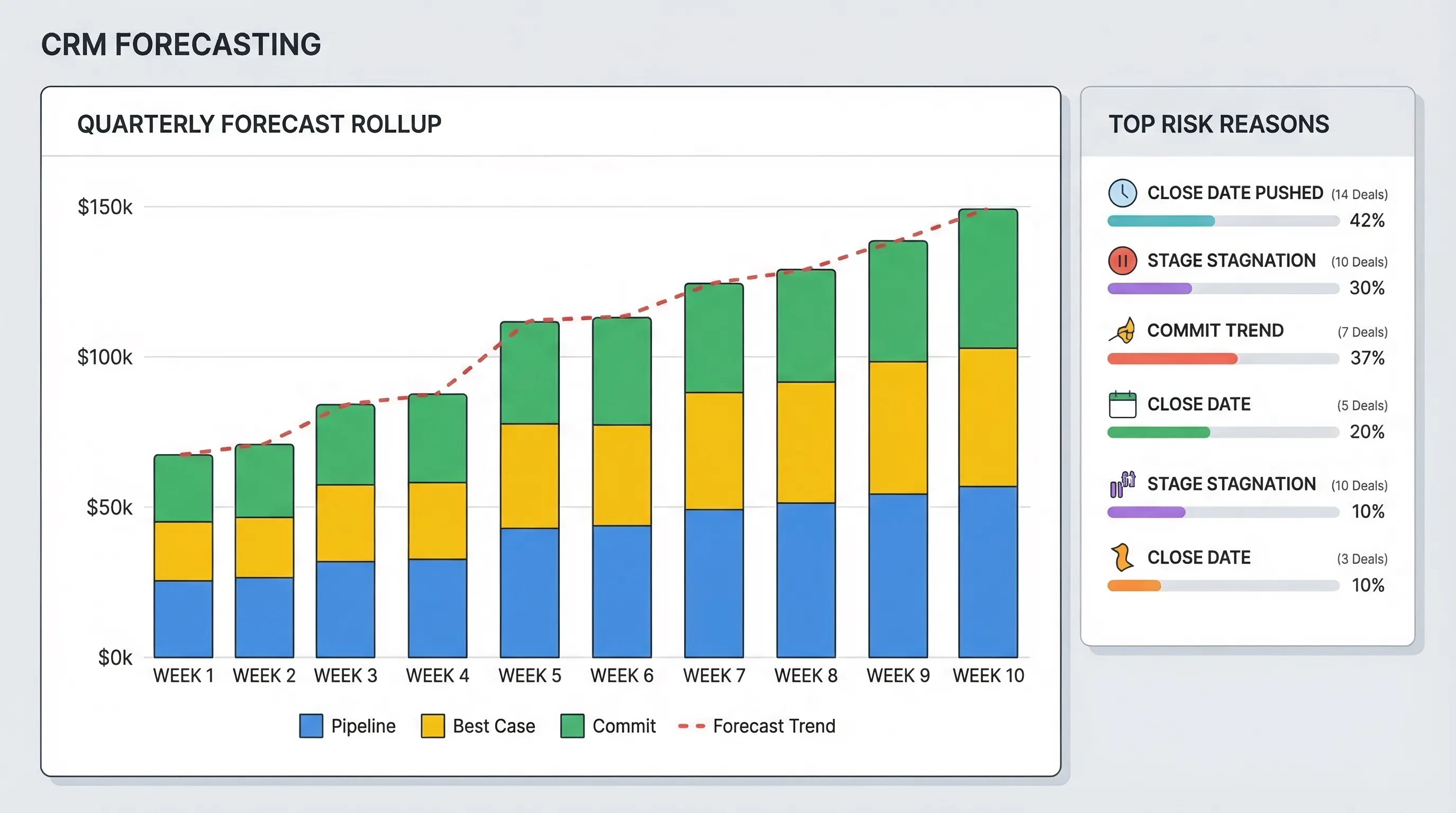
Salesforce Einstein Forecasting
What it does (2 sentences). Einstein Forecasting uses patterns in your Salesforce opportunity history to produce AI-informed projections that complement Collaborative Forecasts. It is designed to help managers see which deals are likely to slip or close, and improve forecast consistency without leaving Salesforce.
Standout feature (1 sentence). The biggest advantage is that it is CRM-native, meaning forecast modeling is tied to the same objects, fields, and governance you already use for pipeline management.
Who it’s for (1 sentence). RevOps and sales leaders who already run forecasting in Salesforce and want AI support without adding another forecasting system.
Pricing. Contact sales (packaging varies by Salesforce edition and add-ons).
Pros
- Native to Salesforce, which reduces integration and data-sync complexity.
- Works best when you already have disciplined opportunity hygiene and consistent stage definitions.
- Easier for reps to adopt because it fits existing forecast workflows.
Cons
- Forecast quality is capped by CRM data quality and consistency.
- It does not create pipeline or run outbound conversations, so it cannot fix a top-of-funnel signal deficit.
Setup: an operator-grade checklist (what actually matters)
Most Einstein Forecasting implementations fail for the same reason forecasting programs fail: unclear definitions, inconsistent stages, and missing “truth” labels. Use this checklist before you touch configuration.
| Setup requirement | Why it matters for Einstein Forecasting | How to verify quickly |
|---|---|---|
| Consistent opportunity stages | Stage drift breaks the relationship between stage and outcome | Report: stage at close-won/lost by segment, look for wide variance |
| Stable close date behavior | If reps constantly push dates, the model learns noise | Report: average close-date pushes per opp, by rep/team |
| Enough closed-won and closed-lost history | Models need outcomes, not activity | Count closed opps per segment in the last 4 to 8 quarters |
| Clean forecast categories | Categories need to reflect real commitment behavior | Audit how often “Commit” actually closes in-period |
| Defined segmentation | Different motions behave differently | Forecast slices: SMB vs Mid-market vs Enterprise, new vs expansion |
On the Salesforce side, start with the fundamentals and use Salesforce’s own guidance for forecasting configuration:
- Confirm you are running Collaborative Forecasts and your forecast types, territories, quotas, and hierarchies are correct.
- Standardize the opportunity fields that drive forecasting (stage, amount, close date, forecast category) and lock required-field discipline.
- Only then enable and test Einstein Forecasting against a baseline (your current rep commit accuracy).
Useful starting points:
- Salesforce Trailhead on forecasting concepts and setup (Collaborative Forecasts): Salesforce Trailhead
- Salesforce help documentation for forecasting configuration: Salesforce Help
Accuracy: what you should measure (and what you should ignore)
Einstein Forecasting can be directionally helpful, but you need to evaluate it like a forecasting product, not like a demo feature.
Measure accuracy in ways that force honesty:
- Forecast bias: Are you consistently over-forecasting or under-forecasting?
- Error by segment: Enterprise and SMB behave differently. If you only measure globally, you hide failures.
- Stability: If the forecast swings wildly week to week without real pipeline changes, adoption will die.
Two data points to keep you grounded:
- Gartner estimates poor data quality costs organizations $15M per year on average, which shows up directly as forecast volatility and broken pipeline analytics. Source: Gartner press release
- Salesforce has reported that sellers spend only 28% of their week actually selling, which is why forecasting workflows must reduce admin and rework rather than add more “check the box” steps. Source: Salesforce State of Sales
Limits: where Einstein Forecasting predictably fails
You should expect limitations in three buckets:
1) Data limitations (most common). If your CRM history is thin, fields are sparsely populated, or stage definitions changed every quarter, the model will look confident while being wrong.
2) Process limitations. Einstein Forecasting does not enforce qualification quality. If your pipeline is packed with weakly qualified opportunities, the model can only estimate the probability of weak opportunities closing, it cannot transform them into real deals.
3) Signal limitations. Salesforce opportunity data often lags reality. If the most important buying signals live in conversations (especially LinkedIn threads) and never make it into the CRM as auditable evidence, forecasting becomes a lagging indicator by design.
Kakiyo
What it does (2 sentences). Kakiyo autonomously manages personalized LinkedIn conversations at scale, from first touch to qualification to meeting booking. It is built so SDRs do not have to live in chat, they step in only when a prospect is qualified and a meeting is ready.
Standout feature (1 sentence). Unlike LinkedIn automation tools that automate sending, Kakiyo autonomously manages the full conversation, qualifies the lead with an intelligent scoring system, and books the meeting.
Who it’s for (1 sentence). Teams that want more qualified meetings from LinkedIn outbound while keeping qualification evidence consistent enough to support downstream reporting and forecasting.
Pricing. Book a demo.
Pros
- Converts LinkedIn outreach into qualified conversations and booked meetings without SDR inbox drag.
- Built for governed experimentation with customizable prompts and A/B prompt testing.
- Handles many simultaneous conversations while preserving override control.
Cons
- Not a forecasting engine, it improves the pipeline inputs that forecasting depends on.
- Requires you to define qualification evidence and “what counts” before scaling.
Clari
What it does (2 sentences). Clari is a revenue platform used to improve forecast calls and pipeline inspection, typically with a focus on rollups, deal risk, and execution workflows. It is often adopted when teams need a forecasting layer that standardizes process across managers.
Standout feature (1 sentence). Strong pipeline inspection workflows that help leaders diagnose forecast movement, not just report a number.
Who it’s for (1 sentence). Mid-market and enterprise teams that run formal forecast cadences and need operational rigor across multiple teams.
Pricing. Contact sales.
Pros
- Good for forecast cadence, inspection, and consistency across teams.
- Helps teams operationalize “what changed” discussions in forecast calls.
Cons
- Still depends on CRM hygiene and honest deal updates.
- Adds another layer to administer if your process is not stable.
Gong
What it does (2 sentences). Gong is primarily conversation intelligence, recording and analyzing sales calls to surface deal risk, next steps, and buyer signals. Many teams use it as a truth layer when CRM notes are incomplete.
Standout feature (1 sentence). Brings call-derived evidence into deal inspection so forecasts are less dependent on rep narration.
Who it’s for (1 sentence). Teams whose deals are heavily driven by meetings and calls and want a more evidence-backed forecast process.
Pricing. Contact sales.
Pros
- Improves coaching and deal inspection with real conversation context.
- Useful for enforcing next steps and MEDDICC-style discipline.
Cons
- Less helpful if your motion is mostly async or LinkedIn-first early in the cycle.
- Does not replace the need for pipeline creation and qualification.
HubSpot Forecasting
What it does (2 sentences). HubSpot Forecasting provides forecasting rollups and pipeline visibility for teams running on HubSpot CRM. It is simpler than enterprise forecasting stacks and can be effective when your sales process is straightforward.
Standout feature (1 sentence). Quick setup and tight coupling to HubSpot’s deal objects and reporting.
Who it’s for (1 sentence). SMB teams that want workable forecasting without heavy RevOps overhead.
Pricing. Contact sales.
Pros
- Fast to implement and easy for reps to use.
- Solid native reporting for smaller teams.
Cons
- Less flexible for complex enterprise segmentation and governance.
- If you are Salesforce-based, switching is usually not a forecasting decision, it is a systems decision.
Which tool should you choose?
If you want Salesforce-native AI forecasting, use Salesforce Einstein Forecasting.
If you want autonomous AI conversation management and LinkedIn lead qualification that produces cleaner pipeline inputs, use Kakiyo.
If you want forecast call rigor and pipeline inspection workflows, use Clari.
If you want deal risk grounded in what buyers actually said on calls, use Gong.
If you want simple CRM-native forecasting for an SMB motion, use HubSpot Forecasting.
FAQs
How do I set up Salesforce Einstein Forecasting?
Start by stabilizing your Salesforce forecasting foundation: Collaborative Forecasts, forecast types, quotas, and consistent opportunity fields (stage, amount, close date, forecast category). Then enable Einstein Forecasting and validate it against a baseline for at least one full cycle. If your stages and close dates are unreliable, fix the process first or your AI forecast will be unreliable too.
Is Salesforce Einstein Forecasting accurate?
It can be useful, but accuracy depends heavily on the quality and consistency of your historical opportunity outcomes. Measure performance by segment, track forecast bias, and compare week-to-week stability against your existing rep commit forecast. If you cannot explain why the model changed, adoption will drop.
What are the limits of Salesforce Einstein Forecasting?
The biggest limits are CRM data quality, inconsistent stage definitions, and missing leading indicators that live outside Salesforce (for example, early qualification evidence in LinkedIn conversations). Einstein can improve forecasting inside Salesforce, but it cannot create pipeline, qualify prospects, or enforce honest updates. Treat it as decision support, not a replacement for process.
What is the difference between Salesforce forecasting and Einstein Forecasting?
Salesforce forecasting (Collaborative Forecasts) is the rollup and workflow layer: forecast categories, hierarchies, quotas, and manager rollups. Einstein Forecasting adds machine learning predictions on top of that system, using historical patterns to estimate likely outcomes. In practice, you need both: a clean forecasting process and AI that augments it.
What are the best alternatives to Salesforce Einstein Forecasting?
If you need a dedicated forecasting and inspection layer, Clari is a common choice. If you want forecast confidence grounded in buyer conversations, Gong can add evidence that CRM often misses. If your problem is that pipeline is unqualified before it even hits Salesforce, tools like Kakiyo improve the upstream qualification and meeting booking that forecasting depends on.
Book a Kakiyo demo to turn LinkedIn conversations into qualified meetings your Salesforce forecast can actually trust.