
 Ilan Asseo
SMMA Email Outreach: A Safe Cold Email Playbook
Operator-grade playbook for SMMA cold email: pick a narrow offer, protect deliverability, write reply-first emails, and convert replies into booked.

Google and Yahoo now enforce bulk sender rules, and a 0.3% spam complaint rate can tank deliverability even if your offer is good. For an SMMA, that means one sloppy list or one “spray and pray” sequence can burn a domain, waste weeks, and stall new client acquisition.
This is a safe, operator-grade SMMA email outreach playbook: how to pick a narrow offer, protect deliverability, write emails that earn replies, and use the right tools to qualify and book meetings without turning your agency into a spam machine.
Industry evidence: “As customers increasingly learn and buy digitally, sales reps become just one of many possible sales channels.” — Cristina Gomez, Managing Vice President, Gartner.
Source: Gartner
What is SMMA email outreach?
SMMA email outreach is the process of sending targeted cold emails to potential clients (brands, local businesses, SaaS companies) to start a conversation that leads to a sales call. Done well, it is permission-based, personalized enough to be credible, and measured on qualified conversations and meetings, not sent volume. Done poorly, it becomes a deliverability problem and a brand risk.
Best tools for SMMA email outreach (quick comparison)
| Tool Name | Best For | Key Feature | Starting Price |
|---|---|---|---|
| Kakiyo | Turning outreach into qualified meetings via LinkedIn | Autonomous LinkedIn conversations that qualify and book meetings | Contact sales |
| Apollo | List building plus basic outbound execution | Database plus sequences in one workflow | Paid plans (varies) |
| Smartlead | Scaling cold email with safer ops controls | Inbox rotation and deliverability-first sending | Paid plans (varies) |
| Instantly | High-volume sending with simple management | Inbox management and campaign control | Paid plans (varies) |
| Lemlist | Personalization-heavy outbound for higher trust | Strong personalization assets and templates | Paid plans (varies) |
| HubSpot Sales Hub | Teams that want CRM-native outreach | Sequences and tracking inside a CRM | Paid plans (varies) |
The safe cold email playbook for SMMAs
1) Pick one ICP slice and one offer (or you will sound generic)
Most agency cold email fails because the offer is “we help you grow on social” and the target is “any business with money.” That forces you into vague claims and long emails.
Instead, choose:
- One buyer (role + business model), for example Founder of a $2M to $15M ecom brand on Shopify, or GM of a multi-location medspa.
- One measurable outcome tied to revenue, margin, or pipeline, for example “reduce CAC on Meta by fixing creative testing,” not “run ads.”
- One proof angle you can actually back up, for example “we improved MER by 18% for a skincare brand,” not “we guarantee 3x ROAS.”
Safety benefit: narrower targeting reduces spam complaints because recipients can instantly tell why they are on the list.
2) Build lists like a risk manager, not a growth hacker
“Bad data” is the fastest path to bounces, complaints, and domain damage.
Minimum standards for SMMA cold email lists:
- Use business emails wherever possible (avoid personal inboxes unless your legal basis and targeting justify it).
- Suppress generic role inboxes (info@, support@) unless your ICP specifically uses them.
- Remove companies that are clearly out of ICP (wrong geo, wrong size, wrong model).
- Verify emails and aggressively suppress invalids.
If you do outreach on behalf of clients, treat list sourcing and consent as part of your service quality. You do not want to be the vendor that gets a client’s domain flagged.
3) Nail authentication and compliance before you write copy
Two things matter before copy: deliverability controls and legal hygiene.
- Authenticate sending domains with SPF, DKIM, and DMARC.
- Add one-click unsubscribe where required (and honor it instantly).
- Include required business identification elements for your jurisdiction.
Real-world constraint: Google’s sender guidelines for bulk email call out a maximum spam complaint rate of 0.3%, and they recommend staying below 0.1% to protect deliverability.
Sources:
Also understand enforcement risk. In the US, CAN-SPAM penalties can be significant per violation (FTC summary here: CAN-SPAM compliance guide). If you operate in or target the EU or UK, GDPR and PECR rules can apply. Do not “guess” your way through compliance.
4) Write emails that earn permission, not attention
Your goal is a reply that signals intent, not a clever opener.
A safe SMMA cold email has five parts:
- Reason (why you, why now): a trigger, observation, or segment-specific pattern.
- Context (prove you are not random): one specific detail that is true.
- Value hypothesis (one sentence): what you believe is broken or missing.
- Proof (one line): a relevant outcome or credential you can back up.
- Micro-CTA (low friction): ask permission for the next step.
Example micro-CTAs that reduce complaints:
- “Worth sharing 2 ideas I’d test on your Meta creative this month?”
- “Should I send the 5-point teardown, or is this not a priority?”
Avoid:
- Fake personalization
- Over-claiming results
- Attachments in first touch
- “15 minutes tomorrow?” as the first ask
5) Use short sequences with stop rules (and treat stop rules as policy)
Most SMMAs lose deliverability by running long, aggressive sequences that keep emailing people who already said no, or never engaged.
A safe default sequence is 10 to 14 days, 3 to 5 total touches, with hard stop rules.
| Day | Channel | Goal | Stop rule |
|---|---|---|---|
| 1 | Email 1 | Permission-based opener | Stop if negative reply or unsubscribe |
| 3 | Email 2 | One specific observation + question | Stop if any reply |
| 6 | Email 3 | Proof snippet + micro-CTA | Stop if any reply |
| 9 | LinkedIn touch | Convert awareness to conversation | Stop if they ask not to be contacted |
| 12 | Breakup email | Close loop, offer value asset | Stop if no response |
This is where most agencies should be blunt with themselves: if you need 8 to 12 emails to get a reply, you do not have a messaging problem, you have an ICP and offer problem.
6) Reply handling is where meetings are won or lost
If you treat replies as “inbox admin,” you will lose deals to faster operators.
A classic benchmark still holds: Harvard Business Review reported that companies that contacted leads within an hour were far more likely to qualify them (about 7x) than teams that waited longer.
Source: HBR, The Short Life of Online Sales Leads
For SMMAs, that translates to an operational SLA:
- Respond to positive replies same day (ideally within 1 hour during business hours).
- Respond to objections with one clarifying question, not a paragraph.
- Disqualify quickly when the fit is wrong.
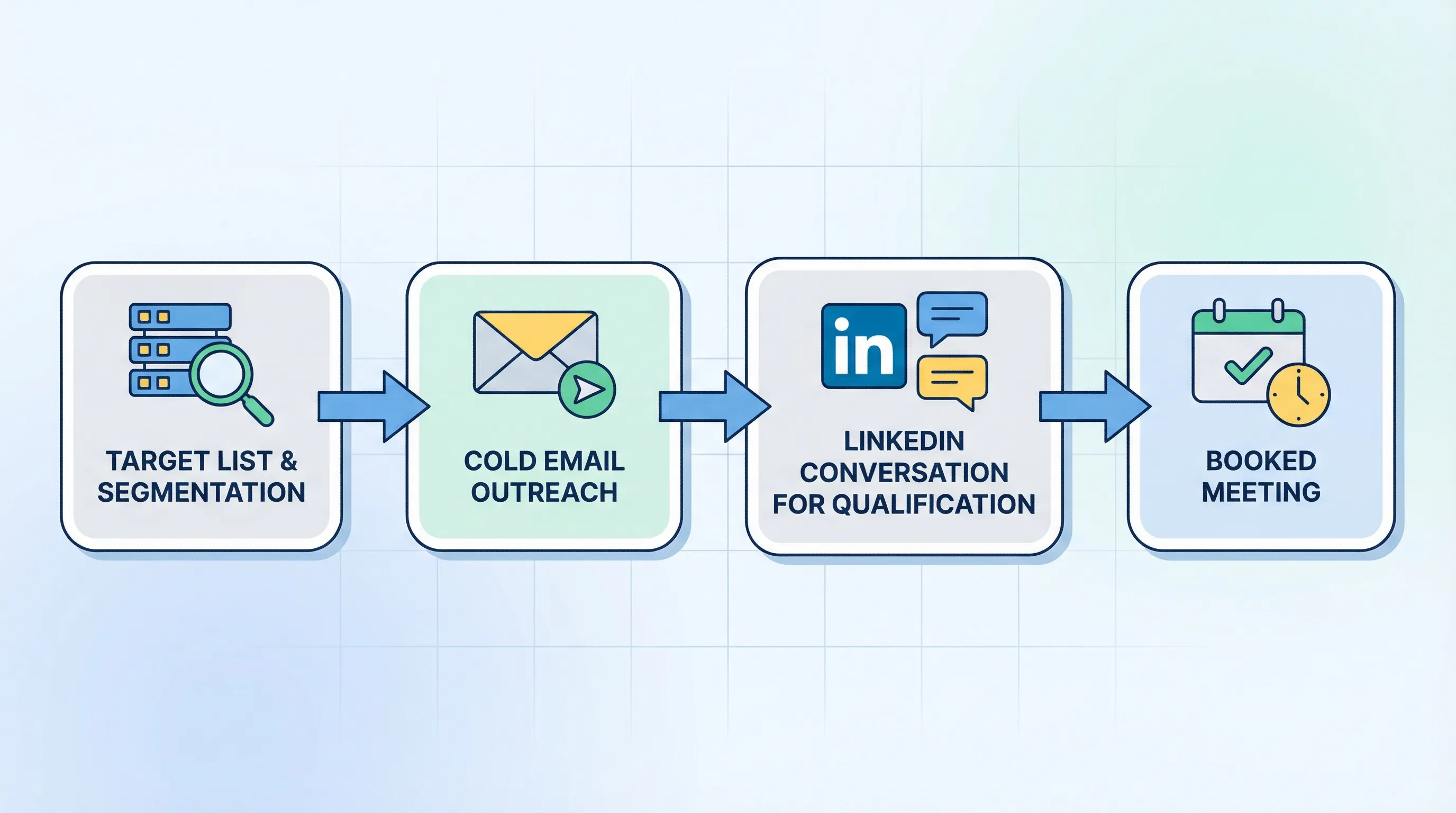
7) Use LinkedIn to qualify and book, without increasing email volume
Cold email is great for starting threads. LinkedIn is often better for:
- Multi-turn qualification
- Handling “maybe later” and “who are you?” replies
- Booking the meeting after the first positive signal
This is the gap most email tools do not solve: they help you send and track, but they do not run the conversation end to end.
That is why an SMMA stack that only optimizes sending volume usually plateaus. The real leverage is converting replies into qualified meetings with consistent qualification and fast follow-up.
Kakiyo
What it does (2 sentences): Kakiyo autonomously manages personalized LinkedIn conversations from first touch through qualification to meeting booking. It is built for teams that want to scale outreach without forcing SDRs (or founders) to babysit every DM thread.
Standout feature (1 sentence): Unlike tools that automate sending, Kakiyo runs the full conversation, qualifies leads with an intelligent scoring system, and books the meeting, with human override controls.
Who it’s for (1 sentence): SMMAs and revenue teams that want LinkedIn to be the qualification and booking layer, so humans only step in for high-value opportunities.
Pricing: Contact sales on Kakiyo.
Pros:
- Automates multi-turn LinkedIn qualification and meeting booking, not just first-touch outreach
- Centralized dashboard and analytics for conversation outcomes, not vanity activity
- Controls for prompts, overrides, and scaling conversations safely
Cons:
- Not an email sending platform, you pair it with an email tool
- Best results require a clear ICP slice and qualification definition
Apollo
What it does (2 sentences): Apollo combines a B2B database with outbound execution, so you can build lists and run email sequences in one place. For SMMAs, it is often the fastest way to get from ICP idea to a runnable campaign.
Standout feature (1 sentence): Strong “all-in-one” workflow for finding contacts and launching sequences without stitching multiple tools.
Who it’s for (1 sentence): Agencies that want speed to launch and acceptable coverage for common SMB and mid-market ICPs.
Pricing: Paid plans, see Apollo pricing.
Pros:
- List building and sequencing in one platform
- Useful filters for slicing by role, company size, tech, and location
- Works well as a starting system before you invest in a heavier stack
Cons:
- Data quality varies by segment, always validate before scaling
- Conversation management after replies is not the core strength
Smartlead
What it does (2 sentences): Smartlead is built for running cold email campaigns with operational controls that help teams manage scale. It is commonly used when you want multiple inboxes, rotation, and campaign management without constant manual work.
Standout feature (1 sentence): Inbox rotation and scale-oriented campaign ops designed for outbound.
Who it’s for (1 sentence): SMMAs that are disciplined about deliverability and want to scale sending across multiple inboxes.
Pricing: Paid plans, see Smartlead pricing.
Pros:
- Designed for scaling outbound across inboxes
- Helps teams keep campaigns organized and consistent
- Good fit for agencies running repeatable outbound plays
Cons:
- Scaling features can amplify mistakes if your ICP and copy are generic
- You still need a strong reply-handling and qualification process
Instantly
What it does (2 sentences): Instantly is a cold email platform focused on sending infrastructure and campaign execution. It is frequently chosen for straightforward campaign setup and managing multiple inboxes.
Standout feature (1 sentence): Simple campaign management geared toward outbound execution at volume.
Who it’s for (1 sentence): Agencies that already have a validated offer and want a dedicated sending tool to run consistent campaigns.
Pricing: Paid plans, see Instantly pricing.
Pros:
- Quick to launch and iterate campaigns
- Built for outbound sending workflows
- Useful if you want a dedicated tool separate from CRM
Cons:
- Does not solve positioning, targeting, or proof, which are the real bottlenecks
- Qualification and booking still require process or another tool
Lemlist
What it does (2 sentences): Lemlist is an outbound platform known for personalization workflows and templates. It is best used when your SMMA pitch benefits from tailored observations and asset-based follow-up.
Standout feature (1 sentence): Personalization tooling that supports more “credibility-first” outbound.
Who it’s for (1 sentence): SMMAs selling higher-ticket retainers where a smaller, more personalized list beats volume.
Pricing: Paid plans, see Lemlist pricing.
Pros:
- Strong fit for personalization-led outbound motions
- Useful templates and campaign structure for small, high-quality lists
- Helps avoid the “mass email” vibe that triggers complaints
Cons:
- Not ideal if your strategy is pure scale
- Personalization takes time unless your targeting is very tight
HubSpot Sales Hub
What it does (2 sentences): HubSpot Sales Hub keeps outreach close to your CRM, which makes tracking, handoffs, and reporting easier. For an SMMA, it is most useful when you also want a real pipeline view, not just campaign stats.
Standout feature (1 sentence): CRM-native sequences and visibility into pipeline stages.
Who it’s for (1 sentence): Agencies with multiple sellers that need consistent process, reporting, and lifecycle hygiene.
Pricing: Paid plans, see HubSpot Sales pricing.
Pros:
- Strong system-of-record for leads, deals, and activity
- Better reporting and governance than standalone senders
- Useful when inbound and outbound both feed the same pipeline
Cons:
- Can feel heavy if you only need a lean outbound tool
- LinkedIn conversation execution and qualification are not the core capability
Which tool should you choose?
- If you want autonomous AI conversation management on LinkedIn, lead qualification, and booked meetings, use Kakiyo.
- If you want list building plus basic email sequences in one place, use Apollo.
- If you want deliverability-first cold email ops with inbox rotation, use Smartlead.
- If you want simple outbound sending execution at scale, use Instantly.
- If you want personalization-heavy outbound for higher-ticket retainers, use Lemlist.
FAQs
What is SMMA email outreach?
SMMA email outreach is cold emailing a targeted list of potential clients to start conversations that lead to sales calls for your agency. The safe version uses tight targeting, permission-based copy, and strict stop rules to protect deliverability.
Is cold email legal for an SMMA in the US?
In the US, cold email is generally legal if you comply with CAN-SPAM requirements, including accurate headers, clear identification rules, and a working opt-out mechanism you honor promptly. If you email prospects in other regions (EU, UK, Canada), additional rules may apply, so get counsel for your exact use case.
What are safe cold email deliverability rules for agencies?
Authenticate your sending domains (SPF, DKIM, DMARC), keep lists clean to minimize bounces, and avoid sending to people who are likely to complain. Also pay attention to Google and Yahoo sender requirements, including keeping spam complaints under the thresholds they publish.
What is the best email outreach tool for SMMA owners?
It depends on your bottleneck. If you need data plus sending in one place, Apollo is a common starting point. If you are scaling outbound and need better campaign ops, tools like Smartlead or Instantly are often used, and pairing email with Kakiyo can improve qualification and booking through LinkedIn.
Should SMMAs use LinkedIn with cold email?
Yes, because email is good for first touch, but LinkedIn is often better for multi-turn qualification and booking once interest is established. A practical approach is email to generate the initial reply, then LinkedIn to qualify and schedule with less friction.
Book a demo of Kakiyo: https://www.kakiyo.com