
 Ilan Asseo
Sybill vs Uniphore vs Zoom IQ: Pricing, Pros, Cons
Compare Sybill, Uniphore, Zoom IQ, and Kakiyo by pricing, pros, cons, and best-fit use cases for conversation intelligence and outreach.

McKinsey estimates generative AI could unlock $0.8T to $1.2T in productivity across sales and marketing. Most teams still waste it by buying the wrong “AI” category, call intelligence when they need conversation execution, or the reverse.
Industry evidence: “Our research suggests that a fifth of current sales-team functions could be automated.” — McKinsey & Company.
Source: McKinsey
What is conversation intelligence software?
Conversation intelligence software records, transcribes, and analyzes sales calls and meetings to surface coaching insights, deal risks, and follow-up next steps. It typically connects to your video conferencing and CRM, then turns raw conversations into searchable notes, highlights, and analytics.
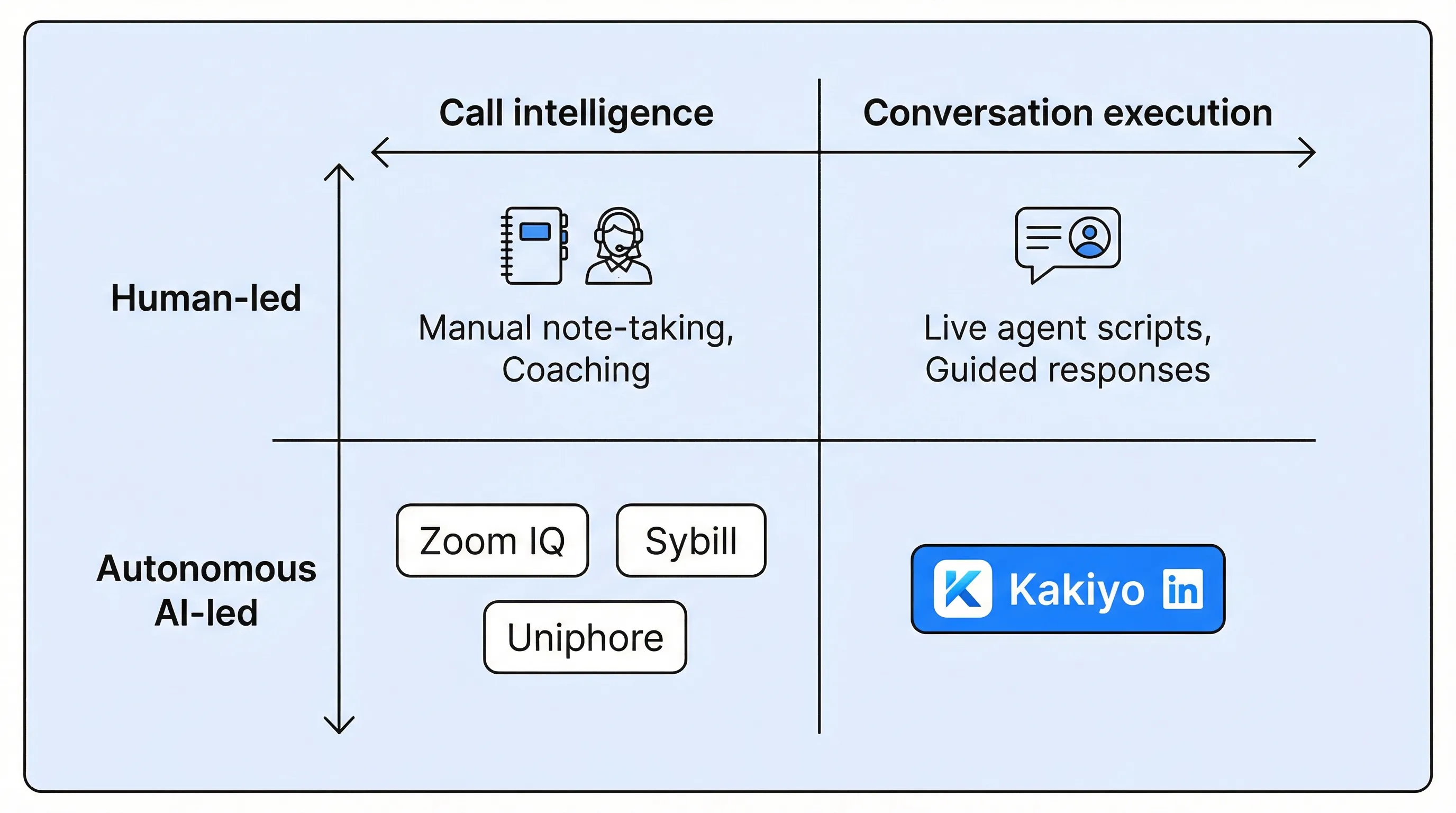
Before you pick between Sybill vs Uniphore vs Zoom IQ, decide what job you need done:
- Call and meeting intelligence: improve what happens in live meetings (notes, coaching, deal inspection).
- Conversation execution: generate and manage top-of-funnel conversations (for many teams in 2026, that is LinkedIn DMs) through qualification and booking.
That distinction is why Kakiyo is included below. It is not a call recorder, it is the execution layer for LinkedIn conversations.
Sybill vs Uniphore vs Zoom IQ (and Kakiyo): Quick comparison
| Tool Name | Best For | Key Feature | Starting Price |
|---|---|---|---|
| Kakiyo | Autonomous LinkedIn conversations, qualification, and meeting booking | AI manages multi-turn LinkedIn DMs, scores leads, and books meetings | Free trial or demo, then quote-based |
| Zoom IQ | Teams running meetings on Zoom that want native conversation intelligence | Zoom-native transcription, summaries, and sales coaching workflows | Add-on, typically quote-based |
| Sybill | Lightweight AI meeting assistant for notes and follow-ups | Fast meeting summaries and relationship-style insights | Public pricing varies, check vendor |
| Uniphore | Enterprise conversation AI across contact center and revenue teams | Real-time assistance and analytics at enterprise scale | Enterprise, quote-based |
One more data point that matters for tool choice: Salesforce’s research has reported sellers spend about 28% of their week actually selling, with the rest going to admin and internal work. Tools that remove non-selling work beat tools that merely “add insights.” See Salesforce’s State of Sales research.
Kakiyo
What it does (2 sentences). Kakiyo autonomously manages personalized LinkedIn conversations at scale, from first touch through qualification to meeting booking. It is built so SDRs do not have to babysit inbox threads, they step in only when a prospect is ready to close.
Standout feature (1 sentence). Kakiyo’s edge is that competitors automate sending, while Kakiyo runs the full multi-turn conversation, qualifies with an intelligent scoring system, and books meetings.
Who it’s for (1 sentence). SDR leaders and revenue operators who want AI LinkedIn prospecting that produces qualified meetings, not just more messages.
Pricing. Free trial or demo is available, commercial terms are typically quote-based.
Pros
- True autonomy for LinkedIn DMs, including qualification and booking, not just sequencing.
- Built for controlled scale with prompt creation, A/B testing, templates, overrides, and analytics.
- Reduces “thread debt” so reps spend time on high-value opportunities.
Cons
- Not a call recording platform, you still pair it with a meeting intelligence tool if that is a requirement.
- Requires clear qualification definitions and routing rules to get the full ROI.
Zoom IQ
What it does (2 sentences). Zoom IQ is Zoom’s sales-oriented intelligence layer for meetings, helping teams capture transcripts, summaries, and conversation insights from Zoom calls. It is typically chosen when your meeting stack is already standardized on Zoom and you want minimal friction for adoption.
Standout feature (1 sentence). Zoom IQ’s main advantage is Zoom-native workflow, fewer moving parts for recording, permissions, and meeting capture.
Who it’s for (1 sentence). Teams that live in Zoom and want conversation intelligence without adding another meeting capture vendor.
Pricing. Commonly sold as an add-on and frequently priced via quote depending on edition and packaging.
Pros
- Tight integration with the Zoom meeting experience, which can simplify rollout.
- Useful for baseline enablement, summaries, and call visibility for managers.
- Lower operational overhead when Zoom is already your standard.
Cons
- Less compelling if your meeting mix is not mostly Zoom, or if you need deeper enterprise-grade customization.
- Does not solve top-of-funnel conversation generation (it improves meetings you already have).
Sybill
What it does (2 sentences). Sybill is an AI meeting assistant focused on turning calls into clean notes, follow-ups, and usable takeaways. It is often evaluated as a simpler alternative when a team wants fast value from summaries and rep workflow support.
Standout feature (1 sentence). Sybill’s strength is a lightweight experience geared toward post-meeting outputs, like summaries and action items.
Who it’s for (1 sentence). Smaller teams, founders, or SDR/AE pods that want meeting notes and follow-up help without a heavier enterprise rollout.
Pricing. Public pricing and packaging can change, verify current plans on Sybill’s site.
Pros
- Quick time-to-value if your main pain is note-taking and follow-up consistency.
- Typically easier to trial with a small group.
- Helps standardize what gets logged after calls.
Cons
- Not designed to be your full revenue intelligence system at enterprise scale.
- Limited impact if your bottleneck is pipeline creation (it optimizes meetings, not outreach).
Uniphore
What it does (2 sentences). Uniphore is an enterprise conversation AI vendor known for contact center and real-time assistance use cases, and it can extend into broader revenue conversation workflows depending on deployment. Teams consider it when they need scale, governance, and cross-functional conversation intelligence.
Standout feature (1 sentence). Uniphore is strongest when you need enterprise-grade conversational AI across high volumes of interactions.
Who it’s for (1 sentence). Enterprises that want conversation intelligence tied to contact center operations, compliance, and large-scale enablement.
Pricing. Typically enterprise quote-based.
Pros
- Built for scale, security, and enterprise operational requirements.
- Strong fit for real-time assistance and large interaction volumes.
- Works well when conversation data is a company-wide asset, not just a sales-team feature.
Cons
- Heavier evaluation, procurement, and implementation motion than lightweight tools.
- Can be overkill if you mainly need straightforward sales meeting notes.
The operator’s take: what you are really buying
Sybill, Uniphore, and Zoom IQ all live in the “make meetings smarter” bucket. That is valuable, but it only matters once you have enough qualified meetings to analyze.
Kakiyo lives upstream, in the “create and qualify conversations” bucket. If your team’s constraint is not enough qualified conversations and booked meetings, meeting intelligence will not fix the root cause.
This is also why “AI SDR tools” are splitting into two distinct categories in 2026:
- Conversation intelligence: analyze what happened.
- Autonomous outreach and qualification: make the right conversations happen, then carry them to an evidence-based next step.
If you are trying to reduce cost per qualified meeting, remember the biggest hidden line item is labor. Salesforce’s research on seller time allocation is a good sanity check: if reps are only spending a minority of time selling, automation that removes inbox work can create outsized ROI.
For broader context on the macro upside, McKinsey’s estimate of $0.8T to $1.2T productivity impact for gen AI in sales and marketing is worth reading, because it frames why “workflow automation” tends to beat “insight dashboards.” See McKinsey’s analysis.
Which tool should you choose?
- If you want autonomous AI conversation management and LinkedIn lead qualification software, use Kakiyo.
- If you want Zoom-native meeting intelligence with minimal rollout friction, use Zoom IQ.
- If you want a lightweight AI meeting assistant for summaries and follow-ups, use Sybill.
- If you want enterprise conversational AI across contact center scale and governance needs, use Uniphore.
- If you want “one tool to do everything,” do not, pick an execution layer plus an intelligence layer based on your actual bottleneck.
FAQs
What is Zoom IQ pricing?
Zoom IQ pricing is often packaged as an add-on or bundled capability depending on your Zoom plan and the specific sales-focused edition you purchase. For most teams, it is quote-based, so the practical move is to confirm whether it is included in your current Zoom licensing or requires an upgrade.
What is Uniphore pricing?
Uniphore pricing is typically enterprise and quote-based. If you are evaluating it, treat the commercial model as part of the technical evaluation, because implementation scope, interaction volume, and governance requirements can change total cost.
What is Sybill pricing?
Sybill pricing is usually presented in tiers and can change as packaging evolves. If pricing is a gating factor, validate the current plan details directly on Sybill’s site and confirm what is included for recording, transcription, and CRM syncing.
Zoom IQ vs Uniphore: which is better?
Zoom IQ is usually the better choice when your meeting stack is standardized on Zoom and you want fast adoption for sales meeting intelligence. Uniphore is usually the better choice when you need enterprise-grade conversational AI across large interaction volumes, often beyond just sales meetings.
What are the best automated LinkedIn outreach tools for qualification?
Most automated LinkedIn outreach tools automate sending and sequencing, but they still require reps to run the conversation. If you want autonomous multi-turn DMs that qualify prospects and book meetings, Kakiyo is purpose-built for that job.
Get a free trial or book a demo at Kakiyo.