
 Ilan Asseo
Top SDR Skills for Modern AI-Driven Sales Teams
Practical guide to the skills SDRs need to win in AI-driven sales: ICP research, prompt crafting, in-thread qualification, compliant LinkedIn outreach.

AI is rewriting the SDR playbook. In 2025, the highest performing teams pair human judgment with autonomous systems that can personalize at scale, qualify in the thread, and book meetings while reps concentrate on high‑value opportunities. Multiple studies, including McKinsey’s analysis of generative AI’s impact on sales productivity and LinkedIn’s State of Sales research, point to a clear pattern, sellers who embrace AI and data outperform peers on activity quality and pipeline consistency. The question is no longer whether SDRs should use AI, it is which skills let them lead in an AI‑driven motion.
Industry evidence: Salesforce Research reports that sales reps spend only 28% of their week actually selling, with the rest consumed by deal management, data entry, and other non-selling work.
Source: Salesforce State of Sales
The new SDR job, partnering with AI instead of competing with it
AI now handles much of the heavy lifting, enrichment, message drafting, objection suggestions, qualification scaffolding, and booking. Human SDRs win by doing what machines cannot, tailoring the strategy, reading intent and risk in real time, designing great prompts and experiments, and building trust.
- What AI should handle most of the time, scalable personalization, structured in‑thread qualification, parallel conversations, analytics collection, and meeting scheduling.
- What humans must own, ICP definition, value hypotheses, brand voice, escalation moments, nuanced objections, experiment design, governance, and relationship building.
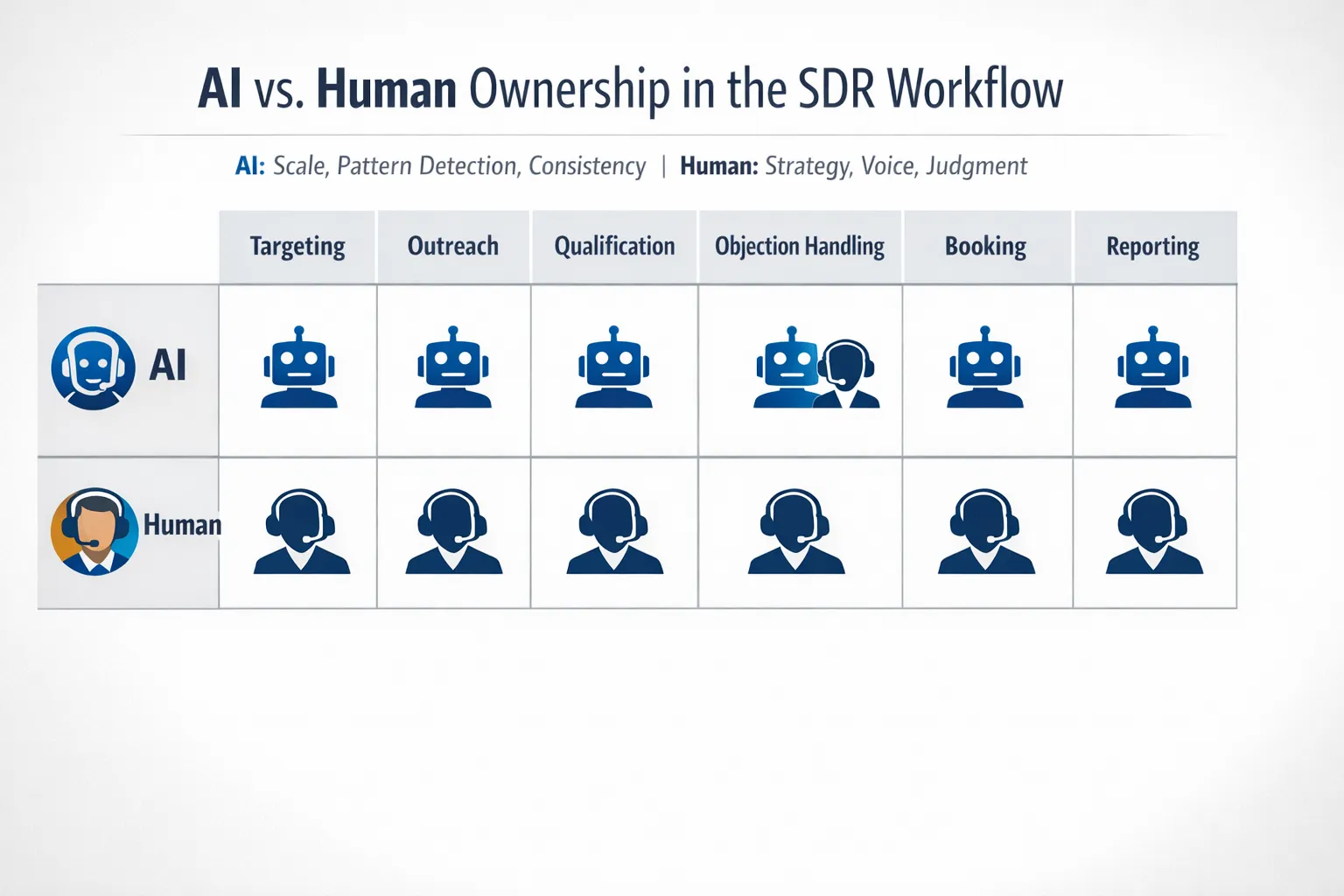
Top SDR skills for modern AI‑driven sales teams
1) ICP research and signal‑driven targeting
Reps need to translate an ICP into actionable signals, job titles with buying authority, industry, tool stack, hiring velocity, funding or product launches, and recent content that reveals pain. Use public sources and buyer profiles to craft a point of view that feels specific, not generic.
Practical habit, maintain a 5‑signal checklist before outreach, role, reason, relevant trigger, current tool, likely pain.
Recommended reading, LinkedIn Prospecting Playbook, From First Touch to Demo.
2) Prompt crafting and conversation design
Great outbound now starts with great prompts. SDRs should be able to encode persona context, value hypothesis, tone, constraints on length and claims, and a soft CTA. Then they should test variations with clean hypotheses.
Mini pattern you can adapt,
- Persona and context, “You are writing to a VP of RevOps at a 200‑500 person SaaS company using Salesforce and Salesloft.”
- Value hypothesis, “Primary pain, reps spend time chasing unqualified replies on LinkedIn.”
- Guardrails, “Keep under 550 characters, avoid claims about revenue lift, ask a single question.”
- CTA, “Open a conversation about their current approach, do not ask for 30 minutes yet.”
Kakiyo fit, customizable prompt creation, A/B prompt testing, and industry‑specific templates let managers standardize prompts while reps personalize safely.
Related post, Business Development Rep, AI Tactics for LinkedIn Outreach.
3) In‑thread qualification, light but structured
Move discovery into the message thread without interrogating buyers. Use a two to three question flow that confirms context, pain, impact, and timing. When a buyer leans in, tighten to a next step.
Examples of thread‑safe questions,
- “How are you handling LinkedIn replies today, manual triage or an automated workflow?”
- “Which signal tends to indicate a serious conversation for you, role, trigger, or stated timeline?”
- “If we could remove reply triage for your SDRs, what would you reassign that time to?”
Kakiyo fit, AI‑driven lead qualification and intelligent scoring help surface qualified intent while conversation override control lets reps jump in at the right moment.
4) Objection handling with brand‑safe AI assist
AI can draft alternatives and offer data points, humans decide tone and risk. Teach reps to ask a clarifying question, acknowledge the concern, and propose a low‑friction path, short async video, mutual evaluation checklist, or a 10‑minute calendar hold.
5) LinkedIn conversation etiquette and compliance
Permission‑based outreach wins, short, contextual, single question CTAs. Pace invites and messages to protect reputation and follow platform rules. Always honor opt‑outs and log disposition.
- Platform references, review LinkedIn’s Professional Community Policies and User Agreement.
- Safe operations guide, Automated LinkedIn Outreach, Do It Safely and Effectively.
6) Experimentation and analytics literacy
Modern SDRs run experiments and read their own data. They write a hypothesis, change one variable at a time, and watch leading indicators before lagging ones. Track acceptance, reply, positive intent, qualified conversation, booked meeting, and safety indicators like spam reports and opt‑out rate.
Kakiyo fit, a centralized real‑time dashboard plus advanced analytics and reporting make it easy to monitor cohorts and A/B results.
7) Scoring fluency and CRM discipline
Reps should understand fit signals versus behavior signals, and how scores map to routing or next steps. Data hygiene is a skill, consistent statuses, clear disposition reasons, and meeting notes that reflect what was qualified in the thread.
Deep dive, MQLs and SQLs, Align Definitions, Boost Pipeline Health.
8) Multi‑threading and account orchestration
Buyers rarely decide alone. SDRs who can map an account, engage adjacent stakeholders, and keep threads aligned with a shared value hypothesis create momentum. Use a priming message for each persona that ties back to the same business case.
9) Meeting setting and handoff excellence
When intent is real, make it easy to book. Offer two time windows or a calendar link, restate the problem and expected outcomes, name who should attend, and confirm the agenda. Update CRM immediately and brief the AE with crisp context.
10) Ethical AI use and governance
Trust compounds, misuse erodes it. Be transparent if asked about AI assistance, avoid fabricating names or results, respect privacy, and keep audit trails. Managers should publish guardrails on pacing, personalization, permission, and provenance. For a measured view of impact, see McKinsey’s overview of generative AI’s potential in sales.
11) Workflow automation oversight
Autonomy needs oversight. SDRs should learn when to pause sequences, when to escalate to a human reply, and how to tune scoring thresholds. Conversation override control is a core capability for healthy AI‑human collaboration.
Skill to metric map, what to practice and how to measure
| Skill | What good looks like | How to practice | Primary metric |
|---|---|---|---|
| ICP research | Outreach tied to a recent trigger and clear reason to engage | Build a 5‑signal checklist and require it before sending | Acceptance and reply rate by segment |
| Prompt crafting | Clear persona, value, tone, and CTA constraints | Write 3 prompt variants, test one variable at a time | Lift in reply and positive intent rate |
| In‑thread qualification | Two to three questions, no interrogation | Use a lightweight CPIT flow, context, pain, impact, timing | Qualified conversation rate |
| Objection handling | Acknowledge, clarify, propose low‑friction next step | Build a rebuttal bank with brand‑safe language | Objection conversion to next step |
| Compliance | Pace, opt‑outs, accurate logging | Weekly audit of activity logs and samples | Safety indicators and domain health |
| Multi‑threading | Two or more stakeholder threads aligned to one case | Persona‑specific openers tied to the same outcome | Meetings per account |
| Handoff | Clear agenda, next steps, buyer context | Send a 3‑point AE brief within 15 minutes | Meeting show rate |
The Prompt, Message, Measure loop for SDRs
- Prompt, encode your buyer context and value hypothesis so AI can personalize safely. Include constraints and a single CTA.
- Message, keep it short and human. Ask one question that makes it easy to respond.
- Measure, watch leading indicators first, acceptance and reply, then positive intent and qualified conversation. Only then chase meetings.
This loop is how teams compound learning instead of shipping one‑off messages.
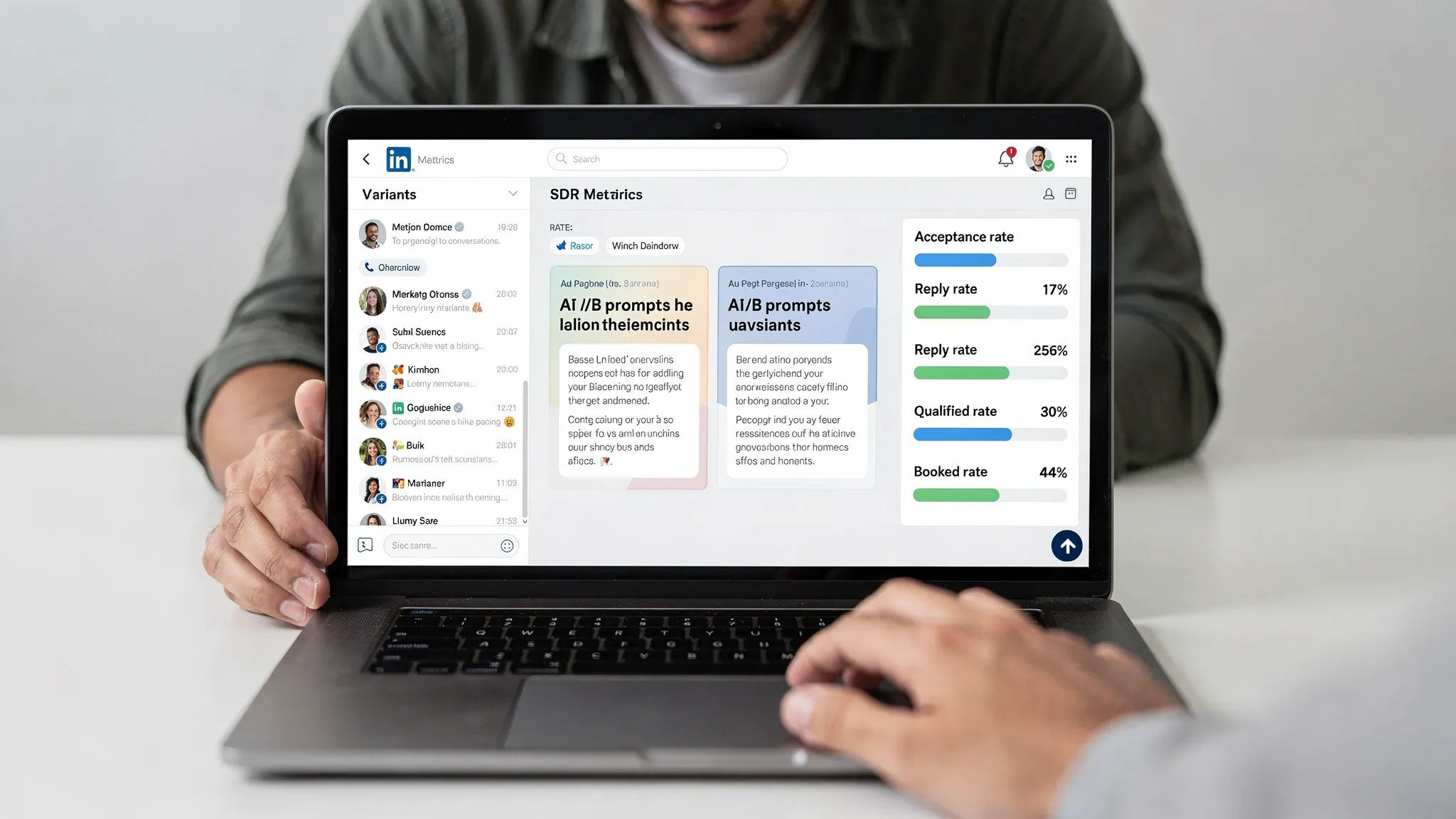
A 30‑60‑90 upskilling plan managers can run now
Days 1–30, foundations and a focused pilot
- Define ICP and five concrete signals. Align on stage definitions and disposition reasons.
- Standardize a first set of prompts and voice guidelines. Establish guardrails, pacing, opt‑out language, escalation rules.
- Launch a narrow LinkedIn pilot to a single segment. Instrument acceptance, reply, qualified conversation, and booked meeting as separate events.
- Hold two weekly reviews to inspect 10 conversation samples and 2 A/B tests. Adjust prompts and qualification questions.
Days 31–60, expand experiments and scoring
- Add two more segments or personas. Introduce systematic A/B prompt testing and a control cohort.
- Bring in scoring, fit plus behavior, with clear thresholds for pause, escalate, book. Expose scores to reps in their daily workflow.
- Start basic multi‑threading on high‑value accounts. Template an AE handoff brief.
Days 61–90, scale with governance
- Document the playbook and templatize prompts and rebuttals. Add weekly safety audits.
- Tie leading indicators to forecast inputs so marketing and sales can plan capacity, see, AI Sales Forecasting, Methods, Models, and Accuracy.
- Graduate successful tests into your standard operating procedures and coach to the new expectations.
Tooling that reinforces these skills
Most teams standardize on a lean stack, conversation AI for LinkedIn, data and enrichment, a sales engagement platform, CRM, and a calendar tool. For a practical overview and evaluation checklist, see Best AI Sales Tools for SDR Teams in 2025.
How Kakiyo supports the top SDR skills
Kakiyo is built for AI‑driven SDR teams that need scale and control.
- Autonomous LinkedIn conversations, run safe, personalized threads from first touch to booking so SDRs can focus on high‑value opportunities.
- AI‑driven lead qualification, score intent in thread and progress only when signals are there.
- Customizable prompt creation and A/B prompt testing, standardize voice and experiment without chaos.
- Industry‑specific templates, start fast with language that fits your market.
- Intelligent scoring system, combine fit and behavior signals to guide next steps.
- Simultaneous conversation management, keep many threads moving without losing quality.
- Conversation override control, let humans jump in when nuance is needed.
- Centralized real‑time dashboard plus advanced analytics and reporting, see what is working, where, and why.
Explore the workflow in, AI SDR, Automate Conversations, Qualify Faster, Book More.
Quick self‑assessment for SDRs and managers
- Can you list five concrete signals that define your ICP today, and are they visible in your workflow?
- Do your prompts include persona, value hypothesis, tone, a single CTA, and hard constraints on length and claims?
- Are you testing one variable at a time and logging outcomes by segment and persona?
- Do you have two to three thread‑safe qualification questions everyone can use?
- When a buyer objects, does a brand‑safe response and a low‑friction next step exist in your library?
- Can reps see scores, dispositions, and next steps in one dashboard, and do they know when to override automation?
Frequently asked questions
Will AI replace SDRs? No. AI excels at scale, personalization, and consistency. Humans set strategy, judge intent, build trust, and handle nuance. Teams that blend both outperform either alone.
What SDR metrics matter most in an AI‑driven motion? Prioritize leading indicators first, acceptance and reply, then positive intent and qualified conversation. Booked meetings and show rate follow. Monitor safety indicators like opt‑outs and spam complaints.
Do SDRs need to learn to code to work with AI? No. They do need prompt design skills, basic data literacy, and comfort reading dashboards and running A/B tests.
How do we ensure LinkedIn automation stays compliant? Pace activity, personalize with a real reason, respect opt‑outs, keep audit logs, and follow LinkedIn’s Professional Community Policies. Use tools with human override and safety controls.
What is a simple in‑thread qualification framework? Try CPIT, context, pain, impact, timing. Ask one question at a time and move to booking when intent is clear.
How fast should we scale after a pilot? Only after two cohorts show consistent lift with healthy safety metrics. Document what worked, then expand segmentation and stakeholders.
Ready to level up your team’s SDR skills for AI‑driven selling? See how Kakiyo’s autonomous LinkedIn conversations, prompt testing, intelligent scoring, conversation overrides, and real‑time analytics help SDRs qualify faster and book more meetings without risking brand or compliance. Start here, Kakiyo.