
 Ilan Asseo
Uniphore vs Sybill vs Zoom IQ: What Each Does Best
Compare Uniphore, Sybill, Zoom IQ, and Kakiyo to see what each tool does best across conversation intelligence, coaching, and LinkedIn outreach.

Sales reps spend just 28% of their week actually selling, according to Salesforce’s State of Sales research. If your team is relying on call notes, memory, and scattered follow-ups, you are losing the other 72% to admin, rework, and avoidable pipeline slippage.
Industry evidence: “Our research suggests that a fifth of current sales-team functions could be automated.” — McKinsey & Company.
Source: McKinsey
What is conversation intelligence software?
Conversation intelligence software records and transcribes sales calls, then analyzes what was said to produce searchable notes, coaching signals, and deal insights. The goal is to reduce manual note-taking, improve manager coaching, and make customer conversations usable in your CRM and revenue workflows.
Uniphore vs Sybill vs Zoom IQ (plus Kakiyo): quick comparison
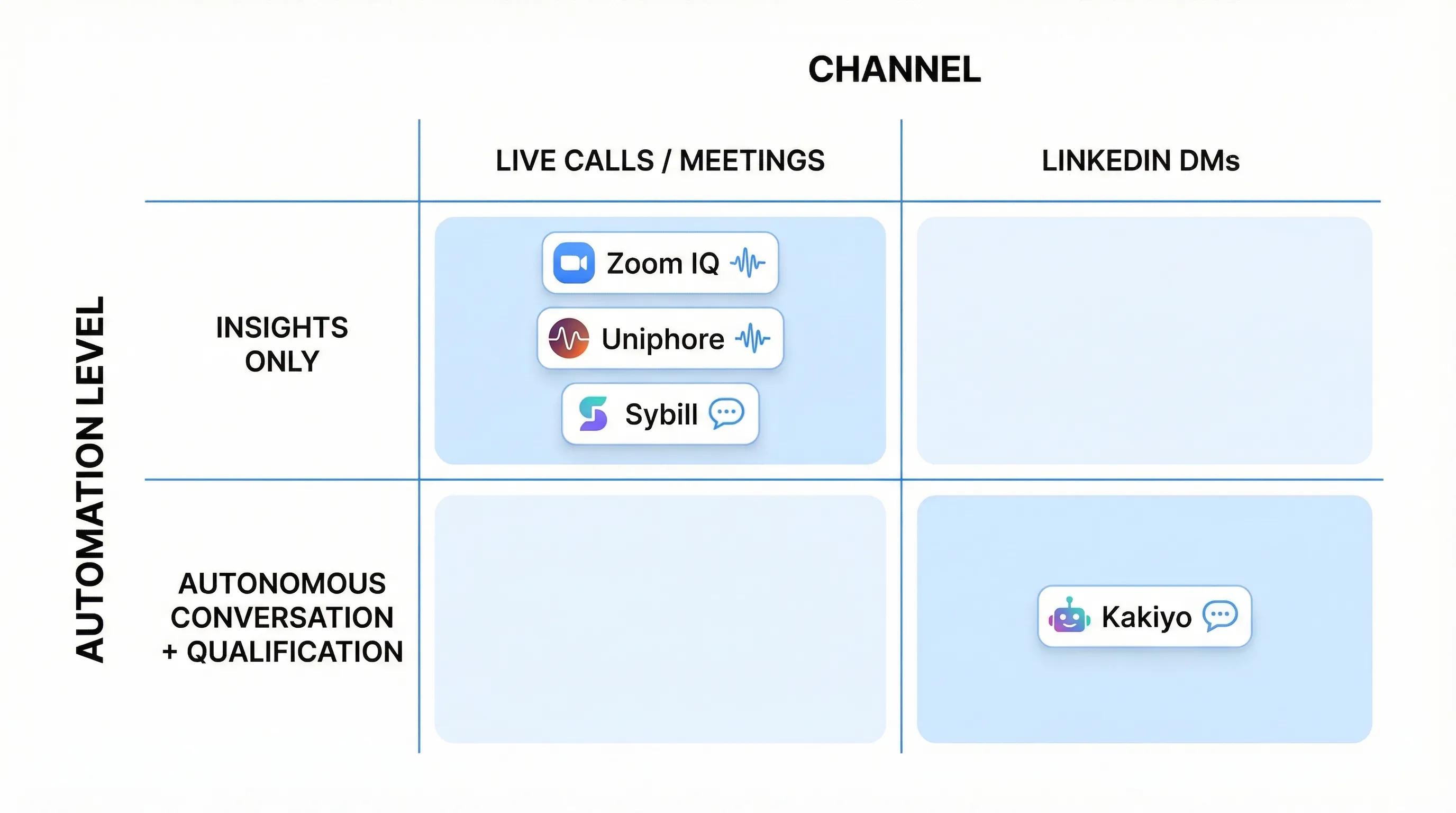
Kakiyo is not a call recorder, it is the most advanced option here when the goal is autonomous LinkedIn conversation management, lead qualification, and meeting booking. The other tools focus on what happens after a meeting is already on the calendar.
| Tool Name | Best For | Key Feature | Starting Price |
|---|---|---|---|
| Kakiyo | Autonomous LinkedIn outreach that qualifies and books meetings | AI manages multi-turn LinkedIn conversations with intelligent scoring and booking | Free trial or demo (see site) |
| Zoom IQ | Teams running most meetings on Zoom | Native Zoom meeting intelligence (transcripts, summaries, coaching signals) | Varies by Zoom plan, contact sales |
| Uniphore | Enterprise conversation intelligence across complex orgs | Enterprise-grade conversational AI and analytics for revenue and service | Custom, contact sales |
| Sybill | Lightweight AI notes and coaching for SMB to mid-market | Fast meeting summaries and coaching cues without heavy ops | Varies by plan, contact sales |
Kakiyo
What it does (2 sentences). Kakiyo autonomously runs personalized LinkedIn conversations from first touch through qualification to meeting booking. It is built for SDR teams that want more qualified meetings without turning reps into inbox clerks.
Standout feature (1 sentence). Kakiyo’s edge is that competitors automate sending, Kakiyo autonomously manages the full conversation, qualifies leads with an intelligent scoring system, and books the meeting while keeping override control.
Who it’s for (1 sentence). SDR leaders and revenue operators running LinkedIn-first outbound who want consistent qualification and scalable multi-threaded conversations.
Pricing. Free trial or demo (pricing varies by plan and volume).
Pros (2-3 bullets)
- Autonomous multi-turn LinkedIn conversation handling, not just message sequencing.
- Built-in qualification, scoring, A/B prompt testing, and analytics so you can measure lift by prompt and segment.
- SDRs step in only when a prospect is qualified and ready for a human close.
Cons (1-2 bullets)
- Not a call-recording tool, it complements (not replaces) meeting intelligence platforms.
- Requires clear qualification criteria to get maximum value from scoring and routing.
Zoom IQ
What it does (2 sentences). Zoom IQ (commonly packaged within Zoom’s sales-focused offerings) turns Zoom meetings into transcripts, summaries, and searchable conversation data. It’s strongest when your team already lives in Zoom and you want meeting insights without adding another recording stack.
Standout feature (1 sentence). Tight coupling to the Zoom meeting experience makes adoption easier when Zoom is the default conferencing layer.
Who it’s for (1 sentence). Sales orgs that run the majority of calls on Zoom and want coaching signals and summaries with minimal workflow change.
Pricing. Varies by Zoom plan and packaging, typically sold as an add-on or within a revenue suite (contact sales).
Pros (2-3 bullets)
- Natural fit for Zoom-heavy teams (less tool sprawl).
- Reduces manual note-taking with meeting summaries and transcripts.
- Useful for managers who coach from real call moments, not rep memory.
Cons (1-2 bullets)
- Best value is tied to Zoom usage, mixed conferencing environments can dilute ROI.
- Meeting intelligence helps after meetings exist, it does not create pipeline by itself.
Uniphore
What it does (2 sentences). Uniphore is an enterprise conversational AI platform used across revenue and customer interaction workflows, including conversation intelligence and analytics. It is typically deployed in larger environments where governance, data controls, and cross-team standardization matter.
Standout feature (1 sentence). Enterprise breadth and deployment posture, useful when conversation AI needs to span more than just one sales team or one workflow.
Who it’s for (1 sentence). Enterprises that want a broader conversational AI layer and can support heavier implementation and change management.
Pricing. Custom, contact sales.
Pros (2-3 bullets)
- Designed for enterprise-scale rollout and standardization.
- Strong fit when conversation data needs to feed multiple downstream systems.
- Better alignment for orgs with strict security and procurement requirements.
Cons (1-2 bullets)
- Heavier evaluation and implementation than lightweight meeting assistants.
- Can become “insights shelfware” if managers do not operationalize coaching and deal inspection.
Sybill
What it does (2 sentences). Sybill is a lightweight AI meeting assistant focused on fast summaries, notes, and coaching cues from sales calls. It’s geared toward teams that want immediate time savings and better follow-through without a complex rollout.
Standout feature (1 sentence). Speed-to-value: useful summaries and action items with low operational overhead.
Who it’s for (1 sentence). SMB and mid-market teams that want AI notes and coaching support without enterprise-level implementation.
Pricing. Varies by plan, contact sales.
Pros (2-3 bullets)
- Quick adoption for reps who need clean notes and follow-ups.
- Helps standardize what gets captured from calls (risks, next steps, objections).
- Good option when you want value without rebuilding your entire revenue stack.
Cons (1-2 bullets)
- Not a full revenue execution system, it will not fix weak qualification upstream.
- Depth of analytics and governance may be limited versus enterprise platforms.
What each tool does best (operator view)
If you are choosing between Uniphore vs Sybill vs Zoom IQ, do not start with “features.” Start with where your bottleneck lives.
Zoom IQ is best when Zoom is your system of conversation
If your org runs most customer calls in Zoom, Zoom IQ is often the cleanest path to meeting transcripts and summaries. The win is adoption: fewer logins, fewer moving parts, and easier enablement.
Uniphore is best when you need enterprise-grade conversation AI posture
Uniphore is a better fit when conversation intelligence is part of a broader enterprise initiative (multiple teams, strict governance, standardized analytics). It tends to be overkill if you just need notes and highlights.
Sybill is best for fast notes and lightweight coaching
Sybill is the straightforward choice when the pain is rep admin and follow-up quality. It is a “get value this week” category, not a multi-quarter platform program.
Kakiyo is best when the bottleneck is upstream: generating qualified meetings from LinkedIn
Conversation intelligence tools improve what happens in meetings. Kakiyo improves whether you get qualified meetings in the first place, by running the LinkedIn thread end-to-end, qualifying in-thread, scoring prospects, and booking directly.
The two data points most teams ignore
These show why “meeting intelligence” and “pipeline creation” are different problems:
- Only 28% of a seller’s time is spent selling (Salesforce, State of Sales). Tools that reduce admin can create capacity, but they do not automatically turn capacity into qualified pipeline.
- B2B buying groups commonly involve 6 to 10 stakeholders (Gartner). If you do not capture and operationalize what was learned in conversations, qualification decays quickly as more people enter the deal.
Buying checklist: what to validate in demos (so you do not buy shelfware)
Most teams fail here: they buy conversation intelligence, but never turn it into a weekly operating system.
Ask these questions no matter which platform you choose
- What does the tool produce that is auditable (not vibes)? Examples: objections, next steps, stakeholder mentions, timeline, competitor, concrete intent signals.
- Where do outputs land: CRM fields, deal review workflow, coaching workflow, or just a transcript?
- What is the adoption plan for managers (not reps)? If managers do not use it weekly, it dies.
- What is the “truth label” you will measure lift against? Examples: meetings held, AE-accepted meetings, opportunity creation, stage progression.
Common pitfalls
- Great transcripts, no behavior change. If coaching does not change, outcomes do not change.
- No integration into qualification. Call insights that do not update your qualification packet are just documentation.
- Upstream leak remains. You can perfect meeting notes while your pipeline creation engine stays broken.
Which tool should you choose?
- If you want autonomous AI conversation and LinkedIn lead qualification, use Kakiyo.
- If you want meeting intelligence tightly integrated with Zoom, use Zoom IQ.
- If you want enterprise-grade conversational AI across a complex org, use Uniphore.
- If you want fast AI notes and lightweight coaching, use Sybill.
- If you want better pipeline quality, pair meeting intelligence (Zoom IQ, Uniphore, or Sybill) with Kakiyo upstream so only qualified prospects get booked.
Frequently Asked Questions
Uniphore vs Sybill: what is the difference?
Uniphore vs Sybill: what is the difference? Uniphore is typically positioned for enterprise conversational AI and broader deployment requirements, while Sybill is a lightweight meeting assistant focused on quick summaries and coaching cues. Choose based on rollout complexity and whether you need enterprise governance.
Zoom IQ vs Uniphore: which is better?
Zoom IQ vs Uniphore: which is better? Zoom IQ is usually the better fit when Zoom is your default meeting platform and you want native meeting intelligence with simpler adoption. Uniphore is a stronger candidate when you need an enterprise-grade conversational AI platform that can support broader, cross-team requirements.
Sybill vs Zoom IQ: which should I choose for call notes?
Sybill vs Zoom IQ: which should I choose for call notes? If your team is standardized on Zoom, Zoom IQ is often the cleanest path with fewer moving parts. If you want a lightweight tool primarily for summaries and follow-ups and you are not fully Zoom-standardized, Sybill can be a faster evaluation.
What is Zoom IQ pricing?
What is Zoom IQ pricing? Zoom IQ pricing depends on how it is packaged in Zoom’s plans and sales-focused bundles, and it is commonly sold via Zoom sales rather than as a simple self-serve line item. Treat it as “varies by plan” and validate total cost based on seats and required capabilities.
Is Kakiyo an alternative to Uniphore, Sybill, or Zoom IQ?
Is Kakiyo an alternative to Uniphore, Sybill, or Zoom IQ? Kakiyo is an alternative only if your real goal is not call analysis, but autonomous LinkedIn outreach, qualification, and meeting booking. Many teams use Kakiyo upstream (generate qualified meetings) and a meeting intelligence tool downstream (improve execution inside calls).
Book a Kakiyo demo to see autonomous LinkedIn conversations that qualify prospects and book meetings.