
 Ilan Asseo
BrightEdge Intent Signal: Prioritize Your Accounts
How to turn BrightEdge intent spikes into prioritized account plays that drive qualified conversations and meetings, with a practical workflow and tool.

Most intent data fails for one simple reason, teams treat it like a lead list instead of a prioritization system. If you cannot turn BrightEdge intent spikes into a same-day play for the right accounts, the signal decays before sales ever touches it.
Industry evidence: “Our research suggests that a fifth of current sales-team functions could be automated.” — McKinsey & Company.
Source: McKinsey
What is BrightEdge Intent Signal?
BrightEdge Intent Signal is an intent data capability that identifies companies showing increased interest in specific topics based on their content consumption behavior. It helps revenue teams prioritize which accounts to engage by surfacing “who is researching what” and, importantly, when that research is rising.
Tools to operationalize BrightEdge Intent Signal (comparison table)
You can use BrightEdge alone, but the fastest path to pipeline is a small stack: one tool to detect intent, one to route and measure, and one to run high-quality conversations that actually qualify and book.
| Tool Name | Best For | Key Feature | Starting Price |
|---|---|---|---|
| BrightEdge (Intent Signal) | Topic-level intent discovery for account prioritization | Keyword and topic intent signals tied to accounts | Custom (contact sales) |
| Kakiyo | Converting high-intent accounts into qualified LinkedIn meetings | Autonomous LinkedIn conversations that qualify with scoring and book meetings | Custom (contact sales) |
| 6sense | ABM orchestration across channels | Account buying-stage and journey analytics | Custom (contact sales) |
| Demandbase | ABM execution and measurement | Account identification and advertising + sales activation | Custom (contact sales) |
| Bombora | Third-party intent data at scale | Company Surge intent across a large B2B data co-op | Custom (contact sales) |
| Salesforce (CRM) | Turning prioritization into SLA-driven execution | Routing, tasking, reporting, and auditability | Varies by edition |
How to use BrightEdge Intent Signal to prioritize accounts (the workflow)
BrightEdge intent is useful when it changes what your team does this week. Account prioritization means you convert a fuzzy “interest” signal into:
- A ranked list of accounts.
- A clear next action by segment.
- A time-bound SLA.
- A measurable outcome (qualified conversations, meetings held, pipeline), not clicks.
Two data points to keep you honest:
First, speed matters because intent decays. A classic Harvard Business Review study found that companies contacting inbound leads within an hour were nearly 7x more likely to qualify them versus those that waited longer (HBR, “The Short Life of Online Sales Leads”). Intent signals are not identical to inbound form fills, but the operational lesson is the same: respond fast or waste the signal.
Second, LinkedIn is a legitimate channel for reaching buying committees. LinkedIn states that 4 out of 5 members drive business decisions (LinkedIn Marketing Solutions). If your intent model prioritizes accounts but your activation channel cannot carry a real conversation, you stall.
Step 1: Decide what “prioritize” means in your org
Before thresholds and dashboards, pick one operational definition.
A practical definition is:
A prioritized account is one that receives a human-grade outreach play within 24 to 72 hours, and is measured on downstream conversions (qualified conversation and meeting quality), not activity volume.
If you cannot commit to a time window and outcome metric, you are not prioritizing, you are sorting.
Step 2: Build a tight topic map (do not start with 50 keywords)
BrightEdge intent is only as good as your topic taxonomy. Most teams overfit here and end up with noise.
Keep the first iteration small:
- 3 to 8 commercial topics that map to problems you actually solve.
- 1 to 3 competitor or alternative topics (useful, but easy to misread).
- 3 to 5 disqualifying topics (students, job seekers, irrelevant adjacent markets) if you can detect them.
Your goal is not “coverage,” it is a topic set where a spike implies a reasonable outreach hypothesis.
Step 3: Combine intent with fit, or you will chase the wrong accounts
Intent without fit produces motion that feels busy and converts poorly.
A simple account priority model that works in the real world uses three inputs:
Fit: firmographics and technographics that match your ICP slice.
Intent strength: how sharp and recent the BrightEdge signal is for your target topics.
Ability to engage: do you have the right contacts, and can you reach them on a channel that supports multi-turn conversation.
If you already have a lead/account scoring system, treat BrightEdge as an input to the “intent” pillar, not the whole score. If you want an auditable scoring approach, keep it explainable and align it to actions (not abstract numbers). A solid reference point is Kakiyo’s conversation-led qualification approach, which keeps scoring tied to observable evidence and next steps (lead qualification process guide).
Step 4: Translate BrightEdge topics into plays, not messages
When an account spikes on a topic, it should trigger a specific play:
- A target persona (or two).
- A one-sentence value hypothesis.
- A proof point that is true for that segment.
- A micro-CTA that earns a reply.
- A qualification question that can be asked in-thread without turning into a discovery call.
This is where most “intent” projects die. The dashboard looks great, but SDRs still have to invent the play. That is slow, inconsistent, and hard to measure.
Step 5: Route with an SLA and stop rules
Routing is where RevOps earns its keep. Decide:
- Who works Tier 1 accounts.
- What “first meaningful touch” means.
- When the system stops.
Stop rules matter because intent signals can be wrong. Your play should exit if the buyer indicates bad timing, wrong persona, or no problem. A respectful exit preserves brand, and prevents your model from looking “successful” on activity while failing on meetings held.
Step 6: Measure downstream, or you will optimize the wrong thing
If you measure intent programs on “accounts spiking” and “accounts touched,” you train the org to game the system.
Measure what sales actually cares about:
- Qualified conversation rate.
- Meetings booked.
- Meetings held.
- AE acceptance rate.
- Meeting-to-opportunity conversion.
(If you want a clean KPI set for SDR teams in 2026, use outcome-first metrics rather than activity counts, and keep definitions stable across quarters: SDR KPIs that matter.)
BrightEdge (Intent Signal)
What it does (2 sentences). BrightEdge Intent Signal helps identify which companies are showing increased interest in specific topics, based on observed content consumption patterns. Used well, it becomes an early-warning system for which accounts to work first.
Standout feature (1 sentence). Topic-level intent lets you align outreach to what the account is actively researching, instead of forcing generic sequences.
Who it’s for (1 sentence). Best for SEO, content, ABM, and RevOps teams that want a topic-driven way to prioritize target accounts.
Pricing. Custom (contact sales).
Pros
- Strong fit when your go-to-market already runs on topics, categories, and keyword clusters.
- Useful for aligning marketing and sales around shared account priorities.
Cons
- Intent is still a hypothesis, you need a conversion play to turn it into meetings.
Kakiyo
What it does (2 sentences). Kakiyo autonomously manages personalized LinkedIn conversations at scale, from first touch to qualification to meeting booking. It is built for the part most tools avoid, handling the full multi-turn conversation so SDRs step in only when the opportunity is real.
Standout feature (1 sentence). Unlike sending automations (Expandi, HeyReach, Salesflow, Dripify, Waalaxy), Kakiyo runs the conversation, qualifies leads with an intelligent scoring system, and books meetings.
Who it’s for (1 sentence). Best for SDR leaders and RevOps teams who want to turn BrightEdge intent into qualified LinkedIn conversations without drowning reps in reply management.
Pricing. Custom (contact sales).
Pros
- Converts intent into outcomes (qualification evidence and booked meetings), not just outreach volume.
- Designed for simultaneous conversation management with override control when humans need to step in.
- Supports A/B prompt testing so “intent plays” improve over time instead of becoming stale.
Cons
- Not a raw intent data provider, you pair it with BrightEdge (or another intent source) for detection.
6sense
What it does (2 sentences). 6sense is an account-based platform focused on identifying in-market accounts and orchestrating engagement across channels. It is commonly used to align sales and marketing around account stages and next-best actions.
Standout feature (1 sentence). Buying-stage modeling helps teams avoid treating every intent spike as “ready for a demo.”
Who it’s for (1 sentence). Best for ABM programs that need cross-channel orchestration and tight marketing to sales alignment.
Pricing. Custom (contact sales).
Pros
- Strong for account selection, segmentation, and journey tracking.
- Useful for coordinating advertising and sales touches across the same target list.
Cons
- Still requires an execution layer for high-quality 1:1 conversations that qualify and book.
Demandbase
What it does (2 sentences). Demandbase is an ABM platform that helps identify target accounts, run account-based ads, and measure engagement at the account level. It is often used to operationalize ABM at scale for enterprise motions.
Standout feature (1 sentence). Account identification and measurement make it easier to report ABM impact beyond lead volume.
Who it’s for (1 sentence). Best for marketing and RevOps teams running mature ABM programs with budget for paid activation.
Pricing. Custom (contact sales).
Pros
- Helpful for making account engagement visible and reportable.
- Strong when you need marketing-led activation to warm accounts before sales outreach.
Cons
- If sales execution is weak, account engagement metrics can become vanity indicators.
Bombora
What it does (2 sentences). Bombora provides third-party intent data that flags companies researching particular topics across a large network of B2B content. It is frequently used to expand beyond first-party signals and uncover accounts you would not find via inbound.
Standout feature (1 sentence). Broad coverage can help you discover “unknown” in-market accounts earlier.
Who it’s for (1 sentence). Best for teams that want third-party intent at scale to feed outbound and ABM.
Pricing. Custom (contact sales).
Pros
- Helpful for prospect discovery beyond your existing web traffic.
- Good input for account tiering when combined with fit and contactability.
Cons
- Third-party intent can be noisy, you need clear thresholds and fast validation plays.
Salesforce (CRM)
What it does (2 sentences). Salesforce is where account prioritization becomes operational, routing rules, tasks, SLAs, and reporting live here. Without a CRM workflow, intent stays stuck in dashboards and spreadsheets.
Standout feature (1 sentence). Routing plus reporting lets you tie intent-driven prioritization to AE-accepted meetings and pipeline.
Who it’s for (1 sentence). Best for any team that wants an auditable, repeatable process for turning signals into actions.
Pricing. Varies by edition.
Pros
- Makes prioritization measurable through lifecycle stages, ownership, and timestamps.
- Enables governance, definitions, and reporting that reduce “random acts of outreach.”
Cons
- CRM does not solve execution quality on conversational channels by itself.
Common pitfalls when using BrightEdge intent for account prioritization
Confusing research with buying
Some of your biggest spikes will be competitors, agencies, and internal learning. That is not “bad data,” it is a reminder that intent is probabilistic.
The fix is a fast validation play, not a bigger dashboard. Use a short outreach that confirms problem, priority, and timing, then exit quickly when the hypothesis is wrong.
Over-prioritizing a single spike
A single surge can be real, or it can be an outlier. In practice, “repeat intent” and “intent velocity” are more reliable than a one-time spike.
If you want a simple rule, prioritize accounts that show sustained or accelerating interest across a small cluster of topics, not just one.
Prioritizing accounts you cannot actually reach
If you cannot identify and reach relevant personas, you do not have a sales motion, you have a list.
Operationally, your “Tier 1” definition should include minimum contact coverage. If you are missing contacts, the next action is enrichment, not outreach.
Measuring the wrong conversion
The point is not to touch more accounts, it is to create more qualified meetings.
If your intent program improves “accounts touched” but does not lift meetings held and AE acceptance, you did not improve prioritization, you just moved work around.
Which tool should you choose?
If you want topic-based intent discovery to prioritize which accounts to work, use BrightEdge Intent Signal.
If you want autonomous AI conversation management on LinkedIn that qualifies prospects and books meetings from those prioritized accounts, use Kakiyo.
If you want ABM orchestration across marketing and sales with buying-stage views, use 6sense.
If you want marketing-led ABM execution and measurement, especially for paid account activation, use Demandbase.
If you want broad third-party intent coverage to expand account discovery, use Bombora.
FAQs
What is BrightEdge Intent Signal?
BrightEdge Intent Signal is an intent capability that surfaces companies showing increased interest in specific topics based on content consumption behavior. Revenue teams use it to prioritize accounts and tailor outreach to what the account appears to be researching.
How do you use BrightEdge Intent Signal to prioritize accounts?
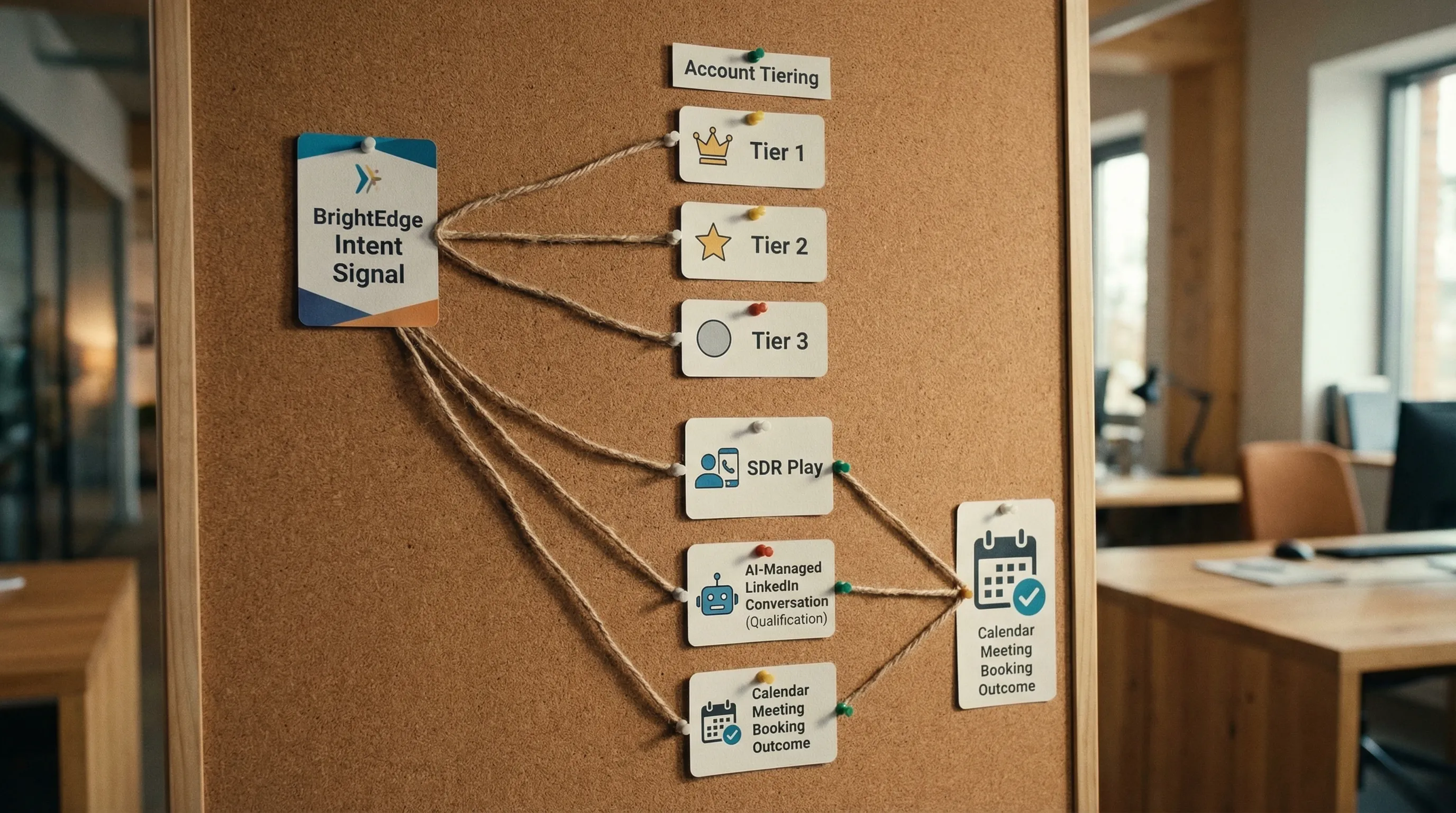
Use BrightEdge to identify intent topics and rising interest, then combine that signal with ICP fit and contact coverage to create Tier 1 to Tier 3 account lists. Finally, attach a specific outreach and qualification play to each tier, with a clear SLA and downstream measurement (qualified conversations, meetings held).
Is BrightEdge intent data enough to book meetings?
No, intent data indicates interest, not readiness or willingness to talk. You still need an execution layer that can run personalized outreach, handle replies, qualify in-thread, and book the meeting.
What is the best way to act on intent signals on LinkedIn?
Treat intent as a conversation opener, not a pitch. Lead with the topic the account is researching, offer a relevant proof point, ask a low-friction question, then qualify with 1 to 2 thread-safe questions before asking for time.
What is LinkedIn lead qualification software?
LinkedIn lead qualification software helps teams capture and evaluate qualification evidence inside LinkedIn conversations, then route or book next steps based on that evidence. The best systems do more than automate sending, they manage multi-turn conversations and enforce consistent qualification.
Book a demo of Kakiyo to turn intent signals into qualified LinkedIn conversations and meetings.