
 Ilan Asseo
Sales Development Representative: KPIs That Matter
Which KPIs SDRs should track in 2026 to predict pipeline: definitions, how to measure them, and how to operationalize them for LinkedIn-first and outbound.

If you manage (or are) a Sales Development Representative, you already know the uncomfortable truth: most SDR dashboards look “busy,” but still fail to predict pipeline. The fix is not more metrics, it is the right KPIs, defined tightly, tied to the buyer journey, and reviewed in a way that forces action.
This guide breaks down the SDR KPIs that actually matter in 2026, including how to calculate them, what they reveal, and how to use them to coach, forecast, and scale responsibly (especially in LinkedIn-first motions).
Industry evidence: Salesforce Research reports that sales reps spend only 28% of their week actually selling, with the rest consumed by deal management, data entry, and other non-selling work.
Source: Salesforce State of Sales
The KPI trap: activity does not equal progress
A lot of SDR teams measure what is easy:
- Messages sent
- Calls made
- Connection requests
- “Touches” per day
Those can be useful, but they are not outcomes. Activity-only scorecards create two common failure modes:
- Vanity volume: reps optimize for “more,” even when targeting is off or messaging is misaligned.
- False confidence: managers assume pipeline will come later because activity looks healthy.
Instead, build your KPI system around stage conversion and quality evidence. Your job is to create predictable movement from first touch to qualified conversation to meetings held to pipeline.
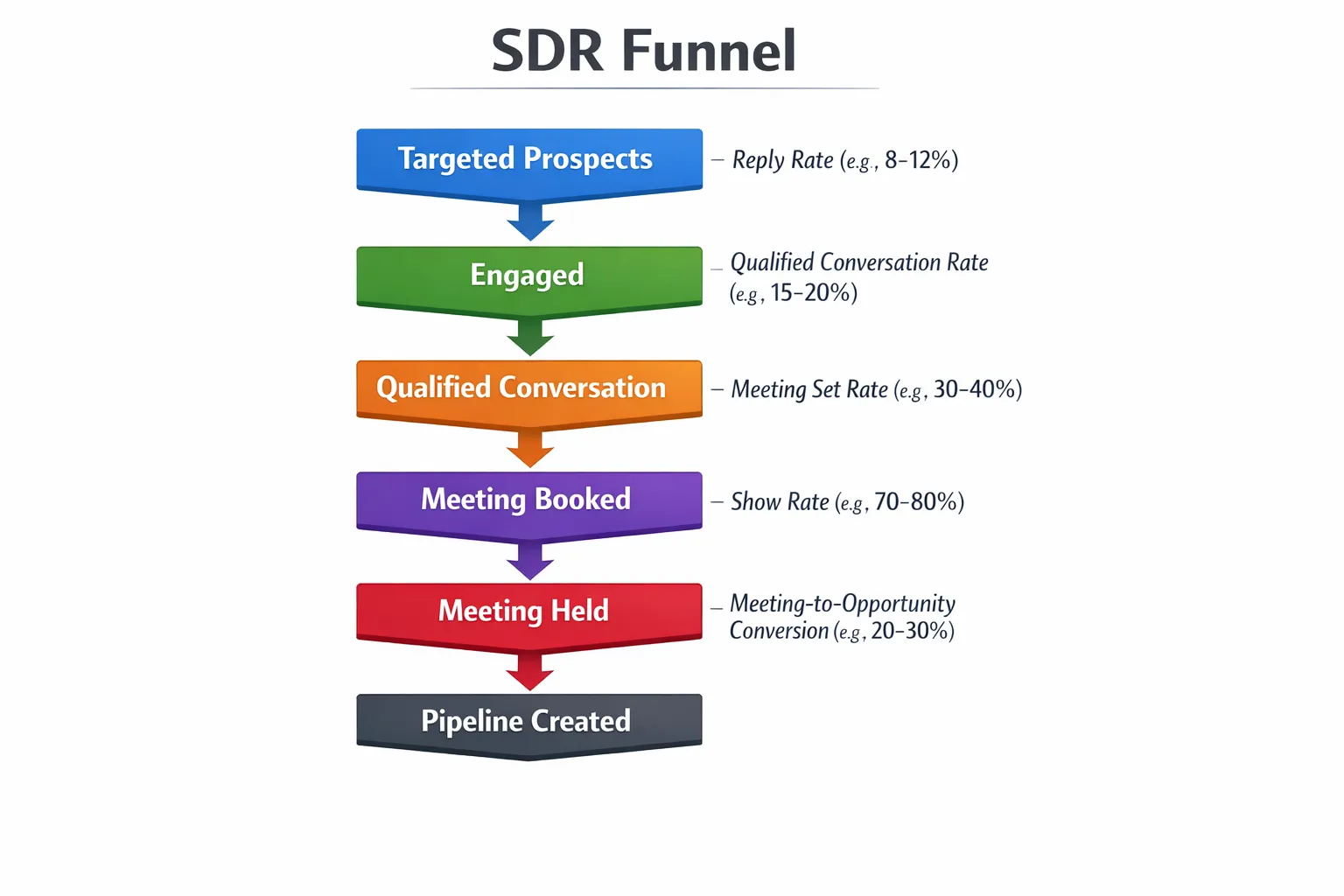
Start with a simple SDR funnel (so your KPIs map to reality)
Before picking KPIs, define your stages. For most outbound SDR motions (email + LinkedIn, or LinkedIn-first), a practical funnel is:
- Targeted prospects (high-fit people you can actually reach)
- Engaged (accepted connection, replied, clicked, or otherwise signaled attention)
- Qualified conversation (you captured evidence of fit and intent, not just a “thanks”)
- Meeting booked (time on calendar)
- Meeting held (showed up)
- Sales-qualified handoff (accepted by AE as legitimate)
- Pipeline created (opportunity opened or stage advanced)
Once stages are stable, the KPIs become obvious: measure conversion, speed, and quality at each transition.
The SDR KPI scorecard that matters (definitions + why it matters)
Use this table as a core scorecard. You do not need every KPI on day one, but you should know what each measures and which ones are leading vs lagging indicators.
| KPI | What it tells you | How to measure (practical definition) | Leading or lagging? |
|---|---|---|---|
| ICP coverage rate | Whether SDR effort is aimed at the right people | % of weekly contacted prospects that match ICP rules (role, company size, industry, geo, triggers) | Leading |
| Connection acceptance rate (LinkedIn) | Targeting + opener relevance | Accepted connections / connection requests sent (exclude follow-ups) | Leading |
| Reply rate (channel-specific) | Whether messaging earns attention | Replies / first touches sent (separate LinkedIn vs email) | Leading |
| Positive reply rate | Whether replies move forward vs stall | Replies that progress (questions, interest, referral, “send info”) / total replies | Leading |
| Qualified conversation rate | Real qualification ability, not just engagement | Qualified conversations / engaged prospects (use a qualification checklist) | Leading |
| Meetings booked | Production output | Count per week, segmented by ICP tier and persona | Lagging (but fast) |
| Meeting held (show) rate | Calendar quality and expectation-setting | Meetings held / meetings booked | Lagging |
| SQL (or AE acceptance) rate | SDR quality as judged by sales | AEs accepted / meetings held (or / meetings booked, depending on your process) | Lagging |
| Meeting-to-opportunity conversion | Whether meetings turn into pipeline | Opportunities created / meetings held | Lagging |
| Pipeline sourced (or influenced) | Business impact | $ pipeline created attributed to SDR conversations | Lagging |
| Speed to first touch | Responsiveness and SLA health | Median minutes/hours from lead assignment or trigger to first outreach | Leading |
| Speed to qualification | Efficiency and focus | Median days from first touch to qualified conversation (or to meeting booked) | Leading |
| Time per booked meeting | Efficiency at scale | Estimated SDR hours / meetings booked | Leading |
KPI 1: ICP coverage rate (the hidden lever behind every other metric)
If your ICP coverage rate is weak, every downstream metric becomes noisy. You will see “normal” reply rates but low qualification, or high meetings with low AE acceptance.
Operationally, ICP coverage answers: Are we spending time on people who can buy and are likely to buy now?
How to implement it quickly:
- Define 3 to 6 ICP rules that can be audited (industry, employee band, tech stack, role level, region, trigger)
- Add an “ICP fit” field (Yes/No, or Tier 1/2/3)
- Review ICP coverage weekly, not quarterly
If you want deeper stage definitions, Kakiyo’s guide on MQLs and SQLs is a useful reference for building auditable criteria across channels.
KPI 2: Reply rate is not enough, track “positive reply rate”
Reply rate is a good leading indicator, but it mixes signal with noise:
- Neutral replies (“thanks,” “not now,” “what is this?”)
- Negative replies (“stop spamming me”)
- Deflection (“talk to procurement”)
Positive reply rate forces clarity. It measures whether your outreach is creating a real next step.
To make it measurable, define “positive” in writing. A practical definition:
A reply is positive if it contains at least one of the following:
- A question about the offer/problem
- A request for proof, pricing, or details
- A willingness to route you to the right person
- A suggestion to reconnect at a specific time
- Agreement to a meeting (or request to schedule)
This KPI becomes especially powerful on LinkedIn, where short messages can generate a lot of “polite replies” that do not convert.
KPI 3: Qualified conversation rate (the KPI most teams should promote to #1)
In 2026, the best SDR teams think in conversation outcomes, not “touch outcomes.” A connection acceptance is not value. A reply is not value. A qualified conversation is value.
A qualified conversation means you captured evidence (in-thread or in CRM) that supports a real business case.
You can implement this with a lightweight checklist (no long forms). For example:
- Confirmed role and relevance (fit)
- Confirmed a problem or priority (need)
- Confirmed timing or trigger (recency)
- Confirmed next step (meeting or agreed follow-up)
If you want a more formal scoring approach, see Kakiyo’s lead qualification process for an example of turning fit and intent into operational scoring.
KPI 4: Meeting held rate (your calendar quality KPI)
Most teams obsess over “meetings booked” and ignore meetings held until the quarter is on fire.
Meeting held rate reveals:
- Whether SDRs are setting expectations well
- Whether qualification is real or superficial
- Whether your scheduling flow is frictionless
Common causes of low show rate:
- “Drive-by demos” booked without a real problem statement
- No agenda in the invite
- No confirmation message the day before
- Wrong persona, wrong priority, or wrong timing
You do not need perfect shows, but you do need show rate stability. Instability is a forecasting problem.
KPI 5: AE acceptance rate (or SQL rate) is your quality gate
If you only track SDR-owned metrics, you can accidentally reward meetings that should never have been booked.
AE acceptance rate (sometimes called SQL rate, depending on your stage definitions) is the cleanest cross-functional KPI because it forces shared definitions.
To keep this KPI fair:
- Define “acceptance” criteria (what must be true for an AE to accept)
- Require a short evidence note from the SDR (what they learned, what was confirmed)
- Require a rejection reason from the AE (so the team can improve)
This is also where stage alignment matters. Kakiyo’s post on what is a Sales Qualified Lead is helpful if your org struggles with “that was not an SQL” debates.
KPI 6: Meeting-to-opportunity conversion (the KPI that stops vanity booking)
Meeting-to-opportunity conversion answers: Did the meeting create real sales motion?
Use it to diagnose problems you cannot see in top-of-funnel metrics:
- Good reply rates but poor discovery (SDR set wrong expectations)
- Good qualification notes but weak pain (qualification checklist is too shallow)
- Strong meetings but low opp creation (handoff gap, pricing mismatch, or product positioning)
Be careful with attribution and time windows. For outbound, opportunities may open days or weeks after the initial meeting, especially if you run multi-threaded account motions.
For industry benchmark context, many leaders reference The Bridge Group’s SDR research (methodology varies by segment and motion), which can help sanity-check your internal ranges: The Bridge Group SDR metrics research.
KPI 7: Pipeline sourced (and pipeline per SDR hour)
Pipeline sourced is the KPI executives care about, but it becomes usable for SDR leadership when you pair it with an efficiency metric.
Two practical versions:
- Pipeline sourced per SDR: helps you plan headcount
- Pipeline per SDR hour: helps you plan process and tooling
Pipeline per hour is especially useful if you are introducing AI into prospecting and qualification. It translates productivity gains into a number finance teams understand.
KPI 8: Speed KPIs (the compounding advantage)
Speed is a multiplier. Two teams can have the same reply rate, but the faster team books more qualified meetings because they:
- reach prospects closer to trigger moments
- keep conversations warm
- reduce drop-off between steps
The two speed KPIs that tend to matter most:
- Speed to first touch (especially for inbound and event leads)
- Speed to qualification (especially for outbound and LinkedIn)
Measure speed using median, not average. A few extremely delayed leads can distort averages and hide operational issues.
KPI 9 (LinkedIn-first teams): Conversation depth and concurrency
LinkedIn prospecting often wins because it creates more natural conversations, but that also creates a management challenge: reps end up juggling dozens of threads.
Two KPIs help you manage that complexity:
- Active conversation count per SDR: how many threads are currently open
- Qualified conversation yield: qualified conversations / active conversations
If active conversations spike but yield drops, your team is running too “wide,” or your follow-up quality is slipping.
KPIs for AI-assisted SDR motions (what to measure so quality stays high)
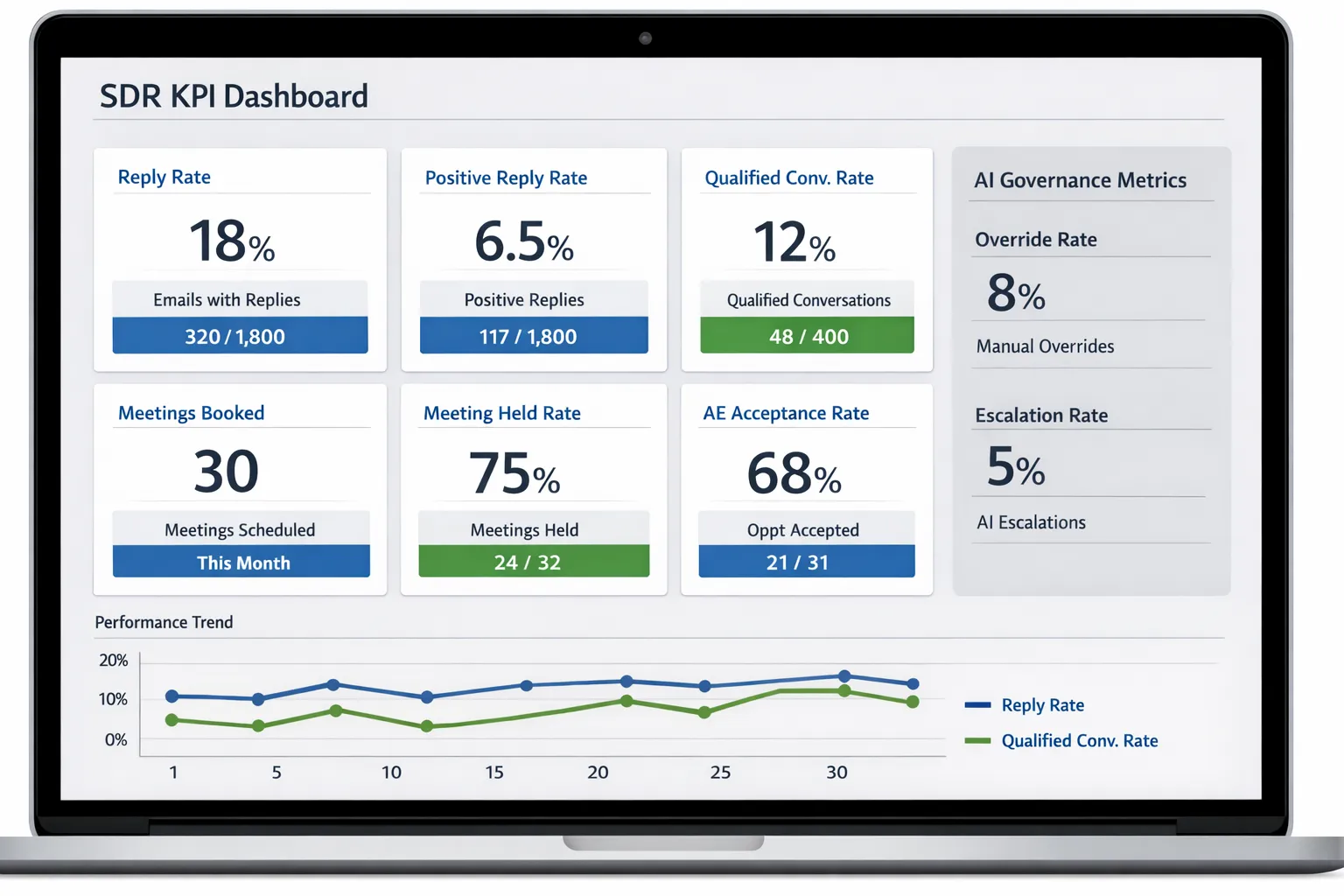
If you are using AI to assist or automate conversations, add a small set of governance KPIs. These are not “nice to have.” They prevent brand damage and keep autonomy from drifting.
Recommended AI motion KPIs:
- Human override rate: % of threads where a rep takes control (high can mean poor prompts, low can mean under-supervision)
- Escalation rate: % of threads that reach an explicit “hot” threshold and get routed to a human
- Prompt experiment velocity: number of A/B tests run per month with a clear success metric
- Disqualification reason distribution: ensures the AI is not booking meetings with obvious non-fits
- Opt-out and complaint rate: protects sender reputation and buyer trust
This is where a purpose-built platform can help, because it makes these signals visible. Kakiyo, for example, supports autonomous LinkedIn conversations, AI-driven qualification, A/B prompt testing, an intelligent scoring system, conversation override control, and a centralized real-time dashboard for supervision and reporting.
How to operationalize SDR KPIs (so they drive behavior)
Most KPI systems fail because they become passive reporting. Make your KPIs enforce decisions with a simple operating cadence.
Weekly KPI review: ask “where is the leak?”
Run a weekly 30 to 45 minute review with one goal: identify the biggest constraint in the funnel.
Example:
- If acceptance is high but replies are low, fix targeting or messaging
- If replies are high but qualification is low, fix conversation control and question flow
- If meetings booked are high but shows are low, fix expectation-setting and confirmation
- If shows are high but opportunities are low, fix handoff and meeting positioning
Use paired KPIs to prevent gaming
Single KPIs get gamed. Paired KPIs create balance:
- Meetings booked + meeting held rate
- Reply rate + positive reply rate
- Qualified conversations + AE acceptance rate
- Pipeline sourced + pipeline per SDR hour
Keep KPI definitions stable for 30 days
If you change definitions every week, your trendlines become meaningless. Lock definitions, run a 30-day baseline, then iterate.
Frequently Asked Questions
What are the most important KPIs for a Sales Development Representative? The most consistently useful SDR KPIs are qualified conversation rate, meetings held, AE acceptance (or SQL rate), meeting-to-opportunity conversion, and pipeline sourced. Add reply rate and positive reply rate as leading indicators so you can diagnose issues early.
What is a “qualified conversation” KPI, exactly? A qualified conversation is a thread where the SDR captured evidence of fit and intent, not just engagement. Define it with a checklist (fit confirmed, problem or priority confirmed, timing or trigger confirmed, and an agreed next step).
Should SDRs be measured on activity metrics like messages sent? Activity metrics are fine as guardrails (minimum effort and consistency), but they should not be the primary success metric. Over-weighting activity encourages spammy behavior and hides targeting and qualification problems.
What is a good meeting held rate for SDRs? It depends on your segment, personas, and motion, and it varies widely across teams. What matters most is that you define “held” consistently and keep it stable, then improve it with better qualification, clearer agendas, and confirmation.
How do you measure SDR performance on LinkedIn specifically? Track connection acceptance rate, reply rate, positive reply rate, qualified conversation rate, meetings booked, meeting held rate, and AE acceptance. LinkedIn also benefits from tracking conversation concurrency (active threads per SDR) because it impacts follow-up quality.
What KPIs should you add when using AI to run or assist outreach? Add governance KPIs like human override rate, escalation rate, opt-out/complaint rate, and prompt A/B test velocity. These help you scale safely without degrading brand quality.
Turn SDR KPIs into more qualified meetings (without more manual work)
If your team is already tracking the basics but struggling to improve qualified conversations, AE acceptance, and pipeline efficiency, the bottleneck is often consistent execution inside the conversation.
Kakiyo is built for that reality: it autonomously manages personalized LinkedIn conversations at scale, qualifies prospects in-thread, and helps book meetings, with the controls SDR leaders need (templates, customizable prompts, A/B testing, scoring, real-time dashboards, analytics, and human override).
Explore Kakiyo at Kakiyo.com or go deeper on conversation-led execution with the LinkedIn prospecting playbook.