
 Ilan Asseo
Business Dev Representative: Daily Workflow
A practical daily workflow for BDRs focused on prioritizing high-fit accounts, in-thread qualification, time-blocked routines, and AI-assisted automation.

A business development representative can do “all the right activities” and still end the week with weak pipeline if their day is not designed around the right sequence: prioritize the best accounts, start quality conversations, qualify quickly, then convert momentum into meetings without letting admin swallow the calendar.
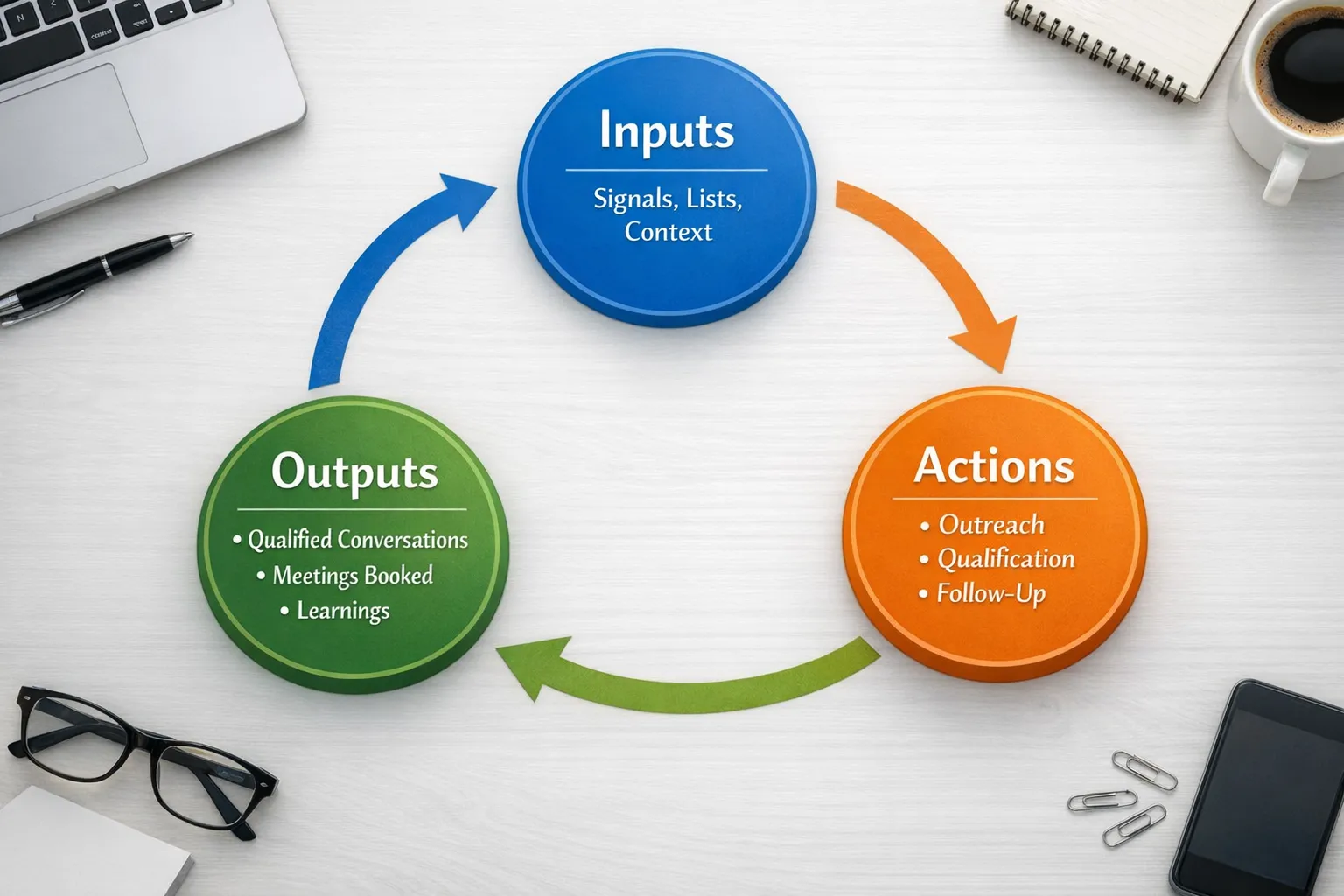
In 2026, the best BDR workflow looks less like a never-ending to-do list and more like a repeatable operating system: clear inputs (signals and lists), consistent actions (outreach + in-thread qualification), and measurable outputs (qualified conversations and booked meetings).
Industry evidence: Salesforce Research reports that sales reps spend only 28% of their week actually selling, with the rest consumed by deal management, data entry, and other non-selling work.
Source: Salesforce State of Sales
What a BDR’s daily workflow is really optimizing for
A typical BDR job has a deceptively simple mandate: create qualified meetings for AEs. But “qualified” is the keyword. Your day should optimize for meeting quality and speed to qualification, not just activity volume.
A useful way to frame daily priorities is:
- Protect your best time (your high-energy hours) for prospecting and live conversation.
- Pull forward high-intent work (replies, warm signals, inbound requests) before cold outreach.
- Reduce friction to booking (calendar links, two-slot scheduling, clean handoffs).
When teams miss targets, it is often not because they lack tools or scripts. It is because they run the day in the wrong order: they start cold, they react to notifications all day, and they do CRM updates late (or never), which erases learnings and breaks routing.
The “inputs → actions → outputs” loop (so your day is measurable)
If your workflow cannot be measured, it cannot be improved. A high-performing BDR day is a loop:
- Inputs: account lists, lead routing, intent signals, LinkedIn profile context, past conversation history.
- Actions: outreach, follow-ups, objection handling, qualification questions, booking.
- Outputs: qualified conversation evidence, meetings booked, disqualifications captured with reasons, clean handoff notes.
The point is not to do more. The point is to compound learnings. Every day should create new information that improves targeting, messaging, and qualification tomorrow.
A practical daily workflow template (time-blocked)
This schedule fits most B2B outbound roles. Adjust the times to your territory and when your buyers reply.
| Time block | Primary goal | What “done” looks like | Notes |
|---|---|---|---|
| 30–45 min (start of day) | Triage and prioritize | Reply queue at zero, today’s target list locked | Start with warm signals and active threads |
| 60–90 min | Build the day’s “hit list” | 25–60 prospects selected (depending on segment) | Focus on fewer accounts with better context |
| 90–120 min | Outbound creation and first touches | Connection requests and first messages sent | Keep messages short, value-first |
| 60–90 min (midday) | Follow-up and qualification | Questions asked, next steps proposed, disquals logged | Speed matters, avoid “checking in” |
| 45–60 min | Meeting booking and handoffs | Booked meetings confirmed, AE notes sent | Add evidence, not vibes |
| 20–30 min (end of day) | Hygiene and learning | CRM updated, experiments logged, tomorrow queued | Make tomorrow easier |
This is intentionally simple. The advantage is consistency: once you run the same structure daily, you can spot which block is underperforming (list quality, openers, follow-up, booking), and fix the right thing.
Block 1: Morning triage (protect momentum)
Start your day by clearing anything that already has buyer intent. This includes LinkedIn replies, email responses, inbound demo requests, and internal pings from AEs.
Your goal is to convert existing momentum into a qualified next step before you spend energy generating new conversations. Practically, that means:
- Responding to all replies that indicate curiosity, confusion, or soft objections
- Asking one clean qualification question when the prospect engages
- Offering a low-friction next step (two time options or a calendar link) when intent is present
A common mistake is to treat every reply as a win and push for a meeting too early. Instead, earn the meeting by clarifying the problem and fit in-thread.
Block 2: Build a focused hit list (quality beats randomness)
A BDR who builds a high-fit list daily will outperform a BDR who sends more messages to lower-fit prospects.
To keep list building fast without becoming shallow, pick one micro-theme per day. Examples:
- A specific role in a specific vertical
- A trigger event (hiring, funding, product launch)
- A tooling change (new CRM, new data provider)
Then select accounts and prospects that match that theme, and capture one personalization hook you can reuse (for example, a recent post, a job opening, a product line, a geographic expansion).
If your team is building a more advanced outbound engine, it can be helpful to study how specialists design meeting-booking operations end-to-end. For instance, agencies like Kvitberg Marketing (premium AI automation & performance marketing) share frameworks that map targeting, outreach, and conversion layers into a measurable acquisition system.
Block 3: First touches (short, relevant, easy to answer)
A good first touch does not “explain everything.” It earns a reply.
Design your first message to answer three silent buyer questions:
- Why you?
- Why now?
- What is the easiest next step?
For LinkedIn, the easiest next step is rarely “book a demo.” It is usually a micro-yes: permission to ask one question, or confirmation that the topic is relevant.
If you want a deeper end-to-end structure for LinkedIn, Kakiyo’s own playbook on moving from first touch to demo is a strong reference: LinkedIn Prospecting Playbook: From First Touch to Demo.
Block 4: Follow-up and in-thread qualification (where pipeline is created)
Most BDRs spend too much time writing first messages and not enough time turning replies into qualified conversations.
Your follow-up block should be built around a lightweight qualification method that fits chat. You do not need a full discovery call in DMs, but you do need evidence.
A practical approach is to capture three pieces of proof in the thread:
- Fit: are they the right type of company and the right role?
- Intent: are they experiencing the problem now, or actively prioritizing it?
- Constraints: is there a realistic path to a meeting (timing, stakeholders, current solution)?
When you do this well, your AE handoff improves dramatically because the AE receives context and momentum, not a calendar invite with no story.
If you need a structured scoring and evidence approach, this guide is a good companion: Lead Qualification Process: Steps, Scoring, and Automation.
Block 5: Booking and handoffs (convert intent immediately)
Booking is its own skill. A simple rule: once you see intent, stop selling and start scheduling.
A clean booking flow includes:
- A clear meeting purpose (one sentence)
- A time ask that is easy to answer (two slots in their timezone)
- Confirmation of attendees (do you need anyone else?)
- A handoff note to the AE that includes qualification evidence and relevant links
The fastest way to lose a meeting is to create ambiguity. The fastest way to keep one is to make the next step feel inevitable and low-effort.
Block 6: End-of-day hygiene (the compounding advantage)
Top BDRs are not “better texters.” They create a feedback loop.
In 20 to 30 minutes, make tomorrow easier:
- Log outcomes (meeting booked, nurture, disqualified) with the reason
- Tag which message or theme the prospect came from
- Save the best-performing openers and objections you handled
This is also where you protect your brand. If anything felt off-tone or unclear in your conversations, fix it now, not after it becomes a repeated pattern.
Where AI fits in a modern BDR day (without losing control)
AI is most useful in the BDR workflow when it reduces low-leverage work and increases consistency. In practice, that means:
- Drafting personalized openers from profile and company context
- Suggesting follow-up phrasing based on the last message
- Summarizing threads for clean AE handoffs
- Scoring conversations so you focus on the highest-intent threads first
Purpose-built platforms can also manage multiple LinkedIn conversations simultaneously while letting reps step in when nuance matters.
Kakiyo, for example, is designed to autonomously manage personalized LinkedIn conversations from first touch through qualification to meeting booking, while providing controls like customizable prompts, A/B prompt testing, intelligent scoring, conversation override, and a centralized dashboard with analytics. The practical impact on your day is simple: fewer context switches, faster response times, and a more consistent qualification standard.
The metrics to track daily (so you know what to fix)
It is easy to obsess over outputs (meetings) and ignore the leading indicators that actually determine whether meetings will happen.
Use a small metric set that maps to your workflow blocks:
| Workflow area | Leading indicator | Why it matters | Typical owner |
|---|---|---|---|
| List quality | Reply rate by segment/theme | Tells you if targeting is right | BDR + manager |
| First touches | Connection acceptance and first-reply rate | Validates opener relevance | BDR |
| Follow-up | Time to first response and time to qualification | Speed creates advantage | BDR |
| Qualification | Qualified conversation rate | Protects AE calendars | BDR + revops |
| Booking | Booked-meeting conversion from qualified conversations | Exposes scheduling friction | BDR |
| Downstream | Show rate and AE acceptance rate | Measures meeting quality | AEs + manager |
When one of these drops, do not “work harder.” Adjust the block that drives that metric.
Weekly rhythm: how great BDRs prevent chaos
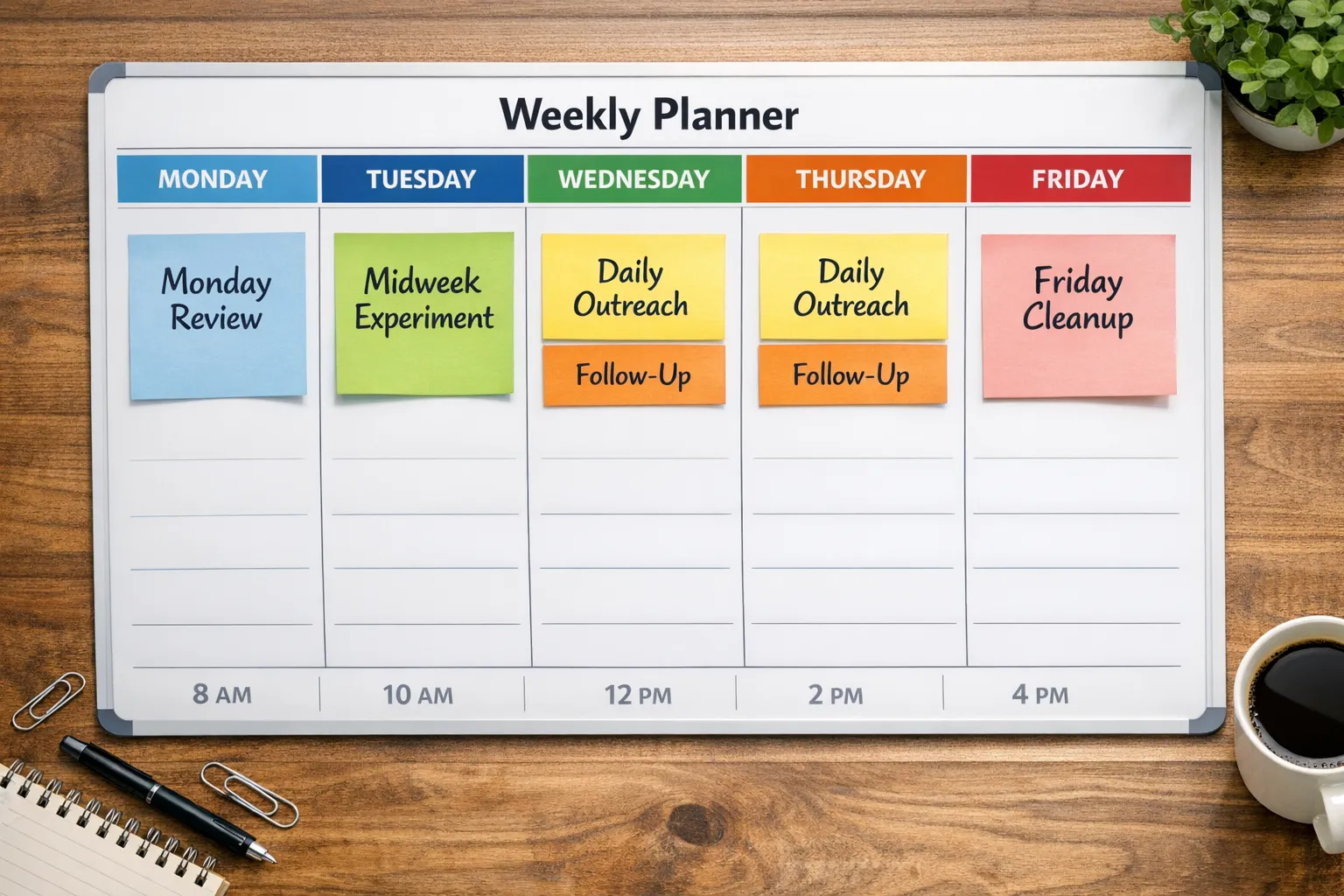
Daily structure is necessary, but weekly rhythm prevents drift. A simple cadence that works:
- Monday: review last week’s conversion rates, pick this week’s micro-themes
- Midweek: run one controlled experiment (new opener, new CTA, new segment) and compare to baseline
- Friday: clean pipeline, close loops, document learnings, queue next week’s lists
This rhythm makes the job feel less reactive and turns improvement into a habit.
Common daily workflow mistakes (and quick fixes)
Many BDRs get trapped in patterns that feel productive but do not create pipeline.
Mistake: starting the day with cold outreach. Fix: clear replies and warm signals first, then create new conversations.
Mistake: doing research for every prospect from scratch. Fix: pick a daily theme, reuse context, and standardize what “enough personalization” means.
Mistake: pushing meetings without evidence. Fix: ask one qualification question after engagement, then schedule.
Mistake: ending the day without logging outcomes. Fix: reserve a short hygiene block that protects your future performance.
Putting it all together
A strong business development representative daily workflow is not about cramming in more tasks. It is about running the right sequence, every day, with enough measurement to improve it.
If you are building a LinkedIn-first outbound motion and want to reduce manual follow-ups, standardize qualification, and book more meetings without living in your inbox, Kakiyo’s approach is designed around that exact workflow: autonomous LinkedIn conversations with testing, scoring, oversight, and analytics so reps can focus on high-value opportunities.
FAQ
What does a strong SDR or BDR actually own?
A strong SDR or BDR owns early-stage pipeline creation: targeting, first conversations, qualification, and clear handoff. The role is not just about booking meetings, but booking the right meetings.
Which skills matter most in modern sales development?
Prospecting judgment, messaging clarity, qualification discipline, and CRM hygiene matter more than raw call volume. In modern teams, AI literacy and channel fluency also matter.
How should teams evaluate SDR performance?
Use a mix of activity, conversion, and pipeline quality metrics. Strong teams look beyond booked meetings to show rates, qualification accuracy, and accepted pipeline.
How long does it take for a new rep to become productive?
Most reps need a ramp period before they consistently generate qualified pipeline. The fastest ramp comes from clear playbooks, tight feedback loops, and strong qualification criteria.