
 Ilan Asseo
Lead MQL SQL Opportunity: Clear Stages and Exit Criteria
Define Lead → MQL → SQL → Opportunity with enforceable exit criteria, CRM-friendly evidence packets, and practical recency windows to prevent stage drift.

Pipeline reporting breaks the moment your team uses the same word to mean different things.
“Lead” becomes anyone with an email. “MQL” becomes a form fill. “SQL” becomes any meeting on the calendar. “Opportunity” becomes a hope and a stage change.
The fix is not a better dashboard. It is clear stages with explicit exit criteria that (1) sales and marketing both agree to, (2) can be enforced in your CRM, and (3) can be audited later when deals convert or die.
This guide defines Lead → MQL → SQL → Opportunity in practical terms and gives you exit criteria you can implement this week.
Industry evidence: Gartner’s research on the B2B buying journey shows that consensus creation is now a core buying job, which is why qualification needs buying-group evidence rather than single-contact activity.
Source: Gartner
The core rule: stages are decisions, not labels
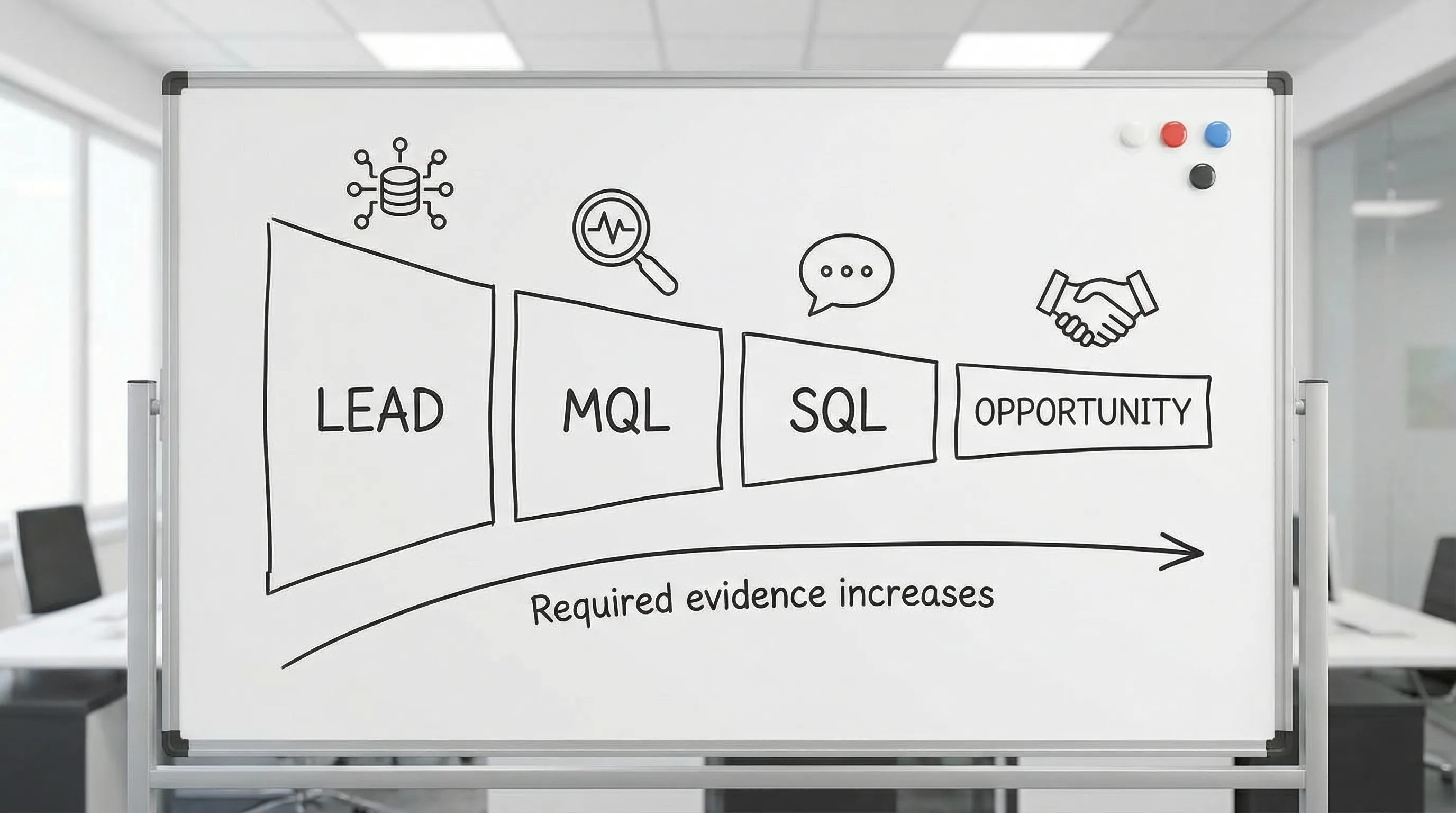
A lifecycle stage should represent an irreversible decision your go-to-market system just made.
- Lead: “We can and should engage this person.”
- MQL: “Marketing has enough fit + intent to justify a sales follow-up SLA.”
- SQL: “Sales has enough evidence to invest discovery time and pursue a defined next step.”
- Opportunity: “We are in an active sales cycle tied to a defined buying process and a measurable business outcome.”
When stages are decisions, exit criteria become simple: “What evidence do we require before we make the next decision?”
Lead, MQL, SQL, Opportunity: recommended definitions (plain English)
These are channel-neutral definitions. They work whether the signal comes from inbound forms, events, product usage, or LinkedIn conversations.
Lead
A Lead is a contact record you can legitimately engage where:
- Identity is real (not a bot, not junk data).
- Contactability exists (at least one usable channel).
- Basic compliance rules are satisfied for your motion (opt-in, legitimate interest, suppression lists).
A lead is not “qualified.” A lead is “reachable and worth a first meaningful touch.”
MQL (Marketing Qualified Lead)
An MQL is a lead that has met minimum fit plus meaningful intent within a defined recency window, and therefore triggers a response SLA from sales (or an SDR team).
Key idea: MQL is a commitment to speed and follow-up, not a trophy.
SQL (Sales Qualified Lead)
An SQL is a prospect where sales has enough evidence of fit and intent to pursue a sales motion, and there is a confirmed next step (often a meeting, but it can also be a specific mutual action).
SQL is where you stop guessing and start operating from evidence.
If you need a deeper SQL-only framework and examples, see Kakiyo’s guide: Sales SQL: Definition, Criteria, and Examples.
Opportunity
An Opportunity is an SQL that has entered an active sales cycle with:
- A defined problem or initiative the buyer agrees is real.
- A target outcome (what changes if you win).
- A buying path (stakeholders, procurement reality, or at least the next milestone that advances the deal).
Opportunities exist to forecast and manage a sales process. If you create opportunities too early, your pipeline inflates and forecasting becomes noise.
Clear exit criteria (what must be true to move forward)
Exit criteria should be:
- Binary where possible (yes or no, present or missing).
- Observable (a field, an event, a message, a scheduled next step).
- Time-bound (recency windows prevent stale “qualified” records).
Below is a practical set of exit criteria you can copy and adapt.
Lead → MQL: exit criteria
To promote a lead to MQL, require all of the following:
- Fit gate (minimum): ICP match on the few factors that truly disqualify (for example, region, segment, industry, role). Keep this short.
- Intent gate: at least one defined intent signal that is stronger than “looked at content.”
- Recency gate: intent happened within a window you specify (commonly 7 to 30 days depending on sales cycle and channel).
- Routing completeness: you can route it to the right queue (correct territory, segment, or book).
MQL intent signals can be inbound (demo request), product (activated a key feature), or conversational (a LinkedIn reply that indicates a real problem). The signal matters less than your team’s agreement that “this is worth an SLA.”
For more on building MQL triggers and handoff packets, see: Marketing Qualified Lead: Definition, Triggers, Handoff.
MQL → SQL: exit criteria
To promote an MQL to SQL, require evidence in five buckets:
- Fit confirmed: not just “looks like ICP,” but confirmed enough to avoid obvious dead-ends.
- Intent confirmed: the buyer acknowledges a relevant problem, initiative, or active evaluation.
- Evidence captured: specific proof in the record (quotes from the buyer, referenced tool stack, trigger event, or stated pain).
- Next step confirmed: meeting booked, or a mutually agreed next action with a date (for example, “send security questionnaire,” “loop in finance,” “review pricing next Tuesday”).
- Recency: confirmation is recent (define a window, often 14 to 30 days).
If you want your SQLs to be trusted, make “next step confirmed” non-negotiable. It is the difference between “they were interested” and “we are progressing.”
SQL → Opportunity: exit criteria
To create an Opportunity, require that the deal is real enough to forecast and manage:
- Problem and impact: what is broken or what initiative exists, and why it matters.
- Buying motion reality: at least one stakeholder beyond the first contact, or a clear path to one.
- Milestone-based next step: not just “discovery,” but the next milestone that moves the deal forward (for example, “technical validation scheduled,” “mutual plan drafted,” “procurement timeline confirmed”).
- Ownership: an AE (or designated owner) accepts responsibility for advancing the cycle.
If you create opportunities on “meeting booked” alone, you will overcount pipeline and underestimate the effort needed to win.
A stage-by-stage cheat sheet (owners, evidence, SLAs)
Use this table to align your team quickly and to sanity-check whether your CRM fields support the definitions.
| Stage | Purpose of the stage | Primary owner | Minimum evidence required | Typical SLA / timer |
|---|---|---|---|---|
| Lead | Enable first meaningful touch | Marketing ops or SDR ops | Real identity, contactable, compliant, routable | Time-to-first-touch target by channel |
| MQL | Commit sales attention to likely-fit, recent intent | Marketing creates, SDR/Sales accepts | Fit gate + intent signal + recency | Speed-to-lead (minutes to hours for hot signals) |
| SQL | Confirm qualification and a next step | SDR or AE (by motion) | Fit + intent + evidence + confirmed next step + recency | Time from first reply to SQL, and SQL aging |
| Opportunity | Manage a real sales cycle and forecast | AE | Problem/impact + buying path + milestone next step | Stage aging and next-step hygiene |
The point is not the exact SLA numbers. The point is that each stage has a clock and a definition your team can enforce.
What “evidence” should look like (so stages are auditable)
Most teams lose trust because they cannot answer: “Why was this promoted?”
A lightweight “evidence packet” fixes that. You do not need a novel, you need a few consistent fields.
| Evidence field (CRM-friendly) | Why it exists | Example value |
|---|---|---|
| ICP match reason | Prevents vague “seems like a fit” | “VP RevOps at B2B SaaS, 200–1000 employees” |
| Trigger / intent signal | Makes MQL defensible | “Replied on LinkedIn asking about qualification workflow” |
| Pain / use case (buyer words) | Improves handoff and personalization | “SDRs spend 2+ hours/day on thread follow-up” |
| Current process / tool context | Helps AEs run discovery faster | “Using Outreach + manual LinkedIn, no scoring rubric” |
| Next step + date | Prevents zombie SQLs | “15-min qualification call booked for Feb 12” |
| Recency timestamp | Prevents stale qualification | “Last meaningful buyer interaction: Feb 10” |
If you already use a scoring model, the score should not replace evidence. It should point a rep to the evidence.
Kakiyo’s broader approach to evidence-based qualification and scoring is covered in: Lead Qualification Process: Steps, Scoring, and Automation.
LinkedIn complicates lifecycle stages (and makes exit criteria more important)
LinkedIn creates a common failure mode: your “best” leads live inside message threads, not inside forms.
That is good, because conversations contain high-signal intent. It is also risky, because without standards:
- One SDR promotes to SQL after any positive reply.
- Another waits for a booked meeting.
- Marketing cannot tell which campaigns influenced pipeline because intent lives in DMs.
If LinkedIn is a meaningful channel for you, treat conversation events as first-class signals:
- “Replied with a relevant pain” is an intent signal.
- “Asked for pricing” is an intent signal.
- “Introduced the right stakeholder” is evidence.
- “Agreed to a time” is a next step.
Tools can help capture and standardize those signals, but the prerequisite is still the same: a written definition for Lead, MQL, SQL, and Opportunity.
Preventing stage drift (the quiet killer)
Stage drift is when your definitions slowly change without anyone noticing. It happens because teams optimize for local metrics:
- Marketing inflates MQL volume to hit targets.
- SDRs inflate SQLs to look productive.
- Sales inflates opportunities to make pipeline coverage look healthy.
Here are practical controls that prevent drift without creating bureaucracy.
1) Make exit criteria enforceable, not optional
If the “next step date” is required for SQL, make it a required field. If “intent signal type” is required for MQL, make it mandatory.
If it is not enforceable, it is a suggestion.
2) Use rejection reasons that teach you something
If sales rejects MQLs, force a short picklist with meaning (for example, “wrong persona,” “no active initiative,” “student/research,” “competitor,” “duplicate”).
This becomes your best dataset for improving targeting and scoring.
3) Review a small sample weekly
You do not need a massive quarterly committee.
A 30-minute weekly calibration can work:
- Pull 10 recent SQLs.
- Check whether the evidence packet is complete.
- Look at 5 rejected MQLs and confirm the rejection reason.
- Update one rule, one prompt, or one field requirement.
4) Track stage conversion with quality guardrails
Conversion rates alone are easy to game. Pair them with quality metrics:
- MQL → SQL conversion rate paired with SQL acceptance rate (by AEs).
- SQL → Opportunity conversion paired with Opportunity stage aging.
- Opportunities created paired with win rate and time-to-close.
A minimal implementation plan (fast, not fragile)
If you want to implement this without boiling the ocean, keep scope tight.
Step 1: Pick one ICP slice
One segment, one persona, one primary use case. Broad definitions fail because everyone argues from edge cases.
Step 2: Write the exit criteria in one page
Use the tables above. Decide your recency windows. Decide which fields are mandatory.
Step 3: Instrument the evidence packet
Add the minimum set of fields that make your stages auditable.
Step 4: Align your SLA to the stage
MQL means nothing if no one responds. SQL means nothing if it sits for weeks.
Step 5: Run a two-week calibration loop
You are looking for:
- Where “qualified” is being over-applied.
- Which intent signals produce real SQLs.
- Where your definitions are too strict and block good pipeline.
Where Kakiyo fits (without changing your funnel)
If LinkedIn is part of your acquisition motion, Kakiyo is designed to help you operationalize the definitions above by managing personalized LinkedIn conversations at scale, including qualification and meeting booking.
Practically, that means you can:
- Run multi-turn LinkedIn conversations with consistent qualification prompts.
- Apply an intelligent scoring approach to prioritize who should get human attention.
- A/B test prompts and templates to improve qualified conversations, not just replies.
- Keep humans in control with override capabilities and centralized reporting.
You can learn how Kakiyo approaches conversation-led qualification in its broader lead qualification resources, or start here: Kakiyo.
Frequently Asked Questions
What is the difference between a lead and an MQL? A lead is a reachable contact you can engage. An MQL is a lead that meets minimum fit plus recent intent, which triggers a sales follow-up SLA.
Should every MQL become an SQL? No. An MQL is a bet that the lead deserves fast follow-up. SQL requires confirmed fit, confirmed intent, captured evidence, and a next step. Many MQLs should be nurtured or disqualified after a quick touch.
Is an SQL the same as a booked meeting? Not necessarily. A meeting can be a next step, but an SQL should still include fit, intent, and evidence. Many teams require a meeting to count an SQL, but the safer rule is “confirmed next step with evidence,” which can include meetings.
When should we create an opportunity? Create an opportunity when there is an active sales cycle with a defined problem or initiative, a clear milestone-based next step, and an AE-owned path to progress. Avoid creating opportunities for every first meeting if it inflates pipeline.
What recency window should we use for MQL and SQL? Use the shortest window that matches your buyer’s reality. Many teams start with 7 to 30 days for MQL intent and 14 to 30 days for SQL confirmation, then adjust based on conversion and sales cycle length.
Turn clear stages into consistent LinkedIn qualification
If your best intent signals happen inside LinkedIn threads, it is easy for lifecycle stages to drift because evidence stays trapped in conversations.
Kakiyo helps teams run and standardize LinkedIn conversations from first touch through qualification to meeting booking, so your Lead → MQL → SQL → Opportunity exits are based on consistent evidence, not rep-by-rep judgment. Explore Kakiyo at kakiyo.com.