
 Ilan Asseo
Sales SQL: Definition, Criteria, and Examples
Make Sales SQL operational with a clear definition, practical CRM-ready criteria, and real examples (plus non-examples) so SDRs, AEs, and RevOps can align.

Sales teams burn time when “SQL” is a vibe instead of a rule. One person marks a lead as sales-qualified because they replied. Another only counts leads with a booked meeting. The result is predictable: noisy pipeline, low AE trust, and endless debates in weekly reviews.
This guide makes Sales SQL operational: a clear definition, practical criteria you can implement in your CRM, and real examples (plus non-examples) so SDRs, AEs, and RevOps can stay aligned.
Industry evidence: Gartner’s research on the B2B buying journey shows that consensus creation is now a core buying job, which is why qualification needs buying-group evidence rather than single-contact activity.
Source: Gartner
Sales SQL: what it means (and what it doesn’t)
In B2B revenue operations, Sales SQL typically refers to a Sales Qualified Lead (SQL): a lead that has met sales-agreed qualification standards and is ready for a sales-owned next step (often a discovery call).
Two quick clarifications:
- SQL here is not “Structured Query Language” (the database language). The acronym overlap creates confusion in search and internal docs.
- A lead becoming an SQL is not “good news” by itself. It’s a cost trigger. It means you are allocating scarce sales time (SDR or AE) and treating the lead as a real opportunity to progress.
If you want a mainstream baseline definition, HubSpot’s overview of lifecycle stages is a helpful reference point, but your SQL must be tailored to your motion and buyer journey: HubSpot lifecycle stage definitions.
Why Sales SQL definitions matter (more than most teams admit)
A tight SQL definition improves four things immediately:
- Pipeline quality: fewer “polite yes” meetings that never convert.
- Speed and prioritization: SDRs know which conversations to push forward and which to nurture.
- Forecasting and reporting: stage conversion rates become meaningful.
- Sales and marketing alignment: fewer handoff arguments, clearer SLAs.
Put simply, SQL is the bridge between early signals (clicks, form fills, replies) and revenue outcomes (pipeline created, closed won). If the bridge is weak, everything downstream wobbles.
The practical definition: an SQL needs fit, intent, and an agreed next step
Most SQL frameworks fail because they over-index on one dimension.
- Fit-only SQLs create “perfect accounts” with no urgency.
- Intent-only SQLs create high-activity leads that will never buy.
- Meeting-only SQLs create calendar wins that waste AE cycles.
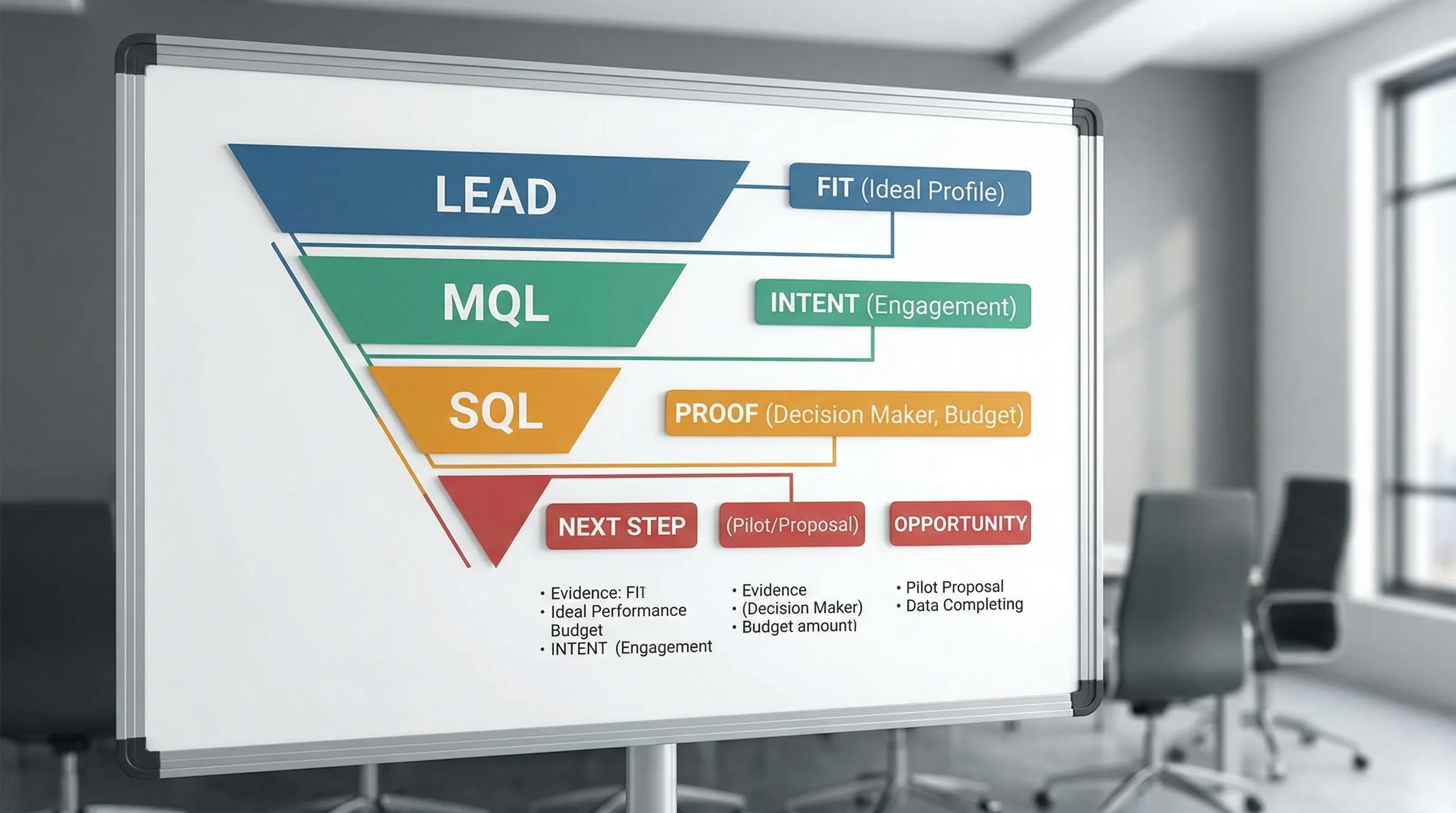
A defensible Sales SQL definition usually includes:
- Fit: the lead matches your ICP and buyer persona.
- Intent: the lead shows credible interest or pain (not just engagement).
- Proof (evidence): you can point to what you saw or what they said.
- Next step: there is a sales-owned action that the buyer agreed to.
- Recency: the evidence is recent enough to be actionable.
If you already have MQL definitions in place, SQL should be the next, stricter gate. Kakiyo’s guide on aligning stages is a good companion for lifecycle consistency: MQLs and SQLs: Align Definitions, Boost Pipeline Health.
Sales SQL criteria you can implement (minimum viable, then upgraded)
You do not need a 30-point scoring model to start. You need clear exit criteria that can be audited.
Minimum viable SQL criteria (MV-SQL)
A lead becomes an SQL when all of the following are true:
- ICP match: company and persona meet your non-negotiables (industry, size, geography, role).
- Intent signal: explicit interest, problem statement, or request that maps to your product’s core value.
- Two-way engagement: a real exchange happened (not a like, not a webinar attendance alone).
- Confirmed next step: a meeting is booked, or the buyer commits to a specific follow-up (date/time or concrete action).
Upgraded SQL criteria (for higher precision)
If you want fewer false positives, add one or two of these:
- Use case clarity: you captured the job-to-be-done (what they are trying to accomplish).
- Buying process access: you have access to a decision-maker, champion, or clear path to one.
- Timing window: the timeline is within a defined range (for example, “this quarter”).
- Disqualifiers checked: you confirmed there’s no obvious reason the deal cannot happen (wrong segment, no budget category, competitor lock-in).
A simple SQL evidence table (what “counts”)
The easiest way to reduce internal debates is to define what counts as evidence.
| Criterion | What “counts” as evidence | What does not count |
|---|---|---|
| ICP match | Firmographics + role match in CRM/enrichment, or stated by buyer | “Looks like a good logo” |
| Intent | Buyer states a pain, project, evaluation, or asks for pricing/demo | Likes, generic compliments, “Sounds interesting” |
| Two-way engagement | Back-and-forth replies with context | One reply with no substance |
| Next step | Calendar invite accepted, or explicit commitment (“Send times”, “Loop in X”) | “Let’s keep in touch” |
| Recency | Signal within your defined window (often 14 to 30 days) | Old activity resurrected with no new trigger |
Sales SQL examples (and why they qualify)
Below are concrete examples that meet typical SQL standards. Adapt the details to your ICP and motion.
Example 1: inbound demo request with clear use case
- Buyer submits: “Need to improve outbound reply quality and stop wasting AE time on unqualified meetings. Looking to evaluate options this month.”
- Persona: Head of SDR / RevOps.
Why it qualifies: ICP match, explicit intent, timeline, and a clear next step.
Example 2: LinkedIn reply that reveals pain and urgency
- Prospect replies to a LinkedIn message: “We tried sequencing tools, replies are fine but qualification is messy. If you can handle LinkedIn conversations and book qualified meetings, I’ll take a look. Can you do Wednesday?”
Why it qualifies: two-way engagement, problem statement, direct request to evaluate, confirmed scheduling.
Example 3: event lead that converts into a committed follow-up
- You meet at an event. Follow-up message gets: “Yes, send a few times next week. We are rebuilding our outbound motion after hiring 3 SDRs.”
Why it qualifies: context, relevant initiative, clear next step.
Example 4: referral intro with an explicit ask
- Referral says: “Intro’ing you to Alex, they’re actively evaluating ways to improve top-of-funnel meetings. Alex asked for a demo.”
Why it qualifies: strong intent and permission, immediate next step.
Example 5: product-led motion with a sales-ready trigger
- A user hits a usage threshold, invites teammates, and requests security docs.
- Your rules require persona fit (admin/owner) and a sales conversation prompt.
Why it qualifies: behavior suggests evaluation, plus a sales-owned next step is appropriate.
Example 6: outbound email reply that includes buying process access
- Prospect replies: “I’m not the owner, but I lead SDR ops. If this works, I’ll bring our VP Sales into the call.”
Why it qualifies: persona relevance and a credible path to the buying group.
Sales SQL non-examples (common false positives)
These look promising in activity dashboards but usually fail in pipeline.
Non-example 1: “Interested” with no detail
- Reply: “Interesting, tell me more.”
Why it’s not an SQL (yet): no use case, no urgency, no agreed next step. Treat as engaged, run lightweight qualification.
Non-example 2: content engagement only
- Prospect liked three posts and viewed your profile.
Why it’s not an SQL: no two-way engagement, no explicit intent.
Non-example 3: booked meeting with the wrong persona
- Meeting booked with someone outside ICP who cannot influence purchase.
Why it’s not an SQL: calendar acceptance is not qualification. If you count these as SQLs, you inflate meetings and tank AE trust.
Non-example 4: old “hot lead” resurrected without a new trigger
- A lead scored high last quarter but has not engaged in 60 days.
Why it’s not an SQL: recency matters. If it’s real, you should be able to capture fresh intent now.
How to set Sales SQL criteria that your AEs will actually accept
The fastest path to a stable SQL definition is to reverse-engineer it from your best outcomes.
Start from the truth label: what does “good” look like downstream?
Pick one primary outcome to anchor the SQL definition, such as:
- AE-accepted meeting (a strong proxy for quality)
- Meeting held (filters out no-shows)
- Opportunity created (closer to revenue, slower feedback loop)
Then define SQL so that it predicts that outcome with acceptable accuracy.
Build an “SQL packet” (evidence, not stories)
Your SQL handoff should be a short, consistent packet that removes ambiguity. In most teams, this includes:
- Who they are (persona, account, segment)
- What changed (trigger or reason now)
- What they said (1 to 2 verbatim lines)
- What they want (use case or pain)
- What happens next (meeting link, date/time, attendees)
This “packet” approach pairs well with conversation-led channels like LinkedIn, where the buyer’s own words are available in-thread.
Add disqualification rules to protect your funnel
Most definitions only say what qualifies, not what must be excluded. Disqualification rules reduce noise and prevent gaming.
Examples of common disqualifiers:
- Outside ICP (segment, geography, regulated industry you do not support)
- Student, recruiter, consultant (unless that is your ICP)
- Vendor, partner inquiry routed elsewhere
- “Not looking”, “No project”, “Maybe next year” (route to nurture, not SQL)
Sales SQL in LinkedIn outbound: what to look for in conversations
LinkedIn is increasingly a conversation channel, not a broadcast channel. That makes it a strong source of SQLs, but only if you treat qualification as a short, respectful exchange.
A practical pattern is:
- Earn permission (ask a low-friction question tied to a relevant trigger)
- Confirm problem relevance (one short question)
- Confirm next step (offer a specific call or an alternate, such as sending a 3-bullet overview)
If your team runs high volumes of LinkedIn conversations, consistency becomes the bottleneck. This is where governed automation can help capture evidence, apply scoring consistently, and escalate edge cases to humans.
Kakiyo is built for this specific problem: it manages personalized LinkedIn conversations at scale, qualifies prospects using your criteria, and books meetings while keeping human override controls. If you want the operational system behind the definition, see: Lead Qualification: A Simple, Repeatable System.

A lightweight Sales SQL checklist (for SDRs and RevOps)
Use this as a pre-handoff check to keep standards consistent:
- Does this lead match our ICP non-negotiables?
- Do we have explicit intent in their words (not inferred interest)?
- Did we capture proof (the exact line, trigger, or request)?
- Is there a confirmed next step with time, attendees, and purpose?
- Would an AE agree this is worth time, based on the packet alone?
If you cannot answer “yes” to the last question, it is usually not an SQL yet.
Frequently Asked Questions
What does Sales SQL stand for? Sales SQL usually means Sales Qualified Lead (SQL), a lead that meets sales-agreed criteria and is ready for a sales-owned next step.
Is an SQL the same as a meeting booked? Not necessarily. A meeting can be booked without fit or intent. Many teams require a booked meeting plus evidence of fit and intent, or they use AE acceptance as an additional quality gate.
What is the difference between an MQL and an SQL? An MQL is marketing-qualified based on marketing’s rules (often intent signals and fit thresholds). An SQL is sales-qualified based on evidence that a sales conversation is warranted now.
Who should own the SQL definition? RevOps should operationalize it, but sales leadership (AEs and SDR leadership) must agree on the criteria because they pay the time cost when it’s wrong.
How do you prevent “definition drift” over time? Add an SQL evidence packet, require consistent fields in CRM, review samples weekly, and calibrate using downstream outcomes like AE acceptance or meeting held rate.
Turn SQL criteria into consistent, scalable LinkedIn qualification
If your SQL definition works on paper but breaks in practice, the gap is usually inconsistent execution in the inbox. Kakiyo helps teams run personalized LinkedIn conversations at scale, apply your qualification criteria consistently, and book meetings with the right prospects.
Explore Kakiyo’s approach to conversation-led qualification at kakiyo.com.