
 Ilan Asseo
Qualified Prospects vs Leads: What Really Matters
Operational framework for qualified prospects vs leads, covering fit, intent, and conversation evidence to drive pipeline and forecast accuracy.

Most teams do not have a lead problem, they have a qualification problem. Piling more names into the top of the funnel does not guarantee revenue. What moves pipeline and forecast accuracy is a repeatable way to turn the right people into qualified prospects, then into scheduled meetings.
This article cuts through semantics and shows how to operationalize qualified prospects in your process, CRM, and daily LinkedIn outreach so SDRs spend time where it compounds.
Industry evidence: “As customers increasingly learn and buy digitally, sales reps become just one of many possible sales channels.” — Cristina Gomez, Managing Vice President, Gartner.
Source: Gartner
Lead vs qualified prospect, working definitions
A lead is a person or record that can be contacted. It might come from an event list, a content download, a scraped directory, or a cold outbound search. A lead is potential energy, not evidence of buying motion.
A qualified prospect is a person in your ideal customer profile who has shown timely intent and has confirmed, in conversation, that a problem you solve is relevant and a next step is welcome. The status is backed by observable signals that can be audited later.
Here is a practical way to see the difference:
| Dimension | Lead | Qualified prospect |
|---|---|---|
| Fit to ICP | Unknown or partial | Meets clear ICP criteria, for example industry, size, tech stack |
| Intent | Weak or inferred, for example a page view 90 days ago | Recent and explicit, for example replied on LinkedIn, asked for examples, shared use case |
| Conversation evidence | None | Short, two way thread documents problem and openness to next step |
| Buying group role | Unclear | Role identified, for example user, champion, budget holder, influencer |
| Next step | Not established | Accepts a call, shares timing, or asks for material that precedes a call |
Why this matters: buying is collaborative and time with suppliers is scarce. Gartner reports typical B2B buying groups include roughly 6 to 10 stakeholders, and buyers spend a small fraction of their journey with vendors, which makes quality interactions count far more than raw volume. See Gartner’s research on the modern B2B buying journey for context (Gartner, Gartner).
What really matters for revenue
- Forecast accuracy, qualified prospects convert to meetings and opportunities at far higher rates than generic leads, which reduces noise and makes pipeline commit more defensible.
- SDR productivity, focusing on qualified conversations lifts meetings per rep and reduces wasted touches.
- Buyer experience, short, relevant micro conversations respect how buyers want to evaluate solutions.
If you want a formal stage language for the rest of your funnel, align your Marketing Qualified Lead and Sales Qualified Lead definitions, then place qualified prospect as the practical, conversation proven bridge between them. For deeper stage definitions, see our guides on the Marketing Qualified Lead and Sales Qualified Lead.
A simple rubric you can run tomorrow
Use three lenses to standardize what counts as a qualified prospect. Keep it lightweight so SDRs can apply it in live LinkedIn threads.
- Fit, the person and account match ICP signals you care about, for example job title, department, company size, industry, geography, tech ecosystem.
- Intent, something happened recently that indicates interest or pain, for example accepted a connection and replied, asked about pricing ranges, reacted to a relevant case study, visited a product page in the last 14 days.
- Conversation proof, you captured a short exchange confirming a problem hypothesis or use case and you gained a micro yes for a next step.
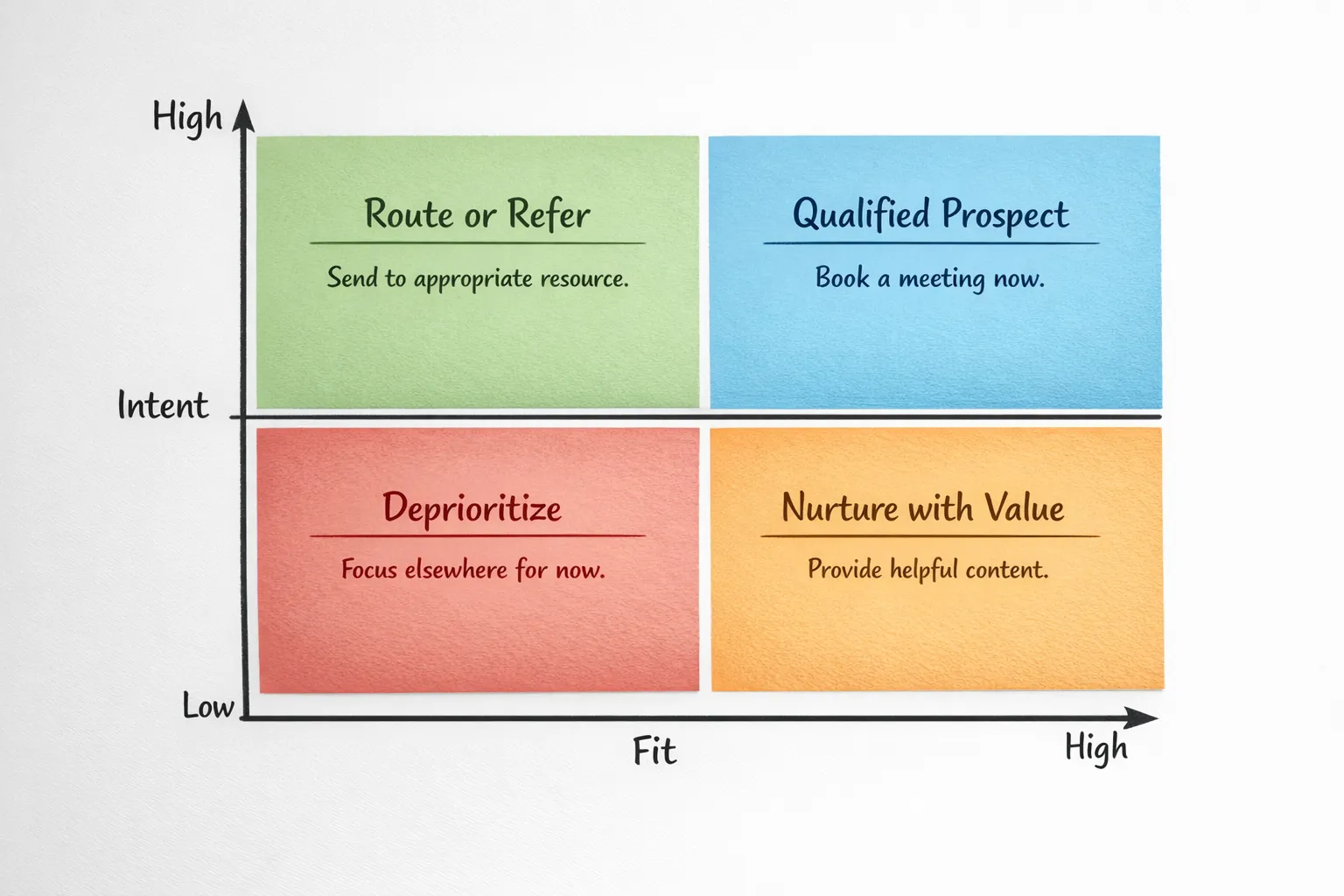
Two practical rules keep the rubric honest:
- Recency window, intent decays fast. Define a window, for example 14 to 30 days, where signals count as active.
- Evidence over opinion, log the snippet of the conversation in CRM so anyone can audit later.
Turning leads into qualified prospects with LinkedIn conversations
Your best source of qualification is a short, buyer first conversation. On LinkedIn this can happen in a handful of messages when you avoid monologues and focus on micro questions.
Try prompts like:
- Context, saw your post about scaling partner sourced pipeline at ACME, curious if attribution or partner ops is the bigger headache right now.
- Value, just helped a similar team reduce manual follow ups by 40 percent by moving qualification into the thread instead of email ping pong, worth a quick compare.
- Micro question, if you had a magic wand for next quarter, would you fix speed to first touch or meeting show rates first.
As soon as the prospect replies with a problem statement or a request for specifics, you have intent. Ask one follow up to confirm role or timing, then offer the next step. Our full outreach cadences and examples live in the LinkedIn prospecting playbook.
Make it operational, fields, SLAs, and routing
Documentation makes qualification scalable and fair. Add a few lightweight fields and rules so everyone plays the same game.
- Fields, ICP fit band, intent source with date, buying group role, conversation proof link or snippet, next step type.
- Entry criteria, all three lenses present at a minimal threshold, for example Fit band A or B, intent within the recent window, conversation proof captured.
- Exit criteria, meeting booked or deliberate recycle reason, for example no project this quarter, wrong region, competitor contract locked.
- SLA, qualified prospects receive a fast follow up, for example calendar invite same day, and sales responds to any new thread reply within 24 hours on business days.
For a full process including scoring bands, routing, and analytics, use the play-by-play in our lead qualification process guide.
Metrics that matter more than lead volume
Vanity metrics like total leads or total touches hide quality. Shift your dashboard to outcomes tied to conversation quality.
| Metric | What it tells you | How to improve |
|---|---|---|
| Qualified conversation rate, replies that contain real pain or interest divided by total conversations | Quality of targeting and message relevance | Tighten ICP, reference timely triggers, shorten openers |
| Meetings per qualified prospect | How well you convert interest into a calendar event | Ask one clear micro question, offer two times, keep friction low |
| Speed to qualification, from first touch to qualified prospect | How quickly you find signal and reduce waste | Move qualification into the thread, avoid long discovery before booking |
| Opportunity creation rate from meetings | Downstream sales fit and expectations alignment | Share a brief agenda and value hypothesis before the call |
| Forecast correlation, qualified prospect volume vs new pipeline created next 30 to 45 days | Predictive power of your definition | Keep evidence airtight, review misses weekly |
Example pipeline math, illustrative only
| Step | Raw lead motion | Qualified prospect motion |
|---|---|---|
| Starting inputs | 5,000 leads from list and forms | 600 qualified prospects from targeted outreach |
| Qualified conversation rate | 3 percent of lead contacts | 45 percent of conversations |
| Meetings booked | 60 meetings | 200 meetings |
| Opportunities created | 24 opportunities | 120 opportunities |
| Revenue impact | Lower, pipeline noisy | Higher, pipeline concentrated on fit and intent |
Numbers vary by segment, channel, and offer. The point is not a perfect ratio, it is that a smaller pool of qualified prospects typically yields more reliable meetings and pipeline than a larger pool of unfiltered leads.
How AI changes the equation, quality at scale
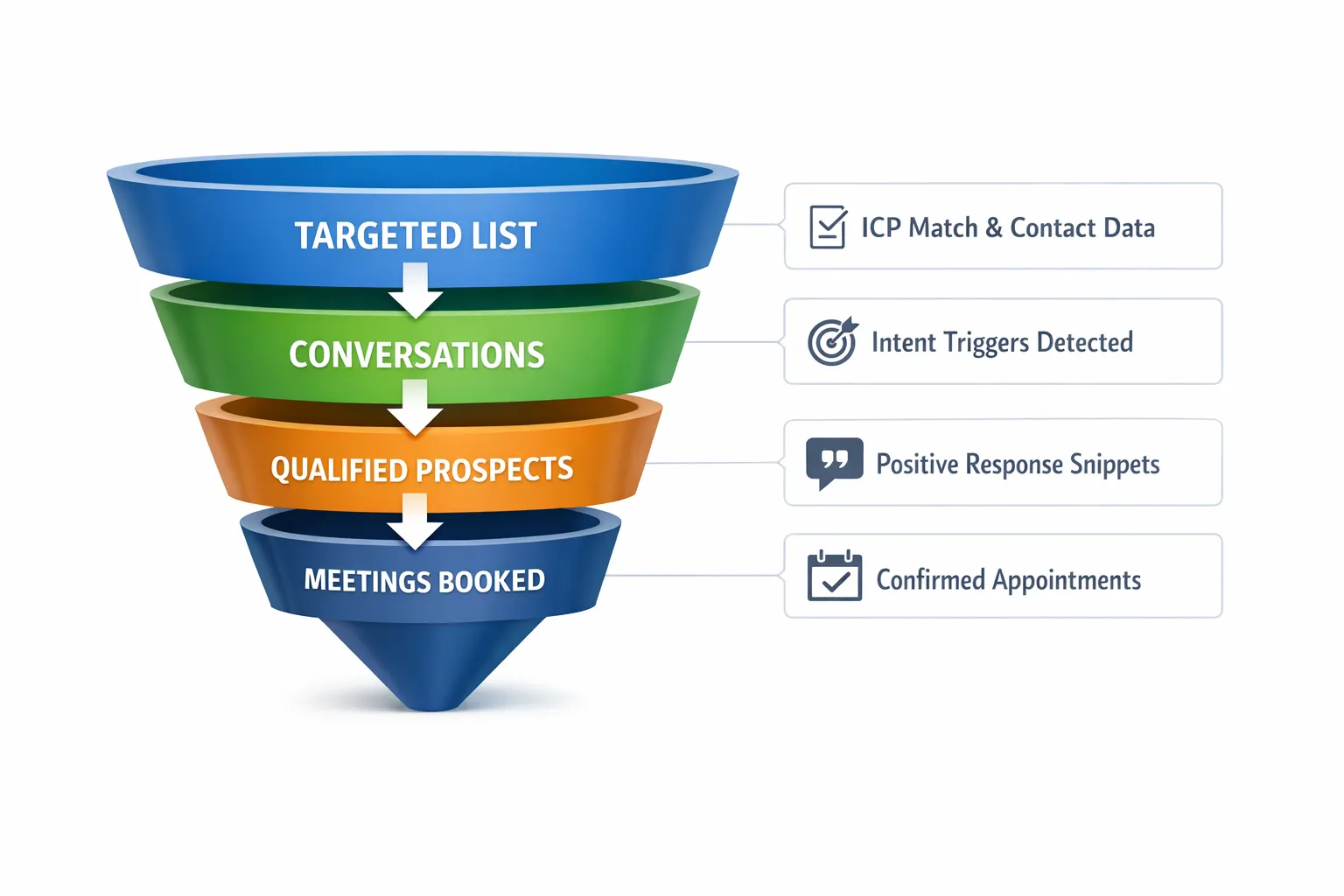
AI helps you keep the bar for qualified prospects high while increasing coverage.
- Autonomous LinkedIn conversations, engage 1 to 1 with context so you can discover intent without blasting networks.
- Real time scoring, evaluate fit, intent signals, and conversation snippets while a thread is live so hot prospects route quickly.
- Prompt libraries and A or B testing, learn which openers and value hypotheses produce qualified conversations in each segment.
- Human in the loop, override conversations when it matters and keep brand voice consistent.
- Dashboards and analytics, watch qualified conversation rate, meetings, and safety indicators in one place.
This is exactly where Kakiyo focuses. Teams use Kakiyo to run personalized, AI managed LinkedIn conversations from first touch to qualification to booking, while leaders get an auditable record and analytics to improve week over week. If you want a deeper dive into patterns and guardrails, read our guide to automated lead qualification.
A 30 day plan to refocus on qualified prospects
Week 1, align and instrument
Agree on your qualified prospect rubric using Fit, Intent, and Conversation evidence. Add the minimal fields to CRM and create one saved view for SDRs that only shows people and accounts in ICP. Document entry and exit criteria in a one page playbook.
Week 2, test conversations
Draft three short openers per segment, one value drop follow up, and two micro questions. Run light A or B tests on 200 to 400 targets in LinkedIn. Capture snippets and dispositions in CRM. Use a fast path to calendar when you see explicit problem statements.
Week 3, route and review
Route qualified prospects to the right owner immediately and set a same day follow up SLA. Hold a 30 minute review midweek to read five conversation transcripts together. Tune prompts, ICP filters, and recycle reasons.
Week 4, scale with guardrails
Expand volume, keep human override on, and watch qualified conversation rate, meetings per qualified prospect, and safety indicators. Publish a short enablement note on what good looks like with two live examples.
Our LinkedIn outreach playbook includes example prompts, cadences, and qualification flows you can adapt for your audience.
Common pitfalls to avoid
- Equating any marketing behavior with qualification, a webinar attendee is not a qualified prospect until you confirm relevance and timing.
- Ignoring recency, a six month old page view has little predictive value compared with a same week reply.
- Over qualifying in the first message, ask one micro question, not a form, then offer the next step when you get a signal.
- Failing to capture evidence, if a definition cannot be audited, it will drift and forecasts will suffer.
- Optimizing for reply rate alone, it is easy to inflate replies that do not convert. Track qualified conversation rate and meetings per qualified prospect first.
Bringing it all together
The shift from chasing leads to nurturing qualified prospects is not a slogan, it is an operating model. Define what a qualified prospect means in your context, instrument the few fields that make it auditable, move qualification into short LinkedIn conversations, and manage to the metrics that actually predict meetings and revenue.
If you want help operationalizing this at scale, see how Kakiyo runs AI managed LinkedIn conversations that qualify prospects in thread and book meetings, with A or B prompt testing, real time scoring, human override, and analytics in one place. Explore Kakiyo at kakiyo.com, or go deeper with our guides on lead qualification process and LinkedIn prospecting.
FAQ
What is the difference between a lead and a qualified prospect?
A lead is simply a potential contact or account. A qualified prospect has enough verified fit, intent, and context to justify a next sales step.
What makes qualification trustworthy?
Qualification is trustworthy when it relies on auditable signals, not labels alone. The more evidence a team can verify, the easier it is to align sales, marketing, and RevOps.
Should qualification be based on one score?
Not by itself. Scores are useful summaries, but teams still need explicit criteria around fit, buying signals, and next-step readiness.
How do I implement proof-based qualification in my team?
Start by defining what evidence is required at each stage, then make those signals visible in your workflows. The goal is consistency across inbound, outbound, and partner-sourced leads.