
 Ilan Asseo
AI Sales Automation: From Prospecting to Qualification
Practical blueprint to implement AI-driven sales automation on LinkedIn — from building high-fit prospect lists to thread-safe qualification and booking.

AI in sales is no longer just a copywriting assistant. Top teams now deploy it as a conversation system that finds the right prospects, opens threads that feel human, qualifies in real time, and books meetings without pulling SDRs into every back-and-forth. This article shows a practical way to implement AI sales automation from prospecting to qualification on LinkedIn, including the operating model, governance, analytics, and a pilot plan you can run in weeks, not months.
Industry evidence: “As customers increasingly learn and buy digitally, sales reps become just one of many possible sales channels.” — Cristina Gomez, Managing Vice President, Gartner.
Source: Gartner
The end-to-end blueprint, from first touch to qualified meeting
Treat AI sales automation as a pipeline with clear stage goals, handoffs, and guardrails. Here is a concise systems view of how work should flow.
| Stage | Objective | What AI automates | Human role |
|---|---|---|---|
| Target | Build high-fit lists by ICP and trigger | Parse titles, firmographics, surface triggers from profiles and posts | Approve ICP rules and triggers |
| Research and personalize | Generate context that earns a reply | Create profile-driven openers, value hypotheses, and light social proof | Approve or edit templates and tone |
| Engage | Start and sustain the conversation | Send connection and first-touch sequences, handle simple objections, route FAQs | Step in for nuanced objections or strategic accounts |
| Qualify | Confirm fit and urgency | Ask thread-safe questions aligned to your framework, summarize signals, score leads | Validate edge cases and final fit |
| Book and handoff | Lock time with minimal friction | Offer time slots, push calendar links when invited, confirm agenda, capture notes | Own relationship and run the meeting |
| Nurture or recycle | Keep non-ready prospects warm | Log reasons, set reminders, send relevant follow-ups later | Reprioritize based on updated triggers |
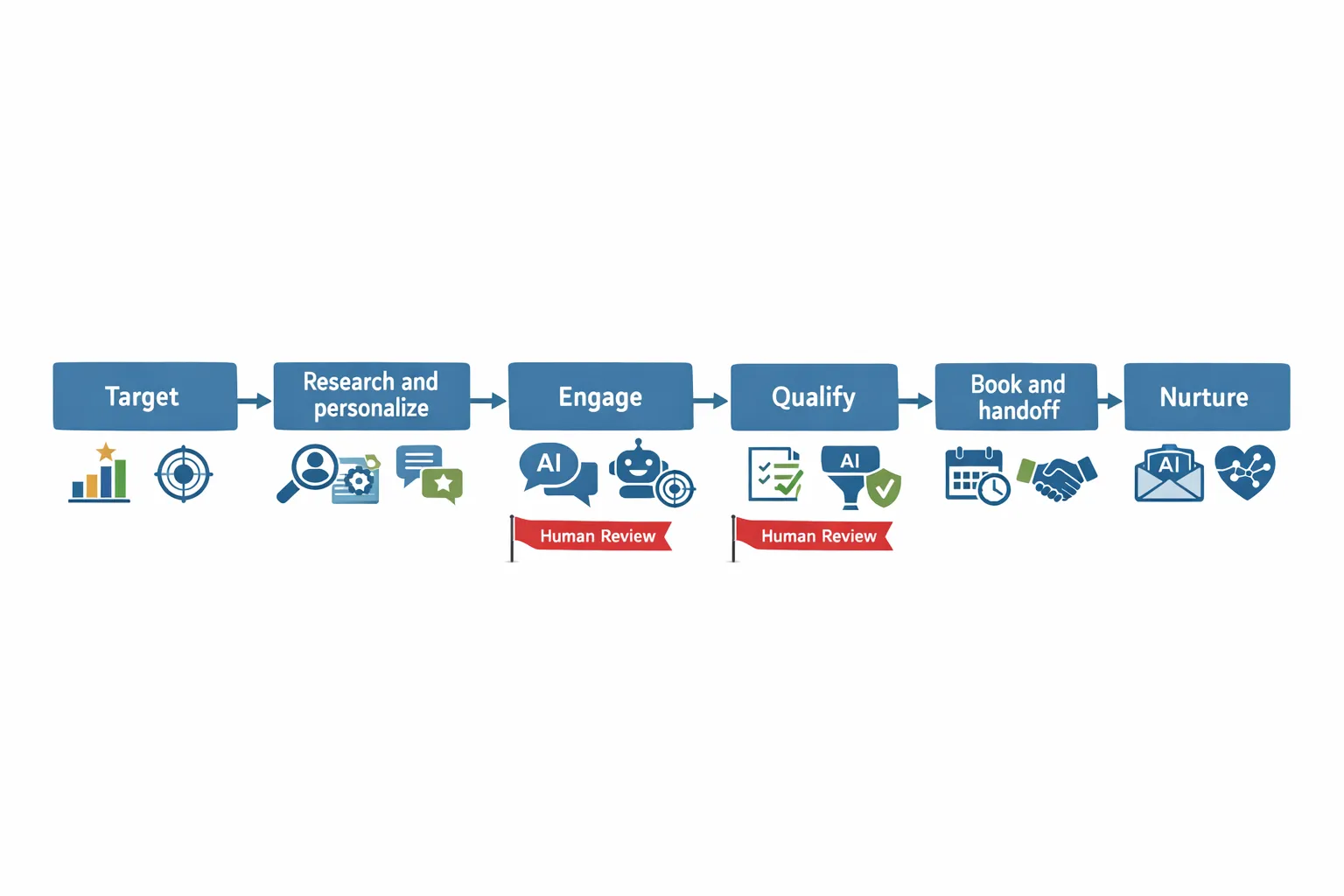
The keys are context, scoring, and escalation. AI should adapt to a prospect’s profile and recent activity, track qualification signals over multiple turns, then escalate to a human or calendar when a confidence threshold is met.
Data, prompts, and policies, the three pillars of reliable automation
Most failed automation comes from weak inputs or vague rules. Set up three pillars before you scale volume.
- Data, define your ICP and triggers in plain language and examples. Titles, seniority, industries, headcount bands, tech stack clues, hiring patterns, funding rounds, or role changes. Give the AI examples of perfect and poor-fit profiles to reduce noise.
- Prompts, standardize how the AI writes and reasons. Establish one prompt for first touch, one for objection handling, one for qualification, and one for handoffs. Keep them modular so you can A or B test variants without rewriting everything.
- Policies, write guardrails the system must follow. Respect opt-out signals, avoid sensitive topics, never push for budget in the first message, cap daily touches per account, and enforce brand voice rules like tone, length, and banned phrases.
A small set of clear examples and rules beats a library of ad hoc instructions. Your prompts should tell the AI when to speak, what not to ask yet, and how to summarize the thread back to your team.
Turning frameworks into thread-safe questions
Whether you prefer BANT, MEDDICC, or SPICED, the job is the same, uncover buying truth without making DMs feel like an interrogation. Translate frameworks into conversational micro-asks and lightweight signals.
| Framework | What to uncover | Thread-safe question examples | Signal to score |
|---|---|---|---|
| BANT | Budget, Authority, Need, Timing | Would a small pilot be realistic if the fit is clear, Who besides you would join a quick discovery, If we solved X, what would that replace this quarter | Budget readiness, stakeholder map, problem severity, timeframe |
| MEDDICC | Metrics, Economic buyer, Decision process and criteria | If outcome Y was achieved, how would you measure it, When new tools get approved, what is the usual path, What matters most when you pick a vendor | Success metric, economic buyer identified, process clarity, criteria |
| SPICED | Situation, Pain, Impact, Critical event, Decision | Noticed Z from your team’s posts, is that priority now, What happens if this waits until Q3, Any upcoming milestone where this must be sorted | Pain intensity, impact magnitude, deadline pressure, decision owner |
The AI should probe one or two items per turn, never all at once, then summarize what it learned and update the score. When the score passes your threshold, offer two time slots and confirm an agenda.
Autonomy levels and when to apply them
A staged autonomy model keeps risk low while proving value.
| Level | Description | Human oversight | KPI gate to graduate |
|---|---|---|---|
| 0, Assist only | Drafts messages and summaries, no sending | Manual review of every send | Quality bar on tone and accuracy |
| 1, Semi-automated | Sends first touch on approved lists | Spot checks and objection escalation | Positive response rate above baseline |
| 2, Qualified handoff | Handles objections and asks light qualification, books on invite | Review all qualified summaries | Meeting rate and no-show rate within target |
| 3, Autonomous threads | Manages end to end through booking for defined segments | Sample audits, override on demand | Pipeline contribution sustained and brand compliance |
Start conservative in high-value segments. Expand autonomy where message quality and compliance hold up.
Analytics that actually steer pipeline
Dashboards should help you decide what to change next, not just count sends. Track these definitions so your team speaks one language.
| Metric | Definition | Why it matters |
|---|---|---|
| Acceptance rate | Connection requests accepted divided by requests sent | Measures list quality and opener relevance |
| First response rate | Prospects who reply at least once divided by accepted connections | Validates first-touch value and timing |
| Qualified conversation rate | Threads that reach your qualification threshold divided by replies | Shows the AI is asking the right questions |
| Meeting rate | Booked meetings divided by replies | Core outcome, confirms CTA friction is low |
| Median turns to qualification | Average number of back-and-forth messages until qualified | Helps tune pacing and question order |
| Stall rate | Percentage of threads with no reply after your last message for X days | Reveals where follow-ups or value are weak |
| Disqualification reasons | Coded reasons per thread, such as timing, budget, wrong role | Informs routing and future segmentation |
Set review cadences weekly, then adjust prompts and targeting like a product team. When one segment shows stronger unit economics, allocate more capacity there.
A 30-day pilot you can run now
- Define one ICP slice and one trigger such as new VP of Sales hired in the last 90 days.
- Write minimal prompts, one for first touch, one for objection handling, one for qualification, and one for booking.
- Create two variants of your opener for A or B testing, such as job-story vs proof-first.
- Cap outreach at a safe volume and require human approval on the first 50 sends.
- Enable escalation rules, human override on complex objections, and a handoff when score exceeds your threshold.
- Review analytics twice per week and prune low-signal triggers or noisy titles.
- Expand to autonomy level 2 for the same segment if reply quality and brand tone hold.
- Document learnings, then clone the playbook into the next segment.
For a tactical walk-through of cadences and copy, see our LinkedIn Prospecting Playbook. For a deeper look at the conversation workflow and rollout planning, our AI SDR guide outlines targeting, engaging, qualifying, and booking.
Compliance and brand safety by design
LinkedIn is a relationship network, so long-term reputation matters. Bake compliance into your system from day one.
- Respect human-like pacing and reasonable daily limits. Avoid behaviors that look like bulk blasting.
- Always include a polite opt-out in early messages. Honor and log opt-out responses.
- Keep messages concise, plain spoken, and specific to the prospect’s context. Avoid over-claiming results.
- Avoid sensitive topics and do not request confidential information in DMs.
- Store conversation data responsibly and restrict access to only those who need it.
Your guardrails should live in prompts and in your operations checklist, so they are enforced automatically and reviewed routinely.
Prototype fast, prove value, then scale
Many teams get stuck in POCs that look great in a slide but never move the revenue needle. Run short experiments that connect to business outcomes such as qualified conversations and meetings booked. If you want a structured approach to prototyping with measurable ROI, this overview on turning an idea into a profitable prototype explains how to frame the problem, build something usable quickly, and evaluate impact with less risk.
How Kakiyo operationalizes AI sales automation on LinkedIn
Kakiyo is purpose-built to manage personalized LinkedIn conversations end to end, so your SDRs can focus on high-value opportunities instead of repetitive back-and-forth.
- Autonomous LinkedIn conversations, the system engages from first touch through qualification and meeting booking within your guardrails.
- AI-driven lead qualification, prompts map to your framework and capture signals in-thread, then summarize fit and next steps.
- Customizable prompt creation, standardize tone and logic and adapt by segment without rebuilding flows.
- A or B prompt testing, compare openers or objection approaches by segment and promote winners quickly.
- Industry-specific templates, start with patterns tuned for common B2B motions and personalize to your ICP.
- Intelligent scoring system, quantify fit and urgency so escalation and booking happen at the right moment.
- Simultaneous conversation management, keep hundreds of threads moving, without dropping a response or repeating yourself.
- Conversation override control, jump into any thread in real time, then return control to the AI when ready.
- Centralized real-time dashboard, see acceptance, replies, qualification signals, and booking outcomes by segment.
- Advanced analytics and reporting, investigate what changed by prompt, ICP slice, trigger, or rep to improve week over week.
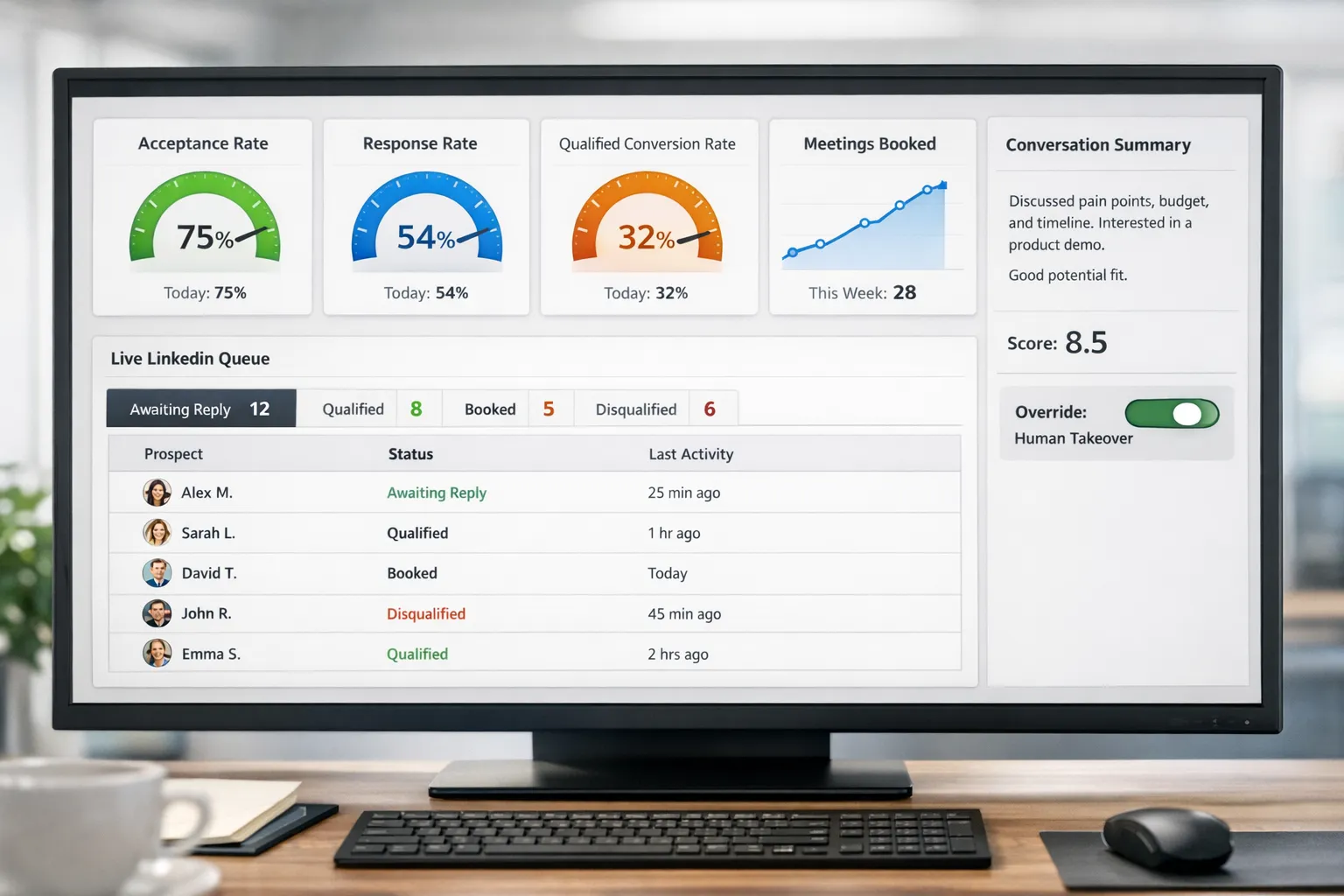
With these capabilities, teams can run controlled pilots, learn fast, and then scale the segments that generate pipeline with the best unit economics.
Frequently asked questions
What is AI sales automation for prospecting and qualification? It is the use of AI to research prospects, start and sustain conversations, ask thread-safe qualification questions, score fit and urgency, then book meetings when a threshold is met, all with clear guardrails and human override.
Does this replace SDRs? No, it removes repetitive tasks so SDRs spend more time on high-value conversations, strategic accounts, and meetings that move deals forward.
How does the AI keep messages human and relevant? It uses profile context and recent activity to personalize openers, follows brand tone rules, and asks small, specific questions one step at a time.
Which qualification frameworks work best? BANT, MEDDICC, and SPICED all work if you translate them into simple, conversational questions and score signals across turns instead of interrogating in one message.
How do we measure success without vanity metrics? Track acceptance rate, first response rate, qualified conversation rate, meeting rate, median turns to qualification, stall rate, and disqualification reasons by segment.
What if a conversation becomes complex or sensitive? Use override control to take over instantly, then hand the thread back to the AI once the issue is resolved.
Put AI to work on your LinkedIn pipeline
If you want your team focused on high-value opportunities while AI handles the repetitive parts of prospecting and qualification, Kakiyo can help. Run a pilot on a single ICP and trigger, validate results with built-in testing and analytics, then scale the segments that convert. Request a walkthrough at kakiyo.com.