
 Ilan Asseo
Amazon SDR Job: Interview Loop, Skills, and KPIs
This post covers what to expect in an Amazon SDR interview, key skills needed, and essential KPIs to discuss.

Sales reps spend shockingly little time doing the job they’re paid for. Salesforce reports sellers spend just 28% of their week actually selling, with the rest eaten by admin, research, and follow-ups that never convert.
An Amazon SDR job interview is designed to catch whether you can operate in that reality: high volume, high standards, measurable outcomes, and crisp judgment.
Industry evidence: Salesforce Research reports that sales reps spend only 28% of their week actually selling, with the rest consumed by deal management, data entry, and other non-selling work.
Source: Salesforce State of Sales
What is an Amazon SDR job?
An Amazon SDR job (Sales Development Representative) is an entry point into Amazon’s sales org where you generate and qualify early-stage opportunities. You’ll prospect accounts, run first-touch outreach, manage multi-step conversations, qualify based on fit and intent, and book meetings for Account Executives. Performance is measured by downstream outcomes (qualified meetings, pipeline influence) as much as activity.
Amazon SDR interview loop (what to expect)
Amazon interview loops vary by org (AWS, Amazon Business, Ads, etc.), but the structure is consistent: they test for writing clarity, structured thinking, and Amazon’s Leadership Principles.
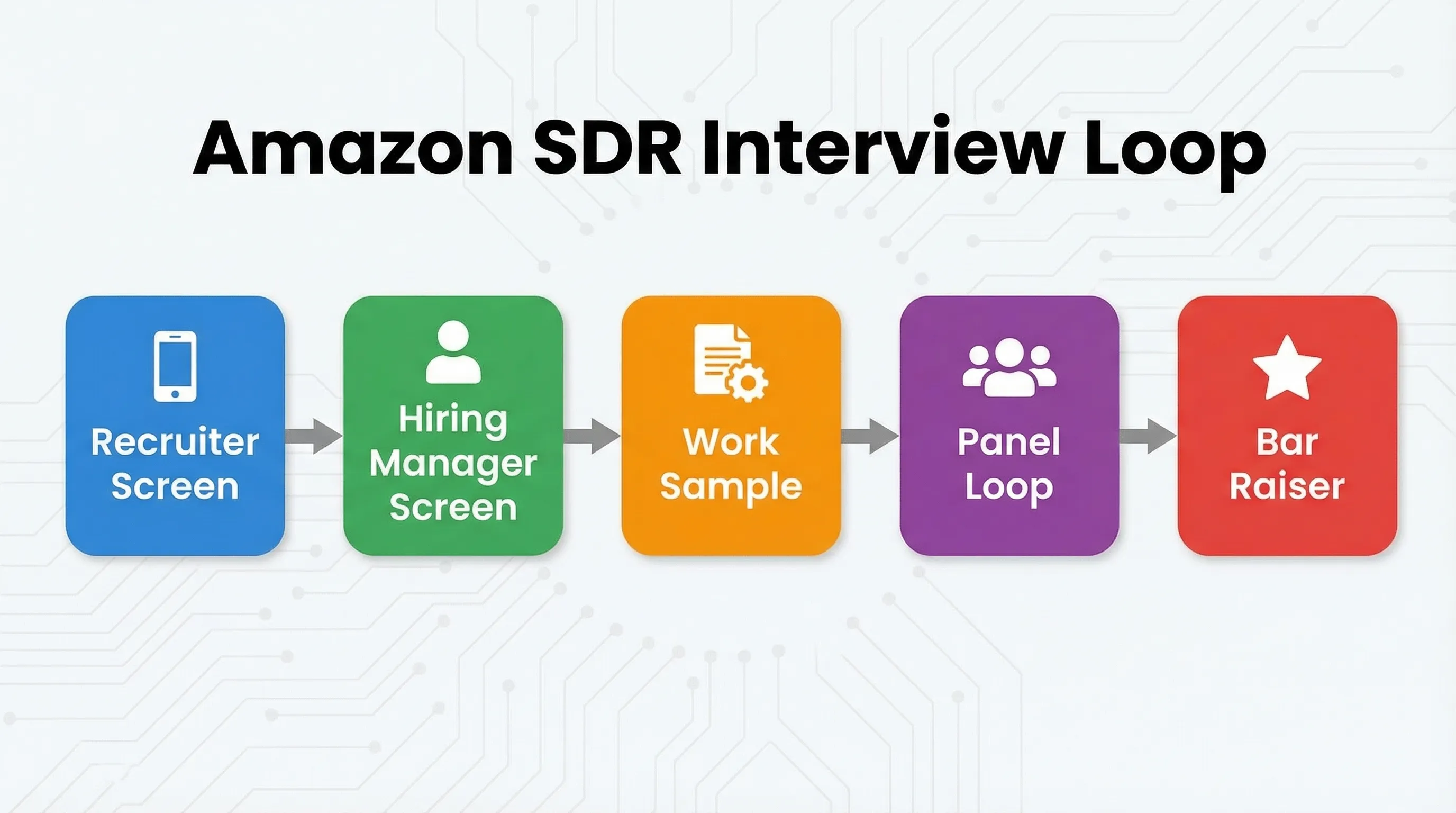
A typical loop looks like this:
- Recruiter screen (20 to 30 min): Motivation, basics of the role, compensation bands, location, and a quick behavioral question or two.
- Hiring manager screen (30 to 60 min): Your prospecting approach, how you qualify, how you handle rejection, and whether you can tie your stories to Leadership Principles.
- Work sample (common): Role-play outreach + qualification, write a prospecting message, or build a mini account plan.
- Panel loop (often 3 to 5 interviews): Behavioral interviews mapped to Leadership Principles, plus at least one deep dive on metrics and execution.
- Bar Raiser (common at Amazon): An interviewer trained to uphold hiring quality and calibration across teams.
Amazon is explicit that it hires against its Leadership Principles and evaluates candidates with behavioral evidence, not opinions. Read the principles and build stories that map cleanly to them on the official page: Amazon Leadership Principles.
The KPIs Amazon SDR interviewers actually care about
Don’t bring a list of vanity metrics. Bring a funnel.
Here’s the KPI set that typically holds up in interviews because it connects activity to outcomes:
- Acceptance rate (LinkedIn connections, email deliverability, list quality): Proves targeting and relevance.
- Reply rate and positive reply rate: Proves message-market fit and basic execution.
- Qualified conversation rate: The percent of conversations that pass your qualification gates.
- Meetings booked and meetings held: Booked is easy to game, held is closer to reality.
- AE-accepted meeting rate: A quality filter that prevents “calendar stuffing.”
- Meeting to opportunity conversion (or pipeline influenced): Proof your meetings turn into revenue work.
- Speed metrics (time to first meaningful response, time to qualification): Shows operational sharpness.
If you want a tighter KPI definition set (formulas, leading vs lagging indicators), use this as a reference: Sales Development Representative: KPIs That Matter.
KPI talk-track that wins interviews
When asked “How do you measure yourself?”, answer in this pattern:
- “I run a micro-funnel: acceptance, reply, qualified conversation, meeting held, AE acceptance.”
- “I optimize top-of-funnel only if downstream quality holds.”
- “I can tell you the one metric I’m trying to move this month and what I changed to move it.”
That’s how operators speak.
The core skills you need for an Amazon SDR job (and how they’re tested)
Amazon will not be impressed by “I’m hungry” or “I’m competitive.” They want repeatable execution and evidence.
Skill 1: Leadership Principle storytelling (STAR, but with metrics)
Most candidates fail because their stories are vague.
Your best stories include:
- A baseline metric (reply rate, meetings held, pipeline created)
- The constraint (bad data, wrong persona, low intent market)
- The change you made (ICP slice, message test, qualification gate)
- The measured outcome (not just “it worked”)
Skill 2: ICP slicing and account selection
Amazon SDR work is rarely “spray and pray.” You need a defensible way to pick who to contact first.
In interviews, be ready to explain:
- Your ICP definition (firmographics + persona)
- 3 disqualifiers you apply fast
- How you prioritize within a territory (intent, triggers, installed tech, org changes)
Skill 3: Conversation-first qualification
This is where modern SDRs separate.
You should be able to describe your qualification approach as evidence capture, not “discovery.” A strong pattern is Fit + Intent + Next step clarity.
If you want a clean, proof-based way to talk about this, this framing holds up well in interviews: A Lead Is Not a Qualified Prospect: Proof-Based Qualification.
Skill 4: Objection handling without pressure
Amazon SDRs typically sell into smart buyers with lots of alternatives.
Good interview answers show:
- You acknowledge the objection
- You ask one clarifying question
- You offer a low-friction next step (a doc, a benchmark, a short call)
Skill 5: Experimentation discipline
You do not need to say “A/B testing” fifty times. You need to show you can run clean tests.
A credible answer:
- One variable changed (opener, proof, CTA, qualification question)
- A minimum sample size goal
- A decision rule (what wins, what gets killed)
Tools that help you hit Amazon SDR KPIs (without drowning in admin)
LinkedIn is a major channel in modern SDR motions, and LinkedIn itself reports it has over 1 billion members globally, which means your buyers are there, but so is your competition. Source: LinkedIn About.
Below is a practical tool set that maps to the work Amazon SDRs are evaluated on: managing conversations, qualifying cleanly, and booking real meetings.
| Tool Name | Best For | Key Feature | Starting Price |
|---|---|---|---|
| Kakiyo | Autonomous LinkedIn conversations and lead qualification | AI manages multi-turn threads, scores leads, books meetings | Contact sales |
| LinkedIn Sales Navigator | Targeting and account insights | Advanced search, lists, alerts | From $99.99/month (plan-based) |
| Apollo | Prospecting and enrichment | Lead database + sequencing | Free plan available (paid plans vary) |
| Outreach | Enterprise sequencing and task workflows | Multi-channel sequences + governance | Contact sales |
| Gong | Call recording and deal insights | Conversation intelligence + coaching | Contact sales |
| Calendly | Scheduling that reduces no-shows | Fast booking links + routing | Free plan available (paid plans vary) |
Kakiyo
What it does: Kakiyo autonomously manages personalized LinkedIn conversations end-to-end, from first touch through qualification to meeting booking. Instead of just sending messages, it runs the actual multi-turn thread so SDRs step in only when a lead is truly worth human time.
Standout feature: Autonomous conversation management with an intelligent scoring system that qualifies leads and pushes clean meetings to your calendar.
Who it’s for: SDR teams and revenue leaders who want LinkedIn to produce qualified meetings without inbox babysitting.
Pricing: Contact sales.
Pros:
- Runs the full LinkedIn conversation (not just connection requests and follow-ups)
- Built-in qualification and scoring to protect AE time
- Supports controlled experimentation (prompt creation and A/B testing) with oversight
Cons:
- Not a fit if your motion is mostly phone-heavy with minimal LinkedIn
- Requires you to define qualification gates clearly to get the best results
LinkedIn Sales Navigator
What it does: Sales Navigator helps you build lead and account lists, monitor triggers, and keep targeting tight. It’s the cleanest way to reduce wasted outreach volume by focusing on the right people.
Standout feature: Saved searches and alerts that keep your territory fresh without constant manual research.
Who it’s for: Any SDR who prospect on LinkedIn and needs repeatable list building.
Pricing: From $99.99/month (plan-based). Confirm current pricing here: Sales Navigator pricing.
Pros:
- Strong filtering for persona-based targeting
- Alerts help with timely, trigger-based outreach
- Native to LinkedIn workflows
Cons:
- Does not manage conversations for you
- Costs add up across large SDR teams
Apollo
What it does: Apollo combines contact data with outbound workflows so SDRs can find prospects, enrich records, and run sequences. It is often used to stand up outbound fast when you need a single system for list-building plus outreach.
Standout feature: Prospecting database tightly connected to outbound execution.
Who it’s for: SDRs who need a budget-friendly prospecting and outbound base layer.
Pricing: Free plan available (paid plans vary by tier and seat).
Pros:
- Quick to go from list to outreach
- Useful enrichment for basic segmentation
- Good value for smaller teams
Cons:
- Data coverage varies by segment and geography
- Sequencing is not the same as real-time conversation management
Outreach
What it does: Outreach is a sequencing and workflow platform that helps teams standardize touches, tasks, and follow-ups across channels. It’s built for governance, scale, and manager visibility.
Standout feature: Enterprise-grade sequencing with operational controls.
Who it’s for: Larger orgs that want consistent outbound execution and reporting.
Pricing: Contact sales.
Pros:
- Strong workflow standardization across SDR teams
- Mature reporting and admin controls
- Integrates into common CRM setups
Cons:
- Requires ongoing ops work to keep sequences clean and effective
- Still depends on humans to manage multi-turn buyer conversations well
Gong
What it does: Gong records calls, analyzes conversations, and helps teams coach to better outcomes. For SDRs, it’s most valuable for improving meeting quality and talk tracks once meetings are booked.
Standout feature: Coaching insights tied to real call moments, not opinions.
Who it’s for: Teams that want to improve meeting-to-opportunity conversion and reduce “bad meetings.”
Pricing: Contact sales.
Pros:
- Speeds up ramp time with real examples
- Helps managers coach with evidence
- Useful for improving handoffs and discovery patterns
Cons:
- Does not generate pipeline by itself
- Value depends on consistent usage and call volume
Calendly
What it does: Calendly removes scheduling back-and-forth and improves booking speed. It is simple, but it directly affects show rates and time-to-meeting.
Standout feature: Fast scheduling links with routing options.
Who it’s for: Any SDR booking meetings at volume.
Pricing: Free plan available (paid plans vary by tier).
Pros:
- Reduces friction in booking
- Standard in most B2B buying motions
- Helps enforce clean scheduling hygiene
Cons:
- Doesn’t improve qualification quality on its own
- Can increase “junk meetings” if you lack gates
How to prep for the Amazon SDR job interview (operator-grade)
Build a “Leadership Principles story bank”
Aim for 6 to 8 stories that map to multiple principles. Each story should have a metric baseline and a measurable outcome. If you cannot quantify the result, quantify the process change (sample size tested, time saved, conversion lift, reduced cycle time).
Bring a simple funnel snapshot
Have a one-slide mental model you can explain without a deck:
- Your ICP slice
- Your outreach channels
- Your micro-conversion targets
- Your qualification gate
- Your meeting quality definition
Be ready for a writing exercise
Amazon values crisp writing. If asked to write an outreach message or a follow-up note, optimize for:
- One clear reason you picked them
- One credible proof point
- One low-friction question
If you want reps-ready message structure, this is a solid practice resource: LinkedIn Outreach Messages That Get Replies.
Which tool should you choose?
If you want autonomous AI conversation and LinkedIn lead qualification, use Kakiyo.
If you want the best LinkedIn targeting and trigger alerts, use LinkedIn Sales Navigator.
If you want an all-in-one prospecting database plus basic outbound, use Apollo.
If you want enterprise sequencing governance and workflows, use Outreach.
If you want scheduling that removes friction, use Calendly.
FAQs
Amazon SDR job: what is the interview loop?
Most Amazon SDR interview loops include a recruiter screen, a hiring manager interview, and a panel loop focused on Amazon Leadership Principles. Many teams add a work sample (writing, role-play, or account plan), and some include a Bar Raiser interviewer for hiring calibration.
Amazon SDR job: what skills should I highlight?
Highlight evidence-based prospecting (ICP slicing), conversation-first qualification, objection handling, and experimentation discipline. In Amazon interviews, the difference-maker is tying these skills to measurable outcomes and mapping your stories to Leadership Principles.
Amazon SDR job KPIs: what numbers should I talk about?
Avoid quoting random activity quotas. Talk about a micro-funnel: acceptance rate, reply and positive reply rate, qualified conversation rate, meetings held, and AE-accepted meeting rate. Interviewers care most about whether your inputs predict downstream pipeline quality.
Amazon SDR job: how do I stand out without direct Amazon experience?
Bring operator artifacts: a simple territory plan, two outreach examples (good and improved), and one short experiment you ran with a clear decision rule. Showing structured learning, clean metrics, and strong written communication typically beats brand-name experience.