
 Ilan Asseo
Leads vs Qualified Prospects: Proof-Based Guide
Learn the difference between a lead and a qualified prospect with a proof-based qualification framework, scoring criteria, and practical examples.

Pipeline problems often masquerade as lead problems.
When dashboards show “more leads,” teams feel like they are winning. SDRs stay busy. Activity rises. But pipeline does not. AEs start rejecting meetings. Forecast confidence drops.
The root cause is usually simple: a lead is not a qualified prospect. A lead is a name with a possible reason to talk. A qualified prospect is a specific person at a specific account with verified evidence that a conversation is worth time now.
This article lays out a proof-based qualification approach that makes that difference measurable, auditable, and coachable, especially in LinkedIn-first outbound motions.
Industry evidence: “As customers increasingly learn and buy digitally, sales reps become just one of many possible sales channels.” — Cristina Gomez, Managing Vice President, Gartner.
Source: Gartner
Why “more leads” feels like progress (and why it is not)
Leads are easy to count. Qualified prospects are harder.
A lead can exist with almost no truth behind it: a list upload, a form fill, a webinar attendee, a Sales Navigator search result, a profile view, a connection accepted. Those can all be useful starting points, but they are not proof.
If your system rewards volume, you will get volume. The cost is hidden downstream:
- SDRs burn time chasing low-probability conversations.
- AEs get “calendar clutter” and develop skepticism toward SDR-sourced meetings.
- Marketing and sales argue about quality because neither side can point to a consistent evidence standard.
A simple corrective is to stop asking, “Is this person a lead?” and start asking, “What is the proof that this is a qualified prospect?”
Lead vs qualified prospect: the operational difference
A qualified prospect is not a vibe. It is a decision backed by evidence.
Here is a useful way to separate the two in day-to-day execution.
| Dimension | Lead | Qualified prospect |
|---|---|---|
| What you have | Identity and a hypothesis | Identity plus verified signals |
| What is true | “They could be a fit” | “They match our fit criteria” |
| What you can do next | Earn permission to talk | Ask for a specific next step |
| What it should include | Minimal context | Evidence packet (fit + intent + proof + next step + recency) |
| Common failure mode | Treating attention as intent | Treating one signal as a buying process |
A lead becomes a qualified prospect only when you can show proof, not when you feel optimistic.
Proof-based qualification: a definition that survives scale
Proof-based qualification is a standard that answers one question:
Would a reasonable teammate, reading the evidence, agree this is worth time now?
In practice, proof-based qualification means you capture evidence across five areas:
- Fit: they match your ICP slice (company and persona).
- Intent: they demonstrate interest, urgency, or active evaluation.
- Proof: you have verifiable signals, not assumptions.
- Next step: there is a specific, mutually agreed action.
- Recency: the evidence is current enough to act on.
If you already have internal definitions for MQL/SQL/SAL, keep them. The improvement here is to make “qualified” auditable: anyone should be able to point to what was said, done, or observed.
What counts as proof (and what does not)
Proof is any signal that is observable, attributable, and decision-relevant.
Not proof:
- “They are in our target industry.” (fit, but not intent)
- “They accepted my connection request.” (attention, not need)
- “They liked a post.” (weak intent unless paired with context)
- “They downloaded an ebook.” (often ambiguous)
Better proof:
- They confirm a pain, constraint, initiative, or goal in conversation.
- They reference a trigger (new role, funding, tool change, hiring) that plausibly creates urgency.
- They ask a question that signals evaluation (“How do teams typically roll this out?”).
- They agree to a time-bound next step and show up.
If your proof cannot be pointed to in the CRM or the conversation thread, it is not operational.
The Proof Ladder: how to qualify without over-qualifying
One reason teams either under-qualify or over-qualify is that they treat qualification as a single gate. In reality, qualification should match the decision you are making.
Use a simple ladder with three thresholds.
Level 1: Conversation-worthy proof (should we invest more messages?)
This is the threshold for continuing a LinkedIn thread.
Typical proof at Level 1:
- Fit is confirmed (right persona, right account characteristics).
- A plausible trigger exists (role change, initiative, relevant content engagement).
- The prospect responds with anything beyond a brush-off.
Your goal is not to “discover everything.” Your goal is to earn enough permission to ask one crisp qualifying question.
Level 2: Meeting-worthy proof (should we book time?)
This is the threshold for putting something on a calendar.
Typical proof at Level 2:
- Fit is confirmed.
- Intent is explicit or strongly implied (pain, priority, active search).
- The meeting has a purpose the buyer agrees with (not “explore,” but “validate X” or “compare Y”).
If you cannot write a one-sentence meeting purpose without guessing, you are still at Level 1.
Level 3: AE-worthy proof (should we hand off as qualified?)
This is where most teams break.
A meeting can be booked with Level 2 proof, but the handoff should require Level 3 proof: enough context that an AE can pick up the thread without restarting from zero.
Typical proof at Level 3:
- Confirmed problem or goal, in their words.
- Why now (trigger, deadline, risk, initiative).
- Buying group path (who else is involved, or how decisions are made).
- Next step that is specific, time-bound, and accepted.

A proof packet you can require on every “qualified prospect”
To make this consistent, define a minimum evidence packet. If it is missing, the record is not a qualified prospect, even if a meeting is booked.
Here is a practical template that works across outbound, inbound, and LinkedIn.
| Evidence field | What “good” looks like | Example proof sources |
|---|---|---|
| ICP fit | Company and persona match a specific ICP slice | Firmographics, role, stack, geography, segment |
| Problem or goal | Stated in the buyer’s words | LinkedIn thread, call notes, inbound form |
| Why now | Trigger or constraint that makes timing real | Job change, initiative, deadline, tooling change |
| Impact | What happens if it stays unsolved | Risk, cost, time, revenue, compliance, churn |
| Buying path | Who decides and how evaluation happens | “I need to loop in Ops,” “We evaluate in Q2” |
| Next step | Specific action with time bound | “15 min on Thursday,” “Send case study + follow-up” |
| Recency | Evidence is recent enough to act on | Timestamped conversation, last activity date |
This packet does two things.
First, it protects AE time. Second, it protects SDRs from subjective rejections because the handoff is based on fields and proof, not opinions.
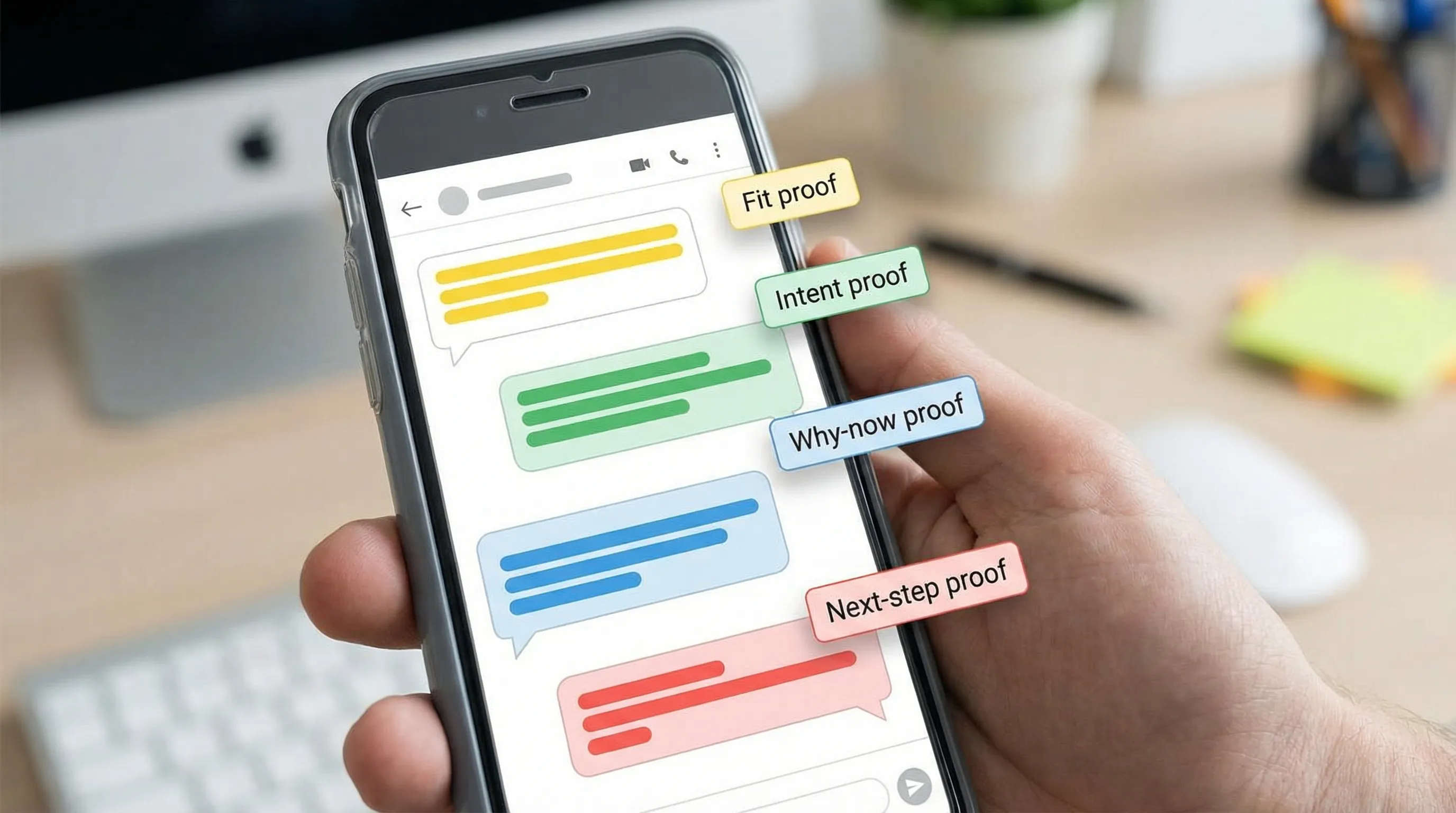
Proof-based qualification on LinkedIn: how to capture evidence inside the thread
LinkedIn is an evidence channel if you treat it like one. The thread itself can contain the proof packet.
A common mistake is to jump from “Thanks” to “Want to see a demo?” That is not qualification, it is calendar gambling.
Instead, use thread-safe proof questions that are short, specific, and easy to answer asynchronously.
Fit proof (fast)
You are trying to confirm you are not wasting both parties’ time.
Examples:
- “Quick check: are you focused on outbound, inbound, or both right now?”
- “Do you own SDR/BDR workflow, or is that RevOps?”
Intent proof (one step deeper)
You are trying to confirm there is an active problem, not just curiosity.
Examples:
- “Is the bigger issue volume of replies, or turning replies into qualified meetings?”
- “What are you using today for LinkedIn conversations and qualification?”
“Why now” proof (the difference between interest and priority)
Examples:
- “Is this a Q1 priority, or more of a ‘nice to fix’ later?”
- “What changed recently that made you look at this now?”
Next-step proof (booking without pressure)
Examples:
- “If I shared a 2-minute outline of how teams qualify in-thread, would it be useful?”
- “Open to a quick 15 min to see whether this fits your workflow, or should I send a short breakdown here?”
Notice the pattern: each question produces evidence you can write down.
How to “prove” qualification inside your CRM (so you can measure it)
Proof-based qualification fails when it lives only in Slack opinions or call chatter. Make it a data model.
At minimum, you want:
- A small set of required evidence fields (aligned to the proof packet above).
- Clear stage entry rules (what must be true to mark “Qualified Prospect” or “SQL”).
- A rejection reason taxonomy that distinguishes “not fit,” “not now,” and “no proof captured.”
This is also how you stop definition drift. If a stage can be entered without evidence, it will be.
If you need a deeper walkthrough on building qualification stages and scoring, Kakiyo’s guide on the lead qualification process is a useful companion.
The metrics that expose whether your qualification is real
If you measure only top-of-funnel activity, you will optimize for activity. Proof-based qualification needs outcome-linked metrics.
Here is a simple scorecard that tells you whether “qualified prospect” means anything.
| Metric | What it tells you | What “bad” often means |
|---|---|---|
| AE acceptance rate | Are handoffs trusted? | Missing proof packet, wrong ICP slice, weak next steps |
| Meeting held rate | Are you booking meetings that happen? | Too early asks, low intent, poor scheduling mechanics |
| Meeting-to-opportunity conversion | Is qualification predicting pipeline? | Discovery is doing the real qualification, SDR is passing leads |
| Time to first meaningful touch | Can you capture intent while it is fresh? | Poor routing, slow reply handling, overloaded reps |
| Qualified conversation rate | Are replies turning into evidence? | No proof questions, pitching too early, unclear definition |
For more on SDR-side metrics that correlate with pipeline quality (not just volume), see SDR KPIs that matter.
Where AI helps, and where it can quietly break qualification
AI can dramatically improve proof-based qualification, but only if it is held to the same evidence standard.
AI helps most when it:
- Maintains multi-turn conversations long enough to collect proof.
- Prompts consistently for missing evidence (fit, intent, why now).
- Captures and summarizes proof into structured fields.
- Runs controlled experiments (message and prompt A/B tests) tied to downstream outcomes.
AI breaks qualification when it:
- Optimizes for replies or booked meetings without measuring AE acceptance or pipeline conversion.
- Hallucinates context, exaggerates claims, or “sounds confident” without evidence.
- Removes human override and governance, which is how spam motions happen.
Kakiyo is designed around this evidence-first workflow on LinkedIn: it can run autonomous LinkedIn conversations, apply an intelligent scoring system, support prompt A/B testing, and keep teams in control via conversation override control, plus a centralized real-time dashboard with analytics. The point is not automation for its own sake. The point is to scale conversations while keeping qualification measurable.
If you want a broader view of responsible automation, Kakiyo’s guide on automated LinkedIn outreach pairs well with this proof-based approach.
A practical calibration ritual: how teams keep “qualified” honest
Most organizations do not fail because they lack a definition. They fail because they stop enforcing it.
A lightweight weekly calibration (30 minutes) prevents drift:
- Pull 10 recent “qualified prospects” at random.
- Review the proof packet fields and the underlying evidence (thread snippets, notes).
- Label each as “qualified,” “premature,” or “wrong fit.”
- Make one concrete fix, such as updating a proof question, tightening an ICP slice, or changing a routing rule.
This is also where A/B testing becomes meaningful: you are not testing for more replies, you are testing for more qualified prospects with proof.
If you need a stricter handoff definition for sales, Kakiyo’s article on Sales SQL criteria and examples can help you set a higher, clearer bar.
Turning the headline into an operating standard
“A lead is not a qualified prospect” becomes real when:
- You define proof thresholds (conversation-worthy, meeting-worthy, AE-worthy).
- You require an evidence packet, not a story.
- You measure quality where it matters (AE acceptance, meeting held, conversion).
- You enforce the standard with weekly calibration.
Leads start conversations. Proof creates pipeline.
If you are scaling LinkedIn-first outbound and want qualification that holds up at volume, explore how Kakiyo manages personalized LinkedIn conversations end-to-end, from first touch to qualification to meeting booking, with governance and analytics built in.
FAQ
What is the difference between a lead and a qualified prospect?
A lead is simply a potential contact or account. A qualified prospect has enough verified fit, intent, and context to justify a next sales step.
What makes qualification trustworthy?
Qualification is trustworthy when it relies on auditable signals, not labels alone. The more evidence a team can verify, the easier it is to align sales, marketing, and RevOps.
Should qualification be based on one score?
Not by itself. Scores are useful summaries, but teams still need explicit criteria around fit, buying signals, and next-step readiness.
How do I implement proof-based qualification in my team?
Start by defining what evidence is required at each stage, then make those signals visible in your workflows. The goal is consistency across inbound, outbound, and partner-sourced leads.