
 Ilan Asseo
Pre-Qualified Business Leads: Quality Signals to Track
Discover key quality signals for pre-qualified business leads, including how to define and categorize them effectively.

“Pre-qualified business opportunity leads” sounds like a shortcut to pipeline. In practice, it often becomes a bucket for contacts who match your ICP on paper but have no real urgency, no access to decision makers, and no verified next step.
The fix is not buying a different list. It is demanding better quality signals, then operationalizing those signals so every lead source (vendors, inbound, outbound, partners) is held to the same evidence standard.
Industry evidence: Gartner’s research on the B2B buying journey shows that consensus creation is now a core buying job, which is why qualification needs buying-group evidence rather than single-contact activity.
Source: Gartner
What “pre-qualified business opportunity leads” should mean (in 2026)
A defensible definition is simple:
A pre-qualified business opportunity lead is a prospect who matches your target profile and has demonstrated intent in a way that can be audited, with enough context to justify a specific next step (usually a meeting).
That is very different from:
- A scraped contact that matches your firmographics
- A lead who clicked an ad once
- A reply that says “send info” with no problem statement
- A “warm intro” with no stated reason for the intro
If you want “opportunity” quality, the lead needs proof, not just labeling.
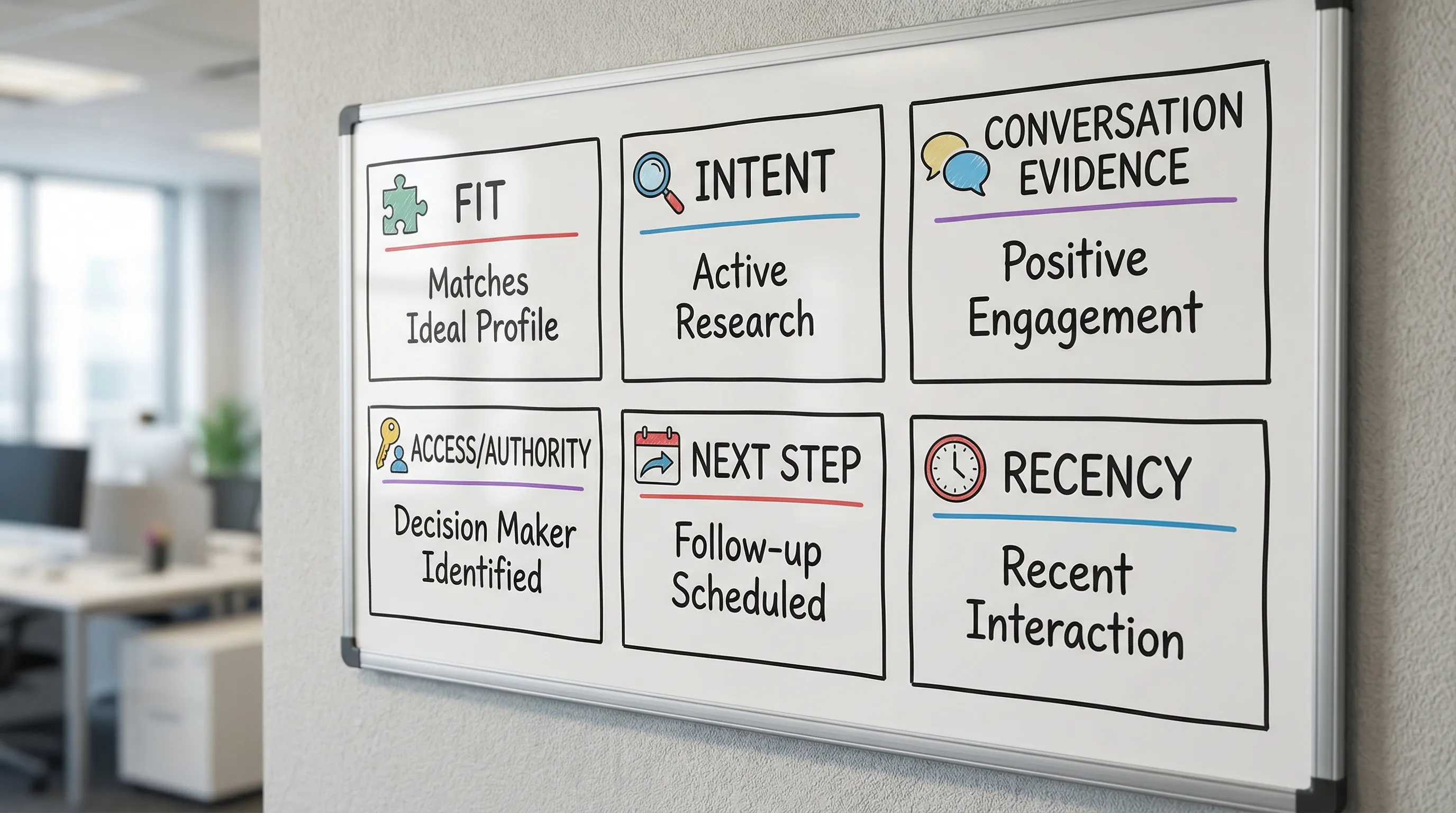
The 6 quality signal categories to demand
Most teams try to qualify with a single score. That is how low-quality leads sneak in. Instead, require signals across categories.
1) Fit signals (can we win here?)
Fit is the least controversial, and also the easiest to fake if it is not specific.
Stronger fit signals include:
- ICP match by industry + size + geography (not just one)
- Clear use case alignment (what they would use you for)
- Role match to your buying group (economic buyer, champion, operator)
- Disqualifiers explicitly checked (for example, “no budget ever,” “must be on-prem only,” “outside supported regions”)
Fit should answer: “Is this the kind of account we close?”
2) Intent signals (do they care right now?)
Intent is where “pre-qualified” usually falls apart.
High-signal intent looks like:
- A stated problem in their own words
- A current initiative (migration, consolidation, cost reduction, new hiring, compliance deadline)
- Trigger events (new leader, funding, tool change, new territory)
- Willingness to engage in a short back-and-forth (not a single vague message)
Be cautious with weak intent:
- “Interested” without a reason
- “Send pricing” without context
- “We are exploring” with no timeline, no stakeholders, no current pain
3) Evidence from conversation (what did they actually say?)
This is the most underused quality signal, and it is the most audit-friendly.
Demand verbatim snippets (or an accurate summary) that capture:
- The job-to-be-done
- The constraint (time, security, budget, integration)
- The current approach (what they do today)
- The consequence of inaction
If you cannot point to a message thread, call note, or form response that proves intent, it is not pre-qualified.
4) Access and authority signals (can you run a real meeting?)
Opportunity-quality leads are not just “people,” they are paths to a buying group.
Signals to require:
- The contact can bring the right stakeholders, or agrees to introduce them
- The lead confirms who owns the area (procurement, IT, RevOps, Finance)
- The lead has the right seniority, or names the decision owner
5) Next-step clarity (is there a committed action?)
A business opportunity is a lead with a mutual next step, not just “good vibes.”
Examples of strong next-step signals:
- Prospect agrees to a meeting with a purpose (“review current workflow and see if X is feasible”)
- Prospect agrees to share key inputs before the meeting (stack, constraints, timeline)
- Prospect confirms the meeting attendees
6) Recency and momentum (is it still real?)
Even good intent expires.
Require:
- A recency window (for example, last meaningful interaction within 7 to 21 days)
- A momentum indicator (reply within the last N messages, meeting booked within N days of qualification)
Recency prevents your team from working “zombie leads” that look qualified in CRM but are no longer active.
A practical “quality contract” for pre-qualified leads
If you buy leads, route leads, or hand off leads, you need a one-page contract that defines what “pre-qualified business opportunity leads” means in your org.
Use a table like this so the definition is enforceable.
| Signal category | What you should accept as evidence | What is not enough | How to capture it consistently |
|---|---|---|---|
| Fit | Firmographics + role match + explicit use case | “SaaS, 200+ employees” only | Required fields + ICP slice tags |
| Intent | Problem statement, trigger, or active initiative | “Interested” | Verbatim snippet or structured summary |
| Conversation proof | 2 to 4 message turns that clarify need | One reply | Thread link, transcript, or summarized bullets |
| Access/authority | Stakeholder identified and path agreed | Title guessing | “Decision owner is X, intro planned” |
| Next step | Meeting purpose + date, or agreed action | “Circle back later” | Calendar event + meeting goal field |
| Recency | Last meaningful interaction date within your window | Old activity | Auto-captured timestamps + decay rules |
If your team already has lifecycle definitions, align this contract with them so you are not creating a parallel system. (If you need a repeatable way to implement qualification end-to-end, see Kakiyo’s guide on lead qualification as a simple, repeatable system.)
The “evidence packet” you should require for every pre-qualified lead
Whether a vendor delivers leads, marketing routes them, or SDRs hand them to AEs, require a consistent evidence packet.
At minimum, every pre-qualified business opportunity lead should include:
- Who: contact, role, account, and buying group notes
- Why now: the trigger or stated pain
- What they want: desired outcome or evaluation goal
- Constraints: tech, security, budget range (if appropriate), procurement realities
- Proof: conversation excerpt, form response, or call note
- Next step: meeting details or agreed action, with dates
This is the difference between “qualified” and “defensible.” It also prevents the common failure mode where SDRs do the work but AEs do not trust the handoff.
What to ask lead vendors (or internal teams) before you accept “pre-qualified”
When someone promises pre-qualified opportunity leads, your job is to turn that promise into testable requirements.
Ask for:
- Their definition of “pre-qualified” in writing, including disqualifiers
- A lead sample (20 to 50) with full evidence packets
- A cohort report: of leads delivered in month 1, what percent became AE-accepted meetings, opportunities, and closed-won
- Source transparency: how leads were generated (channels, targeting method, conversation method)
- Quality controls: how they prevent incentivized mislabeling (for example, paying per meeting can inflate low-quality bookings)
You are not being difficult. You are protecting AE time and forecast quality.
How to measure lead quality without getting fooled
A common mistake is using “meetings booked” as the success metric. Booking volume is easy to inflate.
A better quality label is usually:
- AE-accepted meeting, or
- Meeting held, depending on your motion
Then evaluate each lead source using precision-style metrics.
| Metric | What it tells you | Simple definition |
|---|---|---|
| AE acceptance rate | Sales trust in the leads | AE-accepted meetings ÷ meetings booked |
| Held rate | Whether meetings were real | Meetings held ÷ meetings booked |
| Opportunity conversion | Down-funnel quality | Opportunities created ÷ meetings held |
| Time-to-first-response | Speed, especially for inbound | First response time from trigger |
If you want to go deeper on making scoring auditable and trusted, Kakiyo’s post on qualified leads and scoring that sales trusts lays out an evidence-driven approach.
Where LinkedIn signals can be uniquely valuable
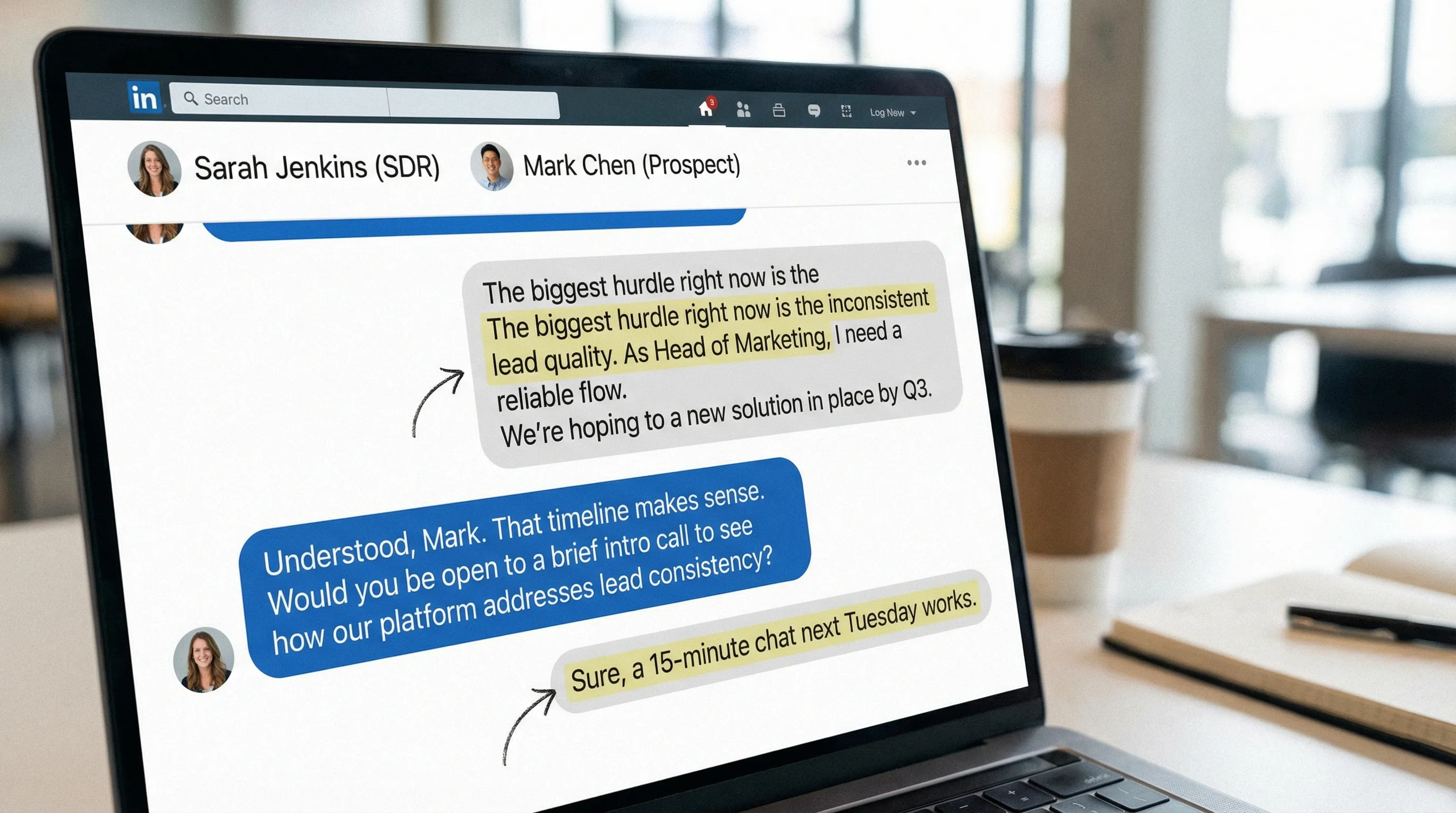
LinkedIn is not just a top-of-funnel channel, it is a conversation channel. That matters because conversation creates auditable proof.
Examples of high-signal LinkedIn evidence include:
- The prospect replies with the current approach (“We use X, it is breaking when…”)
- The prospect confirms ownership (“I run RevOps, happy to explore”)
- The prospect agrees to a scoped meeting (“Yes, 20 minutes to see if this fits our outbound motion”)
This is also why operational discipline matters. If your team cannot manage multi-turn conversations consistently, the evidence quality collapses.
If you are building a more automated system, keep governance in mind, especially around tone, opt-outs, and when to escalate to a human. (Kakiyo’s broader blueprint on automated lead qualification playbooks, tools, and metrics is a useful reference.)
Turning quality signals into an operating system (not a document)
A definition only works if it changes routing, rep behavior, and reporting.
Implement three practical controls:
Routing rules based on evidence, not hope
Make “pre-qualified” a stage that requires specific fields, such as intent summary, proof snippet, next step, and recency. If the fields are blank, it cannot be routed as an opportunity-grade lead.
A weekly calibration loop
Review a small sample (10 to 20) of “pre-qualified” leads each week with SDR leadership and an AE rep.
The goal is not blame, it is calibration:
- Which evidence predicted real opportunities?
- Which evidence was misleading?
- Which disqualifiers should be added?
A/B test the questions that create proof
Most quality comes down to asking better questions in-thread.
Instead of “Interested?”, test prompts like:
- “Curious, are you solving for speed, cost, or compliance this quarter?”
- “What are you using today, and what is the friction?”
- “If this is worth a call, who else should be in the room?”
The key is that each question should produce a signal you can log.
How Kakiyo fits (without changing your whole stack)
Kakiyo is built for teams that want to scale LinkedIn conversations while keeping qualification quality high.
At a platform level, Kakiyo can help you turn “pre-qualified business opportunity leads” into something measurable by:
- Managing autonomous LinkedIn conversations from first touch through qualification to meeting booking
- Applying AI-driven lead qualification with an intelligent scoring system
- Enabling customizable prompts, industry templates, and A/B prompt testing to improve signal capture
- Giving teams conversation override control and a centralized real-time dashboard with analytics and reporting
If your current workflow creates lots of replies but inconsistent qualification, this is exactly the gap to address: converting conversations into auditable evidence packets and booked meetings.
Frequently Asked Questions
What are pre qualified business opportunity leads? Leads that match your ICP and show verifiable intent with enough evidence to justify a specific next step, typically an AE-accepted meeting.
What is the most important quality signal to demand? Conversation evidence. Fit can be purchased in a list, but intent and next-step clarity require proof from an interaction.
How many qualification questions should a “pre-qualified” lead answer? Usually 2 to 4 focused questions are enough to establish need, constraints, stakeholders, and next step. More than that often reduces reply rates without improving quality.
How do I verify a lead vendor’s “pre-qualified” claim? Ask for a written definition, disqualifiers, 20 to 50 lead samples with evidence packets, and cohort outcomes (AE acceptance, held rate, opportunity conversion).
Can AI help generate pre-qualified leads without spamming? Yes, if AI is used to manage multi-turn conversations with guardrails, opt-outs, escalation rules, and measurement tied to quality outcomes, not just volume.
Build a lead standard your pipeline can trust
If you want “pre-qualified business opportunity leads” to actually mean opportunity, start by writing your quality contract, then enforce it with evidence packets and outcome-based measurement.
To see how Kakiyo can manage personalized LinkedIn conversations at scale, qualify prospects, and book meetings with measurable signals, visit Kakiyo.