
 Ilan Asseo
Lead Qualification: A Simple, Repeatable System
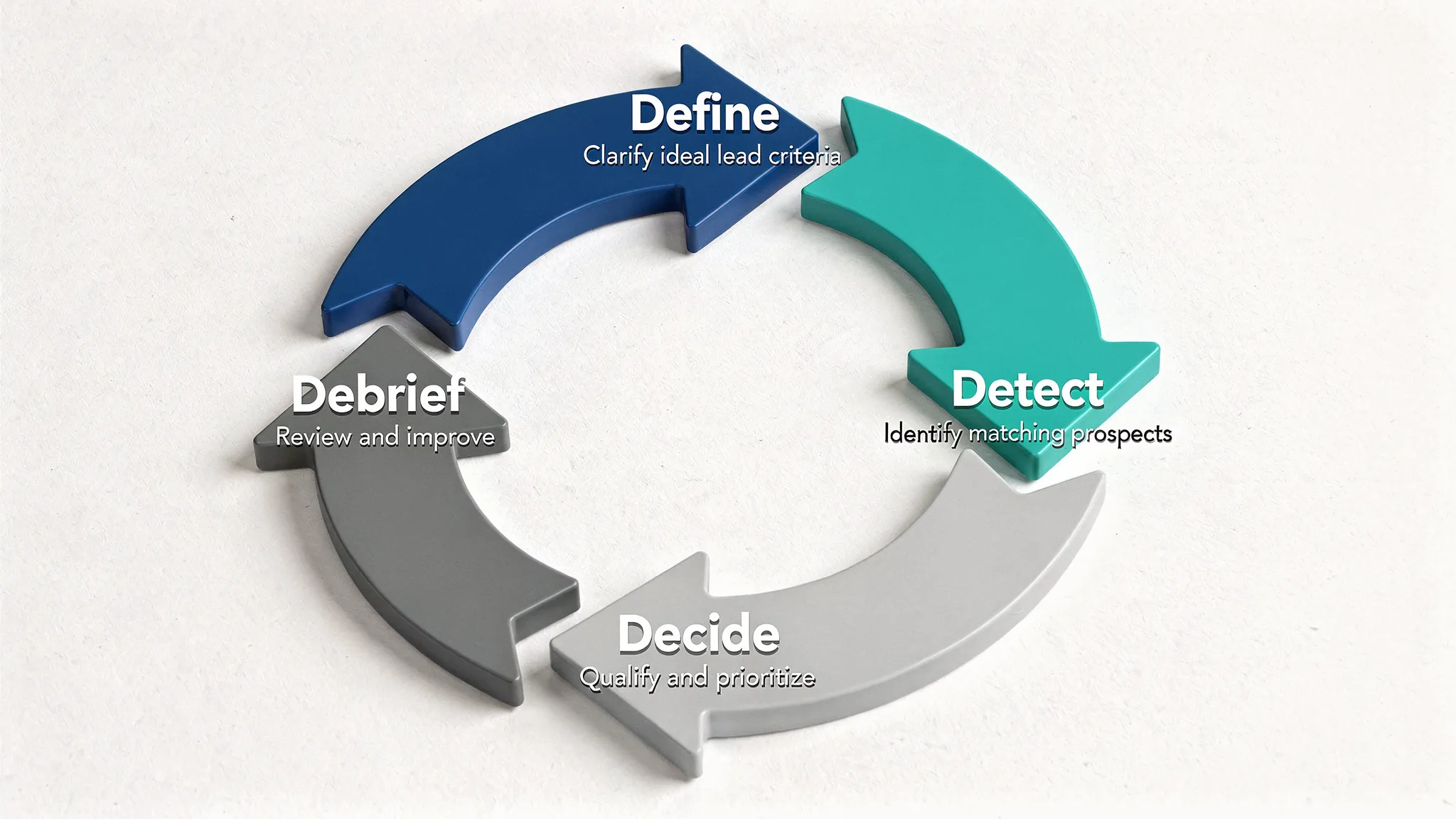
A lightweight, four-part lead qualification system (Define, Detect, Decide, Debrief) to make qualification simple, repeatable, and auditable across.

Lead qualification breaks down for the same reason most “sales processes” break down: everyone thinks they’re doing it, but they’re doing it differently.
One SDR is qualifying based on job title. Another is qualifying based on pain. Another is qualifying because someone replied with a thumbs up.
The fix is not a heavier framework or a more complex scoring model. The fix is a simple, repeatable system that produces the same outputs from the same inputs, no matter who runs it.
Below is a lightweight lead qualification system you can implement across LinkedIn outbound, inbound, and event leads, without turning your team into spreadsheet administrators.
Industry evidence: Salesforce Research reports that sales reps spend only 28% of their week actually selling, with the rest consumed by deal management, data entry, and other non-selling work.
Source: Salesforce State of Sales
What “qualified” should mean (so the system can work)
Before you operationalize qualification, agree on what qualifies someone for the next step in your funnel.
In most B2B motions, the goal of qualification is not “is this a perfect customer?” It’s:
- Should we spend human time here now?
- What is the right next action (book, nurture, route, disqualify)?
- What evidence do we have (so AEs trust it)?
If your team is using “qualified” as a synonym for “interested,” you will book more meetings and create less pipeline.
If you want a deeper definition that aligns with stages like MQL, SQL, and opportunity, reference Kakiyo’s guide on what a Sales Qualified Lead is.
The 4D system: Define, Detect, Decide, Debrief
A repeatable lead qualification system needs four parts. If any one is missing, the system becomes opinion-based again.
1) Define: make qualification auditable (one page)
Your team needs a single, written “qualification contract.” Keep it short enough that an SDR can recall it mid-conversation.
At minimum, define these four items:
ICP boundaries (who it’s for): Industry, company size band, geography, and one or two “must-have” traits.
Disqualifiers (who it’s not for): A short list that prevents time waste. Examples include “students,” “agencies,” “no budget owner exists,” or “not in our supported region.”
Qualification outcome: Exactly what you’re trying to produce. For many outbound teams, a practical outcome is: “A booked meeting with a confirmed problem hypothesis and the right attendee.”
Evidence requirements: What must be true, and what proof is acceptable. This is the part most teams skip, and it’s why AEs reject meetings.
A good test: if someone asks “Why did we qualify this lead?”, you should be able to answer in 20 seconds using evidence captured from the thread, form, or call notes.
| Artifact (keep it simple) | What it answers | Owner | Where it lives |
|---|---|---|---|
| ICP one-liner | “Who is this for?” | Sales + Marketing | CRM notes + enablement doc |
| Disqualifier list | “Who do we drop fast?” | Sales | CRM picklist reason codes |
| Evidence checklist | “What do we need to learn or confirm?” | Sales | SDR playbook |
| Action rules | “What do we do next?” | RevOps + Sales | Routing logic + SDR SOP |
2) Detect: collect the minimum signals that actually predict outcomes
Most teams collect too many signals (noise) and miss the few that matter (proof).
A simple way to structure signals is:
- Fit (are they plausibly a customer?)
- Intent (do they care now?)
- Proof (did we see it in writing, behavior, or confirmed answers?)
You do not need a complex point system to start. You need consistent capture.
Here’s a channel-friendly evidence checklist you can reuse.
| Channel | Fit signals (examples) | Intent signals (examples) | Proof to capture |
|---|---|---|---|
| LinkedIn outbound | Role matches buyer profile, relevant company type | Replies with a problem, asks how it works, requests details | Message excerpts that show pain, current workflow, or meeting acceptance |
| Inbound demo/contact | Form fields align with ICP, business email domain | Mentions a project, timeline, or active evaluation | Form answers, key page path, stated use case |
| Event/webinar | Attended full session, matches target accounts | Asks specific question, engages after event | Q&A transcript, follow-up reply, booked time |
Two important notes:
First, speed matters. Research in lead response management has consistently shown fast follow-up improves conversion odds. A commonly cited reference is Harvard Business Review’s discussion of the short “shelf life” of inbound leads in The Short Life of Online Sales Leads.
Second, proof beats vibes. “Seems interested” is not proof. A forwarded message, a direct quote, a stated constraint, or a clear next step is.
3) Decide: use a simple action matrix (so reps stop guessing)
Once you define what you’re detecting, you need a consistent decision rule.
A practical system is a 2x2 that uses Fit and Intent to trigger the next action.
| Fit \ Intent | High intent | Low intent |
|---|---|---|
| High fit | Book meeting (or route to AE). Capture proof and agenda. | Nurture with a specific hypothesis and recheck trigger. |
| Low fit | Disqualify or route to partner/PLG. Do not book. | Disqualify quickly. |
This matrix seems obvious, but it prevents two expensive behaviors:
- Booking meetings with low-fit leads because the conversation was pleasant.
- Ignoring high-fit leads because they did not use the “right” buying keywords.
What to do in-thread (especially on LinkedIn): You only need a few “thread-safe” questions to place someone in the matrix. Keep them lightweight and easy to answer.
Examples:
- “Curious, are you solving this for your team, or more for clients?” (filters agency/consultant fit quickly)
- “Is this something you’re actively working on this quarter, or just exploring?” (intent + timing)
- “If this is worth a quick look, who besides you typically weighs in?” (attendance quality)
If you want a LinkedIn-specific flow, Kakiyo’s BANT framework guide shows how to do qualification conversationally without interrogating people.
4) Debrief: close the loop weekly (the part that makes it repeatable)
If you do not run a feedback loop, your qualification system becomes stale in 30 days.
A lightweight debrief rhythm looks like this:
- Once per week, review a small sample (10 to 20) of:
- Qualified conversations
- Meetings booked
- Meetings held
- AE-accepted versus AE-rejected
- For each rejected meeting, record one reason code (fit issue, wrong attendee, no problem, no urgency, unclear next step).
- Make one change per week (not ten): tighten a disqualifier, tweak a question, adjust routing, or change the meeting CTA.
That’s it. The goal is not perfection. The goal is controlled improvement.
If you want to tie this to the metrics that matter, see Kakiyo’s breakdown of SDR KPIs that actually predict pipeline.
What “repeatable” looks like in practice (a worked example)
Imagine you run LinkedIn outbound for a B2B SaaS product.
A lead connects and replies: “We’re exploring options. Not urgent.”
A non-repeatable team might:
- Book anyway (because it’s a reply)
- Or drop it (because it’s not urgent)
A repeatable system does this instead:
- Fit check: Are they in ICP? If yes, proceed.
- Intent check: “Not urgent” means low intent right now.
- Action: Place in nurture with a specific next touch tied to a trigger.
- Proof captured: “Exploring options, not urgent” plus any context about the current stack.
The win is not that you “converted” them immediately. The win is that your team did not waste an AE slot, and you created a consistent path to re-engage when intent increases.
Where automation helps (without turning qualification into spam)
Qualification is a conversation problem and a systems problem.
Automation should not replace judgment, but it can standardize the parts humans are least consistent at:
- Following up on time
- Asking the right minimum questions
- Capturing proof in the right fields
- Escalating the right threads to humans
- Running experiments (what question, what CTA, what framing actually lifts qualified conversations)
Kakiyo is built around this exact workflow on LinkedIn: autonomous, personalized conversations that move from first touch to qualification to meeting booking, with controls like prompt customization, A/B testing, scoring, overrides, and centralized reporting.
If your team is already running a LinkedIn-first motion, you can also compare this approach with Kakiyo’s guidance on automated LinkedIn outreach to keep quality and account safety front and center.
Common failure modes (and the quick fixes)
Even a simple system can fail if one of these shows up.
“We qualify based on persona, not problem.”
Quick fix: Require at least one sentence of problem proof before booking. If you cannot articulate the problem hypothesis, you are not qualified yet.
“Meetings get booked, but they don’t hold.”
Quick fix: Tighten the meeting confirmation step. Add one pre-meeting message that restates the agenda in the buyer’s words and confirms attendees.
“AEs don’t trust SDR-qualified leads.”
Quick fix: Standardize the handoff packet. Include:
- Fit reason (why them)
- Intent reason (why now)
- Proof (quote or answer)
- Proposed agenda
“We’re drowning in replies but not getting pipeline.”
Quick fix: Track a qualification conversion, not just reply rate. Replies are a leading metric, not the outcome.
For a deeper treatment of qualification plus routing and automation, Kakiyo’s longer guide on automated lead qualification pairs well with the system above.
Frequently Asked Questions
What is lead qualification in simple terms? Lead qualification is the process of deciding whether a person is a good use of sales time right now, based on fit, intent, and proof. The output is a clear next action (book, nurture, route, or disqualify).
What’s the simplest lead qualification framework that works? A repeatable framework has four parts: Define (ICP, disqualifiers, evidence), Detect (capture fit and intent signals), Decide (use an action matrix), and Debrief (weekly feedback loop to improve).
How do you qualify leads on LinkedIn without being pushy? Ask lightweight, easy-to-answer questions that clarify timing and ownership, then offer a low-friction next step only when intent is clear. Capture proof directly from the thread so the handoff is trusted.
Should I use lead scoring or a qualification matrix? Start with a matrix if your process is inconsistent. Once your definitions and evidence capture are stable, scoring can help you scale and automate routing. The order matters.
Turn qualification into booked meetings (without burning SDR time)
If your team is already generating LinkedIn conversations but struggling to turn them into consistently qualified meetings, Kakiyo helps you operationalize the system above with autonomous LinkedIn conversations, qualification support, meeting booking, and analytics.
Explore Kakiyo at kakiyo.com to see how it fits into your SDR workflow.