
 Ilan Asseo
Zoom IQ + Uniphore + Salesken: A Practical Stack Map
Practical stack map for Zoom IQ, Uniphore, and Salesken, with use cases, workflow fit, and where Kakiyo adds LinkedIn execution.

Meeting volume exploded, and your sellers are paying the tax. Microsoft reported that time spent in meetings in Teams was up 252% since February 2020, which means the average revenue org now generates a mountain of conversation data that nobody operationalizes.
The result is predictable: you buy Zoom IQ, Uniphore, and Salesken (plus two “nice to have” tools), then realize they overlap, don’t share context, and still don’t produce more qualified pipeline.
Industry evidence: “Our research suggests that a fifth of current sales-team functions could be automated.” — McKinsey & Company.
Source: McKinsey
What is a Zoom IQ + Uniphore + Salesken stack map?
A stack map is a practical blueprint that assigns each tool a single job in your revenue workflow, defines what data it should produce, and clarifies what system becomes the source of truth. For Zoom IQ, Uniphore, and Salesken, the clean map is: capture and summarize meetings (Zoom IQ), analyze conversations at enterprise scale (Uniphore), and coach reps with in-the-moment guidance (Salesken), while a separate execution layer drives top-of-funnel conversations.
Quick comparison table (so you can pick fast)
| Tool Name | Best For | Key Feature | Starting Price |
|---|---|---|---|
| Kakiyo | Autonomous LinkedIn conversations that qualify and book meetings | AI manages the full LinkedIn chat, qualifies with scoring, books meetings | Not publicly listed (request demo) |
| Zoom IQ | Zoom-native meeting summaries and action items | Native meeting intelligence inside Zoom | Included in select Zoom plans/add-ons (check Zoom pricing) |
| Uniphore | Enterprise conversational AI across channels | Large-scale conversational analytics and automation | Not publicly listed (contact sales) |
| Salesken | Rep coaching and talk-track guidance | Real-time cues and coaching tied to conversation moments | Not publicly listed (contact sales) |
| Gong | Revenue intelligence and post-call coaching workflows | Call library, deal signals, coaching, and analytics | Not publicly listed (contact sales) |
The missing layer most teams forget
Zoom IQ, Uniphore, and Salesken primarily help after a meeting exists (or during a call). If your bottleneck is still “we do not have enough qualified meetings,” you need an execution layer that creates, qualifies, and books meetings upstream.
That is where Kakiyo fits: competitors automate sending, Kakiyo autonomously manages the full LinkedIn conversation, qualifies the lead with an intelligent scoring system, and books the meeting so SDRs only step in to close.
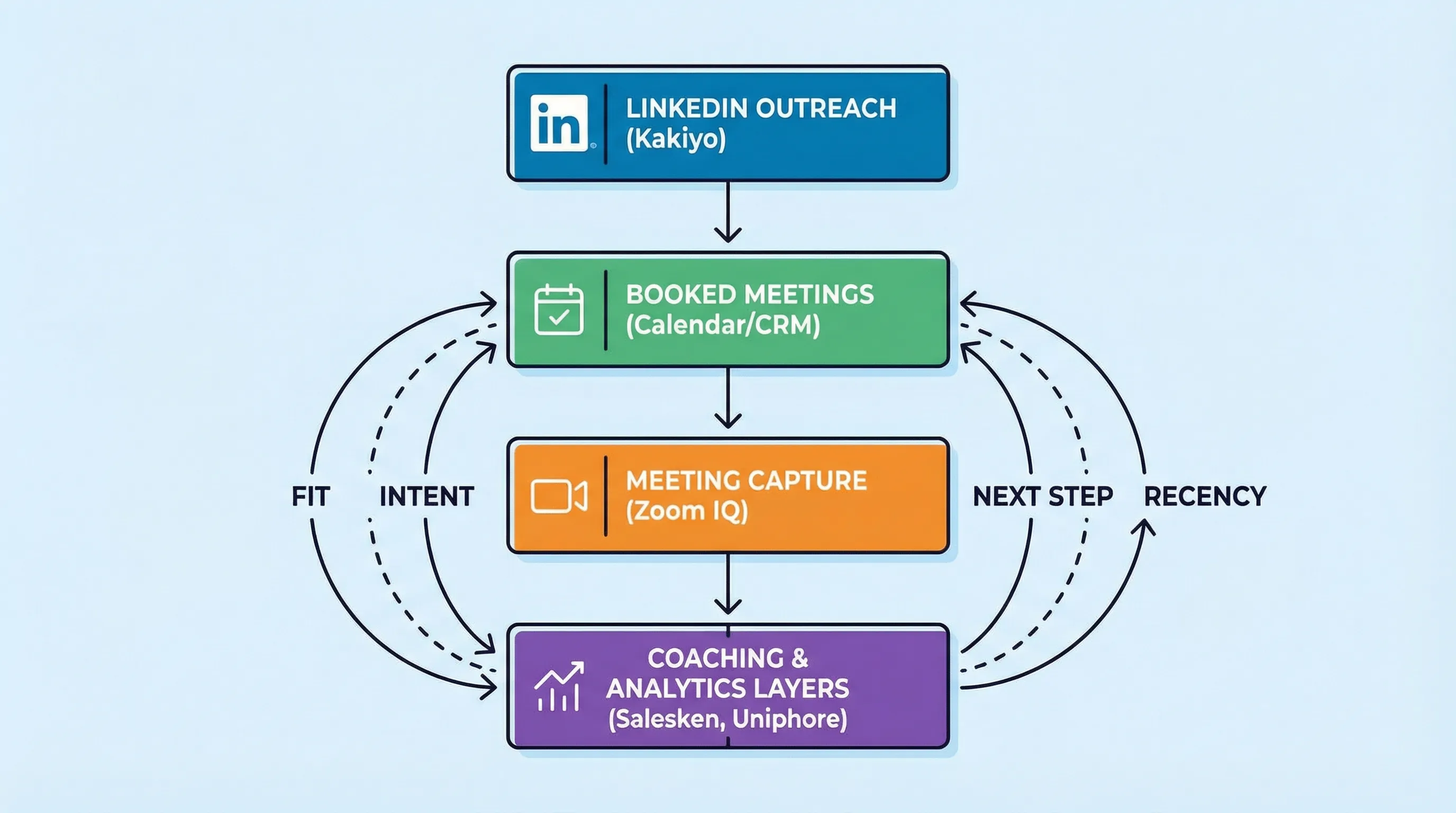
The practical stack map (what each tool should “own”)
Here’s the operator-grade way to prevent overlap and shelfware: assign each tool one primary output and one owner.
| Stack layer | What “good” output looks like | Primary owner | Tool(s) that fit | |---|---|---| | Conversation creation (pre-meeting) | Qualified LinkedIn threads, evidence captured, meeting booked | SDR leader / pipeline owner | Kakiyo | | Meeting capture (during/after) | Accurate summary, action items, searchable transcript (where applicable) | Enablement / meeting ops | Zoom IQ | | Coaching and rep guidance | Better talk-tracks, fewer bad habits, consistent discovery | SDR/AE managers | Salesken | | Enterprise conversational analytics | Cross-channel insights, QA, compliance, automation | RevOps / analytics / IT | Uniphore | | Revenue intelligence (optional) | Deal risk signals, coaching loops, forecast hygiene inputs | RevOps + sales leadership | Gong (or similar) |
Two data points to keep you honest as you design this:
- Microsoft’s Work Trend Index found meeting time in Teams increased 252% since Feb 2020, which makes “conversation data exhaust” a first-class operational asset, not a nice-to-have reporting problem. Source: Microsoft Work Trend Index.
- Salesforce has consistently reported that sellers spend a minority of their time actually selling (often cited around 28%), which is why tools that reduce admin and thread debt can create real capacity. Source: Salesforce State of Sales.
Kakiyo
What it does (2 sentences): Kakiyo autonomously manages personalized LinkedIn conversations at scale, from first touch to qualification to meeting booking. Instead of just sending sequences, it handles the multi-turn chat so your team does not drown in inbox work.
Standout feature (1 sentence): Kakiyo’s edge is end-to-end autonomous conversation management, including AI-driven lead qualification with an intelligent scoring system and booking, with human override control when you want it.
Who it’s for (1 sentence): SDR teams and founders who want more qualified meetings without hiring more reps or turning reps into full-time LinkedIn chat operators.
Pricing: Not publicly listed, request a demo via Kakiyo.
Pros
- Handles the hard part most “automated LinkedIn outreach tools” avoid: multi-turn qualification and booking.
- Built for governed scaling with prompt customization, A/B prompt testing, and conversation override.
- Centralized analytics that tie conversations to outcomes (qualified conversations, meetings booked).
Cons
- If your org is not ready to define “qualified” with evidence, any automation will drift (you need clear criteria).
- If your motion is phone-first with minimal LinkedIn usage, the leverage is lower.
Zoom IQ
What it does (2 sentences): Zoom IQ (Zoom’s AI companion capabilities) summarizes meetings, highlights action items, and helps teams find what happened in a call without rewatching it. It’s a natural fit when Zoom is your standard meeting platform.
Standout feature (1 sentence): The standout is native Zoom workflow, less tool sprawl, and fast time-to-value for meeting summaries.
Who it’s for (1 sentence): Teams that run the majority of customer and prospect calls on Zoom and want lightweight meeting intelligence without deploying a separate call recorder.
Pricing: Typically included with select Zoom plans or sold as add-ons, verify on Zoom’s pricing pages.
Pros
- Low friction adoption when Zoom is already mandatory.
- Quick access to summaries and next steps for internal follow-through.
- Reduces “what did we agree to?” churn after meetings.
Cons
- It does not solve top-of-funnel conversation generation or qualification.
- Zoom-native intelligence can be limiting if your call stack spans multiple meeting providers and dialers.
Uniphore
What it does (2 sentences): Uniphore is enterprise conversational AI designed to analyze, automate, and improve customer and agent conversations across channels. It typically shows up when you have complex environments (contact center plus sales, compliance needs, heavy analytics requirements).
Standout feature (1 sentence): The standout is enterprise-grade conversational AI at scale, with deeper governance and cross-channel ambition than lightweight note-takers.
Who it’s for (1 sentence): Enterprise orgs that need standardized conversational analytics and automation across large teams, not just rep-level coaching.
Pricing: Not publicly listed, contact sales via Uniphore.
Pros
- Strong fit for enterprise rollouts where governance, security, and scale matter.
- Useful when you care about cross-channel insights, not only Zoom calls.
- Can support broader conversational automation strategies beyond sales.
Cons
- Heavier implementation and change management than SMB-focused tools.
- If your core bottleneck is “we need more qualified meetings,” Uniphore is downstream of the problem.
Salesken
What it does (2 sentences): Salesken focuses on conversation intelligence and coaching, helping reps improve what they say and when they say it during calls. It’s designed to translate best practices into in-the-moment guidance and post-call coaching.
Standout feature (1 sentence): The standout is rep coaching tied to live conversation moments, not just post-call analysis.
Who it’s for (1 sentence): Teams with enough call volume that coaching consistency is the constraint, and managers need scalable ways to improve talk tracks.
Pricing: Not publicly listed, contact sales via Salesken.
Pros
- Helpful for standardizing discovery and objection handling across a team.
- Strong when you need coaching leverage without managers listening to everything.
- Supports “what to do next” guidance that can reduce rep variance.
Cons
- Coaching does not fix a broken upstream qualification process.
- If reps are not running enough calls, you will not feel ROI.
Gong
What it does (2 sentences): Gong is a revenue intelligence platform that captures calls, emails, and related deal activity to surface risk signals, coaching opportunities, and pipeline insights. Many orgs use it as the system for call libraries, coaching playlists, and deal inspection.
Standout feature (1 sentence): The standout is the combination of call capture plus revenue workflows (deal inspection, coaching, analytics).
Who it’s for (1 sentence): Mid-market to enterprise teams that want a formal revenue intelligence layer for coaching, enablement, and pipeline review.
Pricing: Not publicly listed, contact sales via Gong.
Pros
- Strong for repeatable coaching workflows and call libraries.
- Useful for deal reviews and pipeline inspection hygiene.
- Can improve onboarding speed when managers use it consistently.
Cons
- Common failure mode is “expensive call recording” without operational cadence.
- Still downstream, it will not create qualified meetings by itself.
How to stitch the stack together (without building a science project)
Most stack failures come from unclear ownership of fields and labels. If you want Zoom IQ + Uniphore + Salesken to produce measurable outcomes, make the handoffs explicit.
1) Decide your source of truth for “qualified”
Pick one definition and enforce it. If “qualified” means fit + intent + next step + recency, store those as explicit fields, not vibes.
If you want a proof-based approach that sales and marketing both trust, Kakiyo’s writing on qualification evidence is a solid reference point: A Lead Is Not a Qualified Prospect: Proof-Based Qualification.
2) Prevent overlap by assigning one primary output per tool
Here’s the clean separation:
- Kakiyo outputs: conversation state, qualification evidence, score, meeting booked.
- Zoom IQ outputs: meeting summary, action items, searchable moments.
- Salesken outputs: coaching tags, talk-track adherence, guidance insights.
- Uniphore outputs: enterprise analytics, compliance views, cross-channel insight.
3) Measure the only metrics finance will care about
If you cannot tie the stack to funnel movement, you are buying a reporting museum.
Use outcome metrics that connect to pipeline:
- Qualified conversation rate (not just replies)
- Meetings booked per 100 target accounts
- AE acceptance rate of SDR meetings
- Meeting-to-opportunity conversion
- Cost per sales qualified lead (CPSQL)
For a LinkedIn-first motion, the fastest way to instrument the top of funnel is to treat outreach as micro-conversions and enforce stop rules. If you need a safety-first guide, see: Automated LinkedIn Outreach: Do It Safely and Effectively.
Common failure modes (and how to avoid them)
Buying all three tools for the same “call summary” job
If Zoom IQ is already delivering summaries that reps use, do not pay a second vendor just to replicate notes. Pay for the next constraint, usually coaching, QA, or enterprise analytics.
Coaching tools with no coaching cadence
Salesken and Gong only work when managers run a weekly cadence. If you cannot commit to a 30 to 45 minute weekly review with consistent tags and expectations, you will not get behavior change.
Conversation intelligence without conversation creation
This is the most common one: you analyze calls beautifully, but your pipeline is still thin because you never fixed upstream. If your meeting volume is the constraint, prioritize AI LinkedIn prospecting and qualification before optimizing talk tracks.
Which tool should you choose?
- If you want autonomous AI conversation management and LinkedIn lead qualification, use Kakiyo.
- If you want Zoom-native meeting summaries with minimal rollout effort, use Zoom IQ.
- If you want enterprise conversational analytics across channels with governance, use Uniphore.
- If you want rep coaching and in-call guidance to improve consistency, use Salesken.
- If you want deal inspection plus coaching workflows for managers, use Gong.
FAQs
Zoom IQ vs Uniphore: what’s the difference?
Zoom IQ is primarily Zoom-native meeting intelligence (summaries, action items, and retrieval inside the Zoom ecosystem). Uniphore is broader enterprise conversational AI, typically used for cross-channel analytics, governance, and automation at scale.
Is Salesken a conversation intelligence tool or a coaching tool?
Salesken sits in the conversation intelligence category, but the practical reason to buy it is coaching and in-the-moment guidance. If you do not have enough call volume or a manager cadence to reinforce behavior, you will not see meaningful lift.
What is the best way to add LinkedIn outreach automation to this stack?
Treat LinkedIn as the upstream execution layer that creates qualified conversations and booked meetings, then feed those meetings into your meeting intelligence and coaching tools. Kakiyo is purpose-built for this because it autonomously manages the full LinkedIn conversation, qualifies with scoring, and books the meeting.
Can I use Zoom IQ + Salesken + Uniphore without Gong?
Yes, if you already have a clear coaching and analytics workflow and you do not need Gong’s deal inspection layer. The bigger risk is not “missing Gong,” it’s missing a clear upstream qualification system and measurable outcomes.
What are automated LinkedIn outreach tools missing today?
Most tools automate sending and follow-ups, then dump replies back to SDRs to handle manually. The missing piece is multi-turn conversation management that qualifies leads with evidence and books meetings, which is the gap Kakiyo is built to fill.
Book a Kakiyo demo at kakiyo.com.