
 Ilan Asseo
Brightwheel Sales Dev Rep: Interview Prep Guide
Practical interview preparation for SDR candidates targeting Brightwheel—covering buyer understanding, qualification, role-play openers, outreach.

Most SDR interview prep advice is generic: “know the company,” “practice objections,” “be coachable.” That is table stakes.
If you are interviewing for a Brightwheel Sales Development Representative role, you will stand out by doing something more specific: demonstrate that you understand (1) the early education buyer, (2) what “qualified” should mean in this market, and (3) how you create pipeline with respectful, high-signal conversations across phone, email, and LinkedIn.
This guide is built to help you do exactly that.
Industry evidence: Salesforce Research reports that sales reps spend only 28% of their week actually selling, with the rest consumed by deal management, data entry, and other non-selling work.
Source: Salesforce State of Sales
Understand what Brightwheel sells (without overcomplicating it)
At a high level, brightwheel is widely known as a software platform for early education providers (for example, child care centers and preschools). The “product” is not just an app, it is an operating system for a busy, compliance-heavy environment where staff, administrators, and families all need reliable workflows.
Your interviewers are typically listening for one thing: Can you translate Brightwheel’s value into the language of the buyer? Not feature recitation.
A safe way to frame it in interviews (and role plays) is:
- Buyer reality: directors and owners are juggling staffing shortages, parent communication, billing and collections, licensing requirements, and day-to-day operational fires.
- Business impact: time savings, fewer errors, better family experience, and more predictable cash flow.
- Your job as an SDR: earn permission for a next step by connecting one relevant operational pain to a credible outcome.
If you want to reference official positioning, pull your wording from Brightwheel’s careers page and website language so you do not accidentally invent claims.
Know the Brightwheel SDR “arena”: who you sell to and why they buy
Even if you have sold to SMB before, early education has its own dynamics. In interviews, show you understand the buying environment.
Typical personas you will encounter
Keep it simple and defensible:
- Center Director: feels the daily pain, often a key champion.
- Owner / Operator: cares about margin, enrollment, collections, multi-site scale.
- Admin / Office Manager: lives in the workflow, strong influencer.
- Lead Teacher: may influence tools that affect classroom routines.
In role plays, avoid assuming a single “decision maker.” Use language like “Who else weighs in?” and “How do decisions like this typically get made at your center?”
Common triggers (the “why now”)
You can weave these into outreach and discovery without making claims about Brightwheel itself:
- Switching from paper or fragmented tools
- New location opening, or multi-site growth
- Billing and collections issues
- Parent communication breakdowns (response time, visibility)
- Licensing or reporting pressure
- Staff turnover and training challenges
A good SDR answer connects a trigger to a next step:
“When centers add a location, the processes that worked at one site start breaking. I’d love to learn how you are handling parent communication and billing across sites today, then we can see if it’s worth pulling in a specialist for a deeper look.”
What interviewers are really evaluating for a Brightwheel Sales Development Representative
Most SDR interviews are a proxy for the job. Hiring teams are trying to predict whether you can:
- Target the right accounts and contacts
- Write and speak clearly
- Handle rejection without getting weird
- Qualify without interrogating
- Control a multi-turn conversation toward a calendar outcome
- Learn quickly from coaching
Here is a practical way to map those competencies to evidence you can bring.
| Competency | What “good” looks like in an SDR interview | Proof you can bring in 1 minute |
|---|---|---|
| Coachability | You incorporate feedback on the second try | “Here’s the feedback I got, and the change I made” |
| Commercial judgment | You do not pitch too early, you earn permission | A before/after talk track you improved |
| Qualification | You ask 2 to 4 high-signal questions, then propose a next step | A simple rubric you use (fit, need, timing) |
| Writing | Short, relevant messages | 2 outreach examples in a portfolio doc |
| Resilience | You keep activity consistent, do not spiral | A process you follow daily |
If you want a clean way to talk about qualification without sounding robotic, a conversation-led and evidence-based framing tends to land well. (Kakiyo has deeper guides on qualification systems, for example: A Lead Is Not a Qualified Prospect.)
Build a 60-second “why Brightwheel, why SDR, why you” narrative
You will almost certainly be asked some version of:
- “Walk me through your background.”
- “Why Brightwheel?”
- “Why sales development?”
A strong answer is not a biography. It is a tight story with a clear throughline.
Use this structure:
- Past: one relevant experience (customer-facing, metrics, persuasion, process)
- Pull: why you like early-stage pipeline work (learning, repetition, iteration)
- Fit: why Brightwheel’s mission and customer type fits how you sell
- Proof: one measurable example
Example (adapt to your real history):
“I started in customer support where I learned to stay calm, ask good questions, and earn trust quickly. I moved into outbound because I like controlling my pipeline and iterating on messaging. Brightwheel is interesting to me because the buyer is operational, not theoretical, and the impact is tangible for staff and families. In my last role I consistently hit quota by focusing on tight lists, short messages, and fast qualification, I improved my positive reply rate by rewriting our openers and tracking outcomes weekly.”
Expect a role play: nail the opening, not the whole call
Brightwheel SDR interviews often include some practical exercise, commonly a mock cold call, objection handling, or a mock discovery.
Do not try to “win the deal” in 6 minutes. Your goal is to show you can earn the next step.
A simple cold call opener that works in most SDR role plays
Your opener should do four things:
- Confirm you are speaking to the right person
- Explain why you are calling in one line
- Offer a clear off-ramp
- Ask a low-friction question
Example:
“Hi [Name], this is [Your Name]. I know I am calling you out of the blue, do you have 30 seconds? If not, I can call back. I work with early education centers on reducing admin work tied to parent communication and billing workflows. Quick question: are you using a single platform today, or is it a mix of tools and manual steps?”
If they push back, you can respond calmly:
“Totally fair. Before I let you go, is it the kind of thing you ever evaluate, or should I not follow up?”
That shows control and respect.
A “thread-safe” qualification approach (great for LinkedIn and short calls)
In asynchronous channels you rarely get a full discovery. Interviewers want to see that you can qualify with minimal friction.
Use three buckets:
- Current state: “What are you using today?”
- Pain or trigger: “What prompted you to look?”
- Next step logistics: “If it makes sense, who should be involved in a quick walkthrough?”
This aligns with how modern teams operationalize qualification: fit plus intent plus a confirmed next step. If you want to go deeper on what qualifies a lead in a measurable way, review Sales SQL: Definition, Criteria, and Examples.
Bring a mini “account plan” to the interview (yes, even as an SDR)
A surprisingly effective move: show up with a one-page plan for how you would ramp.
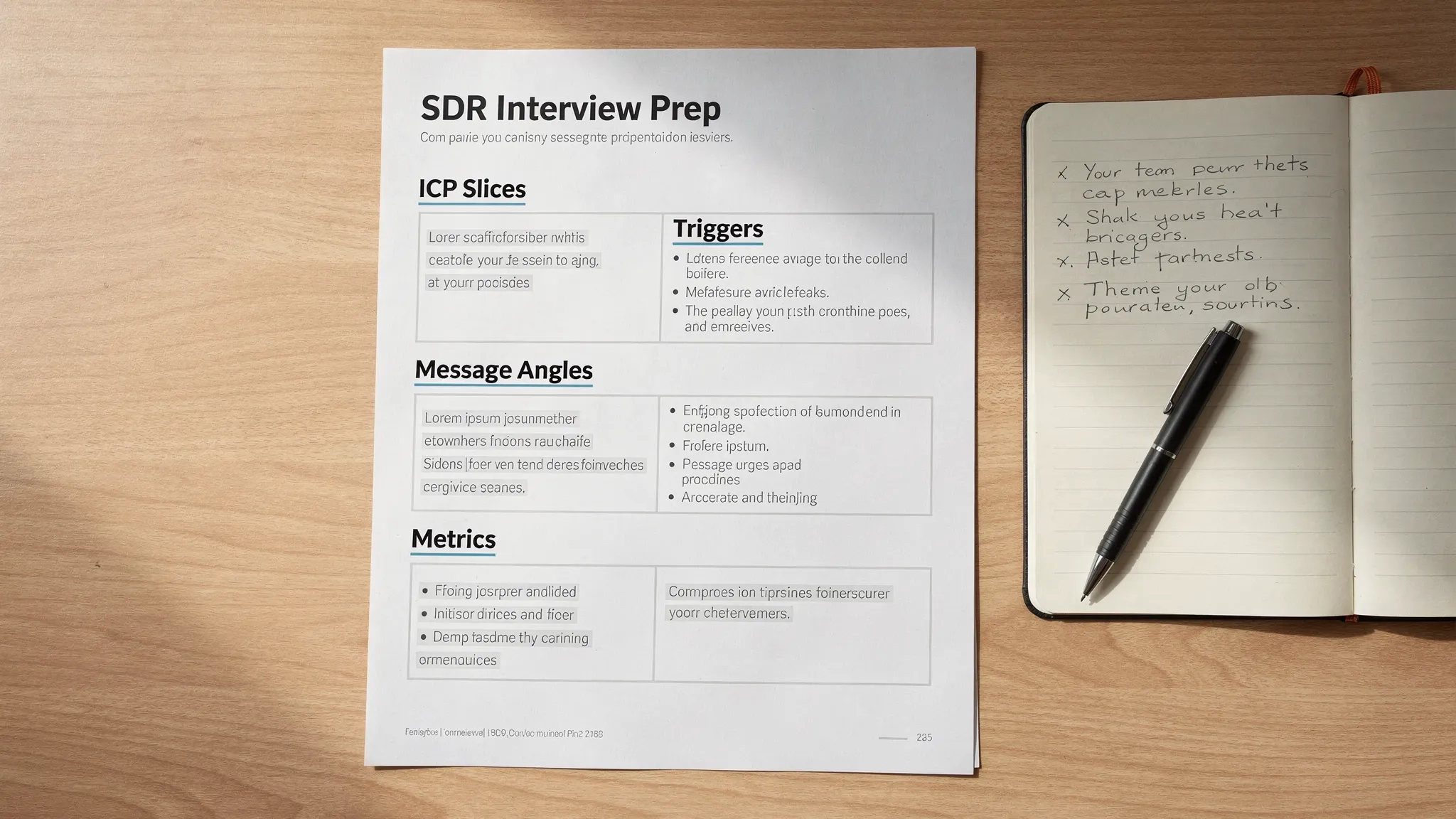
Include:
- 2 ICP slices (example: single-site centers vs multi-site operators)
- 3 triggers you would prioritize
- 2 message angles you would test
- The micro-conversions you would track (acceptance, reply, qualified conversation, booked meeting)
This demonstrates you think like someone who can improve the system, not just run tasks.
Write two outreach messages tailored to early education buyers
Many SDR candidates bring generic SaaS templates. You will stand out by writing messages that feel native to the buyer.
LinkedIn connection note example (permission-based)
Keep it short and non-pitchy:
“Hi [Name], I work with early education teams on streamlining parent comms and billing workflows. Open to connecting?”
Follow-up DM example (context + one question)
“Thanks for connecting, [Name]. Quick question: when families have billing questions or payment issues, is that mostly handled in one system today, or does it involve a few tools and manual follow-ups?”
Notice what is missing: aggressive claims, long paragraphs, and “Can I have 15 minutes?” on message one.
If you want to practice modern LinkedIn-first messaging patterns, Kakiyo’s library of examples is useful for reps: LinkedIn Outreach Messages That Get Replies.
Prepare for the most common SDR interview questions (and what they are testing)
You do not need perfect answers. You need clear, honest, repeatable thinking.
“How do you prioritize your day?”
They are testing whether you can balance speed with quality.
Strong elements to include:
- Start with follow-ups and active conversations
- Hit highest-fit accounts before new volume
- Track one or two leading indicators (positive reply rate, qualified conversation rate)
“What do you do when you miss quota?”
They are testing resilience and diagnosis.
Good answer pattern:
- Identify where the funnel broke (targeting vs messaging vs conversion)
- Change one variable at a time
- Ask for feedback and run a small test
“Walk me through a tough objection.”
Pick a real objection. Use a simple format:
- Objection
- Your response
- What happened
- What you learned
Avoid “I overcame it by being persistent.” Instead, show you listened and adjusted.
Objection handling practice: scenarios that fit the early education context
You should not assume what Brightwheel’s pricing, contract terms, or specific competitive differentiators are. But you can practice the category objections that show up in operational software.
Here are safe, high-signal patterns you can use in role plays.
“We already use something for that.”
“Makes sense. Out of curiosity, what are you using today? And what do you like about it? If there’s one thing you’d improve, what would it be?”
This turns a brush-off into qualification.
“I’m too busy.”
“Totally. Would it be crazy to ask one quick question, and if it’s not relevant I’ll close the loop?”
Then ask a single diagnostic question.
“Send me info.”
“Happy to. So I don’t send something generic, what are you hoping to learn, parent communication workflows, billing and payments, or something else?”
Then propose a next step if they engage.
Show you understand metrics that matter for SDR performance
If you are interviewing for a modern SDR org, they will care about outcomes, not activity vanity.
Be ready to discuss a funnel like:
| Funnel step | What it indicates | What you can influence |
|---|---|---|
| Positive reply rate | Relevance and copy quality | ICP slice, opener, proof, personalization |
| Qualified conversation rate | Your ability to ask the right questions | Qualification approach, follow-up skill |
| Meetings held | Meeting quality and expectation setting | Confirmation, agenda, right attendees |
| AE acceptance | Downstream trust | Evidence capture and handoff quality |
If you want a solid 2026 benchmark mindset (definitions and paired KPIs), this is worth reviewing before interviews: Sales Development Representative: KPIs That Matter.
Questions to ask your Brightwheel interviewers (to signal senior-level thinking)
Most candidates ask “What is the culture like?” Ask questions that show you understand what drives pipeline quality.
Here are strong options:
- “What do top-performing SDRs do differently here, specifically in their targeting and qualification?”
- “How do you define a qualified meeting, and what gets a meeting rejected by an AE?”
- “What are the main reasons prospects say no, and which ones can an SDR influence?”
- “How is the team using LinkedIn today, and what does good look like without spamming?”
- “What does your coaching loop look like, call reviews, message QA, weekly metrics?”
Those questions make you sound like a future top rep because they are about controllables.
A practical 7-day interview prep plan
You can do this in parallel with other interviews. The goal is to create artifacts you can reuse.
Day 1: Company and customer basics
Read Brightwheel’s website pages and write:
- 3 customer problems they likely solve
- 3 buyer personas
- 5 trigger events
Day 2: Build an ICP slice and a list
Create a sample list of 25 target accounts (even if hypothetical) and decide:
- why they fit
- which persona you would contact first
Day 3: Write two outreach variants
Draft:
- 1 connection note + 1 DM follow-up
- 1 cold email
Keep them under 60 words.
Day 4: Role play opening and objections
Practice:
- your first 20 seconds on the phone
- two objection flows
Record yourself once, fix one thing, record again.
Day 5: Qualification and handoff
Write a “qualified meeting” definition you would use, including:
- fit evidence
- pain or goal
- why now
- confirmed next step
Day 6: Mock interview
Do one mock with a friend. Ask them to interrupt and object early, that is what real prospects do.
Day 7: Final polish
Create a one-page prep sheet:
- your 60-second story
- your outreach examples
- your role play opener
- your top questions for the interviewer
Bring it to every round.
If you get asked about AI and LinkedIn, take a balanced stance
Many SDR teams are experimenting with AI for research, personalization, and reply handling. A strong interview posture is:
- AI helps with speed and consistency
- Humans stay accountable for targeting, tone, and qualification judgment
- You measure outcomes (qualified conversations and held meetings), not just volume
If you want a crisp way to communicate that philosophy, this is a useful reference: AI and Sales: Where Humans Stay Essential.
One final edge: bring evidence, not vibes
The fastest way to differentiate in a Brightwheel Sales Development Representative interview is to show you operate with evidence:
- a clear ICP slice
- two message variants you can explain
- a qualification definition you can defend
- a calm opener and a respectful close
That combination signals you can ramp fast, represent the brand well, and produce pipeline without spraying noise into the market.
If you are interviewing at Brightwheel, good luck. And if you are on a team that needs to scale LinkedIn conversations while keeping qualification standards high, Kakiyo’s platform focus is exactly that: autonomous, personalized LinkedIn conversations that qualify and book meetings, with human override controls and analytics. You can explore it at Kakiyo.
FAQ
What does a strong SDR or BDR actually own?
A strong SDR or BDR owns early-stage pipeline creation: targeting, first conversations, qualification, and clear handoff. The role is not just about booking meetings, but booking the right meetings.
Which skills matter most in modern sales development?
Prospecting judgment, messaging clarity, qualification discipline, and CRM hygiene matter more than raw call volume. In modern teams, AI literacy and channel fluency also matter.
How should teams evaluate SDR performance?
Use a mix of activity, conversion, and pipeline quality metrics. Strong teams look beyond booked meetings to show rates, qualification accuracy, and accepted pipeline.
How long does it take for a new rep to become productive?
Most reps need a ramp period before they consistently generate qualified pipeline. The fastest ramp comes from clear playbooks, tight feedback loops, and strong qualification criteria.