
 Ilan Asseo
Cold Outreach: A 7-Day Testing Plan
A disciplined 7-day LinkedIn-first outreach sprint to test one variable at a time and rapidly learn what drives qualified replies and meetings.

Cold outreach works when you treat it like a system, not a guessing game. A short, disciplined sprint can reveal which message angle, call to action, and qualification path actually moves prospects from “seen” to “booked.” This 7-day plan is designed for SDR teams running LinkedIn-first outreach (and it also works if you pair in email), with a focus on fast learning, clean comparisons, and decisions you can defend.
Industry evidence: “As customers increasingly learn and buy digitally, sales reps become just one of many possible sales channels.” — Cristina Gomez, Managing Vice President, Gartner.
Source: Gartner
What this 7-day testing plan is (and isn’t)
It is: a rapid experimentation sprint to improve reply quality and meetings booked by testing one meaningful variable at a time.
It isn’t: a full outbound rebuild, a complex multivariate experiment, or a volume push. If your ICP, list quality, or offer are unclear, fix those first or you will “learn” the wrong things.
Before Day 1: set up the test so results mean something
A week goes fast. Spend 60 to 90 minutes upfront to make sure you are testing, not thrashing.
1) Pick a single outcome and two supporting “micro-conversions”
For cold outreach on LinkedIn, meetings are a lagging indicator. Use micro-conversions so you can make decisions inside a week.
Common choices:
- Primary outcome: qualified conversations started, meetings booked, or meetings held (pick one)
- Micro-conversion 1: first reply rate
- Micro-conversion 2: positive reply rate (intentful reply, not “thanks”)
If you already track a weekly outbound scorecard, align this sprint to it so you do not create a parallel measurement universe. (See: AI sales metrics to track weekly.)
2) Freeze the ICP slice for 7 days
Do not test messaging across a mixed audience. Choose one narrow slice:
- Industry + segment (example: Series B SaaS)
- Persona (example: VP Sales)
- One core pain (example: pipeline coverage)
If you want more coverage, run a second sprint later.
3) Choose a control message you will not change
You need a baseline to compare against, even if the baseline is “pretty good.” If you have an existing working opener, use that. If you don’t, borrow a conservative structure from your current playbooks (without adding new variables).
If you need examples, pull the structure (not the exact copy) from your existing internal scripts or from LinkedIn outreach messages that get replies.
4) Decide what counts as “qualified” in-thread
Cold outreach fails most often at qualification, not at writing. Define what evidence you need before offering a meeting.
Examples of qualification evidence:
- Fit: role and responsibility match
- Need: mentions a relevant problem, initiative, or gap
- Timing: active priority this quarter, or clear trigger
If your team lacks a shared definition, start with a lightweight rubric like the one in Lead qualification: a simple, repeatable system.
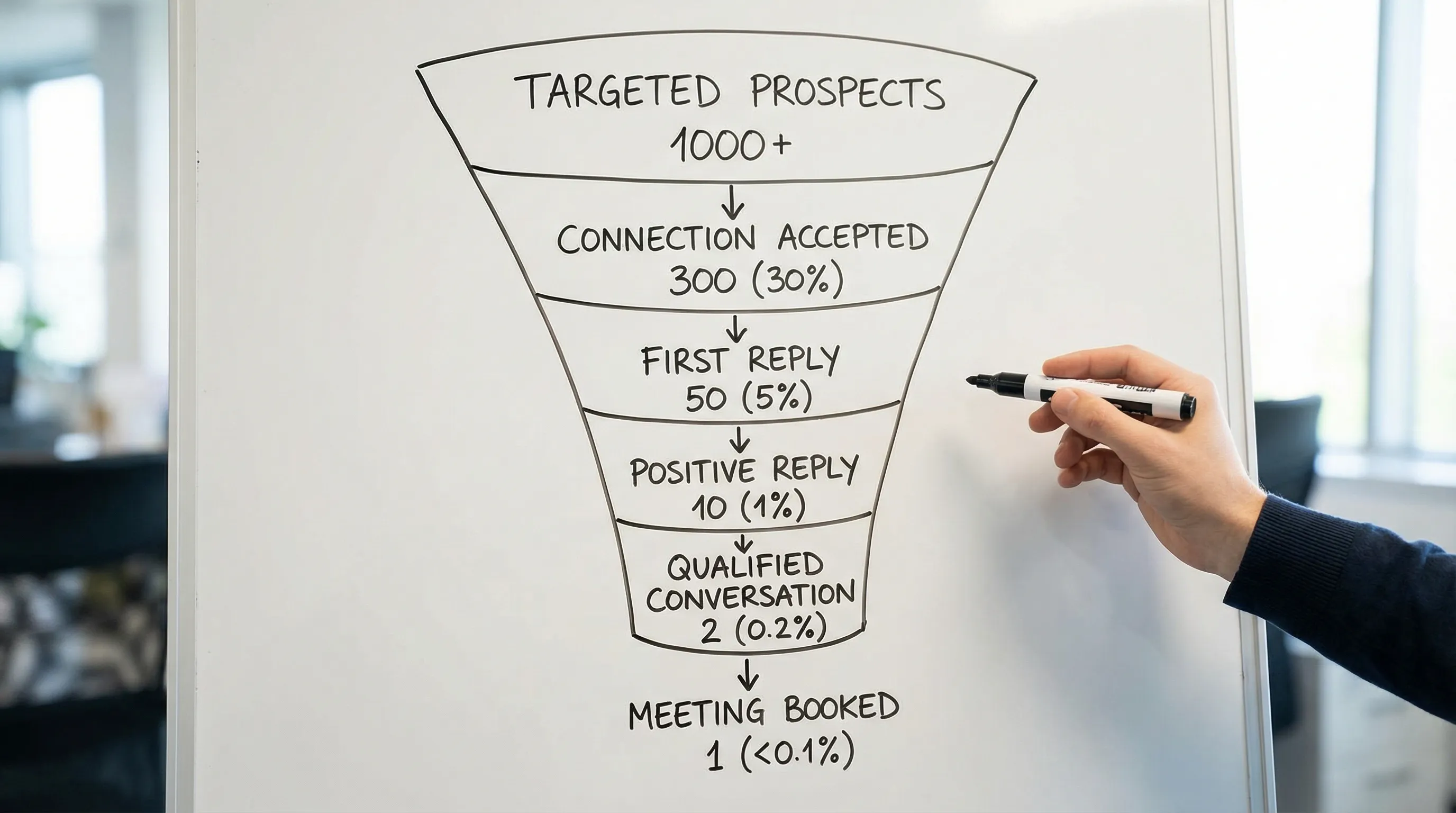
5) Instrumentation: what you will capture per thread
At minimum, capture:
- Audience slice (tag)
- Variant (A, B, C)
- Connection accepted (yes/no)
- First reply (yes/no)
- Positive reply (yes/no)
- Qualified conversation started (yes/no)
- Meeting booked (yes/no)
- Reason codes for “no” (too busy, not a priority, wrong person, already solved)
This is where a centralized system helps, because manual logging is where rigor goes to die.
What to test in a 7-day cold outreach sprint
In a week, you want high-leverage variables that produce clear signal quickly.
Messaging variables that tend to move reply quality
- Opening context: trigger-based (event, hiring, post) vs role-based (common responsibilities)
- Value hypothesis: cost of inaction vs upside outcome
- Proof: specific credibility point vs no proof (keep it short)
- CTA type: question-first vs calendar-offer (calendar too early often underperforms)
- Qualification move: one targeted diagnostic question vs “open-ended”
Variables to avoid in a 7-day sprint
- Changing ICP mid-week
- Testing 5 different offers at once
- Multi-step cadences with many follow-ups (you will not get clean attribution)
- Aggressive personalization that cannot be replicated (you will not be able to scale the winner)
The 7-day testing plan (day-by-day)
This plan assumes LinkedIn-first outreach with a small follow-up window. Adjust volumes to your team size, but keep splits consistent.
The sprint schedule
| Day | Focus | What you ship by end of day | What you measure next morning |
|---|---|---|---|
| Day 1 | Baseline and traffic plan | Control message locked, list segmented, tracking sheet or dashboard ready | Connection acceptance rate, early reply rate |
| Day 2 | Test 1: opening context | Variant B (new opener), everything else held constant | Reply rate and positive reply rate by variant |
| Day 3 | Test 2: value hypothesis | Variant C (new value angle), keep best opener from Day 2 | Positive replies, “confused” responses, objections |
| Day 4 | Test 3: proof line | Add or remove one credibility line, keep message length similar | Positive replies, skepticism signals |
| Day 5 | Test 4: qualification question | Swap the diagnostic question, keep same CTA style | Qualified conversation rate, time to qualification |
| Day 6 | Test 5: CTA mechanics | Question-first CTA vs soft meeting CTA (only after qualification) | Meeting booked rate per qualified conversation |
| Day 7 | Decision and rollout | Winner chosen, next iteration queued, guardrails documented | Lift summary and what changed operationally |
Day 1: establish your baseline and protect comparability
Day 1 is about control and clean lanes.
- Pull a list that is large enough for at least two variants (A and B). Even small samples can be useful, but you need enough volume to avoid reacting to a couple of outliers.
- Randomize assignment. Do not put “better accounts” into one variant.
- Lock send windows. Time-of-day shifts can create fake lift.
Decision rule: If your baseline acceptance rate is unusually low, do not “message your way out.” Recheck targeting and profile positioning first.
Day 2: test the opening context (the fastest lever)
Your opener decides whether the prospect reads the rest.
Run a single change:
- Variant A (control): your current opener
- Variant B: a new opener type (trigger-based or role-based)
Keep everything else identical: value line, question, CTA.
What good looks like: higher positive reply rate, not just more replies. A spike in “who are you?” replies is often a signal the opener is unclear.
Day 3: test the value hypothesis (why now)
Now that you have the better opener (or you keep the control if B underperforms), test the core value angle.
Examples of value hypothesis shifts:
- Reduce risk: “prevent pipeline gaps”
- Increase efficiency: “cut time spent on low-intent threads”
- Improve quality: “increase qualified conversations per week”
Keep it grounded. Vague promises (“boost revenue”) tend to earn polite non-answers.
Day 4: test one proof element (credibility without bloat)
Proof is important, but on LinkedIn it must be compact.
Test a single line change:
- Add a short proof point (customer type, niche specialization, measurable outcome if you can truthfully claim it)
- Or remove proof if your current message feels heavy
Guardrail: Do not invent numbers. If you do not have defensible stats, use truthful, specific positioning (example: “working with SDR teams running LinkedIn-first outbound”).
Day 5: test the qualification question (turn replies into signal)
A reply is not the goal. Evidence is.
Test one diagnostic question that naturally fits the prospect’s world.
Examples of strong qualification questions:
- “Are you currently using LinkedIn for first-touch outbound, or is email still primary?”
- “Do you have a clear definition for what counts as ‘qualified’ before a meeting gets booked?”
What you measure: qualified conversation rate, plus the percent of threads that produce usable routing (wrong person, not a priority, later).
Day 6: test CTA mechanics (when and how you ask for time)
If you ask for a meeting too early, you will lower conversion. If you never ask, you will create endless pen-pal threads.
Test two CTA mechanics:
- Question-first CTA: a small yes/no or A/B question that invites a short response
- Soft meeting CTA: offered only after qualification evidence appears (example: “If it’s helpful, open to a quick 15 minutes next week?”)
Decision rule: judge CTAs by meetings booked per qualified conversation, not by raw reply rate.
Day 7: make the call, then operationalize it
A sprint without a decision becomes content, not growth.
By Day 7, produce a one-page summary:
- What changed (exact variable)
- What improved (micro-conversions and primary outcome)
- Where it broke (segments that underperformed, objection themes)
- What you will roll out for the next 2 weeks
If you want to extend learning, you can evolve this sprint into a longer cadence-based test, but keep the winner as your new control. (Your longer sequencing playbooks live well alongside LinkedIn prospecting playbook: from first touch to demo.)
How to interpret results with small samples (without fooling yourself)
In 7 days, you will rarely have perfect statistical confidence. You can still make smart decisions if you use consistent rules.
Use paired metrics to avoid “gaming” your own test
A classic failure mode is optimizing for an easy metric that does not correlate with pipeline.
| If you optimize for | Pair it with | Why |
|---|---|---|
| Reply rate | Positive reply rate | Filters out low-intent chatter |
| Positive reply rate | Qualified conversation rate | Ensures replies convert to evidence |
| Meetings booked | Meetings held (later) | Prevents low-quality calendar spam |
Look for failure patterns, not just lift
Even if Variant B “wins,” scan threads for:
- Confusion (prospect does not understand what you mean)
- Mismatch (you attracted the wrong persona)
- Premature scheduling (prospects agree then no-show)
Qualitative readouts are part of the data.
Common mistakes that break cold outreach tests
Changing more than one variable at a time
If you change the opener, the value hypothesis, and the CTA in a single variant, you might win, but you will not know why. That makes scaling risky.
Testing on low-quality lists
If your list is off-ICP, the best copy will not save you. Your “learning” will mostly be noise.
Ignoring the middle of the funnel
Most teams obsess over first-touch replies. The real money is in the handoff from reply to qualification to meeting booked. That is why conversation-level evidence matters.
How Kakiyo helps you run this sprint without losing control
A 7-day sprint requires consistency across many simultaneous conversations. Kakiyo is designed for exactly that workflow on LinkedIn:
- Autonomous LinkedIn conversations to move from first touch through qualification to booking
- Customizable prompt creation so your variants are real experiments, not ad hoc edits
- A/B prompt testing to compare variants cleanly
- Industry-specific templates to speed setup while keeping messages relevant
- Intelligent scoring to prioritize human attention on high-value threads
- Conversation override control so reps can step in when nuance matters
- Centralized real-time dashboard plus analytics and reporting to review lift and failure modes
If your team is debating AI versus human control, align on which parts should remain human-led before you scale volume. (See: AI and sales: where humans stay essential.)
Next steps: turn your 7-day winner into a repeatable growth loop
Once you pick a winning variant, run it as the new control for two weeks, then test the next highest-leverage variable. That is how cold outreach becomes predictable.
If you want to scale this without sacrificing personalization or qualification quality, explore how Kakiyo supports governed, conversation-led LinkedIn outbound at scale: Kakiyo.
FAQ
What makes a LinkedIn or cold outreach sequence effective?
An effective outbound sequence matches the buyer's context, uses short messages, and measures reply quality rather than raw volume. Cadence, targeting, and stop rules matter as much as copy.
How many touches should I use before stopping?
Most teams should stop once intent is clearly absent or once the sequence becomes repetitive. The right stop rule protects deliverability, reply quality, and brand perception.
Should I automate all outreach?
No. Automation should remove repetitive work, not replace judgment. The best systems automate targeting, timing, and admin while keeping messaging and qualification grounded in context.
How do I know whether outreach is working?
Track positive reply rate, meeting quality, and downstream conversion instead of open rates alone. If meetings do not progress, the issue is usually targeting or qualification, not activity volume.