
 Ilan Asseo
Marketing Lead Qualification: Fast, Safe, Clear
Practical framework to make marketing lead qualification fast, safe, and clear across channels (especially LinkedIn), so marketing and sales can reliably.

Most marketing teams do not have a lead volume problem. They have a qualification clarity problem.
When “qualified” means something different in ads, events, website forms, and LinkedIn, the result is predictable: slow follow-up, noisy MQLs, SDR distrust, and meetings that never had a chance. Fixing it does not require a bigger scoring model, it requires a fast, safe, clear operating system.
This guide lays out a practical approach to marketing lead qualification that:
- Gets the right lead to the right next step quickly (fast)
- Protects brand, compliance, and buyer experience (safe)
- Produces auditable, sales-usable decisions (clear)
Industry evidence: Gartner’s research on the B2B buying journey shows that consensus creation is now a core buying job, which is why qualification needs buying-group evidence rather than single-contact activity.
Source: Gartner
What “marketing lead qualification” actually is
Marketing lead qualification is the set of definitions, signals, and actions that determines what happens to a lead next.
It is not the same thing as lead scoring. Scoring is a tool. Qualification is the decision.
A robust qualification system answers three questions, consistently:
- Is this a fit? Would we sell to them if timing was perfect?
- Is there intent? Are they demonstrating a real problem or active evaluation?
- Do we have proof? Do we have evidence we could show an SDR or AE to justify the next action?
If you want a deeper primer on MQL design and handoffs, Kakiyo’s guide on MQLs: definition, scoring, and handoff is a helpful companion. This article focuses on making the system fast, safe, and clear across channels, especially conversation-led channels like LinkedIn.
Why speed matters (and why most teams still miss it)
Speed is not a nice-to-have, it is a qualification multiplier. A classic analysis in the Harvard Business Review found that companies responding to leads within an hour were far more likely to qualify them than those waiting longer (HBR: The Short Life of Online Sales Leads).
Even in 2026, the most common “qualification” failure is not the scoring model, it is the lag between signal and response.
Two realities drive this:
- Intent decays quickly. Curiosity turns into distraction, then disappears.
- Buyers choose the fastest competent path. In many categories, they talk to whoever helps them understand the problem first.
The “Fast, Safe, Clear” model
Think of your marketing lead qualification system as three interlocking layers:
- Fast: routing and response that matches the moment of intent
- Safe: guardrails that prevent brand risk and workflow drift
- Clear: definitions and evidence that make decisions repeatable
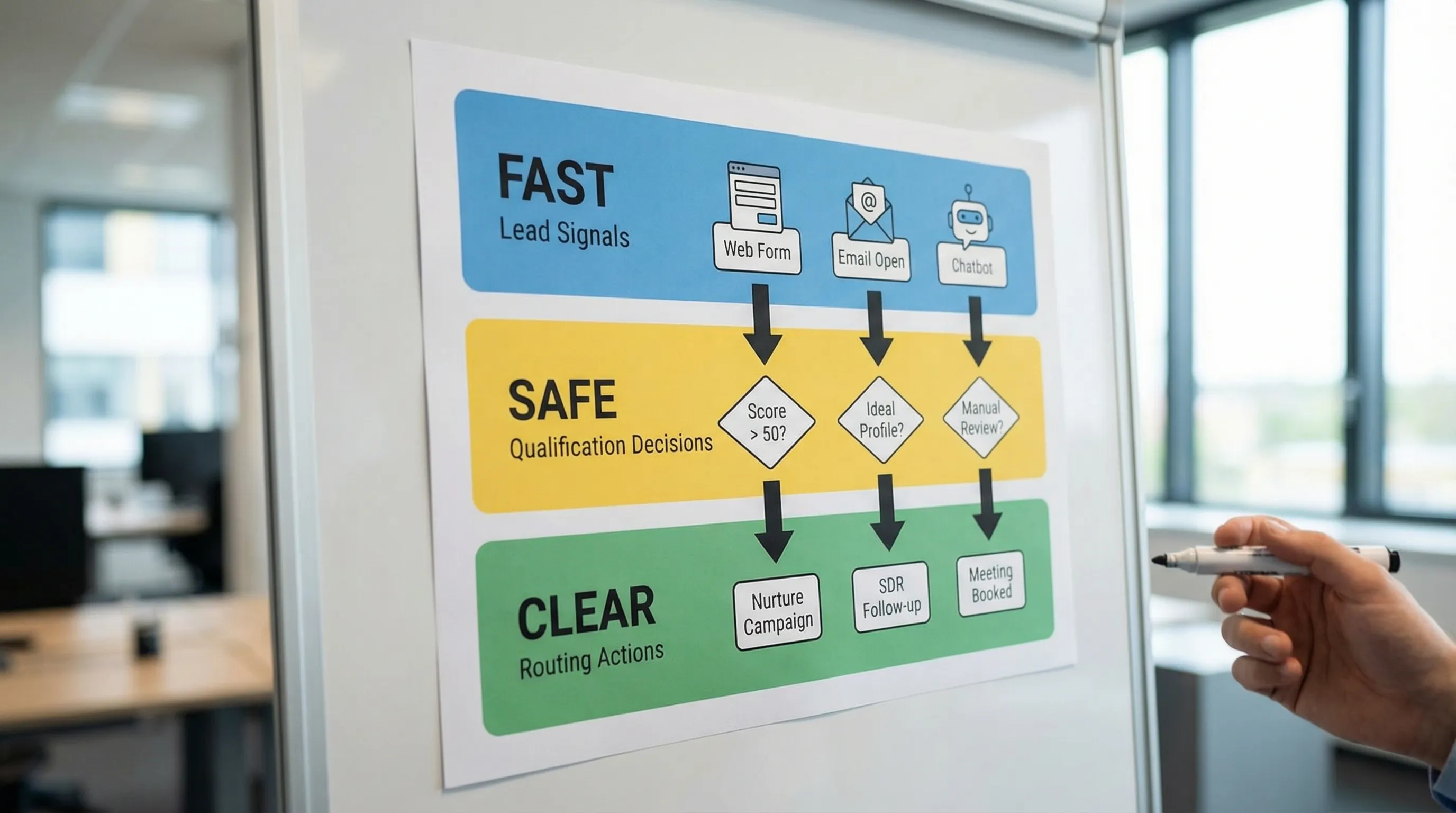
Fast: design for speed-to-next-action, not speed-to-MQL
Most funnels optimize for “MQL created.” High-performing funnels optimize for “next action taken.” That subtle shift changes what you instrument.
Build two response lanes
Create two lanes with explicit SLAs and outcomes:
- Hot lane (high intent): immediate response and a real attempt to book or route to a human
- Warm lane (uncertain intent): fast clarification, then either promote to hot or return to nurture
This removes the false binary where every lead is either “sales-ready” or “marketing-only.”
Make the “clarification step” conversational
A lot of qualification can happen without a discovery call if the buyer is willing to answer two or three lightweight questions.
Conversation-led qualification works especially well on LinkedIn because:
- The buyer can reply quickly without switching context.
- The thread preserves evidence (what they said, what they asked for, what they objected to).
- You can progressively qualify without forcing a form-fill or calendar link too early.
Kakiyo’s post on lead qualification process steps, scoring, and automation goes deeper on how to operationalize conversation evidence.
Track the only speed metric that matters
Track speed-to-first-meaningful-touch, not just speed-to-email.
A “meaningful touch” is a response that advances the thread, for example:
- A relevant follow-up question
- A tailored resource plus a single micro-CTA
- A clear offer to route to the right person
If you want a weekly operating rhythm around these metrics, see AI sales metrics: what to track weekly.
Safe: qualify without creating brand and compliance risk
Speed without safety creates a different kind of funnel leak: reputation damage, policy violations, and internal distrust.
Safety is not “be less aggressive.” Safety is “make your system predictable.”
Common failure modes (and the guardrail that prevents each)
| Failure mode | What it looks like | Guardrail to implement |
|---|---|---|
| Over-qualification | Too many leads marked qualified with thin evidence | Require a minimum evidence packet (fit + intent + proof) before promotion |
| Under-qualification | High-intent leads stuck in nurture | Hot lane SLA, plus escalation triggers based on signals |
| Brand risk in automation | Messages that overpromise, sound spammy, or misrepresent | Approved claim library, prompt constraints, and human override |
| Channel policy risk | Over-messaging or using tactics that violate platform rules | Pace controls and adherence to platform policies |
| Data drift | Scores and rules decay as ICP, offers, or channels change | Monthly calibration and a weekly debrief loop |
On LinkedIn specifically, make sure your team aligns with LinkedIn’s Professional Community Policies and your internal standards for outreach.
“Safe automation” means human control at the decision edges
If you use AI to scale conversations, the goal is not to remove humans from qualification. The goal is to:
- Automate repetitive thread work
- Escalate exceptions to humans
- Make decisions inspectable
A practical rule: automate the first 80 percent of predictable interactions, but force human review when the situation becomes reputationally sensitive (pricing commitments, legal questions, competitor claims, or angry replies).
For a broader view of what to automate vs keep human-led, see AI and sales: where humans stay essential.
Clear: define qualification in a way sales can audit
Clarity is the missing ingredient in most marketing lead qualification systems. Clarity means:
- Everyone uses the same definitions
- Every “qualified” decision includes evidence
- Every score maps to a specific action
Use a three-part evidence packet
A qualified lead should carry an evidence packet that a rep can understand in 10 seconds.
| Evidence type | What “good” looks like | Examples of fields or notes |
|---|---|---|
| Fit | Matches ICP constraints | Role, company size, industry, region, tech stack, must-have criteria |
| Intent | Demonstrates active problem interest | Asked a question, requested pricing, replied positively, visited key pages, attended a high-intent webinar |
| Proof (conversation or behavioral) | A specific quote or observable behavior | “We are replacing X this quarter,” “Need this before renewal,” booked link click, positive reply excerpt |
This is why conversation channels are so powerful: they produce explicit proof, not inferred intent.
Map score bands to actions (and make the actions irreversible)
Most scoring systems fail because they produce a number, but not a decision.
Instead of a single threshold, use bands with fixed actions. Example:
- Band A: route to SDR (or meeting booking flow) within SLA
- Band B: send clarification questions (short conversational step)
- Band C: nurture with a specific hypothesis (not generic drip)
- Band D: disqualify with a reason code (so you can learn)
If you are building scoring that sales will actually trust, Kakiyo’s article on qualified leads scoring that sales trusts is a strong reference.
A practical operating system you can implement in two weeks
This is a lightweight rollout that improves speed and quality without re-platforming your stack.
Week 1: lock definitions and routing
Align marketing and sales on:
- One sentence definition of “qualified” for each motion (inbound, outbound, events, LinkedIn)
- Two lanes (hot, warm) with SLAs
- Evidence packet fields that must be present for promotion
Your objective by end of week 1 is simple: two people should look at the same lead and make the same call.
Week 2: add instrumentation and controlled automation
Add:
- A dashboard view that shows speed-to-first-meaningful-touch, qualified rate, and downstream acceptance
- A weekly 30-minute debrief to review a small sample of qualified and disqualified leads
- Controlled automation for the warm lane clarification step (with escalation triggers)
The weekly debrief is where your system gets smarter. Without it, qualification drifts.
Where Kakiyo fits (LinkedIn conversation-led qualification)
If LinkedIn is a meaningful source of pipeline for you, qualification quality often depends on thread execution: follow-up speed, consistency of questions, and whether the team captures proof.
Kakiyo is designed to help teams scale personalized LinkedIn conversations from first touch through qualification to meeting booking, while keeping governance in place. Based on the product capabilities you shared, Kakiyo can support this model with:
- Autonomous LinkedIn conversations that handle high-volume threads
- AI-driven lead qualification with an intelligent scoring system
- Industry-specific templates, customizable prompts, and A/B prompt testing
- Simultaneous conversation management with conversation override control
- Centralized dashboards plus analytics and reporting to monitor quality and safety
If you want to connect the dots between qualification and booked meetings in a LinkedIn-first motion, the LinkedIn prospecting playbook is the most direct next read.

The standard to aim for
A strong marketing lead qualification system is not the one with the fanciest model. It is the one that produces decisions your team can defend.
Aim for this standard:
- Fast: high-intent signals get a real response immediately
- Safe: automation is governed, inspectable, and reversible
- Clear: every qualified lead carries fit, intent, and proof that sales can act on
When you hit that bar, volume becomes less important because every conversation is more likely to become pipeline.
FAQ
What is the difference between a lead and a qualified prospect?
A lead is simply a potential contact or account. A qualified prospect has enough verified fit, intent, and context to justify a next sales step.
What makes qualification trustworthy?
Qualification is trustworthy when it relies on auditable signals, not labels alone. The more evidence a team can verify, the easier it is to align sales, marketing, and RevOps.
Should qualification be based on one score?
Not by itself. Scores are useful summaries, but teams still need explicit criteria around fit, buying signals, and next-step readiness.
How do I implement proof-based qualification in my team?
Start by defining what evidence is required at each stage, then make those signals visible in your workflows. The goal is consistency across inbound, outbound, and partner-sourced leads.