
 Ilan Asseo
Business Development Rep: Roles & Responsibilities
How BDRs create qualified pipeline: targeting, outreach, qualification, handoffs, and metrics for modern outbound sales teams.

Most sales teams don’t lose pipeline because they lack activity. They lose it because early pipeline work is inconsistent: unclear targeting, weak first touches, sloppy qualification, and handoffs that force AEs to re-discover basics.
That is what the Business Development Representative (BDR) role is built to solve. A great BDR turns a cold account list into qualified, well-packaged meetings with evidence that an Account Executive can confidently advance.
Industry evidence: Salesforce Research reports that sales reps spend only 28% of their week actually selling, with the rest consumed by deal management, data entry, and other non-selling work.
Source: Salesforce State of Sales
What is a Business Development Representative (BDR)?
A Business Development Representative is an early-funnel sales role responsible for creating new pipeline, typically through outbound prospecting. BDRs identify the right accounts and personas, start conversations (often on LinkedIn and email), qualify early intent, and book meetings that have a real chance to convert.
Depending on your org, “BDR” and “SDR” may be used interchangeably. In many teams:
- BDR means primarily outbound, new logo pipeline.
- SDR means inbound or blended (inbound plus outbound).
What matters is not the title, it’s the scope of responsibilities and the definition of “qualified” used to decide what gets booked and handed off.
Business development representative roles and responsibilities (the complete map)
A modern BDR role can be understood as a set of responsibilities that each produce an observable output. If you can’t point to the output, the responsibility is not operational.
1) ICP-based targeting and list building
BDRs don’t “prospect everyone.” They prospect an ICP slice (industry, size, tech stack, triggers, and personas) that can plausibly buy.
Core responsibilities include:
- Building account lists and persona lists (including buying-group mapping)
- Prioritizing accounts by fit and timing signals
- Keeping data clean (duplicates, bounced emails, outdated titles)
Outputs you should expect:
- A prioritized account queue
- A named persona map for each account (at least 2 to 4 roles)
- Documented segment assumptions (why this slice should work)
If your team prospecting lives mainly on LinkedIn, your targeting workflow should match how LinkedIn search and signals work. (Related: Using LinkedIn Sales Navigator for Prospecting: A How-To)
2) First-touch outreach (starting conversations, not pitching)
The BDR’s job is to earn a reply and create enough relevance that a prospect chooses to engage.
Responsibilities:
- Writing concise, specific openers tailored to persona and context
- Choosing a channel strategy (LinkedIn-first, email-first, or blended)
- Running a safe cadence with stop rules so outreach stays respectful
Outputs:
- Connection acceptance rate (if LinkedIn-led)
- Reply rate and positive reply rate
- A measurable “first meaningful touch” time
If you want a cadence that protects deliverability and brand trust, use rules designed for conversation-led channels. (Related: Cold Prospecting on LinkedIn: A Safe, High-Reply Cadence)
3) Conversation management and follow-up
A BDR’s productivity is constrained less by writing messages and more by handling dozens of simultaneous threads without dropping balls.
Responsibilities:
- Tracking conversation state (new, warm, waiting, qualified, disqualified)
- Following up based on behavior (not generic “bumping this”)
- Summarizing threads for continuity and handoff
Outputs:
- Reduced “aging” in threads (fewer conversations stuck in limbo)
- Higher conversion from reply to qualified conversation
- Better context retention across touches
4) Lead qualification (evidence capture, not vibes)
Qualification is where many teams accidentally create pipeline debt. Booking meetings without evidence pushes work downstream and inflates forecast noise.
BDR qualification responsibilities:
- Asking “thread-safe” questions that fit the channel (short, low-friction)
- Capturing evidence of fit and intent
- Confirming a concrete next step (time, attendees, agenda)
Outputs:
- A consistent definition of qualified (documented, auditable)
- An evidence packet in CRM that explains why the meeting is worth an AE’s time
If your org struggles here, fix the definition and the evidence requirements before you change comp plans or add tools. (Related: Lead Qualification: A Simple, Repeatable System and A Lead Is Not a Qualified Prospect: Proof-Based Qualification)
5) Meeting booking and show-rate mechanics
Booking the meeting is not the finish line. The BDR is accountable for meeting quality and attendance, within reason.
Responsibilities:
- Setting expectations (what the call is, what it is not)
- Ensuring the right attendees (buyer role coverage when possible)
- Reducing no-shows (confirmation note, light agenda, easy reschedule)
Outputs:
- Meetings held rate
- AE acceptance rate
- Conversion from meeting held to next stage (opportunity, pilot, technical eval)
6) Handoff to AE (packaging the meeting)
Great BDRs don’t “throw meetings over the wall.” They package context so the AE can start at step 3, not step 1.
Responsibilities:
- Writing a handoff note with fit, intent, proof, and open questions
- Tagging the right stakeholders and mapping the buying group
- Logging outcomes and updating statuses quickly
Outputs:
- Higher AE acceptance
- Faster speed-to-next-step after the meeting
- Cleaner stage hygiene in CRM
7) Feedback loops and experimentation
A BDR role is part sales, part applied experimentation.
Responsibilities:
- Running small A/B tests (openers, value hypotheses, CTAs)
- Tracking micro-conversions, not just booked meetings
- Feeding insights back to marketing and product (objections, language, triggers)
Outputs:
- Consistent week-over-week learning
- Segment-specific playbooks that improve over time
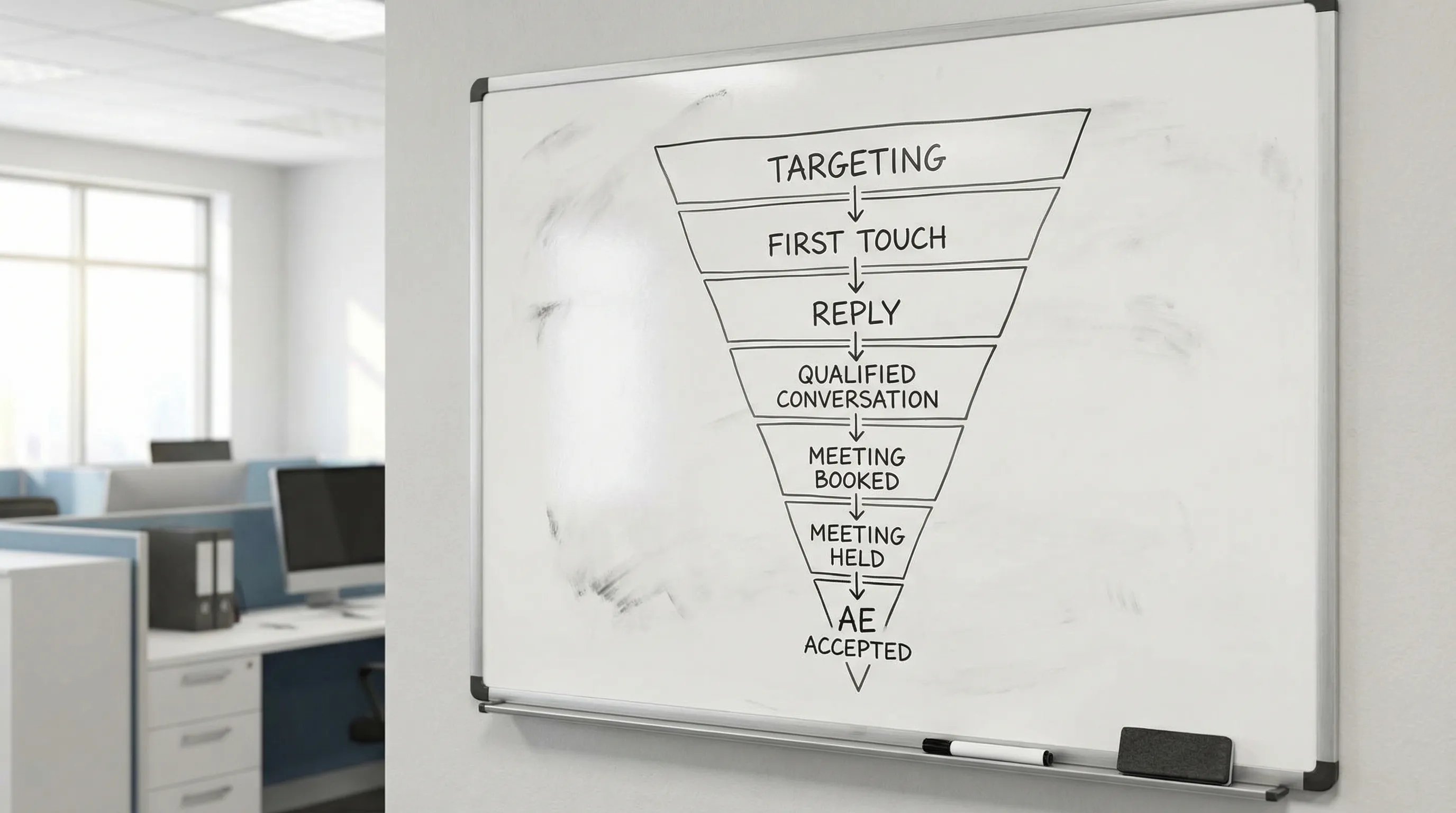
What BDRs are responsible for (and what they are not)
A common failure mode is expecting BDRs to be accountable for outcomes they do not control (like closing revenue) while under-investing in what they do control (like qualification evidence).
Here is a practical boundary:
| Area | BDR accountable for | Not primarily accountable for |
|---|---|---|
| Pipeline creation | Creating qualified meetings and opportunities via outbound | Closing revenue (that is typically AE-owned) |
| Qualification | Capturing and documenting evidence (fit, intent, next step) | Deep discovery, technical validation, negotiation |
| Handoff | Context-rich meeting notes and stakeholder mapping | Running the full sales cycle |
| Data hygiene | Accurate statuses, timestamps, conversation evidence | Fixing broken CRM architecture alone |
| Learning | Testing messages and segments, reporting insights | Rebuilding positioning without enablement support |
If your org wants BDRs to do deeper discovery, multi-meeting nurturing, or expansion, that is valid, but you should rename the role and reset metrics accordingly.
BDR vs SDR vs ADR: common role shapes
Titles vary widely, but the responsibilities usually cluster into a few patterns.
- Outbound BDR: New logo targeting, outbound messaging, qualification, booking.
- Inbound SDR: Responding to inbound leads, routing, qualification, meeting set.
- ADR (Account Development Rep): Account-based work, multi-threading, close AE partnership, often tied to named accounts.
The operational question is: where does the role start and end in the funnel, and what evidence must exist at the handoff?
Key BDR skills that actually predict performance
BDR performance is not just “grit” or talk track memorization. The role rewards a specific set of skills.
Commercial judgment (fit and prioritization)
Top BDRs can explain, in one sentence, why an account belongs in the queue today. They don’t confuse “interesting” with “likely to buy.”
Conversation design
Especially on LinkedIn, you are not writing a pitch, you are designing a sequence of micro-commitments: accept, reply, answer one question, agree to time.
Evidence-based qualification
Strong BDRs don’t ask random discovery questions. They ask questions that produce decision-grade evidence.
Systems discipline (CRM and workflow)
If it is not logged, it did not happen. The best BDRs keep clean timestamps, statuses, and handoff notes so the system can be measured and improved.
Experimentation literacy
BDRs who can run small tests, interpret results, and iterate safely will outperform those who only “work harder.”
The metrics that matter for BDRs (and what they diagnose)
Measuring BDRs only on meetings booked invites low-quality bookings. Measuring only activity invites spam. Modern teams use a balanced scorecard.
| Metric | What it measures | What it helps you diagnose |
|---|---|---|
| Reply rate / positive reply rate | Message-market fit | Targeting, copy, proof, relevance |
| Qualified conversation rate | Early qualification quality | Whether reps are capturing evidence or skipping steps |
| Meetings held rate | Execution quality | Booking mechanics, expectation setting, reminder flow |
| AE acceptance rate | Downstream trust | Whether meetings meet your “qualified” standard |
| Meeting held to opportunity | Real pipeline creation | Whether the ICP slice is viable, and whether handoffs are useful |
| Time to first meaningful touch | Speed and freshness | Whether the motion is responsive enough to catch intent |
If you want a deeper definition of qualification stages and exit criteria (Lead to MQL to SQL to Opportunity), use a stage system with enforceable promotion rules. (Related: Lead MQL SQL Opportunity: Clear Stages and Exit Criteria)
Typical BDR tools and systems (by job-to-be-done)
A BDR’s stack should reduce manual busywork while improving evidence capture.
Common tool categories:
- CRM: System of record for lifecycle, evidence, and handoffs.
- Prospecting and enrichment: Account and contact sourcing.
- Engagement channels: Email and LinkedIn workflows.
- Scheduling: Removing friction in booking and rescheduling.
- Analytics: Measuring micro-conversions and segment performance.
Where teams get into trouble is adding tooling before they define qualification. Automation amplifies whatever you standardize, including bad standards.
How AI changes BDR responsibilities in 2026
AI is shifting the BDR role away from writing and toward supervision, judgment, and quality control.
In practical terms, AI can help with:
- Drafting and personalizing first touches at scale
- Managing many LinkedIn threads simultaneously
- Summarizing conversations and extracting qualification evidence
- Scoring conversations based on fit and intent signals
- Running prompt experiments (A/B tests) and reporting performance
But the BDR (and the team) still owns:
- The ICP and what “qualified” means
- The guardrails (tone, stop rules, compliance)
- Escalation decisions (when to override AI, when to disqualify)
Kakiyo fits into this shift by autonomously managing personalized LinkedIn conversations from first touch through qualification and meeting booking, with controls like customizable prompts, A/B testing, scoring, and override options. If you are evaluating this approach, start by defining what evidence is required before a meeting can be booked, then automate only after that standard is stable.

What a strong BDR job description should include
If you are hiring, the best job descriptions make responsibilities measurable. At minimum, specify:
- Your ICP and primary channel mix (LinkedIn-first, email-first, blended)
- What “qualified meeting” means (in observable terms)
- The core handoff artifacts required (fields, notes, evidence)
- Success metrics that balance quality and throughput
For a copy-ready structure, you can adapt an SDR template by swapping inbound responsibilities for outbound account development and tightening the “qualified” definition.
The fastest way to improve BDR performance without hiring more reps
If you want a high-leverage improvement plan, do these in order:
- Define qualification evidence (fit, intent, proof, next step, recency).
- Instrument micro-conversions (reply, qualified conversation, meetings held, AE acceptance).
- Standardize handoffs so AEs stop re-qualifying from scratch.
- Then scale with automation and testing.
If you want a practical workflow view, pair this article with Kakiyo’s guide to a time-blocked day for BDRs: Business Dev Representative: Daily Workflow.
FAQ
What does a strong SDR or BDR actually own?
A strong SDR or BDR owns early-stage pipeline creation: targeting, first conversations, qualification, and clear handoff. The role is not just about booking meetings, but booking the right meetings.
Which skills matter most in modern sales development?
Prospecting judgment, messaging clarity, qualification discipline, and CRM hygiene matter more than raw call volume. In modern teams, AI literacy and channel fluency also matter.
How should teams evaluate SDR performance?
Use a mix of activity, conversion, and pipeline quality metrics. Strong teams look beyond booked meetings to show rates, qualification accuracy, and accepted pipeline.
How long does it take for a new rep to become productive?
Most reps need a ramp period before they consistently generate qualified pipeline. The fastest ramp comes from clear playbooks, tight feedback loops, and strong qualification criteria.