
 Ilan Asseo
Cold Email Outreach Strategy: Playbooks That Land Meetings
Cold email still opens calendars in 2025 when treated as precision outreach — focused lists, lightweight personalization, compliant sending, and short.

Cold email can still open calendars in 2025, as long as you treat it like precision outreach, not a volume game. Buyers are stricter about inbox quality, mailbox providers tightened rules, and generic pitches get filtered by people and machines alike. The upside is clear. With focused lists, lightweight personalization, compliant sending, and short, helpful messages, you can consistently start conversations that turn into meetings.
Below are practical cold email outreach playbooks, tuned for modern deliverability and measurement. Each playbook shows who it is for, a simple cadence, and copy you can adapt. You will also find a quick deliverability checklist, optimization tips, and ways to pair email with LinkedIn so more replies become qualified meetings.
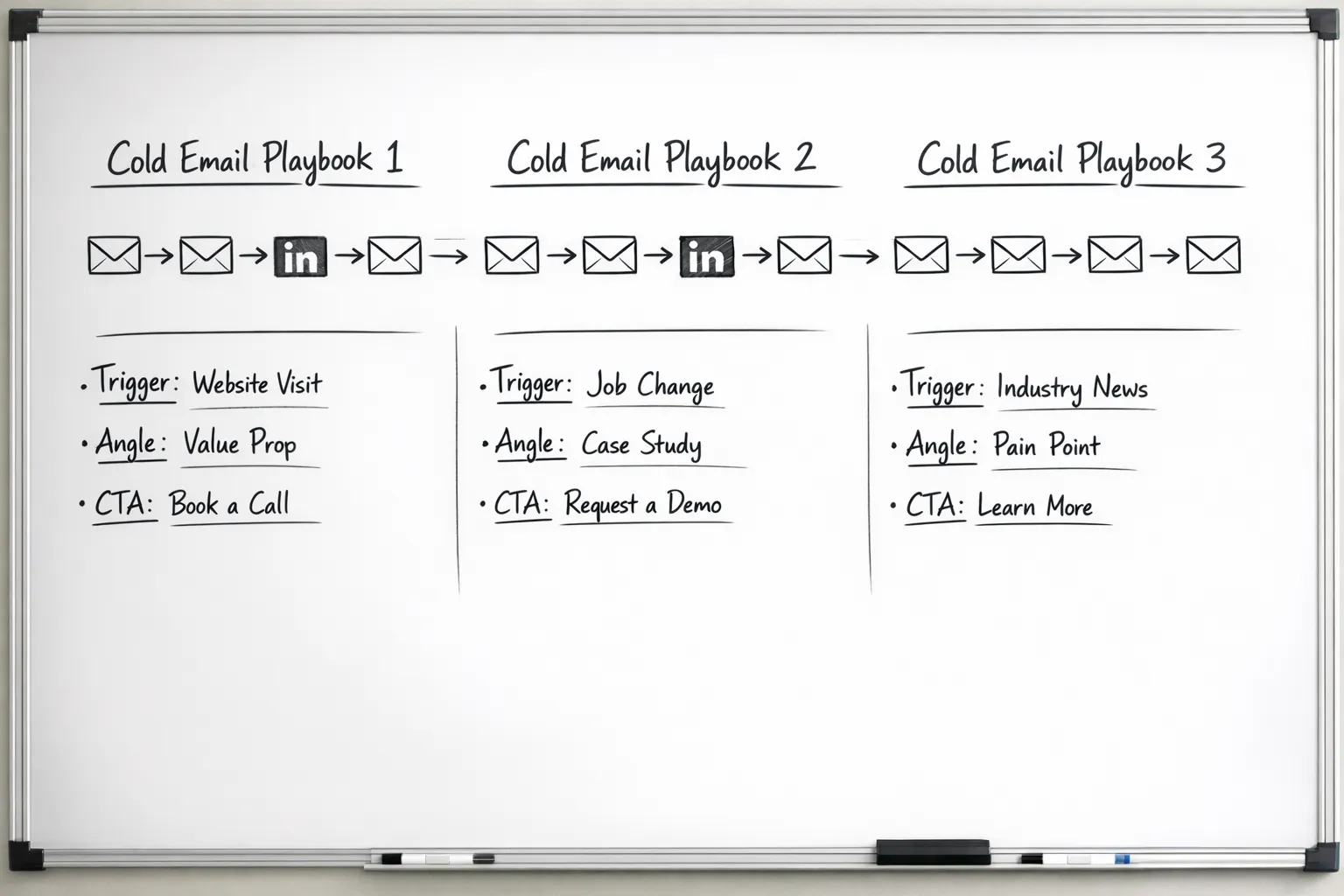
Industry evidence: “As customers increasingly learn and buy digitally, sales reps become just one of many possible sales channels.” — Cristina Gomez, Managing Vice President, Gartner.
Source: Gartner
The foundations that make cold email land meetings
Great cold email is not a clever subject line. It is the intersection of a real problem, a tight list, and a simple ask.
-
ICP clarity, target one segment per campaign and one use case per sequence.
-
Signal-based lists, prioritize prospects with a recent trigger like a new role, hiring plan, funding, technology change, or compliance date.
-
Message anatomy, context, credibility, value, soft CTA, brevity. Aim for 45 to 85 words, plain text, one question.
-
One clear outcome, book a short discovery call or confirm the right person. Avoid mixed asks.
-
Respect the channel, fast opt out, no attachments, limited links, human tone.
Cold email works best when it is coordinated with LinkedIn and phone. If a prospect responds on LinkedIn first, continue there instead of forcing email. If you rely on LinkedIn to qualify and schedule, AI can help you scale those conversations while SDRs focus on high-value threads. For examples of short, buyer-first message patterns on LinkedIn, see Kakiyo’s guides on LinkedIn outreach that converts and the LinkedIn prospecting playbook.
Deliverability in 2025, the must-do checklist
Mailbox providers raised the bar. Google and Yahoo introduced new requirements for bulk senders in 2024, including authentication, easy unsubscribes, and keeping spam complaints very low. Google’s announcement outlines complaint rates that should be kept below 0.3 percent and one-click unsubscribe for commercial mail. See Google’s post for details: A safer, less spammy inbox with new Gmail protections.
Minimum setup before you send:
-
Authenticate your domain, set up SPF, DKIM, and DMARC with alignment. Google’s help articles are a good reference for SPF, DKIM, and DMARC.
-
Use a sending subdomain, for example hello.company.com, to protect your root domain reputation and keep branding consistent.
-
Add one-click unsubscribe headers, List-Unsubscribe and List-Unsubscribe-Post, and a visible plain-text opt out.
-
Start small and ramp gradually, for example start at 20 to 30 messages per inbox per day and increase by 10 to 20 percent weekly as long as complaints remain near zero.
-
Keep complaint rates low, use tight lists, avoid purchased data, and honor opt outs immediately.
-
Limit links and trackers, use your own domain for tracking links if possible, avoid attachments on first touch.
-
Monitor health, track bounces, blocks, spam complaints, and reputation. Pause and fix when signals degrade.
-
Comply with laws, see the U.S. CAN-SPAM compliance guide. This is not legal advice.
Playbook 1, Founder-led outbound to early adopters
Best for startups and new motions where the founder or sales leader can credibly speak to the problem with a short note. The goal is to start a real conversation and book a 15 to 20 minute discovery call.
Cadence and copy
| Day | Subject | Angle | Example snippet |
|---|---|---|---|
| 1 | Quick idea for {{company}} | Problem-first | Hi {{first_name}}, noticed {{trigger}} at {{company}}. Teams in your space tell me {{pain}} hurts {{metric}}. I built {{one-line product}} to make this a non-issue. Worth a 15 minute chat to see if the angle fits your roadmap? |
| 3 | Re, quick idea | Bump with value | If helpful, I can share a 3 line teardown of how peers cut {{pain}} for their {{team}}. Happy to send here or chat live. |
| 7 | 2 alternatives | Social proof or case hint | Two patterns we see work, small pilot with one team, or a 30 day sandbox to validate impact on {{metric}}. Either relevant at {{company}}? |
| 12 | Close the loop | Breakup, invite correction | If this is not a priority, no problem at all. Should I circle back next quarter or speak with someone else on {{team}}? |
Notes on personalization:
-
Use one business trigger, for example a hiring plan, a shift to a new tool, a public roadmap post.
-
Keep credibility to one line, a relevant customer, a simple outcome, or a short qualifier like worked at X.
-
Avoid links in email 1, keep it conversational and specific.
What good looks like
-
Reply rate above baseline, early signals matter more than volume.
-
Positive reply rate trending up as you tighten the list and wording.
-
1 in 4 to 1 in 3 positive replies converting to booked meetings over the first two weeks is a solid early target.
Playbook 2, Trigger-based mid-market outreach
Best for SDR teams going after a clear ICP with recent signals. You reference the trigger to earn relevance, then frame a simple business outcome and ask a question that is easy to answer.
Common signals to filter by include a new VP, a funding announcement, a job post that hints at a pain, a technology change visible on their site, or a compliance date approaching.
Cadence and copy
| Day | Subject | Angle | Example snippet |
|---|---|---|---|
| 1 | {{trigger}}, quick question | Trigger plus value | Saw {{company}} is {{trigger}}. When teams do that, {{pain}} pops up for {{persona}}. We help {{peer}} reduce {{metric}} by simplifying {{process}}. Open to a short call to see if this maps to your plan? |
| 4 | Re, quick question | One-liner proof | Sharing because it is similar, {{peer}} cut {{metric}} in 30 days after {{action}}. If no overlap, happy to close the loop. |
| 8 | Right person? | Routing ask | If you are not the right person for {{topic}}, is there someone on {{team}} you would suggest I speak with? |
| 13 | Timing check | Soft exit | Should I circle back after {{milestone}} or park this for now? I will follow your lead. |
Personalization tokens that pull weight:
-
{{trigger}} that shows you did a minute of research.
-
{{peer}} in the same segment, not a household name with no relevance.
-
{{metric}} tied to the persona, conversion rate, time to value, cycle time, cost per meeting.
Playbook 3, Event motion, pre, during, and post
Best for teams attending industry events or hosting webinars. The goal is to set meetings around the event, then convert post-event momentum.
Cadence and copy
| Timing | Subject | Angle | Example snippet |
|---|---|---|---|
| 7 to 10 days before | Are you at {{event}}? | Scheduling | I will be at {{event}} on {{dates}} talking with {{persona}} about {{topic}}. Open to a 15 minute coffee to swap notes on {{theme}}? |
| 2 days before | Quick schedule check | Logistics | I have openings at {{time windows}}. If onsite is busy, happy to set a follow-up the week after. |
| 1 day after | Great to meet, next step? | Recap, next step | Enjoyed the chat about {{pain}}. As discussed, I can share a 1 page plan for {{company}} to test {{approach}}. Want me to send that and pencil a 20 minute review? |
| 5 days after | Close the loop on {{event}} | Breakup with value | If now is not the time, I will park this. If helpful, I can share the checklist we used to reduce {{pain}} in 30 days. |
Operational tips:
-
Keep a tight list of targets you want to meet, then confirm times early.
-
Capture notes immediately after conversations, then reflect those notes in post-event follow-ups.
Message teardowns, short copy that earns replies
You do not need to write like a marketer. Write like a helpful peer.
-
Subjects, simple and literal, for example Quick idea for {{company}}, Right person to ask?, {{trigger}}, quick question.
-
First line, establish context in one line, trigger or observation.
-
Credibility, one proof point or qualifier.
-
Value, one outcome tied to the persona’s metric.
-
CTA, one question that is easy to answer, worth a quick chat?, open to a brief call?, or should I circle back later?
-
Length, 4 to 6 short lines. No jargon. No images. One link at most, and only when it clarifies next steps.
Measurement, what to track and how to decide
Focus on the full path from delivered emails to booked meetings. Avoid vanity metrics without the context of quality.
| Metric | Definition | Starting target |
|---|---|---|
| Deliverability rate | Delivered divided by sent | Above 95 percent once warmed |
| Reply rate | Replies divided by delivered | Improve week over week, use as direction |
| Positive rate | Positive replies divided by replies | Aim for consistent gains by segment |
| Meetings booked | Meetings divided by delivered | Set a baseline, then improve by list quality |
| Cost per meeting | Total cost divided by meetings | Use to compare playbooks |
How to A or B test without overcomplicating it:
-
Test one variable at a time, subject or CTA or first line.
-
Give each variant a fair run, for example 200 to 300 prospects per variant.
-
Decide on learning, keep the winner, then move to the next variable.
-
Recycle proven winners into your templates library, then build around them.
Multi-channel, let prospects reply where they want
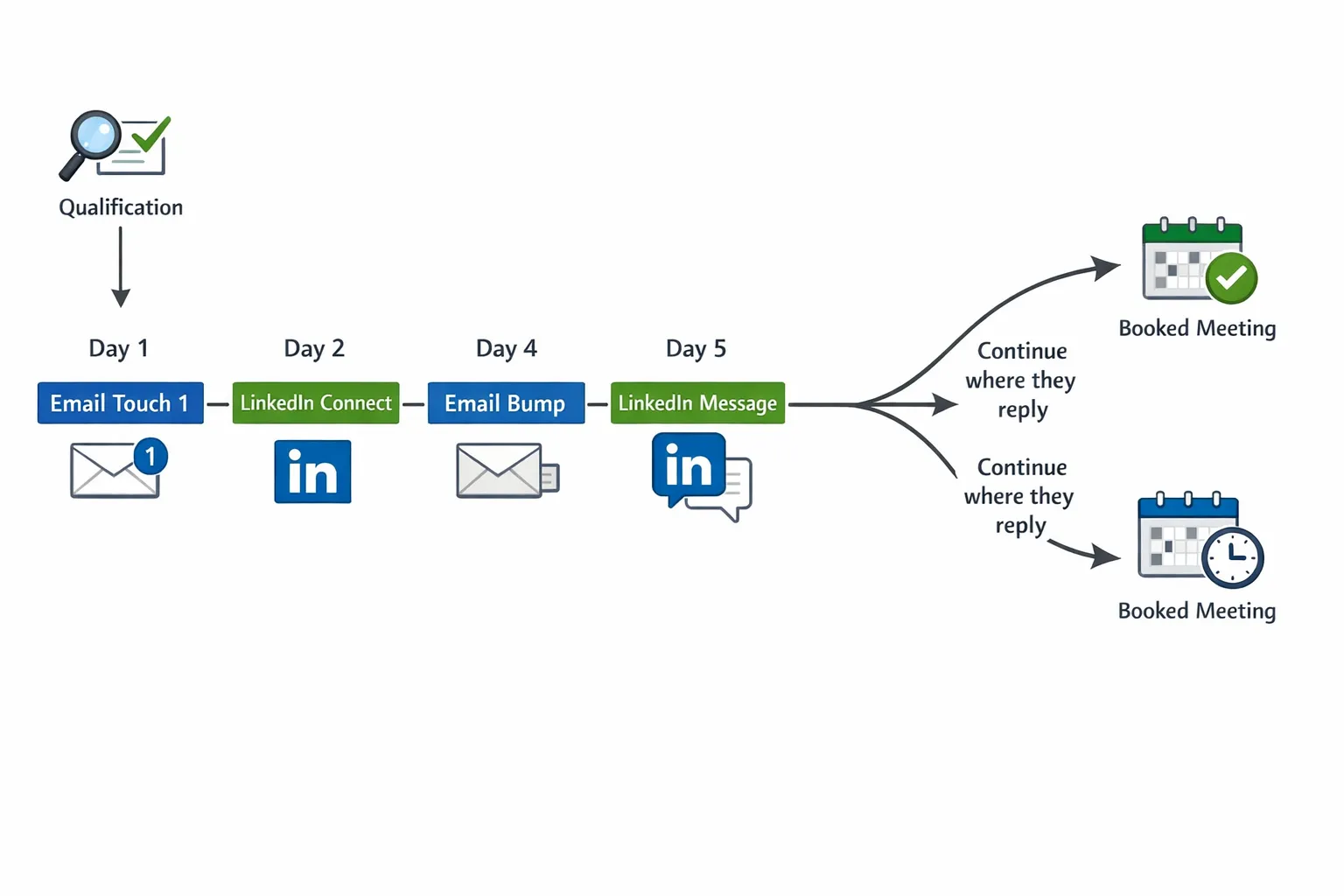
Cold email and LinkedIn work better together. A practical pattern is to begin via email, then add a gentle LinkedIn touch to warm recognition, then continue the conversation where the buyer replies.
-
Day 1, email touch 1.
-
Day 2 or 3, connect on LinkedIn with a short note referencing the same problem, no pitch.
-
If they reply on LinkedIn, qualify and schedule there instead of pushing back to email.
-
If they reply by email, stay in email.
If your team wants to scale LinkedIn replies without losing quality, Kakiyo can help. Kakiyo manages personalized LinkedIn conversations at scale from first touch to qualification to meeting booking, with customizable prompts, A or B prompt testing, intelligent scoring, conversation override, and a real-time dashboard. For patterns that convert on LinkedIn and how to pilot AI safely, see AI SDR, automate conversations, qualify faster, book more and Conversational AI for sales.
Common pitfalls to avoid
-
Overpersonalization with fluff, skip vanity icebreakers, use one specific trigger.
-
Overlinking, link only when necessary and prefer your own domain.
-
Big asks, no 30 minute demos in the first email, propose a short call or a quick yes or no.
-
Mixed goals, one campaign, one ICP, one use case.
-
Ignoring signals, do not email people who cannot buy, route to the right person early.
-
Neglecting compliance, have visible opt outs and one-click unsubscribe headers.
Quick start checklist
-
Define ICP and a single use case to pitch.
-
Build a signal-rich list and verify emails.
-
Set up SPF, DKIM, DMARC, subdomain, and unsub headers.
-
Choose one playbook above and load the cadence.
-
Write short copy, one message for first touch and a bump.
-
Send small, review daily, and iterate weekly based on reply quality.
Frequently Asked Questions
How long should cold emails be? 45 to 85 words is a practical range. Aim for 4 to 6 short lines, one question, and no attachments.
How many touches should a cold email sequence include? Three to five is enough for most campaigns. If you go beyond five, add real value, not more pressure.
Should I use a new domain for cold email? Use a subdomain dedicated to outbound and authenticate it with SPF, DKIM, and DMARC. Monitor reputation and ramp carefully.
Do I need one-click unsubscribe? If you send commercial mail at scale, yes. Gmail and Yahoo tightened requirements in 2024 that include easy unsubscribes and low complaint rates. Add List-Unsubscribe headers and a visible opt out in the footer.
What is a good reply or meeting rate? These vary by segment and offer. Focus on positive replies and booked meetings per 100 delivered. Improve list quality and message clarity before increasing volume.
How does LinkedIn fit with cold email? Use it to improve recognition, qualify faster, and book meetings where the buyer prefers. With Kakiyo, you can run personalized LinkedIn conversations at scale and keep humans in the loop.
Turn more replies into meetings with Kakiyo
Cold email starts the conversation, LinkedIn often finishes it. Kakiyo’s AI manages personalized LinkedIn conversations at scale, qualifies prospects in-thread, and books meetings so your SDRs focus on high-value opportunities. See how autonomous conversations, customizable prompts, A or B prompt testing, intelligent scoring, and real-time analytics work together in one dashboard.
Explore Kakiyo at kakiyo.com or dive into our guides on LinkedIn outreach that converts and the LinkedIn prospecting playbook to add a high-converting LinkedIn track to your cold email strategy.