
 Ilan Asseo
Highly Qualified Leads: A Definition Both Teams Trust
A sales-and-marketing-safe definition of Highly Qualified Leads, with required evidence, operating rules, and an evidence-packet template to align.

Most “lead quality” debates are really definition debates.
Marketing says the leads are good because they match the ICP and engage with content. Sales says the leads are bad because they do not convert into accepted meetings, opportunities, or revenue. Both can be right, because “highly qualified leads” is often an undefined label that each team uses differently.
This article gives you a sales-and-marketing-safe definition of highly qualified leads, plus the evidence requirements and operating rules that keep the definition stable.
Industry evidence: Gartner’s research on the B2B buying journey shows that consensus creation is now a core buying job, which is why qualification needs buying-group evidence rather than single-contact activity.
Source: Gartner
What are highly qualified leads?
A highly qualified lead is a person (or account) that has:
- Fit: they match your Ideal Customer Profile (ICP) and target persona requirements.
- Intent: they show credible, recent buying intent (not just generic engagement).
- Evidence: there is verifiable proof for fit and intent (fields, signals, or conversation excerpts), not just a score.
- Next step: a clear, agreed action that moves the deal forward (for example, a booked meeting, a referral introduction, or a confirmed evaluation step).
- Recency: the evidence is recent enough to still be actionable.
Put into one sentence you can paste into your SLA:
Highly qualified leads are ICP-fit leads with recent buying intent and documented evidence, plus a confirmed next step that sales agrees is worth pursuing now.
This definition matters because it forces “qualified” to mean more than engagement, and more than a hunch.
Why sales and marketing often don’t trust the same “qualified” label
Misalignment tends to come from four predictable gaps.
1) Different success metrics
Marketing is often accountable to coverage and pipeline creation. Sales is accountable to revenue and cycle efficiency. If the only shared number is “leads,” you will optimize for volume.
A definition that both teams trust must tie back to a downstream outcome that sales cares about (for example, AE-accepted meetings, opportunities created, or pipeline sourced).
2) Hidden assumptions inside scoring
Many lead scoring models hide the “why.” When a rep cannot see what drove the score, they will not treat it as real.
If you want the label “highly qualified,” you need an explainable rubric (even if you also use predictive scoring).
3) Missing evidence packets
Sales distrust spikes when leads arrive with no context:
- No persona confirmation
- No problem statement
- No trigger
- No proof of urgency
- No notes on why now
A highly qualified lead should never be just a record. It should arrive with a short, auditable evidence packet.
4) Recency drift
A lead that was “hot” 60 days ago can be dead today. Without explicit recency rules, teams argue about leads that should have been recycled or suppressed.
A practical “highly qualified lead” definition that works across funnels
To make the definition operational, you need two things:
- Where the label sits in your lifecycle (relative to MQL, SAL, SQL)
- What minimum evidence is required to earn it
If you already have mature MQL and SQL definitions, treat “highly qualified lead” as a precision label that sits between “qualified” and “sales qualified,” or as a stricter “SQL-ready” gate.
Here is a simple, CRM-friendly way to structure it.
| Stage label | Purpose | Minimum requirements | Typical owner |
|---|---|---|---|
| Qualified lead | Filter out obvious non-fit and low-signal engagement | ICP basics met, no disqualifiers | Marketing or SDR |
| Highly qualified lead | Commit sales attention because odds of progression are high | Fit + intent + evidence + recency, and a clear next step proposed | Marketing + SDR (shared) |
| Sales qualified lead (SQL) | Confirm it is worth an AE workflow | Fit + intent + evidence, plus confirmed buying process step (for example, discovery booked and held, buying group identified) | SDR + Sales |
If you want a deeper breakdown of the handoff mechanics, Kakiyo’s guides on Marketing Qualified Leads and Sales SQL definition and examples are useful companion references.
The non-negotiables: fit, intent, evidence, next step, recency
The easiest way to make “highly qualified leads” trustworthy is to standardize what counts as proof.
Fit (ICP and persona)
Fit answers: “Should we sell to them?”
Examples of fit evidence:
- Company: industry, employee range, region, tech environment (only what you truly need)
- Persona: role, function, seniority
- Use-case alignment: the problem you solve exists in their world
Fit should include explicit disqualifiers (for example, excluded segments, students, agencies if you do not sell to them).
Intent (why now)
Intent answers: “Do they care, and is it active?”
Good intent signals are specific and time-bound:
- A direct request (pricing, demo, evaluation)
- A problem statement tied to an initiative
- A trigger (new role, new funding, tooling change, hiring wave)
- A competitive comparison question
Be careful with generic engagement (page views, likes). Those can be early signals, but they rarely justify “highly qualified” on their own.
Evidence (auditability)
Evidence answers: “Can someone else verify why we tagged this lead as highly qualified?”
This is where teams gain trust fast. You do not need a novel, you need enough context that an AE can take a confident first step.
Next step (commitment)
Next step answers: “What are we doing next, and did the prospect agree?”
Highly qualified leads should not be parked with vague notes like “seems interested.” The next step can be:
- Meeting proposed and accepted
- Referral to the right owner agreed
- Short qualification questions answered with substance
Recency (time window)
Recency answers: “Is this still actionable?”
Set a written window, then enforce it. Common patterns:
- High intent (explicit request): shorter window, but immediate routing
- Medium intent (trigger + engagement): moderate window, nurture if not acted on
The exact days vary by sales cycle, but the key is that you choose and you operationalize it.
What a “highly qualified lead” evidence packet should include
A simple evidence packet prevents 80 percent of downstream rejection.
Here is a format that works across inbound, outbound, and LinkedIn conversation-led motions.
| Evidence element | What to capture | Example (channel-neutral) |
|---|---|---|
| Fit snapshot | ICP match fields, persona confirmation, disqualifiers checked | “VP RevOps at 400-employee B2B SaaS, North America, currently running SDR team” |
| Intent proof | The trigger or expressed need | “Asked how we handle LinkedIn qualification at scale, mentioned Q2 pipeline goal” |
| Pain or job-to-be-done | The problem in their words | “Too many replies, not enough qualified meetings, reps spend time on dead ends” |
| Constraints | Budget band, timeline, security, stakeholders (only what you have) | “Needs something live this quarter, wants RevOps involved” |
| Next step | Confirmed action and date or criteria | “Accepted 20-min meeting next week” or “Will introduce AE to decision owner” |
If you want to build this into a scoring model, Kakiyo’s post on Qualified leads scoring that sales trusts goes deeper on explainability and adoption.
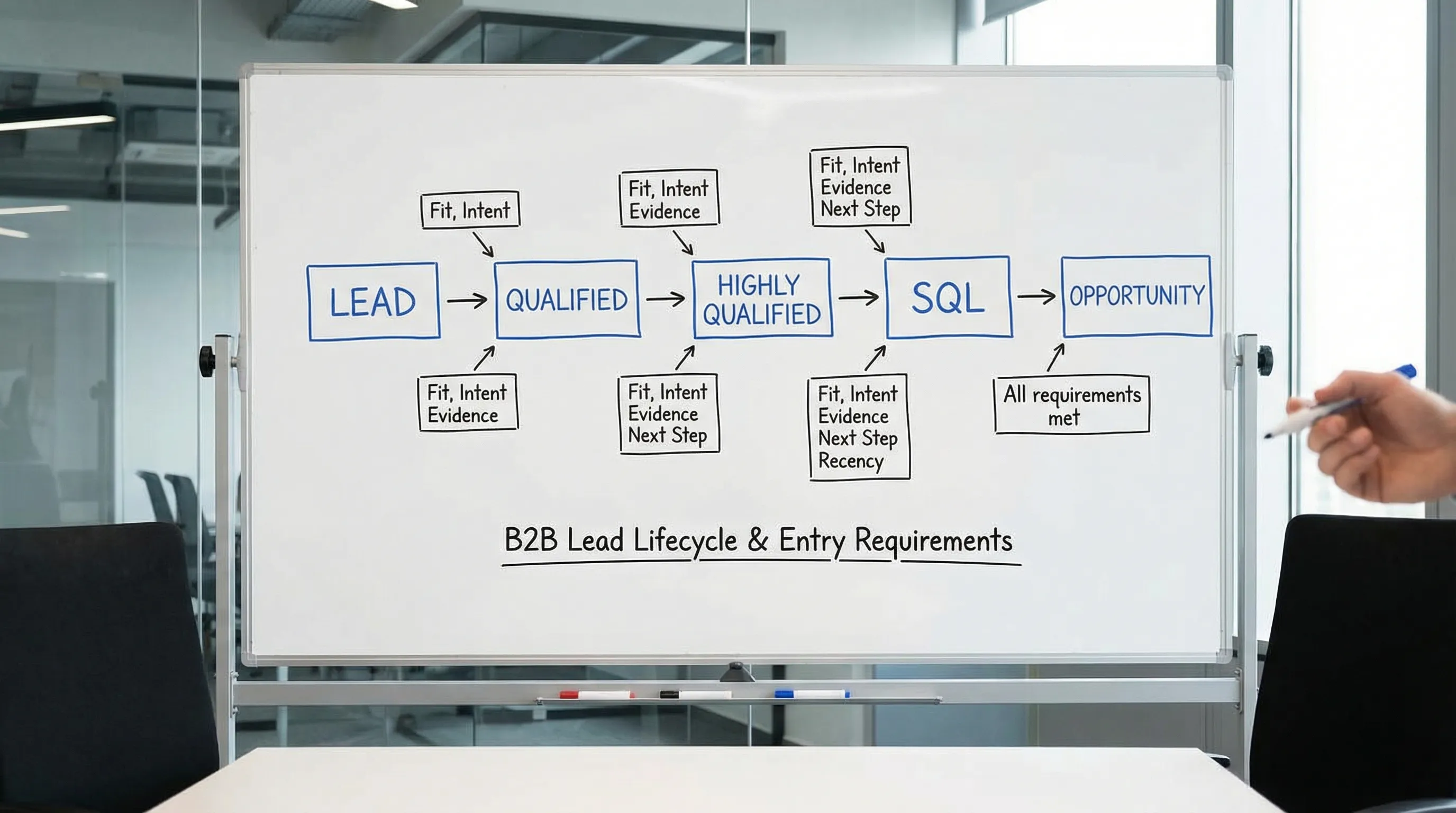
How to measure whether your “highly qualified leads” definition is working
A definition is only as good as its downstream performance.
Instead of arguing in anecdotes, track a small set of quality-first measures:
Acceptance and progression (sales trust)
- AE acceptance rate: percent of highly qualified leads that sales accepts (or does not bounce/reject)
- Meeting held rate (if meeting is the next step): booked-to-held is a fast quality proxy
- SQL-to-opportunity conversion (or highly qualified-to-opportunity, depending on your lifecycle)
Precision vs coverage (avoid gaming)
If you tighten the definition too much, you can inflate conversion rates while starving the pipeline. If you loosen it, you inflate volume.
Your goal is a stable balance:
- Precision: of the leads labeled highly qualified, how many progress?
- Coverage: how many total leads can you reliably label without sacrificing quality?
Time-to-action (speed is part of quality)
Even a great lead decays. Track:
- Speed to first sales touch after the label is applied
- Time from “highly qualified” to “next step completed” (for example, meeting held)
If you care about efficiency, connect quality to cost metrics like CPSQL, but keep quality guardrails in place (AE acceptance and conversion). Kakiyo’s Cost per Sales Qualified Lead guide covers the counting rules that prevent misleading benchmarks.
How to operationalize highly qualified leads (so the definition does not drift)
A definition only works if the workflow enforces it.
Build one shared rubric, not two translations
Keep the rubric short enough to live in your CRM and your weekly review.
A common pattern is a 3-part rubric:
- Fit
- Intent
- Evidence (including recency and next step)
Then define what score or combination earns “highly qualified.”
Put the rules in routing and SLAs
If your process allows people to bypass the definition, they will.
Operational controls that stabilize the label:
- Required fields before the stage can be set
- Clear SLAs for speed and follow-up
- Suppression rules and recycle rules when recency expires
Run a weekly calibration loop
Once per week, review a small sample:
- A handful of accepted highly qualified leads
- A handful of rejected highly qualified leads
Your goal is not blame. It is to identify:
- Which signals were misleading
- What evidence was missing
- Whether the rubric is too strict or too loose
This is also where prompt libraries, messaging templates, and qualification questions get updated.
Where LinkedIn conversations fit (and how “highly qualified” gets clearer)
LinkedIn is a unique channel because qualification often happens in asynchronous, multi-turn threads. That is an advantage if you treat conversation as evidence.
Instead of tagging a lead as “highly qualified” because they replied, tag them when the thread contains:
- A clear fit confirmation (role, scope, environment)
- A credible intent statement (problem, trigger, initiative)
- A next step the prospect agrees to
This is also where teams struggle at scale: it is hard for SDRs to maintain quality across hundreds of parallel conversations.
Kakiyo is designed for this specific problem: AI-managed, personalized LinkedIn conversations that can qualify and book meetings, with controls like prompt creation, A/B prompt testing, scoring, conversation override control, and analytics. The practical takeaway is not “automate everything,” it is “standardize the evidence capture so your highly qualified label stays trustworthy as volume grows.”
If you are building your conversation-led qualification motion, you may also like Kakiyo’s Lead qualification process guide and its 2026 perspective on SDR sales from outreach to booked meetings.
A lightweight alignment sprint you can run in two weeks
You do not need a quarter-long project to fix the definition.
Days 1 to 3 (definition): Agree on the downstream outcome (for example, AE-accepted meeting). Write the highly qualified lead definition in one sentence, then list fit, intent, evidence, next step, and recency requirements.
Days 4 to 7 (instrumentation): Add the minimum fields required for the evidence packet. Make at least one field mandatory before the “highly qualified” stage can be applied.
Days 8 to 10 (workflow): Set routing rules and SLAs. Define recycle rules when recency expires. Document what happens when sales rejects a lead.
Days 11 to 14 (calibration): Review a small sample of labeled leads with sales and marketing together, adjust the rubric, and lock version 1.0.
The goal: a label that predicts pipeline, not arguments
“Highly qualified leads” should not be a subjective compliment. It should be a repeatable, auditable label that sales and marketing trust because it consistently turns into the next meaningful step.
When you anchor the definition on fit, intent, evidence, next step, and recency, you get three benefits at once:
- Sales wastes less time on dead-end conversations
- Marketing gets clearer feedback on what actually converts
- RevOps can forecast and optimize based on real signals
If your team is generating demand on LinkedIn and wants to scale qualification without losing quality, explore how Kakiyo manages personalized conversations from first touch through qualification to meeting booking, with the governance and analytics needed to keep your “highly qualified” definition honest.
FAQ
What is the difference between a lead and a qualified prospect?
A lead is simply a potential contact or account. A qualified prospect has enough verified fit, intent, and context to justify a next sales step.
What makes qualification trustworthy?
Qualification is trustworthy when it relies on auditable signals, not labels alone. The more evidence a team can verify, the easier it is to align sales, marketing, and RevOps.
Should qualification be based on one score?
Not by itself. Scores are useful summaries, but teams still need explicit criteria around fit, buying signals, and next-step readiness.
How do I implement proof-based qualification in my team?
Start by defining what evidence is required at each stage, then make those signals visible in your workflows. The goal is consistency across inbound, outbound, and partner-sourced leads.