
 Ilan Asseo
SDR Sales: From Outreach to Booked Meetings
Practical 2026 operating model to turn targeted LinkedIn outreach into qualified conversations and meetings that hold—covering funnel stages.

SDR sales is often described as “booking meetings,” but the teams that consistently hit pipeline targets treat it as a controlled system: the right accounts, the right first touch, fast and relevant conversations, lightweight qualification, then a clean handoff into a meeting that actually holds.
This guide breaks down SDR sales from outreach to booked meetings with a practical, modern (2026) operating model, including what to measure, where deals leak, and how to scale without sacrificing buyer experience.
Industry evidence: “As customers increasingly learn and buy digitally, sales reps become just one of many possible sales channels.” — Cristina Gomez, Managing Vice President, Gartner.
Source: Gartner
What SDR sales actually is (and why most teams struggle)
In practice, SDR sales is the discipline of turning targeted attention into qualified conversations and then into meetings worth taking.
Most teams struggle for predictable reasons:
- They optimize for activity (messages sent) instead of micro-conversions that predict meetings.
- They separate “outreach” and “qualification” into different motions, so the thread loses context.
- They ask for meetings too early, before there is evidence of fit and intent.
- They scale volume faster than they scale relevance, which lowers reply rate and harms brand trust.
If your SDR motion lives primarily on LinkedIn, your core unit of work is not the email sequence. It is the conversation thread.
The SDR sales funnel, measured as micro-conversions
A clean SDR funnel makes it obvious where you are winning, and where you are leaking.
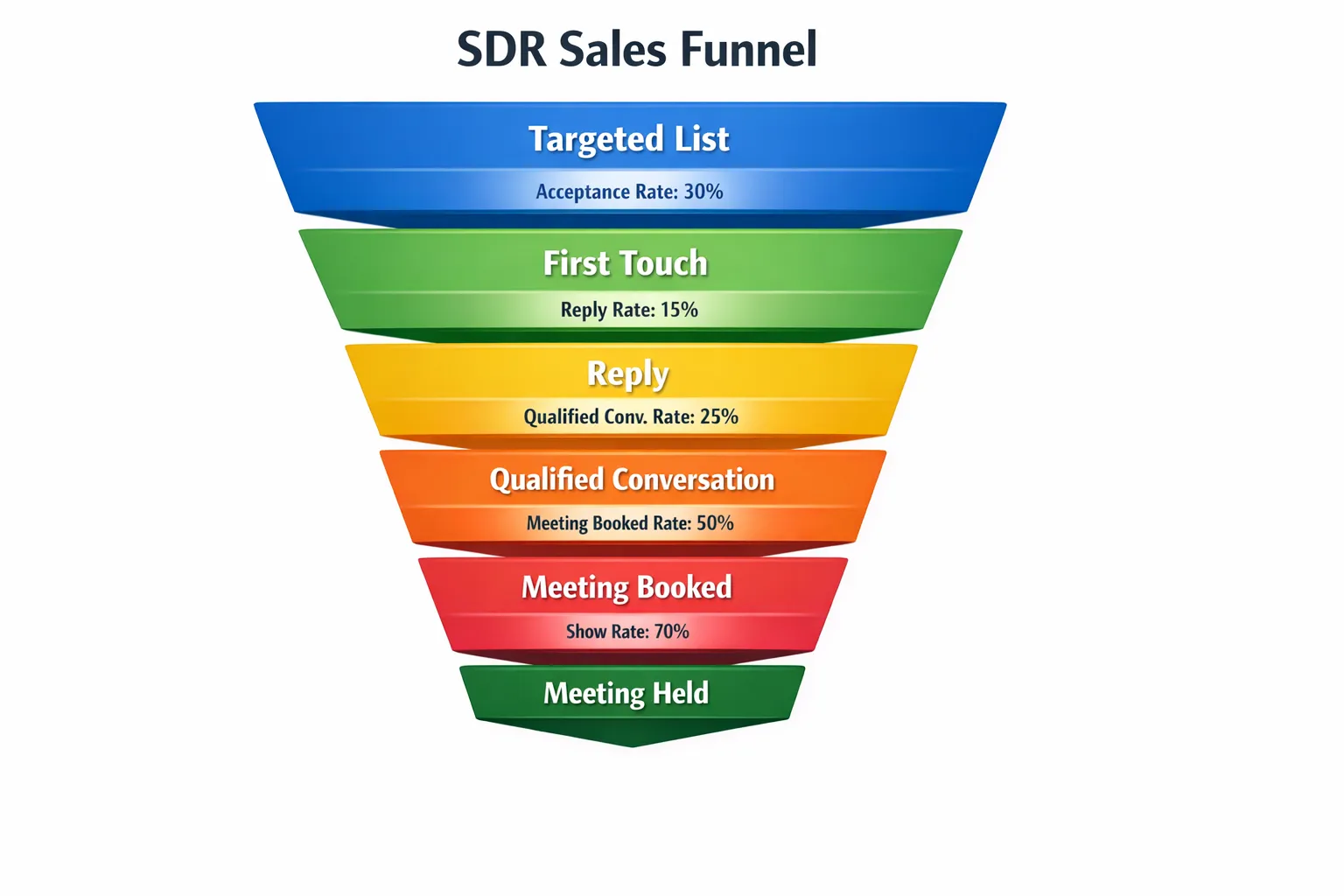
Here is a practical set of funnel stages and metrics that are channel-friendly (especially for LinkedIn).
| Funnel stage | What “good” looks like | KPI to track | Common leak |
|---|---|---|---|
| Targeting | Lists are specific enough to personalize quickly | ICP coverage, list quality checks | Overbroad ICP, low relevance signals |
| First touch | Short, contextual, credible | Connection acceptance (if applicable) | Generic openers, unclear “why you” |
| Reply | The prospect engages (not necessarily positive yet) | Reply rate, positive reply rate | Slow follow-up, unclear next question |
| Qualified conversation | Evidence of fit + a real problem + timing signal | Qualified conversation rate | Pitching early, skipping discovery |
| Meeting booked | A calendar event exists with a clear agenda | Booked meeting rate | High friction CTA, vague meeting value |
| Meeting held | The prospect shows, and AE accepts | Show rate, AE acceptance | Wrong persona, weak qualification, poor handoff |
If you want a deeper KPI map (including definitions and measurement tips), see Kakiyo’s guide to Sales Development Representative KPIs that matter.
Step 1: Outreach that earns replies (not just impressions)
Outreach works when it earns the next message. That is it. Your first touch should be designed to unlock a specific follow-up question, not force a demo.
Start with a “value hypothesis,” not a product
Before writing messages, define a one-sentence value hypothesis per segment:
- Who (role + company type)
- What changed (trigger or constraint)
- Why it matters (business impact)
- What you can help with (outcome, not feature)
This prevents the most common SDR mistake: using the same pitch across different contexts.
Keep the first touch narrow and verifiable
On LinkedIn, credibility is often created through specificity. Instead of “we help teams grow pipeline,” anchor to something observable:
- Hiring signals (new SDR leader, new AEs)
- Tech stack signals (CRM change, intent tooling)
- Market signals (new region, new product line)
- Personal signals (recent post about a problem)
You do not need heavy personalization. You need relevant personalization.
If you want copy-ready messaging structures, Kakiyo has a dedicated swipe file in LinkedIn outreach messages that get replies.
Step 2: Qualification that feels like a conversation (not an interrogation)
The fastest path to meetings is not asking more questions. It is asking the right questions in the right order, and capturing evidence inside the thread.
A useful mental model is: qualify for “a meeting worth taking,” not “a lead worth scoring.”
A thread-safe qualification sequence
For LinkedIn, qualification works best as short, low-friction prompts that feel like normal conversation. You can structure it as:
- Context: “How are you handling X today?”
- Problem: “What is the hardest part about that right now?”
- Impact: “What does that cost you (time, pipeline, conversion)?”
- Timeframe: “Is this something you are looking to improve this quarter or later?”
This style avoids forcing buyers into form-like BANT answers while still producing decision-quality signals.
If your team prefers classic frameworks, see Kakiyo’s LinkedIn-first implementation of BANT sales framework.
Turn answers into “proof,” not vibes
A qualified conversation should include at least one of the following:
- A clear pain or goal stated in the prospect’s words
- A constraint (team bandwidth, process gap, tooling gap)
- A timing signal (initiative now, planning window, evaluation)
- A next step permission (open to a quick chat, intro to right owner)
This is also how you prevent calendar spam. Meetings get better when qualification is evidenced.
Kakiyo covers this distinction in detail in Qualified prospects vs leads: what really matters.
Quick scoring you can use without overengineering
You do not need a complex model to decide “book” vs “continue” vs “disqualify.” You need consistent thresholds.
| Signal type | Example in a LinkedIn thread | Action |
|---|---|---|
| Strong fit + active pain | “We are missing pipeline and it is a priority for Q1” | Move to meeting CTA |
| Fit but unclear urgency | “We are thinking about it, maybe later this year” | Offer a resource, set a follow-up |
| Wrong persona | “Not my area, talk to RevOps” | Ask for intro, then pivot |
| No fit / no pain | “All set, not a priority” | Disqualify politely and exit |
Step 3: Converting interest into a booked meeting (without tanking show rate)
A surprising amount of SDR performance is “meeting mechanics,” not persuasion.
Use a meeting CTA that matches the thread
Choose the lightest CTA that fits the current level of intent:
- If intent is moderate: ask a one-question check (“Worth a quick 10 minutes to see if this maps to your situation?”)
- If intent is high: offer times (“I can do Tue 11:00am ET or Wed 2:30pm ET, what works?”)
- If the org is complex: propose a role check (“Is this you, or should we loop in the owner of X?”)
Calendar links can work, but they are often higher friction on LinkedIn if the prospect is still uncertain. Use them when the buyer is already leaning in.
Add an agenda in one sentence
The easiest way to increase held rate is to reduce ambiguity:
- What you will cover n- What you will not cover n- What the buyer gets out of it
Example (generic pattern): “We will map your current process for X, identify the biggest leak, and decide whether it is worth a deeper dive.”
Step 4: Make meeting quality measurable (so you stop arguing about it)
Most SDR teams measure booked meetings, but the business feels held meetings and accepted pipeline.
Two high-leverage definitions to align with AEs:
- Meeting held: the right persona attended for at least a minimum time threshold and engaged.
- AE accepted: the AE agrees the meeting met your qualification bar and should be worked.
If you want to formalize this across your funnel stages (MQL, SQL, etc.), Kakiyo’s MQLs and SQLs alignment guide is a practical playbook.
Step 5: Scale SDR sales without sacrificing buyer experience
Scaling SDR sales usually breaks in one of two places:
- Speed: replies come in, but humans cannot respond fast enough, so threads go cold.
- Consistency: different reps qualify differently, so meeting quality is unpredictable.
This is where AI can help, as long as it is implemented with guardrails.
What to automate vs what to keep human
AI performs best on:
- Drafting personalized openers based on profile and company context
- Managing simultaneous threads and responding quickly
- Asking consistent, thread-safe qualification questions
- Scoring and prioritizing which conversations deserve human time
- Running controlled experiments (A/B testing prompts and sequencing)
Humans should stay accountable for:
- ICP decisions and segmentation strategy
- Approval of messaging voice and boundaries
- Handling high-stakes objections and complex account dynamics
- Final judgment calls (book, recycle, disqualify)
Kakiyo is designed specifically around this conversation-first motion on LinkedIn, with autonomous LinkedIn conversations, AI-driven lead qualification, industry templates, custom prompts with A/B testing, an intelligent scoring system, override control, and analytics and reporting in a centralized dashboard. You can learn more at Kakiyo.
For safety and compliance considerations when automating LinkedIn, see Automated LinkedIn outreach: do it safely and effectively.
A simple weekly operating rhythm for SDR sales teams
If you want predictable improvement, run the team like a lab, not a hustle.
A practical cadence:
- Monday (30 minutes): pick one segment to focus, define the value hypothesis, and choose one variable to test (opener, CTA, qualification question).
- Midweek (15 minutes): review replies, identify where threads stall (no reply after question, no meeting after intent signal), adjust.
- Friday (30 minutes): inspect funnel metrics end-to-end, especially qualified conversation rate and held rate, then document what to keep.
This rhythm keeps experimentation controlled and prevents “random acts of outreach.”
Common SDR sales failure modes (and fast fixes)
| Symptom | Likely cause | Fix you can implement this week |
|---|---|---|
| Low reply rate | Message is not specific enough to the buyer’s context | Tighten segments, add one verifiable trigger |
| Replies but no meetings | You are not advancing with a clear question | Use a consistent qualification prompt after first reply |
| Many meetings, low held rate | Meeting value is unclear, wrong persona, weak agenda | Add a one-sentence agenda and persona check |
| AEs reject meetings | Qualification criteria are not aligned | Define “qualified conversation evidence” and enforce it |
| SDRs overwhelmed by threads | Too many parallel conversations without prioritization | Add scoring and response SLAs, automate first responses |
Frequently Asked Questions
What is SDR sales? SDR sales is the process of creating qualified pipeline by turning targeted outreach into real conversations, qualifying prospects quickly, and booking meetings that hold and convert.
How do SDRs go from outreach to booked meetings on LinkedIn? The reliable path is: segment tightly, send short first touches grounded in buyer context, ask thread-safe qualification questions, then use a low-friction meeting CTA with a clear agenda.
What metrics matter most for SDR sales performance? Beyond activity, track reply rate, qualified conversation rate, meetings booked, meetings held, and AE acceptance. These show whether you are generating real pipeline, not just calendar volume.
How do you qualify without turning the chat into an interrogation? Use short, conversational questions that uncover context, problem, impact, and timeframe. Capture evidence in the prospect’s words so the meeting has a real reason to exist.
Can AI help SDRs book more meetings without spamming buyers? Yes, if AI is used to increase relevance and speed while keeping governance in place (approved prompts, safe pacing, scoring, and human override). The goal is better conversations at scale, not more noise.
Turn SDR sales into a repeatable meeting engine
If your team is strong at outreach but struggles to consistently convert threads into qualified meetings, the biggest lever is usually operational: faster follow-up, consistent qualification, and better prioritization across many simultaneous conversations.
Kakiyo helps teams run that end-to-end motion by autonomously managing personalized LinkedIn conversations from first touch through qualification to meeting booking, with prompt control, A/B testing, scoring, analytics, and human override.
Explore Kakiyo at kakiyo.com, or go deeper on the LinkedIn motion with the LinkedIn prospecting playbook.