
 Ilan Asseo
SDR Job Description: Skills, KPIs, Daily Workflow
A practical guide for 2025 SDRs and hiring teams: responsibilities, core skills, KPIs, ramp goals, and a realistic daily workflow that blends buyer-first.

High-performing SDR teams in 2025 look different from five years ago. The job is still about creating qualified pipeline, but the work now blends buyer-first research, short personalized messages, tight qualification in-thread, and responsible use of AI to scale conversations without sacrificing relevance. If you are writing an SDR job description or preparing to step into the role, this guide covers the essentials: responsibilities, core skills, KPIs that matter, and a practical daily workflow that consistently turns outreach into booked meetings.
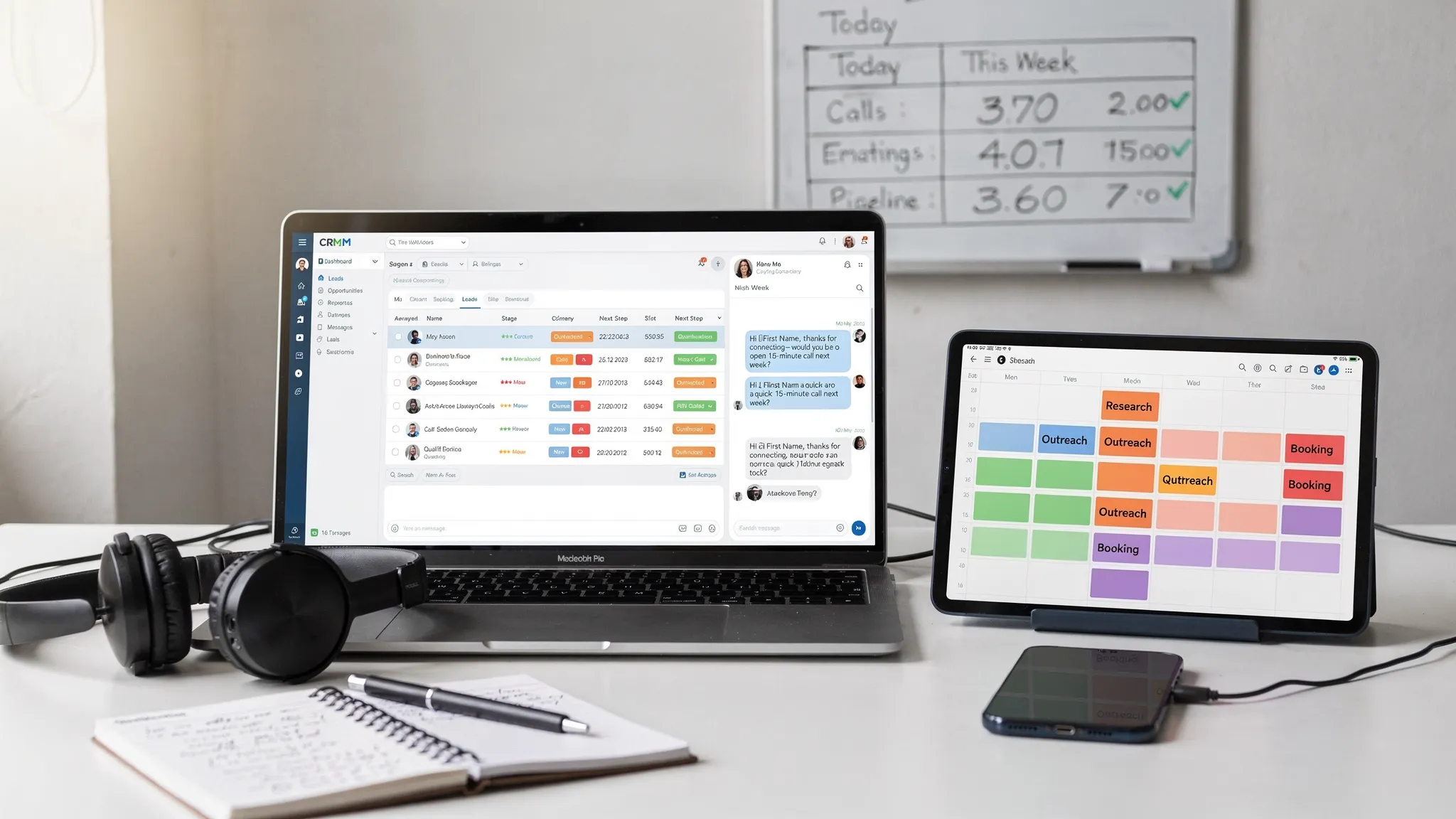
Industry evidence: Salesforce Research reports that sales reps spend only 28% of their week actually selling, with the rest consumed by deal management, data entry, and other non-selling work.
Source: Salesforce State of Sales
What an SDR actually does
An SDR (Sales Development Representative) creates qualified opportunities for Account Executives, primarily through outbound and social channels like LinkedIn, and sometimes by triaging inbound leads. The output is not volume of messages, it is qualified meetings that move into pipeline.
Common scope by channel and outcome:
- Target and research accounts and contacts that match your ICP.
- Start respectful, relevant conversations on LinkedIn and email, then follow up by phone where appropriate.
- Qualify in-thread using a simple rubric, for example CPIT (Context, Problem, Impact, Timeframe).
- Book meetings with clean handoffs into the CRM and calendar, and reduce no-shows with confirmation flows.
- Capture conversation signals and reasons for loss so the team can learn and iterate.
If your team distinguishes SDR and BDR, SDRs may focus on inbound and BDRs on outbound. In many orgs the titles are interchangeable. What matters is agreement on the definition of qualified, the KPIs you own, and the daily workflow to hit them.
Copy‑ready SDR job description template
Use this template as a foundation, then adapt to your ICP, channels, and motion.
Summary
We are hiring a Sales Development Representative to create qualified pipeline through buyer-first outreach on LinkedIn, email, and phone. You will research target accounts, start relevant conversations, qualify needs, and book meetings for our Account Executives. You will use AI and automation responsibly to scale personalization and maintain data quality in our CRM.
Responsibilities
- Research and prioritize accounts and contacts that match our ICP, including triggers like hiring, product launches, and partner moves.
- Start and manage LinkedIn conversations, personalize first touches, and follow up with short, value-led messages.
- Qualify prospects in-thread using a standard rubric and schedule meetings when fit, problem, interest, and timing are confirmed.
- Coordinate handoff to AEs, including context notes, meeting agendas, and confirmation messages to reduce no-shows.
- Maintain clean CRM records, update lead and contact statuses, and tag conversation outcomes and objections.
- Run small A/B tests on messaging and prompts, report results, and collaborate with marketing and sales leadership on improvements.
- Follow channel rules, opt-out requests, and team guardrails for respectful outreach.
Requirements
- 1 to 3 years in an SDR or BDR role, or a strong interest in sales with evidence of customer-facing success.
- Strong writing skills for short, clear messages and comfort with phone follow up.
- Basic proficiency with CRM and LinkedIn Sales Navigator. Experience with conversation automation is a plus.
- Curiosity, resilience, time management, and a data-driven approach to improvement.
- Willingness to learn prompt crafting and to work alongside AI tools within governance.
Success metrics you will own
- Acceptance, reply, positive intent, qualified conversation, and meetings booked rates.
- Speed to first touch for inbound and speed to next step in active threads.
- Data hygiene and completion of required fields for handoff.
For message frameworks and cadences you will use in the role, see our LinkedIn playbooks, including the LinkedIn prospecting guide from first touch to demo and our outreach templates that get replies.
- LinkedIn playbook: From first touch to demo: https://kakiyo.com/blog/linkedin-prospecting-playbook-from-first-touch-to-demo
- Message templates that earn replies: https://kakiyo.com/blog/linkedin-outreach-messages-that-get-replies
Essential SDR skills in 2025
The fundamentals still win, but teams now expect SDRs to be comfortable partnering with AI. Prioritize these skills:
- ICP and trigger research, quickly synthesize why-now context and a relevant angle for outreach.
- Short-form writing, 40 to 80 word messages that deliver context, credibility, value, and a soft CTA.
- Thread-safe qualification, gather CPIT signals without interrogations, earn permission for the next step.
- Prompt literacy, write and iterate prompts that steer AI to your voice, guardrails, and ICP specifics.
- Data hygiene, keep CRM and routing fields accurate so follow up and reporting are reliable.
- Compliance mindset, respect channel rules, rate limits, consent and opt-out norms, and privacy.
If you sell into education or community-led businesses, leveling up your domain knowledge can improve credibility in conversations. A practical way to do this is to skim resources that buyers read, for example guides on AI tools for course creators to understand their workflows and challenges.
For a deeper breakdown of modern competencies and how to build them, read our skills guide for AI-driven SDR teams: https://kakiyo.com/blog/top-sdr-skills-for-modern-ai-driven-sales-teams
The SDR KPIs that matter (with simple formulas)
Set targets by channel and ICP. The ranges below reflect focused, trigger-led outbound on LinkedIn in mid-market B2B. Your mileage will vary, so baseline your funnel and iterate.
| Metric | What it measures | How to calculate | Typical range |
|---|---|---|---|
| Connection acceptance rate | Relevance of target + profile strength | Accepted connections divided by connection requests sent | 25 to 45 percent |
| First message reply rate | Initial message resonance | Replies to first messages divided by first messages sent | 8 to 15 percent |
| Positive response rate | Intent among responders | Positive replies divided by total replies | 20 to 35 percent |
| Qualified conversation rate | Fit and need discovered | Qualified conversations divided by total conversations | 20 to 40 percent |
| Meetings booked rate | Conversion from qualified to meeting | Meetings booked divided by qualified conversations | 40 to 60 percent |
| No-show rate | Meeting quality and confirmation effectiveness | No-shows divided by meetings booked | 10 to 20 percent |
| Speed to first touch | Responsiveness to triggers or inbound | Median hours from trigger or assignment to first outreach | Under 24 hours |
| Speed to next step | Follow-through inside active threads | Median hours from reply to your next message | Under 4 hours in working time |
| A/B test coverage | Culture of iteration | Contacts in an active A/B test divided by all active contacts | 25 to 50 percent |
| CRM hygiene | Data quality for handoff and reporting | Records with all required fields divided by total active records | 95 percent plus |
If you are new to scoring and qualification, learn how to operationalize fit, intent, and conversation signals in our lead qualification guide: https://kakiyo.com/blog/lead-qualification-process-steps-scoring-and-automation
A realistic SDR daily workflow
Use time blocks and protect them. This sample day assumes a LinkedIn-first outbound motion with phone and email as supporting channels. Replace slots with your channel mix.
- 8:30, Plan the day, review your dashboard, confirm inputs and targets.
- 9:00, Account research, select 10 to 15 contacts with a strong why-now signal.
- 9:30, LinkedIn first touches, send short, personalized connection requests and value-led messages.
- 10:30, Call block, follow up opens and replies, summarize value and propose a short next step.
- 11:30, Follow-up and thread management, move active conversations toward qualification.
- 1:00, Qualification and booking, tighten CPIT signals and offer two time slots to schedule.
- 2:00, Micro-campaign, launch a 20 to 40 contact test around a single trigger with two message variants.
- 3:00, CRM hygiene and handoffs, update statuses, fill required fields, and confirm meetings.
- 3:45, Learn and iterate, review top and bottom messages, refine prompts, and note objections.
- 4:15, Manager sync or peer role play, focus on one objection or stage where you see drop off.
Weekly rhythm, keep Mondays for list strategy and Friday for review and reset. Midweek, run one small experiment and one skills rep session.
For channel-specific cadences and message examples that fit this workflow, reference our end-to-end LinkedIn prospecting playbook: https://kakiyo.com/blog/linkedin-prospecting-playbook-from-first-touch-to-demo and our safety guide for automated outreach: https://kakiyo.com/blog/automated-linkedin-outreach-do-it-safely-and-effectively
30-60-90 ramp goals for new SDRs
Keep ramp measurable and confidence-building.
- Days 1 to 30, Setup and baselines, master your ICP, tools, and message patterns. Inputs, 400 to 600 targeted connection attempts and 200 first messages. Outcomes, establish baselines for acceptance, reply, and positive rates. Shadow 3 to 5 AE calls and write debriefs.
- Days 31 to 60, Consistent output, run two micro-campaigns per week and own full-thread qualification to booking for a subset of accounts. Aim to cut time to next step under 6 working hours.
- Days 61 to 90, Precision and scale, specialize on 1 to 2 triggers that outperform baseline. Own your own A/B tests and report weekly learnings to the team. Reduce no-shows with confirmation flows and agendas.
Tooling and where AI fits
A lean, effective stack for LinkedIn-first teams typically includes:
- CRM for routing, statuses, and reporting.
- LinkedIn Sales Navigator for targeting, lists, and alerts. If you are new, start here: https://kakiyo.com/blog/using-linkedin-sales-navigator-for-prospecting-a-how-to
- Calendar and scheduling for frictionless booking and reminders.
- Conversation automation that can scale personalization and manage threads safely.
How Kakiyo maps to the SDR job-to-be-done:
- Autonomous LinkedIn conversations, start, manage, and progress many 1-to-1 threads at once, while keeping buyers’ context intact.
- AI-driven lead qualification, gather CPIT signals in-thread and score fit and intent so you focus on higher-value opportunities.
- Customizable prompts and A/B testing, keep your brand voice and continuously improve message performance.
- Intelligent scoring and routing, prioritize follow up and handoffs using conversation-level signals.
- Conversation override and a real-time dashboard, step in at key moments, monitor KPIs, and coach using live context.
See how an AI SDR works in practice: https://kakiyo.com/blog/ai-sdr-automate-conversations-qualify-faster-book-more
Interview signals for hiring managers
Screen for behaviors you can coach up and traits that persist under pressure.
- Curiosity in research, ask candidates to reverse-engineer your ICP and propose three triggers that justify outreach this week.
- Messaging clarity, give a real buyer scenario and ask for a 70 word first touch and a 50 word follow up.
- Qualification skill, role play a LinkedIn thread where the buyer is skeptical. Look for concise questions and clear next steps.
- Data and learning, ask for an example of a small experiment they ran and what changed as a result.
- Ethics and compliance, probe how they would handle opt-outs and platform rules.
How to manage by the numbers without losing the human
- Track the full funnel weekly, acceptance, reply, positive, qualified, booked, and no-shows. Use small cohorts by trigger or persona so your comparisons are fair.
- Optimize the buyer experience first, shorten messages, remove fluff, and always offer an easy exit.
- Standardize qualification, adopt a rubric that your AEs trust so they accept handoffs without re-qualifying.
- Coach with live context, review a handful of threads together, not just aggregate numbers, and turn learnings into prompt updates and new tests.
Final word
The best SDR job descriptions set a clear standard for outcomes, give people a workable daily plan, and empower them with tools that make buyer-first personalization scalable. Write the role for precision and learning, not just activity volume. Then give your team the support, prompts, and analytics to continuously improve.
FAQ
What does a strong SDR or BDR actually own?
A strong SDR or BDR owns early-stage pipeline creation: targeting, first conversations, qualification, and clear handoff. The role is not just about booking meetings, but booking the right meetings.
Which skills matter most in modern sales development?
Prospecting judgment, messaging clarity, qualification discipline, and CRM hygiene matter more than raw call volume. In modern teams, AI literacy and channel fluency also matter.
How should teams evaluate SDR performance?
Use a mix of activity, conversion, and pipeline quality metrics. Strong teams look beyond booked meetings to show rates, qualification accuracy, and accepted pipeline.
How long does it take for a new rep to become productive?
Most reps need a ramp period before they consistently generate qualified pipeline. The fastest ramp comes from clear playbooks, tight feedback loops, and strong qualification criteria.