
 Ilan Asseo
Google Cloud Customer Dev Rep: What They Do
Guide to the Google Cloud Customer Development Representative role, covering responsibilities, qualification, and technical buyer alignment.

Many organizations struggle to effectively convert target accounts into qualified conversations. This guide explains the role of a Google Cloud Customer Development Representative (CDR) and how they bridge the gap between technical and business stakeholders to achieve this.
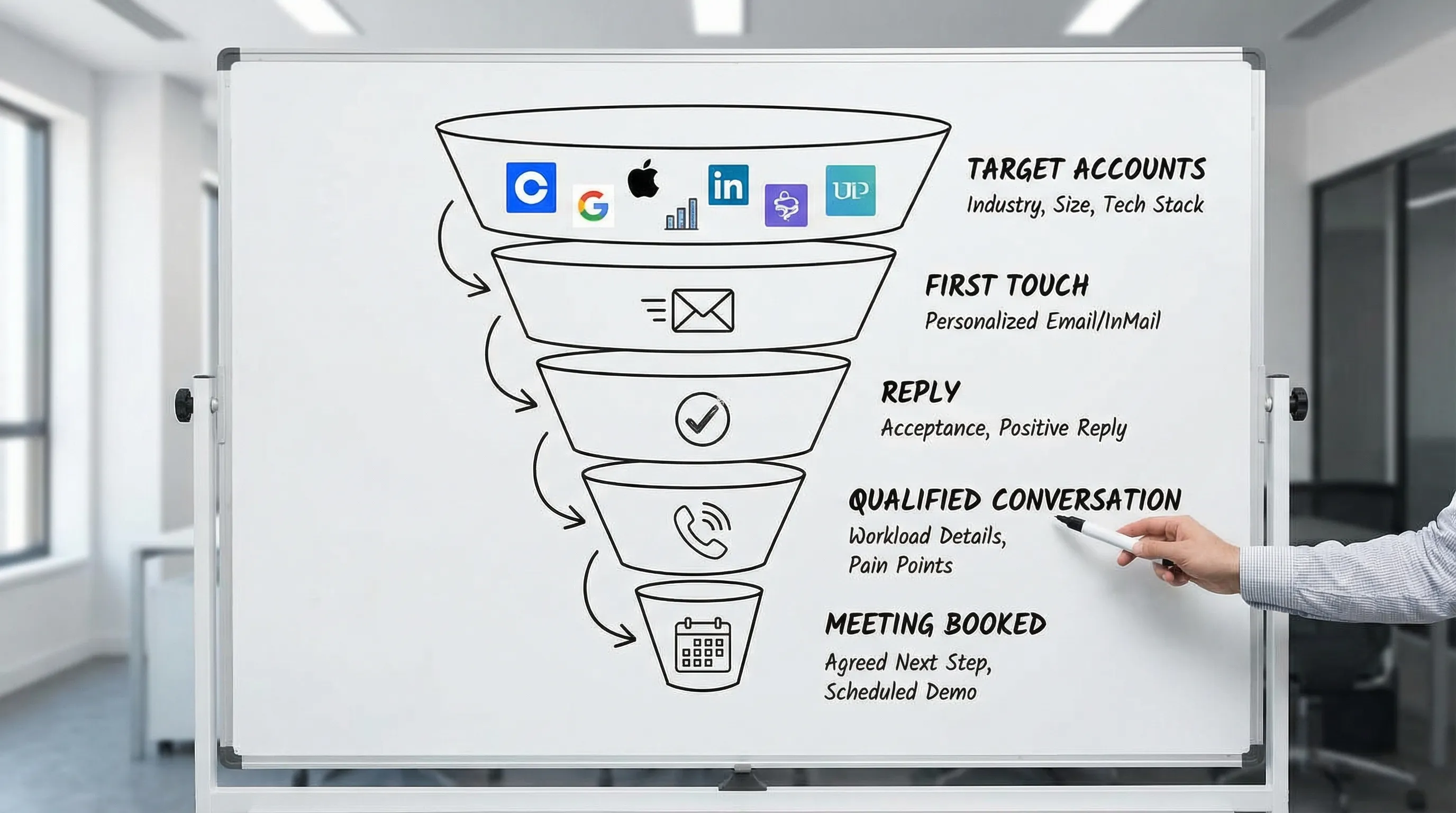
A “Google Cloud Customer Development Representative” (often shortened to CDR) is essentially a cloud-focused sales development role. The job is to turn a target account list into qualified conversations and booked meetings for the closing team, while speaking credibly to both business and technical stakeholders.
In other words, a Google Cloud CDR sits at the critical point where demand generation becomes real pipeline: they identify the right companies, reach the right people, start relevant conversations, qualify quickly, and hand off the right next step.
Industry evidence: Salesforce Research reports that sales reps spend only 28% of their week actually selling, with the rest consumed by deal management, data entry, and other non-selling work.
Source: Salesforce State of Sales
What a Google Cloud Customer Development Representative does
Most CDR roles in cloud sales are designed around one outcome: create sales-ready meetings by qualifying early interest and converting it into an agreed next step (discovery, technical deep dive, workshop, migration assessment, proof of concept, or pricing conversation).
In practice, a Google Cloud CDR will spend their week doing five categories of work:
1) Targeting and account planning
Cloud deals are rarely single-threaded. A CDR typically starts by building a focused account list based on ICP signals like industry, size, growth stage, tech stack, regulatory environment, hiring, and trigger events (modernization initiatives, data platform changes, security incidents, new CIO/CTO, M&A).
Because many cloud initiatives are programmatic, not transactional, a CDR’s targeting work is about finding accounts where a “why now” is plausible.
2) Prospecting and multi-channel outreach
CDRs prospect across channels, but in 2026, LinkedIn is often the highest-leverage channel for starting credible conversations with technical and business stakeholders.
Outbound work usually includes:
- Personalized LinkedIn connection requests and DMs
- Email, especially for follow-ups and sharing technical resources
- Calls, mainly when there is strong intent or a clear path to a meeting
The best-performing CDRs treat outreach as a conversation system, not a sequence. They optimize for micro-conversions like connection acceptance, first reply, and “permission to ask one question” before pushing for a meeting.
3) Early qualification for cloud fit and intent
Cloud qualification is different from many SaaS categories because the “product” is a portfolio (compute, storage, data, AI/ML, security, networking) and the buying group includes both technical and business owners.
So qualification tends to focus on:
- Workload reality: what is the system, where does it run today, what is changing?
- Motivation: what is driving the initiative (cost, speed, security, AI readiness, compliance, data modernization)?
- Constraints: security posture, data residency, procurement, architecture standards, timeline
- Stakeholders: who owns architecture, budget, delivery, and risk
The goal is not to run a full discovery call. The goal is to collect enough evidence to route the opportunity correctly (or disqualify quickly).
4) Meeting booking and handoff quality
A Google Cloud CDR’s credibility often shows up in the handoff. The handoff is strong when it includes:
- Who the meeting is with and why they care
- What problem or initiative was confirmed
- What evidence was captured (quotes, signals, constraints)
- What the prospect agreed to as the next step
This is where many teams lose time. Meetings get booked, but they are not sales-ready, or the closing team has to redo basic context.
5) Pipeline hygiene and feedback loops
Modern development roles are measured on outcomes, but they still require operational excellence. CDRs typically maintain CRM hygiene, log conversation evidence, update stakeholders, and participate in weekly quality reviews.
A well-run CDR motion also includes a feedback loop: which messages create qualified replies, which account segments convert, and which “qualified” meetings are actually accepted and progress.
Where the CDR fits in a Google Cloud buying motion
In enterprise cloud sales, the CDR is often partnered with roles like Account Executives (AEs) and technical specialists (sometimes called customer engineers or solution architects in many orgs). Titles vary across companies and teams, but the system is consistent:
- The CDR creates and qualifies the conversation.
- The closing and technical team advances it through deeper discovery, validation, and commercial steps.
This separation exists because cloud deals tend to be complex:
- Multiple stakeholders across IT, security, data, finance, and the business
- Competitive displacement (AWS, Azure, on-prem, hybrid)
- Non-trivial implementation and partner involvement
That is why CDR work is not just “set meetings.” It is reduce wasted meetings by qualifying for real cloud change.
What makes a cloud CDR different from a general SDR
Many SDR basics still apply, but cloud adds specific complexity.
The conversation has to bridge business value and technical reality
A strong cloud CDR can talk about outcomes (modernization, analytics, AI readiness, resilience, time-to-market) while also asking grounded questions about the system.
They do not need to be a deep technical expert, but they need enough technical literacy to avoid vague discovery.
If you need a reliable source of baseline product context, Google Cloud’s own product pages and architecture resources are a good starting point, for example the Google Cloud Architecture Center.
“Qualification” often includes workload, not just persona
In many SaaS motions, persona fit is the major gate. In cloud, workload fit matters equally. Two companies with the same title may have completely different readiness depending on:
- Legacy dependencies
- Security requirements
- Data gravity
- Existing vendor commitments
The buying group is wider and harder to map
Cloud deals often require consensus across security, finance (FinOps), platform engineering, data teams, and business sponsors. The CDR’s job is frequently to start the account map and open multiple threads, not just find one champion.
A day-to-day workflow for a Google Cloud CDR
A realistic daily workflow is less about doing more touches and more about keeping the funnel moving:
- Morning triage: reply handling, prioritizing hot threads, booking next steps fast
- Account expansion: adding 3 to 10 net-new accounts (or buying-group contacts) based on triggers
- First touches: sending highly targeted LinkedIn connection notes and short openers
- Qualification follow-ups: 2 to 3 question flows to confirm workload, priority, and next step
- Handoff packaging: writing a tight evidence summary for the AE and technical team
- End-of-day hygiene: updating statuses, logging evidence, tagging themes for iteration
If your team wants a broader reference for development workflows and outcomes, Kakiyo’s SDR resources on role design and measurement are a useful baseline, for example this guide on the Sales Development Representative role, KPIs, and career path.
How cloud qualification should work (and what “good evidence” looks like)
If you want qualification to be repeatable, you need a consistent evidence model. A simple, defensible approach is:
- Fit: account and persona match your target segment
- Intent: there is a real initiative, not curiosity
- Evidence: you captured proof in the conversation that the next step is justified
For cloud, the “evidence” component is usually the missing piece. Here are examples of evidence that typically strengthens a cloud handoff:
| Evidence type | What it sounds like in a conversation | Why it matters |
|---|---|---|
| Workload clarity | “Our data warehouse is struggling with X and we are evaluating options.” | Proves the problem is concrete, not generic interest |
| Timeline | “We need a plan this quarter.” | Determines urgency and routing priority |
| Stakeholder access | “Security and platform engineering need to be involved.” | Signals complexity and improves meeting success |
| Constraints | “Data residency rules apply.” | Avoids wasting cycles on non-viable paths |
| Next step agreement | “Yes, a 30-minute discovery with your specialist makes sense.” | Converts interest into a committed action |
If you already run an evidence-based definition of qualified leads, you can align cloud conversations to the same system. A practical internal reference is Kakiyo’s guide on lead qualification as a simple, repeatable system.
KPIs that matter for a Google Cloud CDR
Activity metrics exist, but cloud teams win by measuring conversion and quality. A useful CDR scorecard usually includes leading indicators (conversation health) and lagging indicators (pipeline impact).
| KPI | What it measures | Why it matters |
|---|---|---|
| New qualified conversations | How many net-new threads reached qualification evidence | Predicts meetings that stick |
| Positive reply rate | Replies that indicate relevance or curiosity | Quality signal, reduces spammy volume |
| Qualified conversation rate | Share of replies that reach fit and intent | Shows targeting and messaging quality |
| Meetings booked | Calendar outcomes | Necessary, but not sufficient |
| Meetings held | Show rate and booking quality | Protects AE time and improves pipeline yield |
| AE acceptance rate | Percent of meetings accepted as “good” | Best quality control mechanism |
| Time-to-first-response | Speed to handle inbound replies | Prevents deals dying in-thread |
The key principle is: pair every throughput metric with a quality metric. Meetings booked without acceptance and held rates are not a win.
For deeper operational definitions, Kakiyo’s 2026 guide to SDR KPIs that matter is a solid reference.
Skills that make a Google Cloud CDR successful
The skills that consistently show up in high-performing cloud development reps are not exotic. They are just applied in a more complex environment.
Curiosity plus structure
Cloud conversations reward CDRs who can ask sharp questions without interrogating the prospect. The fastest way to lose trust is to ask generic discovery questions that show you did not do basic homework.
Technical literacy (not deep engineering)
You do not need to design architectures, but you do need to understand concepts like migration, data platforms, security posture, and cost considerations well enough to:
- avoid vague “tell me about your infrastructure” questions
- identify when a specialist should join
- write a handoff that the technical team respects
Clear writing
Most CDR output is written: LinkedIn messages, short emails, and handoff notes. If you can write tight, human messages, you will book more meetings.
If you want examples of short, conversion-oriented message structure, see Kakiyo’s guide to LinkedIn outreach that converts.
Experimentation discipline
Because cloud segments vary by industry and trigger, the best CDRs run controlled tests. They change one variable at a time (opener, proof point, qualification question, CTA) and learn quickly.
The tools a CDR typically relies on
Tooling varies by org, but the job generally requires:
- A CRM to track stages, evidence, and handoffs
- Account and contact discovery, enrichment, and intent signals
- Outreach tools (including LinkedIn workflows)
- Scheduling and handoff mechanics
- Analytics to see which segments and messages are producing accepted meetings
The limiting factor is rarely “more tools.” It is whether your tools help you manage multi-turn conversations and capture evidence, especially on LinkedIn.
How AI changes the Google Cloud CDR role (without breaking trust)
AI is increasingly used to remove low-leverage work: drafting, personalization at scale, reply triage, and consistent qualification capture. The risk is obvious too: if AI is deployed like a volume machine, it creates spam and damages your brand.
A safe, high-performing model is “controlled autonomy”:
- AI handles repetitive conversation management and follow-ups.
- Humans set the strategy (ICP slices, value hypotheses, disqualifiers).
- Humans keep override control, escalation rules, and QA.
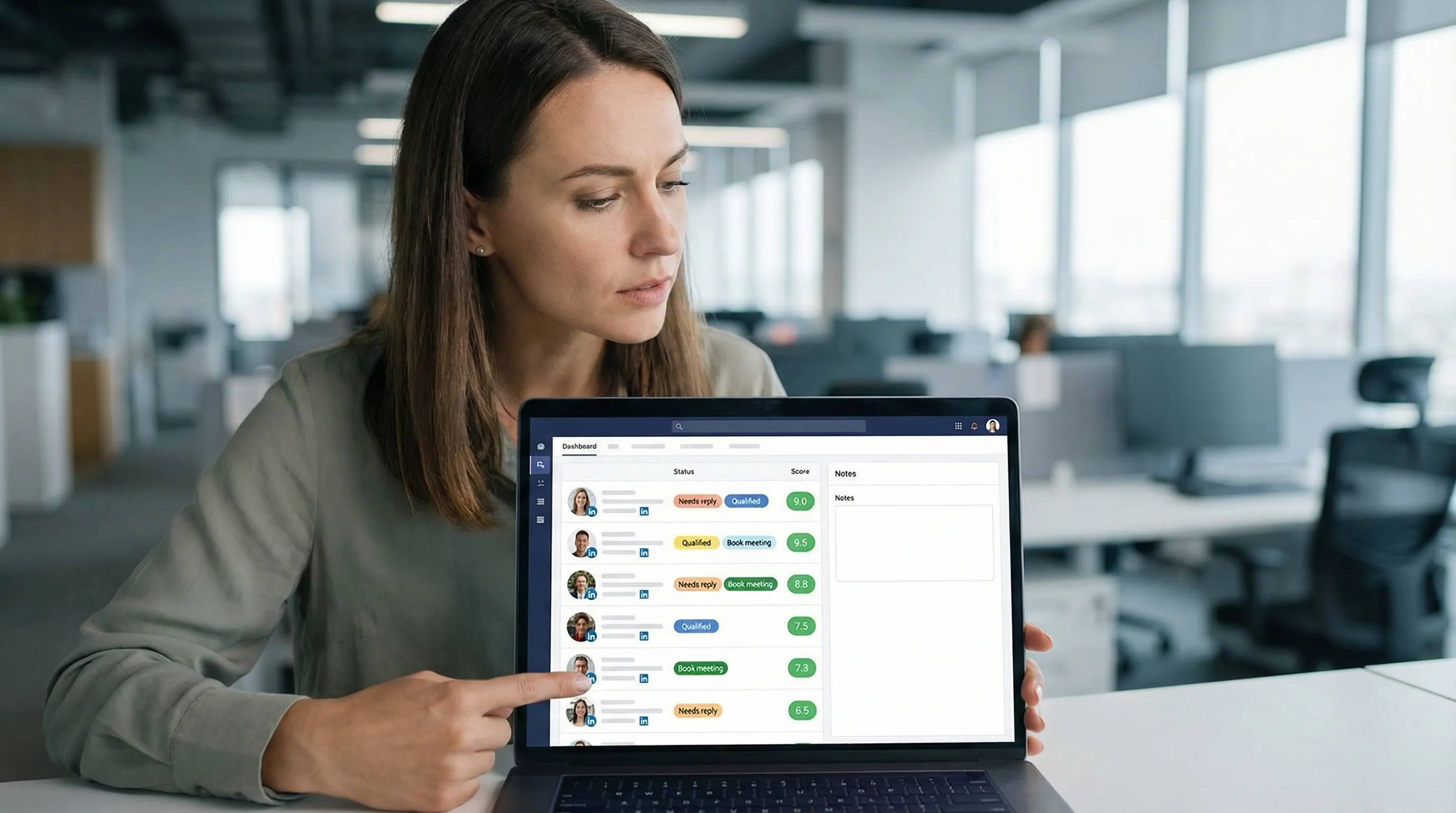
That is exactly the category Kakiyo is built for. Kakiyo autonomously manages personalized LinkedIn conversations from first touch through qualification to meeting booking, with controls like A/B prompt testing, scoring, overrides, and a centralized dashboard. If you are trying to scale a cloud development motion without burning your network, start with Kakiyo’s guide to automated LinkedIn outreach done safely.
Career path for a Google Cloud CDR
Many CDRs use the role to build fundamentals that translate into several next steps, depending on strengths:
- Closing roles that own opportunities end-to-end
- Technical or solution-facing paths for those who gravitate toward architecture and implementation conversations
- Team leadership or enablement paths for those who enjoy coaching, experimentation, and process design
Regardless of path, the transferable asset is the same: the ability to consistently create qualified pipeline from targeted accounts.
If you are hiring (or applying), focus on outcomes, not buzzwords
For hiring managers, the best CDR candidates can explain:
- which segments they targeted and why
- the exact conversation flow they used to qualify
- how they measured meeting quality (not just volume)
- how they learned and iterated on messaging
For candidates, your strongest proof is specific, measurable, and tied to quality, for example:
- “Built pipeline in X segment by increasing qualified conversation rate from A to B.”
- “Improved meeting held rate by changing qualification and booking mechanics.”
- “Ran weekly A/B tests on openers and CTAs, documented wins, and operationalized the best-performing prompts.”
If you want a modern template for what “good” looks like in development roles, Kakiyo’s SDR job description guide is a helpful reference point.
Turning cloud conversations into qualified meetings, at scale
A Google Cloud Customer Development Representative is not just a meeting setter. Done well, the role is a conversation-led qualification engine that protects the closing team’s time and creates predictable pipeline.
If your team is leaning into LinkedIn as a primary channel and wants to scale without losing relevance, Kakiyo’s platform is designed to run personalized, multi-turn LinkedIn conversations with qualification and booking built in. Learn more at Kakiyo.
FAQ
What does a strong SDR or BDR actually own?
A strong SDR or BDR owns early-stage pipeline creation: targeting, first conversations, qualification, and clear handoff. The role is not just about booking meetings, but booking the right meetings.
Which skills matter most in modern sales development?
Prospecting judgment, messaging clarity, qualification discipline, and CRM hygiene matter more than raw call volume. In modern teams, AI literacy and channel fluency also matter.
How should teams evaluate SDR performance?
Use a mix of activity, conversion, and pipeline quality metrics. Strong teams look beyond booked meetings to show rates, qualification accuracy, and accepted pipeline.
How long does it take for a new rep to become productive?
Most reps need a ramp period before they consistently generate qualified pipeline. The fastest ramp comes from clear playbooks, tight feedback loops, and strong qualification criteria.