
 Ilan Asseo
Sales Development Rep: Role, KPIs & Career Path
A practical guide to the modern SDR role: what SDRs do, the KPIs that predict pipeline, common career paths, and how AI is reshaping SDR work and workflows.

Sales Development Representatives (SDRs) sit at one of the most leveraged points in B2B revenue: the moment a buyer goes from “maybe” to an actual conversation with proof, next steps, and a calendar invite. In 2026, the best SDR orgs are not “activity factories.” They are conversation-led teams that turn targeted outreach (often LinkedIn-first) into qualified meetings that AEs accept and advance.
This guide breaks down the modern SDR role, the KPIs that actually predict pipeline, and the most common career paths (including how AI is changing what “great” looks like).
Industry evidence: Salesforce Research reports that sales reps spend only 28% of their week actually selling, with the rest consumed by deal management, data entry, and other non-selling work.
Source: Salesforce State of Sales
What does a Sales Development Representative do?
An SDR’s job is to create pipeline by starting, shaping, and qualifying sales conversations, then handing them off cleanly to an Account Executive (AE) or closing motion.
In practical terms, a modern Sales Development Representative typically owns:
- Targeting and ICP coverage: building a focused list (accounts, personas, buying groups) instead of spraying volume.
- First touch and permission-based outreach: short messages that earn the right to continue the conversation.
- Conversation management: handling replies, follow-ups, and branching paths based on what the prospect says.
- Qualification: confirming fit and intent, and capturing evidence that sales trusts.
- Booking logistics: converting interest into a meeting that actually holds.
- Handoff quality: passing the right context to the AE (not just “Booked demo”).
If your team is LinkedIn-first, the SDR role leans even more toward in-thread conversation skill, because the channel rewards relevance and punishes obvious automation. For practical messaging mechanics, see Kakiyo’s guide to LinkedIn outreach that converts.
SDR vs BDR (and why the titles vary)
Companies use titles differently, but a useful rule of thumb is:
- SDR: often tied to inbound or hybrid qualification, plus outbound support.
- BDR: often outbound-first and focused on new logo pipeline.
In reality, many orgs blend these into one “SDR” function that covers both inbound triage and outbound conversation creation.
The SDR funnel (what “good” output looks like)
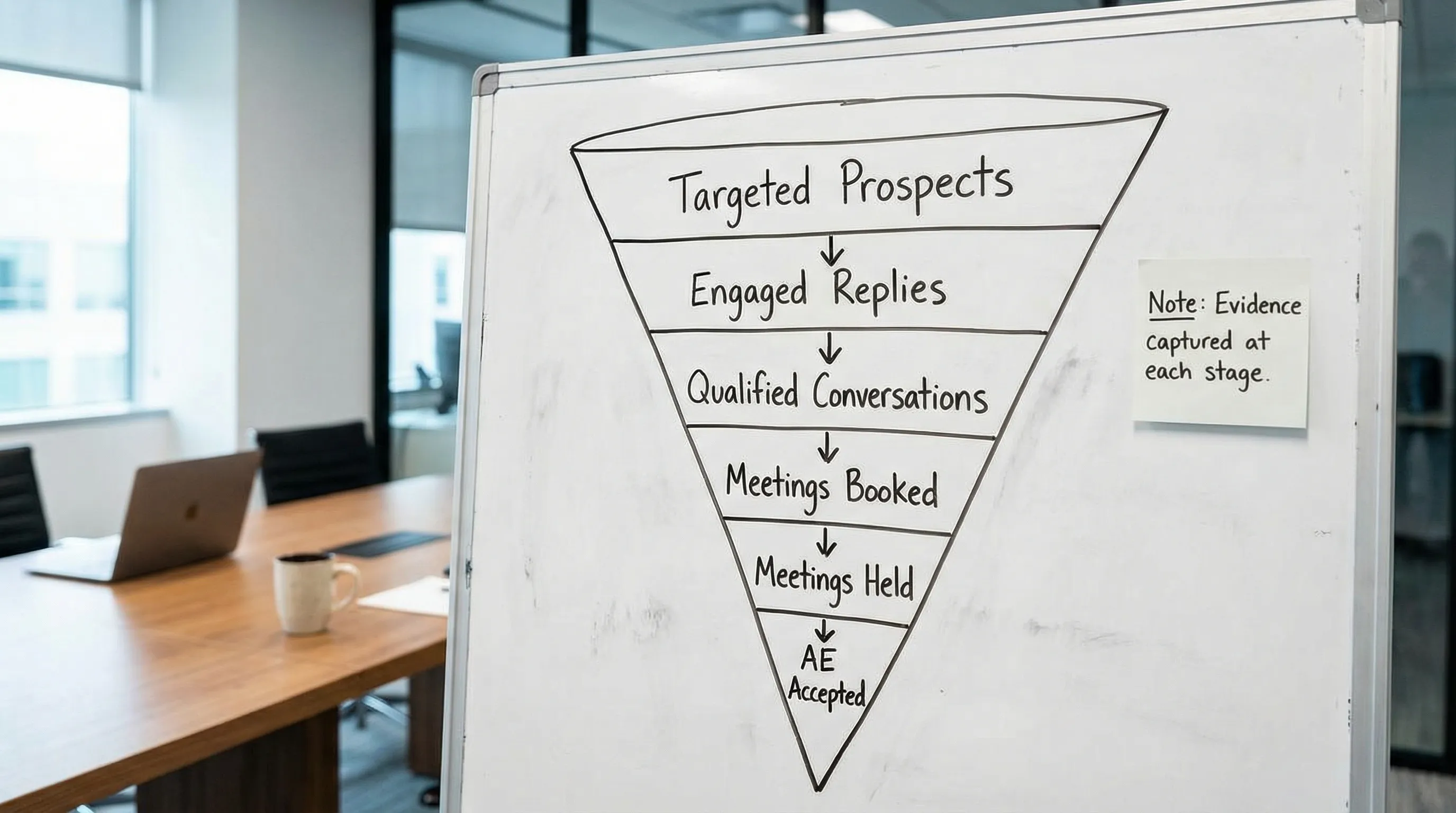
SDR performance becomes much easier to manage when you define a small funnel and instrument it consistently. A simple, conversation-led view looks like:
Targeted prospects → Engaged replies → Qualified conversations → Meetings booked → Meetings held → AE accepted
The key idea: SDRs do not “generate leads.” They generate qualified conversations that convert into held meetings and pipeline.
Here’s a practical mapping of outputs and what evidence should exist at each step.
| Funnel step | SDR output | Evidence you should capture (minimum viable) |
|---|---|---|
| Targeted | Accounts and personas aligned to ICP | ICP criteria used, persona, segment, reason for targeting |
| Engaged | A real reply that indicates openness | Reply category (positive, neutral, objection, not now), timestamp |
| Qualified conversation | Fit and intent are confirmed (or disconfirmed) | Fit notes, intent signals, disqual reason if applicable |
| Meeting booked | Calendar invite with the right stakeholders | Meeting purpose, agenda, who is attending |
| Meeting held | Buyer shows up and has the conversation | Held vs no-show, notes, next step |
| AE accepted | AE agrees it was worth taking | Acceptance status and reason codes |
If you want a deeper operating model for turning outreach into held meetings, Kakiyo’s SDR sales guide is a useful companion.
SDR KPIs that matter (and how to avoid “activity theater”)
The most common KPI mistake is optimizing for what is easy to count (messages sent, connection requests) instead of what predicts pipeline (qualified conversations and accepted meetings).
A modern SDR scorecard should combine:
- Leading indicators (you can improve them weekly)
- Lagging outcomes (they prove value, but they move slower)
- Quality checks (they prevent gaming)
Kakiyo has a full deep dive on this topic in Sales Development Representative: KPIs That Matter. Below is the practical “role, KPIs, career path” version: what to track, how to define it, and what it tells you.
Core SDR KPI definitions
| KPI | What it measures | Why it matters | Common failure mode |
|---|---|---|---|
| ICP coverage | % of touches going to true ICP | Fixes the “wrong list” problem | Inflated volume to low-fit prospects |
| Positive reply rate | % of replies that are meaningfully positive | A proxy for message-market fit | Counting any response as success |
| Qualified conversation rate | % of conversations that meet your qualification gates | Predicts meeting quality | “Qualifying” with vague notes or no proof |
| Meetings booked | Calendar invites created | Throughput | Booking meetings with weak intent |
| Meeting held rate | % of booked meetings that occur | Real buyer commitment | High no-shows due to low-friction booking without validation |
| AE acceptance rate | % of meetings AEs accept as worthwhile | Alignment and downstream trust | SDR and AE disagree on what “qualified” means |
| Speed to first meaningful touch | Time from signal or targeting to first real exchange | Drives conversion in many motions | Slow follow-up that lets intent decay |
| Disqualification rate (with reasons) | How often you correctly say “no” | Protects AE time and improves targeting | Disqualifying without structured reason codes |
The “paired KPI” trick (prevents gaming)
If you only track one metric, reps will unintentionally optimize the wrong behavior. Pair a throughput metric with a quality metric, for example:
- Meetings booked + Meeting held rate
- Replies + Qualified conversation rate
- Activity volume + ICP coverage
This keeps the focus on outcomes, not motion.
A simple weekly SDR scorecard
Keep weekly reviews tight and repeatable. Many teams use a short scorecard plus a diagnostic conversation. For an example cadence, see AI sales metrics: what to track weekly.
Career path for Sales Development Representatives
The SDR role is one of the best “training grounds” in GTM because it forces mastery of targeting, messaging, objection handling, qualification, and operating discipline.
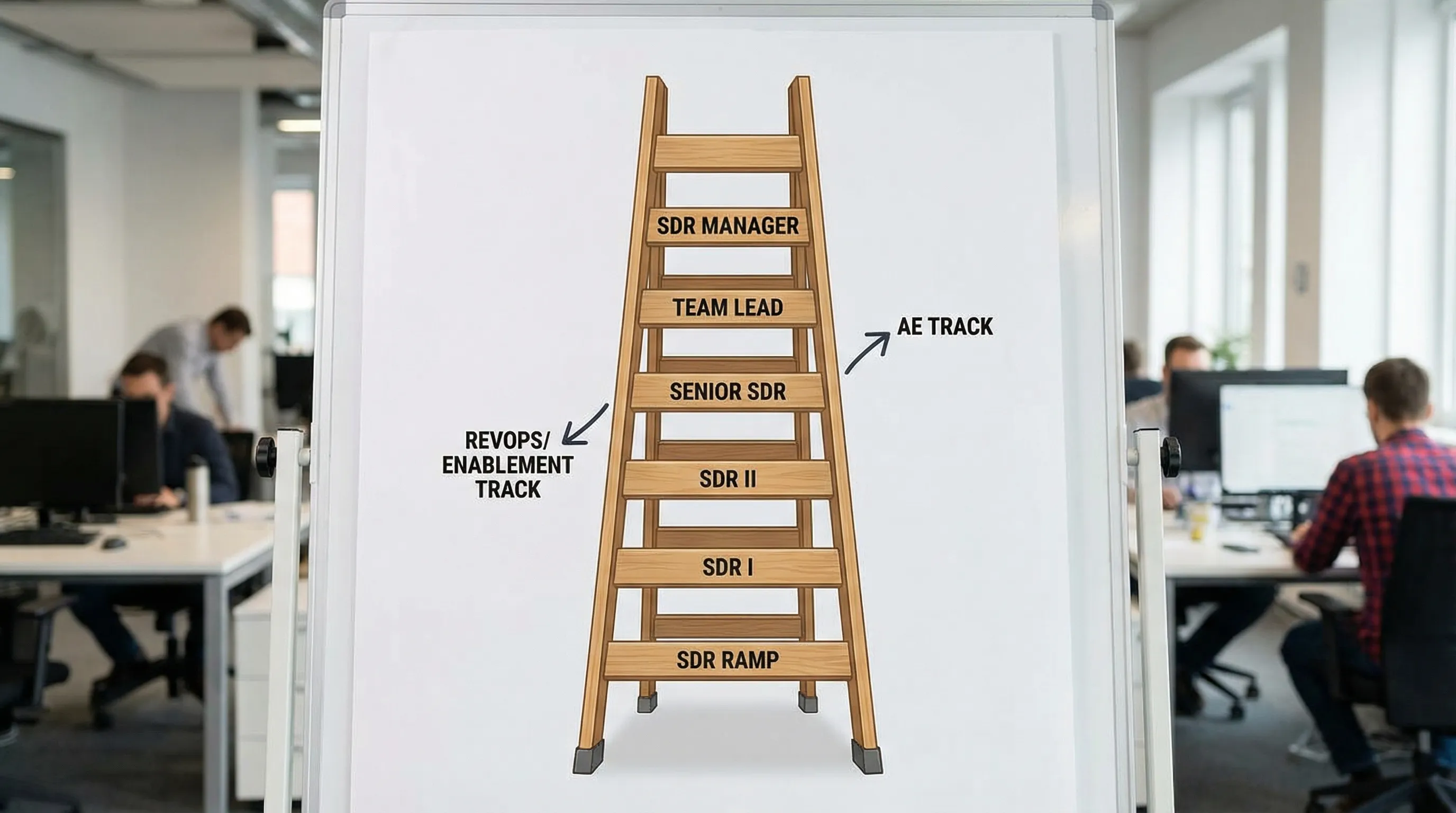
There are three common career paths:
- SDR → AE (closing role): best for reps who want discovery, negotiation, and quota ownership.
- SDR → SDR leadership (manager/director): best for reps who enjoy systems, coaching, and performance management.
- SDR → RevOps / Enablement / GTM ops: best for reps who love process, tooling, analytics, and scaling what works.
Typical SDR progression (what changes at each level)
| Level | Primary focus | What “great” looks like | Promotion signals |
|---|---|---|---|
| SDR (Ramp) | Fundamentals | Clean targeting, consistent activity, accurate notes | Hits activity and quality basics without supervision |
| SDR I | Repeatable conversion | Stable reply and qualification rates in one segment | Can explain what works and why, not just results |
| SDR II | Segment ownership | Runs a slice (persona/vertical) and improves it | Drives lift via testing and better qualification |
| Senior SDR | High-stakes execution | Handles enterprise threads, multi-stakeholder scheduling | Strong AE trust, low re-qualification, clean handoffs |
| Team Lead | Peer leverage | Coaches others, QA on messages, runs weekly reviews | Raises team baseline, not only personal numbers |
| SDR Manager | System building | Hiring, enablement, forecasting, process and tooling | Predictable output, low variance, strong AE alignment |
What to build if you want to become an AE
AEs promote fastest when SDRs can prove they already do “AE-adjacent” work. Focus on:
- Discovery readiness: run a short pre-discovery qualification flow that captures pain, urgency, and stakeholders.
- Buying group awareness: multi-thread into at least two relevant personas when appropriate.
- Clean handoff packets: the AE should understand the “why now” in 60 seconds.
If your org uses a formal framework (BANT, MEDDICC, or a lighter rubric), learn how to apply it conversationally. A practical example is Kakiyo’s BANT framework guide.
What to build if you want SDR leadership
Leadership candidates stand out when they can translate performance into systems:
- A testing discipline: one variable at a time, a clear control, and documented learnings.
- A QA habit: reviewing conversations for tone, relevance, and qualification evidence.
- Operational clarity: definitions, stages, reason codes, and a steady weekly cadence.
For a structured approach to qualification systems, see Lead qualification: a simple, repeatable system.
How AI is changing the Sales Development Representative role
AI is not removing the need for SDRs. It is changing what humans should spend time on.
In 2026, AI can reliably assist with:
- Drafting first-touch variations and follow-ups
- Summarizing threads into CRM-ready context
- Categorizing replies and suggesting next steps
- Running controlled A/B tests on messaging
- Managing many simultaneous conversations without dropping the ball
Humans still need to own:
- ICP strategy and segmentation judgment
- Message intent and brand voice
- High-stakes moments (pricing pressure, legal/compliance flags, sensitive objections)
- Qualification accountability (what counts as evidence)
Kakiyo’s perspective on this division of labor is laid out in AI and sales: where humans stay essential.
The practical goal: more judgment, less busywork
The best outcome is not “automate outreach.” The best outcome is freeing SDRs to focus on high-value conversations and decisions, while automation handles the repetitive coordination.
If you are exploring an AI SDR motion, it is worth reading AI SDR: how to deploy without spamming before you scale volume.
A simple career plan: how to grow in 90 days (without burning out)
If you are an SDR trying to level up, your goal is to build a small portfolio of proof. That proof is a mix of metrics and artifacts.
Metrics to stabilize
Pick two conversion metrics and one quality metric to improve over 90 days:
- Conversion metric examples: positive reply rate, qualified conversation rate, meeting held rate
- Quality metric examples: AE acceptance rate, disqualification accuracy with reason codes
Artifacts to build (your “promotion packet”)
- A tight ICP slice: who you target, and who you exclude
- A repeatable message set: 3 openers and 3 follow-ups, each with a use case
- A qualification checklist: the 3 to 5 evidence points you always capture
- A learning log: what you tested, what won, and what you changed
For managers, this is also how you spot who is ready for more responsibility.
Frequently Asked Questions
What is a Sales Development Representative (SDR)? An SDR is a sales role responsible for starting and qualifying early-stage buyer conversations, then booking meetings and handing off qualified opportunities to AEs.
What KPIs should an SDR be measured on? The most useful SDR KPIs track conversation and meeting quality, not just activity: positive reply rate, qualified conversation rate, meetings held, and AE acceptance rate, plus ICP coverage.
What is the difference between an SDR and an AE? SDRs focus on creating and qualifying opportunities. AEs run deeper discovery, manage the sales process, and close revenue (or advance it to the next stage).
Can AI replace SDRs? AI can automate parts of the workflow (drafting, follow-ups, routing, scoring), but teams still need humans for strategy, judgment, and accountability in qualification and buyer trust.
How long does it take to move from SDR to AE? It depends on your company and performance, but the fastest path is proving AE-ready skills: clean qualification evidence, strong handoffs, and consistent meeting quality that AEs trust.
Scale LinkedIn conversations without losing quality
If your SDR team is spending hours keeping up with LinkedIn replies, follow-ups, and qualification notes, the bottleneck is often conversation management, not effort.
Kakiyo autonomously manages personalized LinkedIn conversations at scale, from first touch to qualification to meeting booking, with controls like prompt customization, A/B testing, intelligent scoring, overrides, and analytics. That means SDRs can spend more time on high-value threads, sharper qualification, and better handoffs.
Explore Kakiyo and see what AI-managed LinkedIn conversations look like in a governed, measurable workflow: kakiyo.com.