
 Ilan Asseo
Sales Development Representative Onboarding Checklist
A practical, quality-first onboarding checklist to ramp SDRs into a LinkedIn-first, conversation-led motion—prioritizing qualification, measurable.

The biggest problem with SDR onboarding is that new reps learn how to send messages before they learn how to qualify. They ramp on tools and scripts, but not on judgment — who to talk to, what evidence matters, when to book, when to walk away. The result is high activity, low pipeline quality, and slow time-to-value.
This checklist fixes that. It gives SDR leaders and enablement teams a structured, week-by-week onboarding plan built around a LinkedIn-first, conversation-led motion where qualification quality matters as much as meeting volume.
Industry evidence: Salesforce Research reports that sales reps spend only 28% of their week actually selling, with the rest consumed by deal management, data entry, and other non-selling work.
Source: Salesforce State of Sales
How to use this checklist (so it actually sticks)
Treat onboarding as a set of certifications, not a slide deck. Every item below should result in an observable artifact: a saved search, a scored conversation, a completed handoff packet, a dashboard screenshot, a manager sign-off.
Two rules make this work:
- Teach the rep the definition of a qualified outcome before you ask them to generate volume.
- Instrument the workflow early so you can coach with data, not opinions.
If your org already has a 30-60-90 plan, use this as the execution layer underneath it.
Preboarding (before Day 1): set the standards and remove friction
Your goal in preboarding is to eliminate setup drag and ambiguity. A new SDR should log in on Day 1 and see a clear definition of success, a clear ICP, and a clear messaging lane.
1) Role charter and outcomes
Write down the role in one paragraph. It should answer: “What pipeline outcomes does this SDR create, for which segment, through which channels, with what constraints?”
At minimum, document:
- Primary motion (LinkedIn outbound, inbound follow-up, ABM support, event follow-up)
- Target segment (SMB, mid-market, enterprise) and territory rules
- Success outcomes (qualified conversations, meetings held accepted by AEs, pipeline sourced)
- Non-goals (for example, “do not pitch in the first message” or “do not book meetings without qualification evidence”)
If you want a quality-first lens for this, align on the difference between “leads” and truly qualified prospects, then operationalize it. Kakiyo’s breakdown of qualified prospects vs leads is a useful rubric for tightening that definition.
2) ICP, personas, and disqualifiers (in writing)
Don’t just provide a persona slide. Provide disqualifiers and edge cases.
Define:
- ICP firmographics (industry, size, geography, tech stack constraints if relevant)
- Buying roles (primary champion, economic buyer, influencers)
- “No-go” accounts (customers, partners, competitors, regulated exclusions)
- Common false positives (titles that look right but never own the problem)
3) Conversation policy (brand, safety, and compliance)
LinkedIn is a trust channel. Automation and scale do not excuse sloppy behavior.
Document your outreach guardrails:
- Voice and tone rules (what “on-brand” sounds like)
- Personalization rules (what is acceptable to reference)
- Cadence limits and pacing philosophy
- Escalation rules (when a human must take over)
If you need a practical framework for “safe automation,” start with the guardrails in Automated LinkedIn Outreach: Do It Safely and Effectively.
Day 1 to Day 3: tools, access, and data capture (make it measurable)
Early onboarding should focus on one thing: ensuring every conversation can be tracked, scored, coached, and handed off cleanly.
Systems access checklist (minimum viable)
Use the table below as a sign-off sheet. The “Verified” column matters because “access granted” is not the same as “working correctly.”
| Area | What the SDR needs on Day 1 | Why it matters | Verified by |
|---|---|---|---|
| CRM | Login, correct role permissions, lead/account/contact views, required fields documented | Prevents lost activity and inconsistent stage changes | RevOps or Manager |
| Calendar + scheduling | Calendar connected, meeting types, buffers, routing rules (if any) | Avoids no-show risk and booking friction | SDR + Manager |
| Profile ready, Sales Navigator access (if used), saved searches enabled | LinkedIn-first motion fails without list building | SDR | |
| Messaging templates | Approved first-touch and follow-up templates, objection snippets, meeting CTA patterns | Consistency without turning reps into copy-pasters | Enablement |
| Qualification rubric | Fit + intent + evidence fields, definitions, and examples | Stops “meetings at any cost” behavior | Sales Ops |
| Analytics | Dashboard for leading indicators (reply rate, qualified conversation rate, speed-to-first-touch) | Coaching becomes objective and fast | Manager |
If your team is implementing AI support, this is also when you define what gets automated versus what must remain human-owned. The goal is not “more messages,” it’s better conversations with traceable evidence.
Week 1: targeting readiness (build the list before the pitch)
Week 1 should end with the SDR able to produce a high-quality hit list and explain why those accounts are worth messaging now.
What “targeting ready” looks like
A rep is targeting-ready when they can:
- Build a list that matches ICP and excludes bad-fit accounts
- Identify 2 to 3 buyer roles per account (not just one champion)
- Write a simple value hypothesis tied to a plausible trigger
If you want a practical workflow for Sales Navigator-based list building and daily execution, reference Using LinkedIn Sales Navigator for Prospecting: A How-To.
Deliverables to collect (so you can coach them)
Ask the SDR to submit:
- 25 target accounts with a one-line “why now” note per account
- 75 leads mapped to roles across those accounts
- 10 personalization signals they’ll use repeatedly (role change, recent post, hiring, product launch)
Those artifacts let a manager coach targeting with specificity instead of general advice like “go more enterprise” or “personalize more.”
Week 1 to Week 2: messaging standards (short, relevant, and thread-safe)
Most new SDRs overwrite. They try to prove credibility, explain the product, and close the meeting in one message. Your onboarding should enforce a simpler standard: earn the right to ask the next question.
Your messaging QA rubric (use this for reviews)
Instead of arguing about style, use a repeatable rubric:
| Message element | What good looks like | Common failure mode |
|---|---|---|
| Context | Clear reason you chose them, not “thought you’d be a great fit” | Generic flattery or vague relevance |
| Credibility | One line proof or shared context, optional | Overexplaining company background |
| Value | A helpful insight or hypothesis in plain language | Feature dump |
| CTA | Low-friction question or micro-commitment | “Want to hop on a call?” too early |
| Brevity | Skimmable in 8 to 12 seconds | Paragraphs and jargon |
For copy patterns and templates your SDR can adapt, point them to LinkedIn Outreach Messages That Get Replies and your internal approved library.
Thread-safe conversation rules (especially important with AI)
If you use AI to help scale conversations, define rules that protect buyer experience and reduce risk:
- Don’t ask multiple qualifying questions at once
- Don’t “handle objections” by escalating pressure
- Don’t imply you saw something you didn’t (for example, inventing a trigger)
- Don’t pitch when the buyer is asking clarifying questions
Kakiyo’s positioning here is useful: autonomous conversation support should still allow human override control and consistent scoring so reps and managers stay accountable.
Week 2 to Week 3: qualification (turn frameworks into conversational evidence)
This is where ramp speed usually breaks. New SDRs either qualify too lightly (booking meetings that get rejected) or qualify too aggressively (interrogation that kills replies).
Your onboarding goal is to make qualification conversational, evidence-based, and consistent.
Pick one qualification framework and operationalize it
If you already use BANT, teach it as a conversation sequence rather than a checklist. The practical approach in BANT Sales Framework: Qualify Leads Without Wasting Time is a good model for doing this in LinkedIn threads.
The key is translating your framework into:
- The exact questions you ask in-thread
- The evidence you capture in CRM
- The score or stage change that follows
Build a “minimum qualification packet” for every booked meeting
A meeting should never be booked without a handoff packet. Keep it lightweight, but non-negotiable:
- Fit summary (why this matches ICP)
- Problem and impact (in the buyer’s words if possible)
- Why now (trigger, timeline, internal deadline)
- Stakeholders involved (or missing)
- Conversation proof (links or notes that show buyer intent)
This aligns tightly with a quality-first motion and reduces AE frustration. If you want a deeper rubric for what counts as qualification evidence, see What Is a Sales Qualified Lead? Examples and Benchmarks.
Week 3 to Week 6: operating rhythm, coaching, and measurable improvement
Once the rep can target, message, and qualify, the next step is making performance predictable. That requires an operating cadence that treats outreach like a system you improve weekly.
Establish a weekly cadence (and keep it simple)
A good weekly rhythm typically includes:
- 1 pipeline review (what got qualified, what was rejected, why)
- 1 messaging review (5 threads, scored against the rubric)
- 1 experiment review (A/B prompt or template test, with a clear hypothesis)
If you want KPI definitions that map directly to this cadence, use Sales Development Representative: KPIs That Matter as your measurement reference.
The “paired metrics” rule (to prevent gaming)
SDRs will optimize for what you celebrate. Pair activity with quality so you do not accidentally incentivize junk meetings.
Examples:
- Meetings booked paired with meeting-to-opportunity conversion
- Replies paired with qualified conversation rate
- Volume of first touches paired with AE acceptance rate
This is also where AI-driven scoring can help, provided it is transparent and tied to outcomes, not vanity activity.
Onboarding certifications: the fastest way to make readiness visible
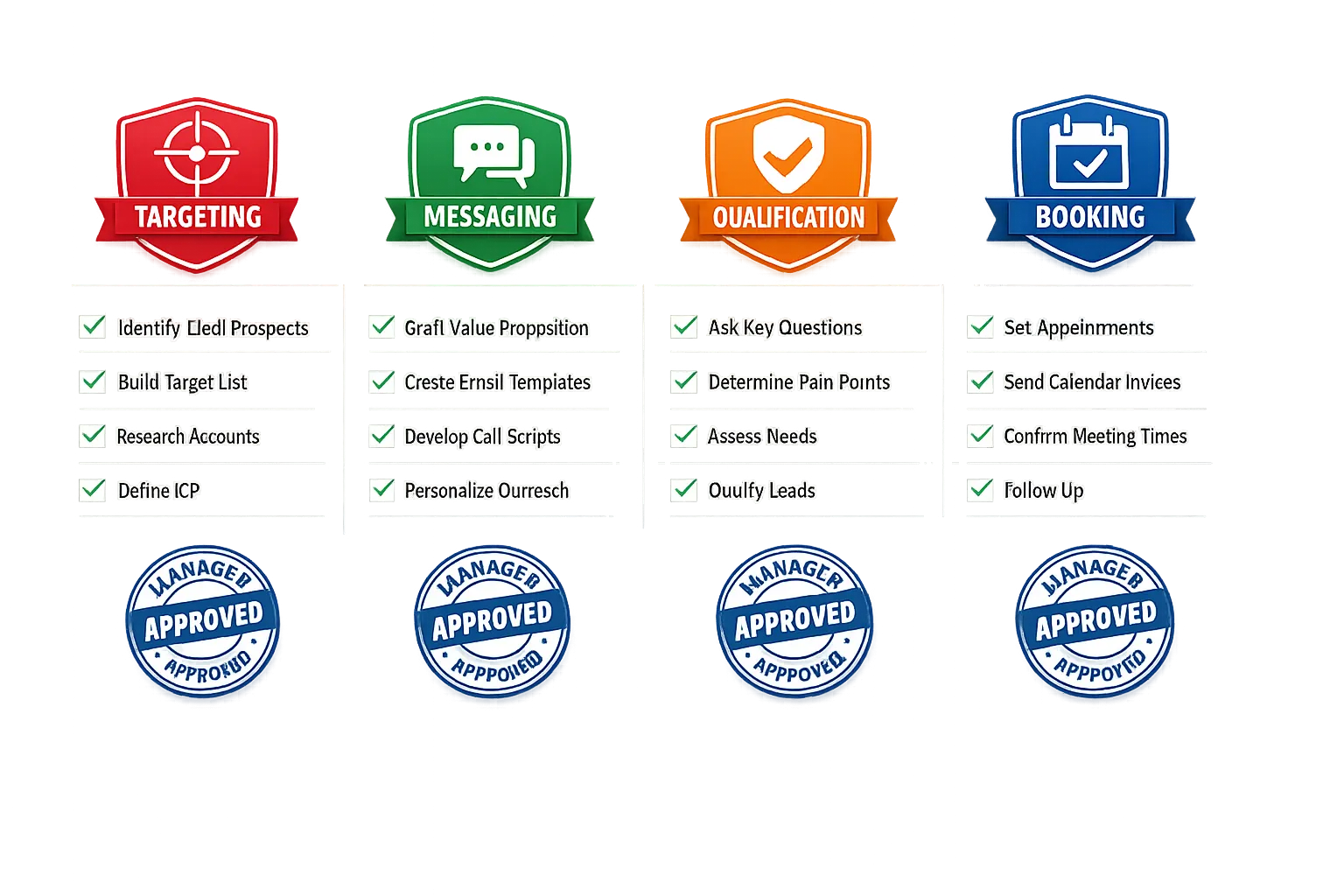
Instead of waiting 60 or 90 days to decide if onboarding “worked,” use certifications with manager sign-off.
| Certification | What the SDR submits | Pass criteria (example) | Sign-off owner |
|---|---|---|---|
| Targeting certified | 25 accounts, 75 leads, persona mapping | 80% match ICP, clear disqualifiers applied | Manager |
| Messaging certified | 10 first-touch messages + 10 follow-ups | Meets rubric for context, brevity, CTA | Enablement |
| Qualification certified | 5 real threads with notes and scores | Evidence captured, correct next step chosen | Manager/AE |
| Booking certified | 3 handoff packets for booked meetings | AEs accept, low rework required | AE lead |
| Governance certified (if using AI) | Examples of overrides + edge cases | Escalations handled correctly | Manager/RevOps |
You can tailor pass criteria to your segment and cycle, but the structure matters. Certifications create shared expectations and reduce subjective coaching.
Where Kakiyo fits in an SDR onboarding (without overcomplicating it)
If your team is LinkedIn-first, the hardest part to scale is not sending more messages. It’s maintaining consistent, high-quality conversations while capturing qualification evidence and booking meetings reliably.
Kakiyo is designed to support that workflow by managing personalized LinkedIn conversations at scale, from first touch through qualification to meeting booking, with controls that matter during onboarding and ramp:
- Customizable prompt creation and industry-specific templates to standardize quality without forcing generic scripts
- A/B prompt testing so new reps learn experimentation as a habit
- Intelligent scoring to reinforce what “qualified” means operationally
- Conversation override control so humans can step in when nuance matters
- Centralized real-time dashboard and advanced analytics for coaching and accountability
If you are building an onboarding program around conversation quality and measurable outcomes, it can be worth evaluating whether autonomous conversation support should own parts of the thread work, while SDRs focus on high-value judgment calls and account strategy.
You can also align this approach with the end-to-end execution guidance in LinkedIn Prospecting Playbook: From First Touch to Demo.
Common onboarding pitfalls (and what to do instead)
Many SDR programs have the right components but sequence them in a way that creates bad habits. These are the patterns most likely to hurt you.
Pitfall 1: “Shadow calls” without a scoring rubric
Shadowing is useful, but without a rubric it becomes entertainment. Require the SDR to score what they observe: what signals indicated intent, what question advanced the conversation, what evidence was captured.
Pitfall 2: Tool training before qualification standards
If a rep learns how to blast sequences before they learn what “qualified” means, you are training them to generate noise. Teach your qualification definition and handoff packet first, then let them scale.
Pitfall 3: Too many templates, not enough constraints
Templates are helpful, but constraints are what produce consistency. A simple rule like “no message longer than 300 characters unless replying to a direct question” often improves quality faster than adding more copy.
Pitfall 4: Measuring meetings without measuring acceptance
If AEs reject meetings or opportunities stall immediately, onboarding is not working. Add AE acceptance and meeting-to-opportunity conversion to the ramp scorecard early.
The onboarding checklist recap (for managers)
If you want a single view, here is the practical sequence:
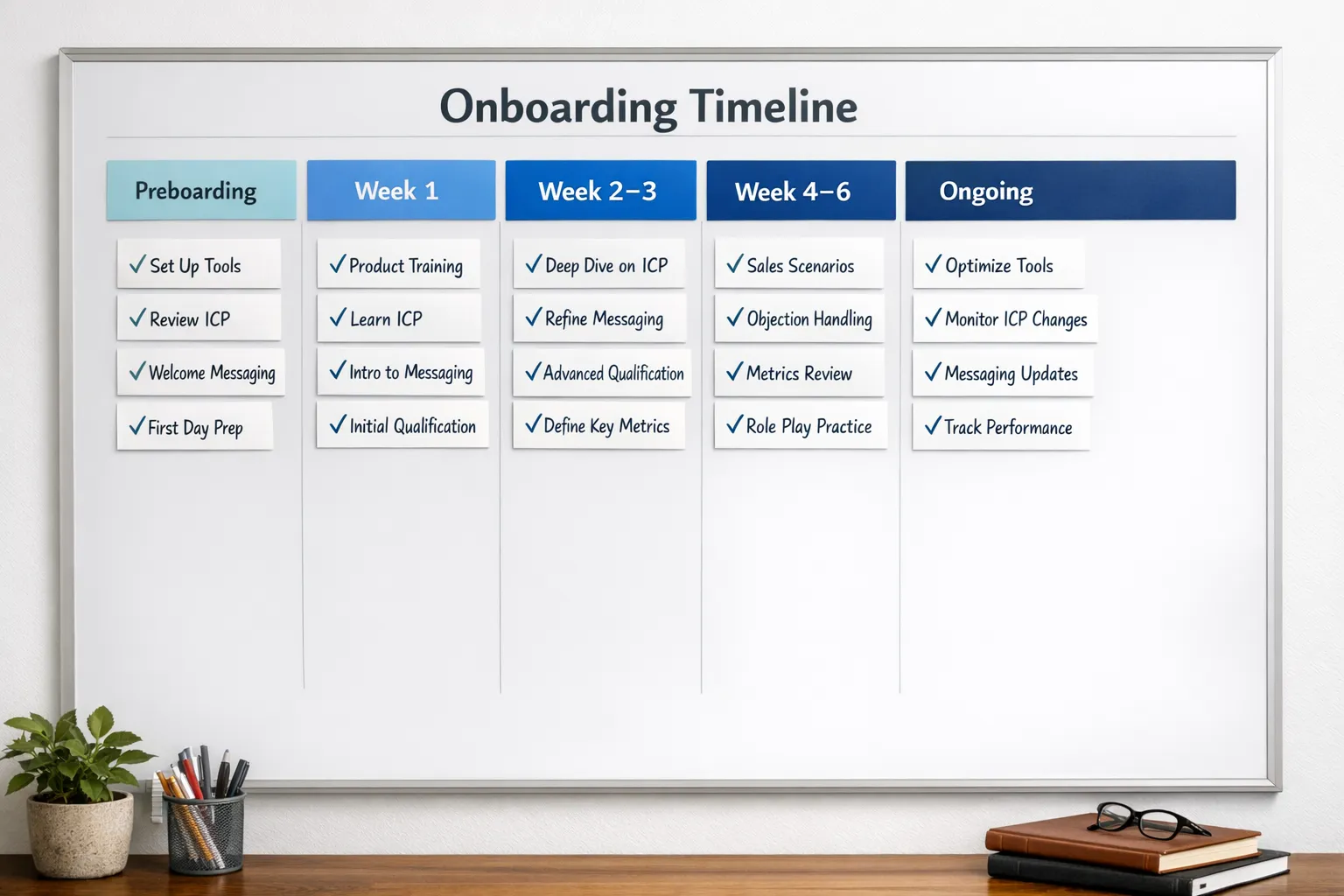
- Preboarding: role charter, ICP and disqualifiers, conversation policy
- Day 1 to Day 3: systems access verified, dashboards live, data capture required fields documented
- Week 1: targeting artifacts submitted and reviewed
- Week 1 to Week 2: messaging rubric trained, QA process started
- Week 2 to Week 3: qualification framework operationalized, handoff packet mandatory
- Week 3 to Week 6: weekly coaching cadence running, one experiment per week, paired metrics tracked
- Ongoing: certifications, refreshers, and governance reviews
If you are tightening your onboarding this quarter and want to scale LinkedIn conversations without sacrificing qualification quality, explore how Kakiyo works at Kakiyo.
FAQ
What does a strong SDR or BDR actually own?
A strong SDR or BDR owns early-stage pipeline creation: targeting, first conversations, qualification, and clear handoff. The role is not just about booking meetings, but booking the right meetings.
Which skills matter most in modern sales development?
Prospecting judgment, messaging clarity, qualification discipline, and CRM hygiene matter more than raw call volume. In modern teams, AI literacy and channel fluency also matter.
How should teams evaluate SDR performance?
Use a mix of activity, conversion, and pipeline quality metrics. Strong teams look beyond booked meetings to show rates, qualification accuracy, and accepted pipeline.
How long does it take for a new rep to become productive?
Most reps need a ramp period before they consistently generate qualified pipeline. The fastest ramp comes from clear playbooks, tight feedback loops, and strong qualification criteria.