
 Ilan Asseo
What “Seamless AI Sales” Looks Like Across Your Funnel
Design a connected, evidence-driven AI sales funnel where personalization, qualification, handoffs, and governance stay seamless—especially for multi-turn.

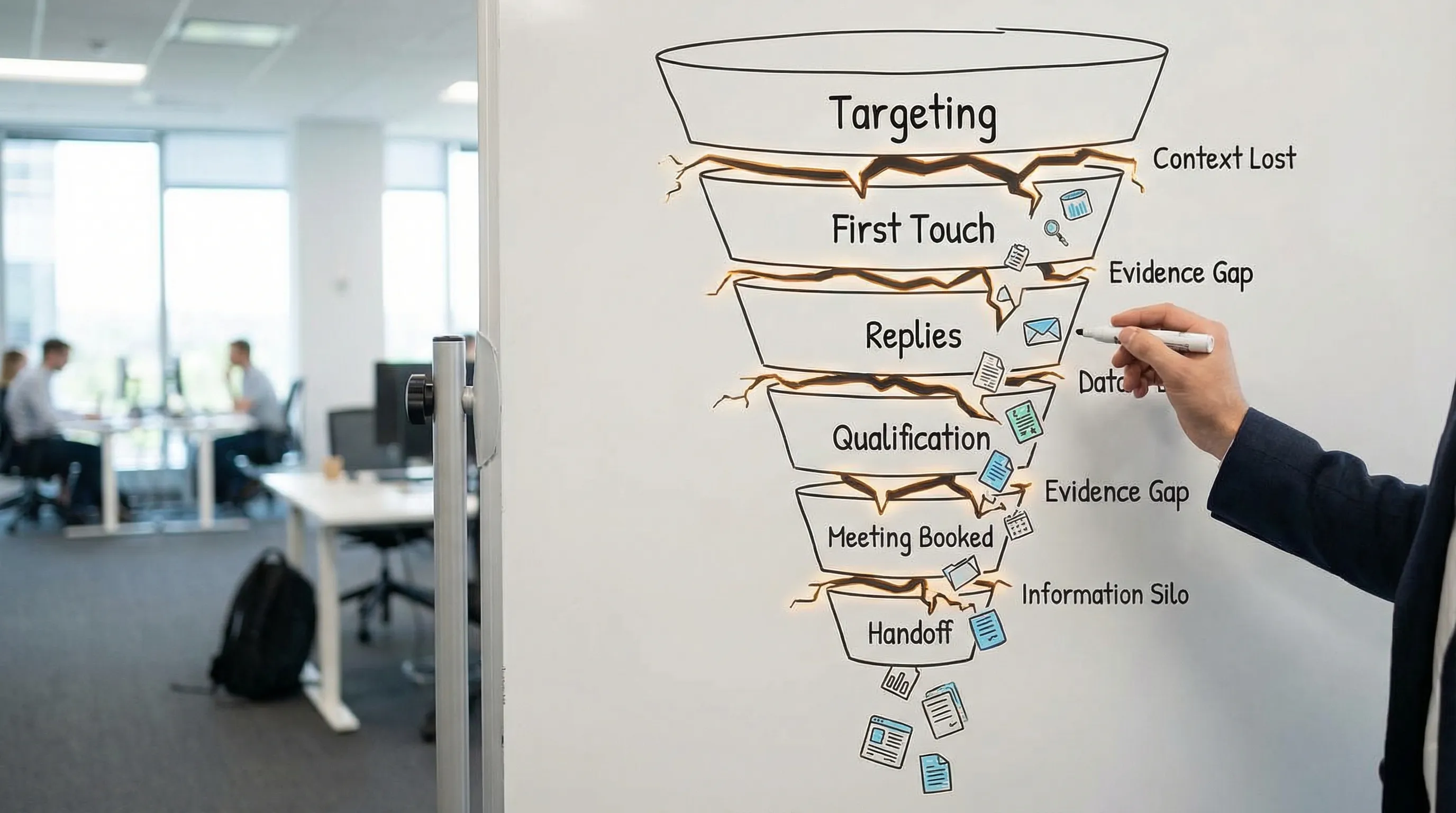
“Seamless AI sales” is not a new tool in your stack. It is a connected experience where every step of the funnel (targeting, first touch, replies, qualification, booking, handoff, and follow-up) shares the same definitions, the same context, and the same proof.
In practice, seamless AI sales means buyers never feel the join lines between systems, and sellers never lose time rebuilding context that the business already has.
Industry evidence: “Our research suggests that a fifth of current sales-team functions could be automated.” — McKinsey & Company.
Source: McKinsey
Why most “AI sales” still feels clunky
Teams adopt AI in pockets. A copy assistant here, an enrichment workflow there, a sequencer with “AI steps” somewhere else. Each piece might help, but the funnel still leaks because the seams stay open.
Common breakpoints look like this:
- Context resets at every stage. Personalization is generated, but replies are handled in a different place by someone who never saw the original rationale.
- Qualification is inconsistent. Different reps ask different questions, log different fields, and use different thresholds for “qualified.”
- Handoffs are opinion-based. A meeting is booked, but the AE gets a vague note instead of auditable evidence.
- Governance is bolted on later. Brand tone, compliance, and stop rules are not enforced at the point of execution.
Seamless AI sales closes these gaps by treating the funnel as one continuous conversation system, not a chain of disconnected tasks.
What seamless AI sales looks like across the funnel
A seamless funnel has two properties:
- Continuity of intent and evidence from the first message to the booked meeting.
- Clear division of labor between AI (speed, scale, consistency) and humans (judgment, strategy, trust).
Here is a practical way to define what “good” looks like at each stage.
| Funnel stage | Primary goal | What AI should do | What humans should do | Output artifact you can audit | Metrics that matter |
|---|---|---|---|---|---|
| Targeting | Reach the right people with a specific reason | Segment lists by ICP slice, surface relevant signals | Choose slices, set hypotheses, approve boundaries | ICP slice definition, targeting rules | ICP coverage, segment performance |
| First touch | Earn permission to talk | Personalize openers to the signal, keep it short and respectful | Define positioning, proof points, and disqualifiers | Message rationale tied to signal | Acceptance rate, negative feedback rate |
| Reply handling | Convert replies into real conversations | Classify reply intent, respond fast, ask the next best question | Handle high-stakes replies, edge cases, sensitive accounts | Reply intent label + next action | Reply rate, median response time |
| Qualification | Confirm fit and intent with minimal friction | Run a consistent question flow, capture evidence, score consistently | Override when nuance matters, disqualify decisively | Evidence packet (fit, intent, proof, next step) | Qualified conversation rate, evidence completeness |
| Meeting booking | Make scheduling frictionless | Propose times, confirm attendees, set agenda context | Decide when not to book yet, protect AE calendars | Booked meeting + agenda + context | Booked rate, show rate, AE acceptance |
| Handoff to AE | Ensure the meeting is worth holding | Summarize the thread, attach proof, standardize fields | Validate quality, coach patterns, refine criteria | CRM-ready handoff note + fields | AE acceptance, meeting-to-opportunity conversion |
| Post-meeting follow-up | Keep momentum and prevent drop-off | Nurture, recap, route next steps based on outcome | Run discovery, negotiate, manage deal strategy | Next-step commitments and timeline | Next-step set rate, cycle time |
If your AI only helps at the top (writing messages) but the rest of the funnel runs on manual judgment and scattered notes, you have “AI-assisted outreach,” not seamless AI sales.
The real definition of “seamless”: no context loss, no definition drift
The fastest way to evaluate whether your funnel is seamless is to test two questions:
1) Can you trace every booked meeting back to specific evidence?
A booked meeting should not be the output. A booked meeting with evidence is the output.
That evidence can be simple, but it must be consistent:
- Fit: role, company type, use case match
- Intent: what they said they care about, and how urgent it is
- Proof: a trigger, pain statement, constraint, or current workflow detail
- Next step: agreed action, attendees, and why a meeting is the right next move
If you cannot audit that chain, AI will scale noise faster than it scales pipeline.
2) Does the buyer experience feel like one conversation (not a campaign)?
Buyers notice when your outreach is personalized, but your follow-up is generic. They also notice when they answer a question and get asked the same thing again by a different rep.
Seamless AI sales keeps a thread coherent by maintaining:
- A single “source of truth” for conversation state
- Consistent tone and boundaries
- Clear stop rules and escalation paths
For LinkedIn motions, you also need to respect platform and buyer expectations. LinkedIn’s Professional Community Policies are a useful baseline for thinking about respectful behavior and safety.
What has to be true behind the scenes (the operating system)
Seamless AI sales is mostly operational design. Tools matter, but only after you lock the system.
Shared lifecycle definitions (so AI optimizes the right outcome)
AI will optimize whatever you label as success. If your success label is “replied,” you will get more replies, including low-quality ones.
A stronger approach is to define success in terms of qualified conversations and AE-accepted meetings, then instrument micro-conversions as leading indicators.
If you want a reference structure for aligning the funnel and SLAs, Kakiyo’s perspective in AI for Sales and Marketing: One Funnel, One SLA is a solid starting point.
Prompt-to-production discipline (so performance improves, not randomness)
Seamless AI sales requires that prompts behave like sales assets:
- Versioned (you know what changed)
- Tested (A/B where it matters)
- Governed (tone, compliance, and boundaries are enforced)
This is where many teams get stuck, they treat prompts as individual rep hacks instead of a managed library.
Scoring you can explain (so routing is trusted)
If scoring exists, sellers will ask “why.” If you cannot answer, they will ignore it.
Explainable scoring does not need to be complicated. What it does need is:
- A small set of inputs aligned to outcomes
- Clear score bands tied to actions
- A place to attach conversation evidence
(If you are building this across MQL and SQL definitions too, Kakiyo’s guide on MQLs and SQLs: Align Definitions, Boost Pipeline Health goes deeper on operational alignment.)
Human-in-the-loop controls (so autonomy stays safe)
Seamless does not mean fully autonomous.
A practical model is “autonomy with interrupts,” where AI runs the routine parts and escalates when stakes rise, for example:
- A prospect asks a pricing or contract question
- The buyer expresses frustration or concern
- The conversation enters a regulated or sensitive area
- The account is strategic and requires custom handling
This is also where override control matters, not as a panic button, but as a normal part of operating the system.
If you want a deeper read on the boundaries, see AI and Sales: Where Humans Stay Essential.
Where Kakiyo fits in a seamless AI sales funnel
Kakiyo is designed for the part of the funnel where “seamless” often breaks first: multi-turn LinkedIn conversations that must stay personalized, safe, and qualification-driven at scale.
Based on Kakiyo’s published capabilities, the platform supports:
- Autonomous LinkedIn conversations from first touch through qualification and booking
- AI-driven lead qualification with an intelligent scoring system
- Customizable prompts, industry templates, and A/B prompt testing
- Simultaneous conversation management with conversation override control
- A centralized real-time dashboard with analytics and reporting
If your LinkedIn motion currently relies on templates plus manual reply chasing, the biggest seam is usually between “message sent” and “qualified conversation.” A conversation-led system closes that seam by keeping state, evidence, and next actions connected.
For teams comparing approaches, this distinction is similar to the one explored in Sales AI Tools vs Legacy Sequencers: optimizing a cadence is different from optimizing a conversation.
A practical way to “stitch” your funnel (without boiling the ocean)
Most teams get better results by stitching one seam at a time, starting where the value and pain are highest.
Start with the seam that costs you the most
Pick one:
- Slow reply handling (speed-to-lead problem)
- Inconsistent qualification (meeting quality problem)
- Weak handoffs (AE trust problem)
Define what “done” means in observable terms (evidence fields, score bands, escalation triggers), then build around that.
Instrument the funnel as micro-conversions
If you only measure meetings, you will diagnose problems too late.
A simple weekly scorecard should include both throughput and quality, for example:
- New conversations started
- Reply rate and positive reply rate
- Qualified conversation rate
- Meetings booked and meetings held
- AE acceptance rate
- Evidence completeness rate
Kakiyo’s post on AI Sales Metrics: What to Track Weekly provides a practical set of definitions you can adapt.
Build governance into execution, not review
If QA happens only after outreach has been sent, you are reacting.
At minimum, define:
- Stop rules (when to stop messaging)
- Tone boundaries (what you will never say)
- Escalation triggers (when AI must hand off)
- Auditability (what gets logged as evidence)
For LinkedIn-first teams, a safety-first deployment approach is also covered in AI SDR: How to Deploy Without Spamming.
How you know you achieved seamless AI sales
Seamless should show up in metrics and in seller behavior.
Here are the signals that usually appear first.
| Signal | What it tells you | What to check if it is missing |
|---|---|---|
| AE acceptance rate rises | Handoffs are trusted | Tighten evidence packet, add disqualifiers, calibrate scoring |
| Faster time-to-first-response | AI is reducing latency | Improve reply intent classification and escalation rules |
| Meeting show rate improves | Booking is aligned to readiness | Add agenda context, confirm attendees, reduce premature booking |
| Higher qualified conversation rate with stable reply rate | You are not trading quality for volume | Review qualification flow, adjust prompts by segment |
| Lower manual “copy/paste” work for SDRs | AI is actually removing toil | Ensure conversation state and next actions are centralized |
The qualitative test is even simpler: your best reps should feel like the system amplifies their judgment, not replaces it or fights it.
If you want to implement seamless AI sales on LinkedIn
If LinkedIn is a core outbound channel for your funnel, Kakiyo is built to manage personalized conversations at scale from first touch through qualification to meeting booking, with A/B testing, scoring, override control, and analytics.
You can explore how Kakiyo works at Kakiyo and use the funnel table above as your evaluation checklist: continuity of context, evidence-based qualification, safe autonomy, and measurable micro-conversions.
FAQ
Where does AI actually help in sales?
AI helps most when it reduces repetitive work, surfaces better signals, and improves execution speed. It is strongest in research, qualification support, follow-up, and workflow automation.
What are the limits of AI in sales?
AI still depends on clean inputs, good process design, and human oversight. It can accelerate bad workflows just as easily as good ones.
How should teams evaluate AI sales tools?
Evaluate tools by workflow fit, data quality, implementation friction, and measurable business outcomes. A feature-rich tool is not automatically the right tool for your motion.
Does AI replace SDRs or sales reps?
Usually no. In most teams, AI reshapes the role by taking over repetitive execution while humans stay responsible for judgment, positioning, and relationship depth.