
 Ilan Asseo
AI for Sales and Marketing: One Funnel, One SLA
How to align sales and marketing around a single funnel and SLA so AI speeds qualification, enforces evidence, and improves handoffs instead of amplifying.

Misalignment between sales and marketing funnels is the most common source of pipeline leakage in B2B. This article shows how to unify both teams under one funnel with shared definitions and a single SLA.
Most revenue teams don’t have a “sales funnel” and a “marketing funnel.” They have one buyer journey that gets split into two operating systems, two sets of stage definitions, and two dashboards.
That split creates predictable problems:
- Marketing optimizes for volume (leads, MQLs, clicks).
- Sales optimizes for throughput (meetings, pipeline).
- Nobody owns the messy middle (the conversation that turns interest into qualified intent).
AI makes this either much better or much worse.
Used well, AI can capture intent signals, speed up follow-up, standardize qualification, and keep every handoff auditable. Used poorly, AI amplifies misalignment by scaling the wrong behaviors faster.
The fix is not “more tools.” It’s a shared operating agreement: one funnel and one SLA.
Industry evidence: “Our research suggests that a fifth of current sales-team functions could be automated.” — McKinsey & Company.
Source: McKinsey
What “one funnel” actually means (and what it doesn’t)
“One funnel” does not mean every channel is the same, or that marketing does outbound, or that sales owns inbound.
It means your team agrees on:
- A single set of lifecycle stages that reflect buyer progress (not internal team boundaries).
- Stage-entry rules based on evidence (fit, intent, recency, and proof).
- One definition of done for every handoff, so a lead cannot be “done” for marketing but “not real” for sales.
A useful way to pressure test your funnel: if someone asked, “Where did this opportunity come from?” you should be able to trace a clean line from first touch to meeting held to pipeline creation.
A practical one-funnel model for B2B teams
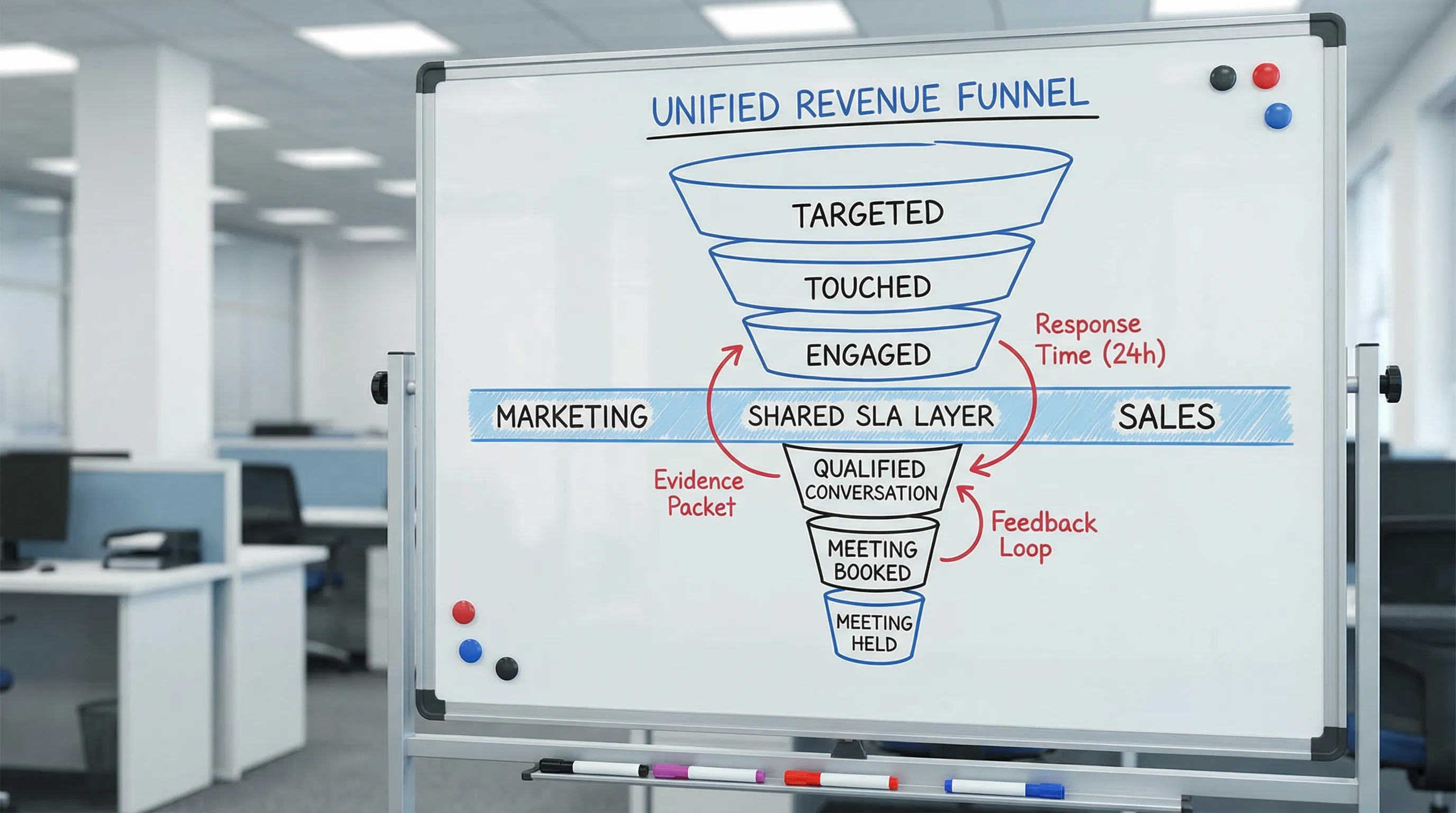
Below is a funnel model that works well for LinkedIn-first motions, inbound demand, and mixed outbound. It’s conversation-led, meaning it treats “qualified conversation” as a real stage, not a vague activity.
| Funnel stage (shared) | What has to be true (evidence) | Primary owner | Output artifact you can audit |
|---|---|---|---|
| Targeted | Prospect matches ICP (account + persona). | Marketing and Sales | ICP tag, segment, list/source |
| Touched | A first meaningful touch happened (message, email, form submit, event scan), not just an impression. | Marketing and Sales | Timestamp, channel, message/campaign ID |
| Engaged | The prospect responded or took an action that indicates attention (reply, booked intent, content request). | Marketing and Sales | Response text, action type, context |
| Qualified conversation | Fit and intent are confirmed (or disqualified) with recorded proof. | SDR team | Qualification notes, captured signals, score band |
| Meeting booked (sales accepted) | Meeting is booked and accepted with the right persona and purpose. | SDR + AE | Invite details, agenda, handoff packet |
| Meeting held | Meeting occurred and outcome is logged. | AE | Disposition, next step, opportunity link |
If you already run MQL and SQL stages, you can map them into the model (for example, MQL often sits between Engaged and Qualified conversation). What matters is that the buyer’s progress is consistent across teams.
For deeper stage definitions and alignment mechanics, it’s worth pairing this with Kakiyo’s guide on MQLs and SQLs alignment.
What “one SLA” means in 2026
Many SLAs are written like this:
Sales will follow up with MQLs within X hours.
That is a start, but it’s not enough for modern, AI-assisted motions.
A useful SLA is broader and more explicit. It defines commitments on speed, quality, and feedback from both sides.
A modern SLA has three parts
1) Speed commitments (time-to-action)
Speed matters because intent decays quickly. Harvard Business Review has long highlighted the impact of fast response on lead outcomes in “The Short Life of Online Sales Leads” (HBR).
But “speed” should be defined as speed-to-first-meaningful-touch, not just “someone clicked a task in the CRM.”
2) Quality commitments (evidence and acceptance rules)
Sales teams ignore leads when they cannot tell:
- Why this prospect is a fit.
- What triggered the outreach or inbound action.
- What the prospect actually said (intent).
- What the next step should be.
That is why the handoff must include an evidence packet, not just a score.
3) Feedback commitments (disposition and loopback)
Marketing cannot improve lead quality if sales dispositions are vague (“bad lead”) or missing. The SLA should require:
- Standard disposition codes.
- A time-bound feedback window.
- A recycling path that preserves context.
Build one funnel, one SLA: a straightforward implementation
You do not need a six-month RevOps project. You need a tight working session, a pilot segment, and weekly iteration.
Step 1: Pick one segment and one entry lane
Start with a single segment where sales and marketing both care about outcomes, for example:
- One ICP tier (mid-market SaaS, series B to D).
- One persona cluster (VP Sales, Head of RevOps).
- One or two channels (LinkedIn outbound plus inbound demo requests).
This reduces debates about edge cases and makes the SLA measurable.
Step 2: Define stage-entry rules using evidence
In 2026, “score-only” funnels break because AI can generate activity without generating intent.
Instead, define stage-entry rules using a simple evidence standard:
- Fit: firmographics, role, tech stack, constraints.
- Intent: explicit need, pain, trigger, timeline.
- Recency: how fresh the signal is.
- Proof: what the prospect did or said (a reply snippet, a question asked, a meeting request).
If your team wants a clean qualification model, align on the same rubric across channels. Kakiyo’s post on qualified leads scoring that sales trusts is a good reference point for building explainable bands.
Step 3: Write the SLA as “if-then” rules
A good SLA reads like an operating contract.
| Trigger | Required response | SLA clock starts | SLA time | Required notes |
|---|---|---|---|---|
| Hot inbound (high-fit, explicit intent) | Personal response and next step attempt | Form submit or inbound message | Same business day (ideally faster) | Intent proof, meeting goal, routing outcome |
| Warm inbound (fit yes, intent unclear) | Conversation-led qualification | Form submit | 1 business day | Qualification question asked, disposition plan |
| Outbound positive reply | In-thread qualification and meeting attempt if qualified | Reply received | Same day | Captured pain/trigger, next step asked |
| Sales reject/return | Marketing adjusts routing/scoring or recycles with context | Rejection timestamp | Within 5 business days | Rejection reason code, fix applied |
This is intentionally channel-neutral. LinkedIn, email, chat, and events all fit.
If you want a dedicated framework for marketing’s side of the bargain, see Marketing Lead Qualification: Fast, Safe, Clear.
Step 4: Instrument a shared scorecard
Your SLA will not hold if each team reports different metrics.
A minimal shared scorecard:
- Speed-to-first-meaningful-touch (by lane)
- Engaged rate (reply or action rate)
- Qualified conversation rate
- Meeting booked rate
- Meeting held rate
- AE acceptance rate (quality proxy)
This also becomes your AI monitoring layer. If you are using automation, you should track where AI helped and where it needed override.
Kakiyo’s weekly metric model in AI sales metrics pairs well with a one-funnel SLA because it focuses on micro-conversions, not vanity volume.
Where AI fits: making the SLA enforceable, not aspirational
AI for sales and marketing works best when it is used to reduce variance and increase speed without lowering standards.
Here are practical ways AI supports a one-funnel, one-SLA model.
1) Standardize the first meaningful touch
The hardest part of SLAs is not writing them. It’s ensuring the first touch happens on time, with the right context.
AI can help by:
- Drafting context-aware first messages from a shared prompt system.
- Handling immediate responses in conversational channels.
- Keeping tone and claims consistent with policy.
2) Capture evidence automatically
If the handoff requires proof, your system has to collect it without adding hours of admin work.
AI can:
- Extract intent signals from replies (questions, pain statements, timelines).
- Summarize thread context into an auditable handoff packet.
- Apply consistent tagging so you can measure outcomes by segment and message variant.
3) Enforce qualification consistency
Humans vary. That is normal. But inconsistent qualification destroys funnel trust.
AI can support consistency through:
- Qualification playbooks embedded into conversation flows.
- A scoring model that is explainable (what changed the score and why).
- Guardrails that prevent premature meeting pushes when evidence is missing.
For teams that want a process-first approach, Kakiyo’s lead qualification process guide is a useful blueprint.
4) Make experimentation safe
If you want marketing and sales to share a funnel, you need shared learning. AI makes it easier to run controlled tests, but only if you track them properly.
Look for:
- A/B prompt testing
- Segment-level reporting
- Outcome tracking tied to micro-conversions (qualified conversation, held meetings)
The operating rhythm that keeps one funnel real
A one-funnel SLA fails when it becomes a document instead of a habit.
A lightweight rhythm that works:
- Weekly 30 to 45 minute funnel review (one dashboard, one narrative)
- One agreed change per week (prompt update, routing tweak, stage rule refinement)
- Monthly definition audit (are we still using the same stage-entry rules?)
If you need a broader implementation approach, Kakiyo’s Sales and AI team playbook outlines a structured model for governance and measurement.
Common failure modes (and how to avoid them)
“One funnel” becomes “one spreadsheet”
Teams unify stages but do not unify actions. You end up with shared labels and separate behavior.
Fix: tie each stage to a required artifact (proof) and a next action.
The SLA measures speed but not outcomes
Fast follow-up is good, but fast low-quality follow-up creates negative brand impact and lowers conversion.
Fix: measure speed and quality together (for example, speed-to-first-meaningful-touch plus qualified conversation rate).
AI increases volume without increasing intent
This usually happens when AI is used like a sequencer, pushing steps instead of managing real conversations.
Fix: optimize for micro-conversions and evidence, not total sends. If you run LinkedIn automation, also adopt safety and oversight practices like those in Automated LinkedIn Outreach: Do It Safely and Effectively.
Marketing hands off too early, sales rejects too vaguely
Without clear rejection reasons, marketing cannot adjust targeting, messaging, or scoring.
Fix: require a small set of rejection codes and a feedback window inside the SLA.
How Kakiyo supports a one-funnel, one-SLA motion (especially on LinkedIn)
A common place funnels break is LinkedIn, because the conversation is the funnel. The “middle” happens inside threads, not forms.
Kakiyo is built for that reality: it autonomously manages personalized LinkedIn conversations at scale, from first touch through qualification to meeting booking, with controls for teams that need speed and governance.
In the context of one funnel, one SLA, Kakiyo can help teams:
- Maintain fast response times with autonomous LinkedIn conversations
- Standardize qualification with industry templates, custom prompts, and an intelligent scoring system
- Improve conversion with A/B prompt testing and analytics & reporting
- Keep humans accountable with override control and a centralized real-time dashboard
If your SLA includes “respond fast, qualify consistently, and hand off with proof,” a conversation-led system is often the difference between a policy and a working pipeline.
The bottom line
AI for sales and marketing is not primarily a tooling decision. It’s an alignment decision.
When you commit to one funnel, you force shared definitions of progress. When you commit to one SLA, you force shared accountability for speed, evidence, and feedback.
That’s how AI becomes a revenue multiplier instead of an activity amplifier.
If you want to operationalize this specifically on LinkedIn, explore how Kakiyo supports conversation-led qualification and meeting booking with human control and measurable outcomes.
FAQ
Where does AI actually help in sales?
AI helps most when it reduces repetitive work, surfaces better signals, and improves execution speed. It is strongest in research, qualification support, follow-up, and workflow automation.
What are the limits of AI in sales?
AI still depends on clean inputs, good process design, and human oversight. It can accelerate bad workflows just as easily as good ones.
How should teams evaluate AI sales tools?
Evaluate tools by workflow fit, data quality, implementation friction, and measurable business outcomes. A feature-rich tool is not automatically the right tool for your motion.
Does AI replace SDRs or sales reps?
Usually no. In most teams, AI reshapes the role by taking over repetitive execution while humans stay responsible for judgment, positioning, and relationship depth.