
 Ilan Asseo
Improve Lead to MQL Conversion Rate with AI
Practical guide to using AI—especially LinkedIn conversation automation—to boost lead-to-MQL conversion by fixing definition drift, response time.

Most teams try to fix pipeline by generating more leads. The faster, cheaper lever is usually improving what happens after a lead is created, especially the lead to MQL conversion rate.
When lead volume is flat (or getting more expensive), the ability to convert the same pool of leads into Marketing Qualified Leads (MQLs) becomes a compounding advantage. AI can help, but only if you apply it to the real bottlenecks: definition drift, slow response, inconsistent qualification, missing context, and weak feedback loops.
This guide shows how to improve lead to MQL conversion rate with AI in a way that is measurable, auditable, and aligned with sales.
Industry evidence: Gartner’s research on the B2B buying journey shows that consensus creation is now a core buying job, which is why qualification needs buying-group evidence rather than single-contact activity.
Source: Gartner
Lead to MQL conversion rate, what it actually measures (and why it breaks)
Lead to MQL conversion rate is the percentage of leads that become MQLs in a defined time window.
A simple formula:
- Lead to MQL conversion rate = (# of leads that became MQLs) / (# of leads created) × 100
The deceptively hard part is defining “lead created” and “became MQL” consistently across channels.
In practice, this metric breaks for four common reasons:
-
MQL criteria are vague (teams rely on “looks good” instead of fit, intent, and recency).
-
The handoff is slow or inconsistent, so leads that could have qualified go cold.
-
Qualification is not conversational, so you never collect the evidence required to confidently mark an MQL.
-
Attribution is noisy, so you cannot tell which changes improved conversion versus just moved labels around.
If you want a deeper operational definition (fit, intent, recency, plus handoff rules), see Kakiyo’s guide on Marketing Qualified Lead: Definition, Triggers, Handoff.
A practical “audit-friendly” version of lead to MQL
To improve conversion without gaming the funnel, define MQL in a way that produces proof.
For example, an “audit-friendly MQL” typically has:
- Fit: firmographic match (industry, size, geo) and role match.
- Intent: at least one meaningful signal (reply with a relevant pain, inbound action, event engagement).
- Recency: signals happened within a time window your team can act on (often days, not months).
- Evidence: a short text snippet, field update, or conversation link explaining why it qualifies.
AI becomes most valuable when it captures that evidence at scale.
Diagnose the biggest leaks before you add more AI
Improving lead to MQL conversion rate is less about “more automation” and more about fixing where leads stall.
Leak 1: You are qualifying too late (or not at all)
Many funnels treat qualification like a back-office step: enrich, score, route, then ask questions. That order often fails because buyers decide whether to engage before your process catches up.
A better approach is conversation-led qualification. You collect the minimum evidence early (role, priority, timing), then decide whether to invest.
Leak 2: Your lead response time is slower than buyer attention
Speed matters because intent decays quickly. A frequently cited analysis in Harvard Business Review highlights how quickly lead contact rates drop as response time increases (HBR: “The Short Life of Online Sales Leads”).
Even if your motion is LinkedIn-first rather than form-fill inbound, the principle holds: when you get a signal, you want a relevant response while the context is still “warm.”
AI is uniquely good at this because it can respond instantly, consistently, and without queue backlogs.
Leak 3: Your MQL rules do not match how buyers actually buy
If your MQL definition assumes a single person “is the lead,” you may misclassify accounts where buying decisions are shared.
Practical fix: track MQL qualification at two levels when possible.
- Contact-level: this person has role relevance and intent.
- Account-level: enough buying-group evidence exists to justify sales follow-up.
AI-driven LinkedIn conversations can help here because you can multi-thread and capture signals from multiple stakeholders without turning it into a manual research project.
Leak 4: Your scoring and your messaging are disconnected
Teams often run scoring in one system and outreach in another, then wonder why “high score” leads do not convert.
If your messaging does not reflect the reason a lead is “hot,” you waste the intent signal. AI can bridge this gap by generating outreach that references the specific trigger or context that produced the score.
How AI improves lead to MQL conversion rate (by stage)
You improve conversion by increasing the number of leads that (1) engage, (2) provide enough qualification evidence, and (3) do so quickly enough to be acted on.
Here is a stage-by-stage view of where AI typically creates lift.
| Funnel stage | What blocks MQL conversion | What AI changes | What to measure |
|---|---|---|---|
| Lead created | Missing context, bad fit, duplicate records | Rapid categorization, research summaries, dedupe assistance (via workflows) | % leads with ICP fields filled, duplicate rate |
| First touch | Slow response, generic copy, low relevance | Instant, personalized openers and follow-ups | Response rate, time to first response |
| Qualification | SDRs avoid asking hard questions, inconsistent criteria | Consistent qualification flows, evidence capture | Qualified conversation rate, completion of key fields |
| MQL decision | Definition drift, subjective marking, weak audit trail | Standardized scoring and reason codes, explainability | MQL acceptance rate by sales, MQL to SQL rate |
Kakiyo specifically focuses on the middle of this funnel on LinkedIn: it autonomously manages personalized LinkedIn conversations from first touch to qualification to meeting booking, with controls like industry templates, A/B prompt testing, scoring, analytics, and human override.
The highest-impact AI pattern: conversation-led qualification
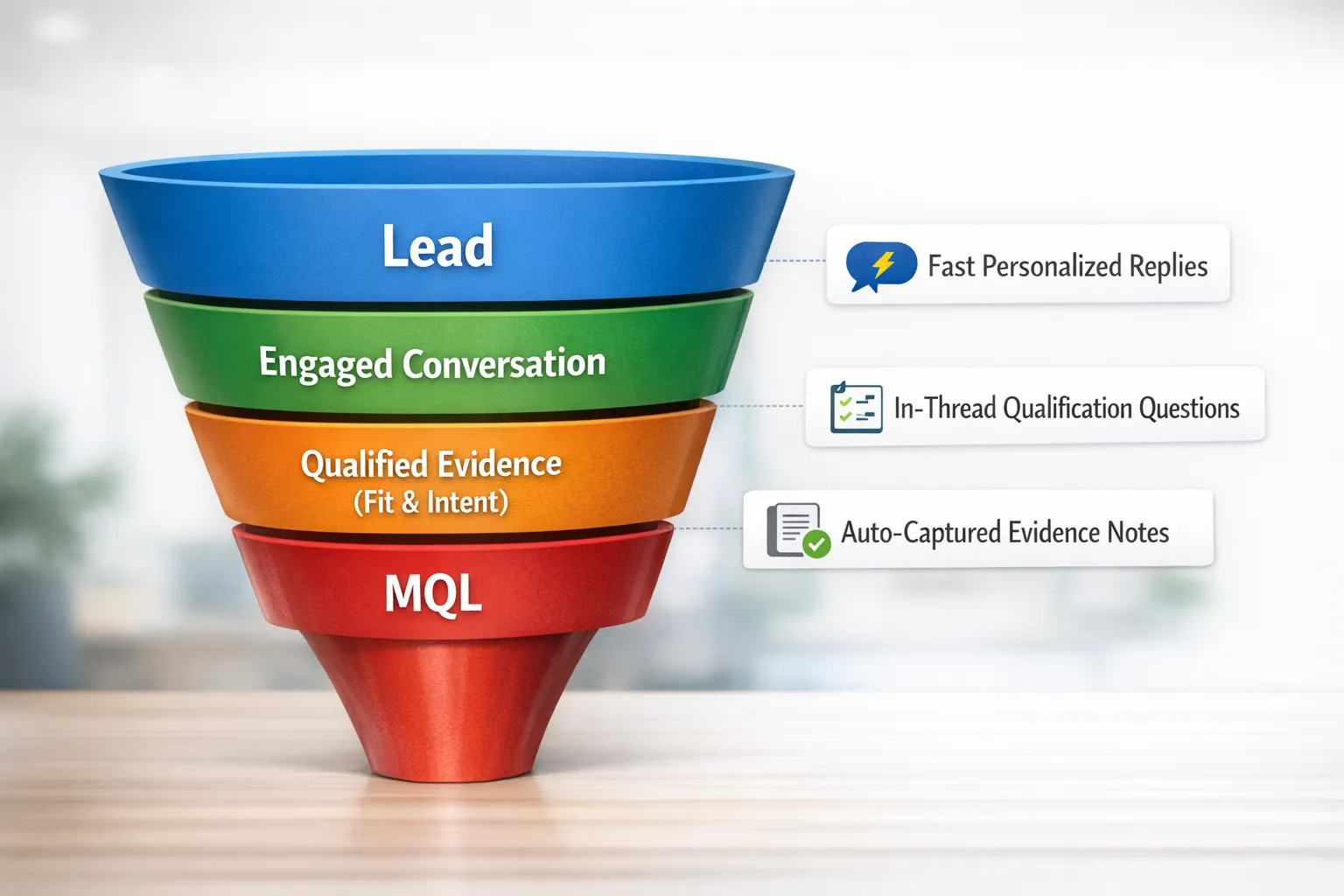
Most teams attempt to “score leads into MQLs.” A faster path is to talk leads into MQLs by collecting the minimum evidence that sales trusts.
LinkedIn is a strong channel for this because it supports short, natural back-and-forth, and many prospects will answer lightweight questions there faster than they will complete forms.
Use micro-commitments instead of big asks
If your first goal is “book a meeting,” you force prospects to make a large decision before they have enough context.
If your first goal is a micro-commitment, you can qualify without friction.
Examples of micro-commitments that often precede MQL:
- Confirming role scope (“Do you own X, or does someone else handle it?”)
- Confirming priority (“Is improving X a Q1 focus, or later?”)
- Confirming environment (“Are you using Y today, or something else?”)
- Confirming timeline band (“If it worked, would you want to change this in weeks or months?”)
AI helps because it can run these mini-flows consistently and keep the conversation moving without forcing SDRs to be online 24/7.
Turn qualification into a reusable rubric
Your goal is not “ask more questions.” Your goal is “ask the same critical questions the same way, then label outcomes consistently.”
A practical rubric (kept intentionally lightweight) might require evidence for:
- Fit: role and company match
- Problem: a credible pain or goal the prospect recognizes
- Priority: a hint that it matters now (or soon)
This is where AI-driven systems outperform ad hoc SDR work. The model does not get tired, it does not skip steps, and it can capture structured notes.
If your team prefers a named framework, you can also run BANT-style questions conversationally. Kakiyo’s BANT Sales Framework guide is a useful reference.
Improve conversion by making “MQL” easier to earn (without lowering quality)
The dirty secret of lead to MQL conversion is that it can rise for the wrong reasons: you can lower the bar.
A better approach is to make MQL easier to earn by reducing effort and delay, not by reducing standards.
1) Capture missing fields through the conversation
A lot of leads fail to become MQLs because they never accumulate enough data to qualify.
Instead of adding more form fields (which often reduces submissions), ask for information progressively in conversation:
- Confirm the persona and ownership
- Confirm current approach
- Confirm initiative timing
AI can do this naturally if your prompt is designed for short, buyer-first turns.
2) Increase speed-to-signal for LinkedIn leads
“Speed-to-lead” is not only for inbound forms. On LinkedIn, your key moments are:
- Connection accepted
- First reply
- Objection expressed
- Buying question asked
Each moment is a chance to either qualify toward MQL or lose momentum.
An AI system that manages simultaneous conversations can keep these threads alive, then escalate the ones that meet your rubric.
3) Personalize to the trigger, not the profile
Profile personalization (“Congrats on the promotion”) is easy to automate and easy to ignore.
Trigger personalization (“Saw you are hiring X, teams often hit Y problem right before that”) is what moves conversion.
AI is useful here because it can consistently frame relevance around a small set of repeatable triggers, then your team can A/B test which trigger narratives produce more qualified responses.
For LinkedIn-specific messaging structure and testing ideas, see LinkedIn Prospecting Playbook: From First Touch to Demo.
Use A/B prompt testing to systematically lift lead to MQL conversion
Teams often A/B test openers for reply rate, then stop. To improve lead to MQL conversion rate, you want to test deeper parts of the conversation.
High-leverage prompt tests include:
- Qualification question phrasing: direct vs indirect (“Are you responsible for…” vs “Who owns…”)
- Value framing: outcome-focused vs cost-focused
- Timing of the first qualifying question: first message vs after first response
- Offer type: benchmark, teardown, short question, resource
Kakiyo supports customizable prompt creation and A/B prompt testing, which matters because you can treat qualification like a conversion flow, not like SDR improvisation.
A practical way to manage this is to define one primary metric per test.
- If you test openers, optimize reply rate.
- If you test qualification turns, optimize qualified conversation rate.
- If you test booking language, optimize meeting booked rate.
You can still monitor the other metrics as guardrails, but one metric should decide the winner.
Make scoring explainable, or sales will ignore it
AI can generate scores, but if sales cannot understand why a lead is labeled MQL, conversion will stall at acceptance.
Explainability is not about showing model internals. It is about capturing evidence:
- What did the prospect say?
- What trigger did they engage with?
- Which rubric criteria were met?
Conversation evidence is especially powerful because it is harder to argue with “they said this” than “the score is 83.”
If you use CRM-native scoring, connect it to the same evidence trail. Kakiyo’s post on Salesforce Einstein Lead Scoring: Setup, Tips, Pitfalls is helpful for avoiding common scoring adoption failures.
The dashboard that actually improves lead to MQL conversion
Most teams track lead to MQL as a single number. That is a lagging indicator.
To improve it, you need a small set of leading indicators that tell you what changed.
| Metric | Why it matters | Diagnostic question |
|---|---|---|
| Lead to engaged conversation rate | Measures if targeting and first touch work | Are we attracting the right people and earning replies? |
| Time to first meaningful response | Measures whether you are “on time” to intent | Are we responding while the prospect still cares? |
| Qualified conversation rate | Measures whether you can collect rubric evidence | Are conversations reaching qualification questions? |
| Lead to MQL conversion rate | Outcome metric | Are more leads becoming MQLs overall? |
| MQL to SQL (or meeting) rate | Quality control | Did we raise conversion by lowering the bar? |
Kakiyo’s centralized real-time dashboard and advanced analytics and reporting are designed for exactly this kind of operating cadence, where you can see which prompts, segments, and conversation steps produce qualified outcomes.
A 30-day plan to improve lead to MQL conversion rate with AI
You can move this metric in a month if you avoid giant re-platforming projects.
Week 1: Lock the definition and the evidence
Align sales and marketing on:
- MQL criteria (fit, intent, recency)
- Required evidence fields (short notes, reason codes)
- Disposition rules (accept, reject, recycle)
If you need a template for operational alignment, Kakiyo’s MQLs and SQLs alignment guide covers the workflows and SLAs that prevent definition drift.
Week 2: Build a qualification flow that fits LinkedIn
Design a short conversation flow that:
- Starts with relevance (trigger-based)
- Asks one qualifying question early
- Uses micro-commitments
- Captures evidence in structured form
This is where AI conversation systems are strongest, because they can run the same flow across thousands of threads without forgetting steps.
Week 3: Run controlled prompt experiments
Choose two to three tests maximum so results are interpretable. Example focus:
- A/B test the first qualifying question
- A/B test a value drop follow-up
- A/B test the “what prompted me to reach out” trigger
Track effects on qualified conversation rate and lead to MQL conversion.
Week 4: Scale what works, add guardrails
When you scale, add governance so conversion gains do not create brand risk.
- Clear pacing rules
- Opt-out language where appropriate
- Human override for sensitive threads
- Audit logs and review sampling
Kakiyo’s guide on Automated LinkedIn Outreach: Do It Safely and Effectively is a solid checklist for scaling responsibly.
Where Kakiyo fits (and when it is the right tool)
If your lead to MQL conversion rate is low because leads are not being engaged, qualified, or followed up with consistently on LinkedIn, Kakiyo is built for that specific gap.
Kakiyo autonomously manages personalized LinkedIn conversations at scale from first touch to qualification to meeting booking, so SDRs can focus on high-value opportunities. Key capabilities include:
- Autonomous LinkedIn conversations with industry templates
- AI-driven qualification supported by an intelligent scoring system
- Custom prompts plus A/B prompt testing
- Simultaneous conversation management with override control
- Real-time dashboards and analytics for iteration
If you want to see how this looks as an end-to-end operating motion, start with Kakiyo’s AI SDR guide, then map the same qualification evidence to your MQL definition.
The mindset shift that improves conversion fastest
The teams that improve lead to MQL conversion rate in 2026 do not treat MQL like a label. They treat it like a measurable outcome of a short, evidence-based conversation.
AI helps most when it is used to:
- Respond fast to intent signals
- Ask consistent qualification questions
- Capture evidence automatically
- Let humans step in only when it matters
That combination increases conversion while keeping MQL quality high, which is the only kind of improvement your sales team will actually celebrate.
FAQ
What is the difference between a lead and a qualified prospect?
A lead is simply a potential contact or account. A qualified prospect has enough verified fit, intent, and context to justify a next sales step.
What makes qualification trustworthy?
Qualification is trustworthy when it relies on auditable signals, not labels alone. The more evidence a team can verify, the easier it is to align sales, marketing, and RevOps.
Should qualification be based on one score?
Not by itself. Scores are useful summaries, but teams still need explicit criteria around fit, buying signals, and next-step readiness.
How do I implement proof-based qualification in my team?
Start by defining what evidence is required at each stage, then make those signals visible in your workflows. The goal is consistency across inbound, outbound, and partner-sourced leads.