
 Ilan Asseo
Sales Representative Skills for 2026 Pipelines
Practical skills and measurable processes sales reps need in 2026 to convert intent into qualified meetings on LinkedIn, covering targeting, conversation.

Pipeline in 2026 looks less like “more touches” and more like a measurable system that converts intent into qualified meetings. AI has made it cheap to generate messages, but it has also raised buyer skepticism and punished teams that confuse automation with relevance.
The result is a new bar for sales reps: you are not just a communicator, you are an operator of a pipeline machine. The best reps build repeatable conversion at each micro-stage (connect, reply, qualify, book, show, accept) while keeping quality high.
Below are the sales representative skills that matter most for 2026 pipelines, along with practical ways to build them.
Industry evidence: Salesforce Research reports that sales reps spend only 28% of their week actually selling, with the rest consumed by deal management, data entry, and other non-selling work.
Source: Salesforce State of Sales
What changed about pipelines in 2026
1) Activity is abundant, attention is scarce
Prospects now receive more “personalized” outreach than ever, much of it generated by AI. When everyone can produce decent copy, differentiation shifts to:
- Better targeting (who you contact)
- Better timing (when you contact them)
- Better qualification (what you capture and how fast)
- Better governance (how you avoid brand damage)
2) LinkedIn conversations became a primary qualification surface
Email still matters, but many teams now treat LinkedIn threads as the place where intent, objections, and buying context show up earliest. If you cannot qualify in-thread, you will burn time on low-quality calls.
3) Buying groups got harder to map, not easier
Even in mid-market, decisions involve multiple stakeholders with different success criteria. Pipeline quality increasingly depends on whether you can:
- Identify who else matters
- Earn permission to loop them in
- Preserve context across threads and handoffs
4) AI is now part of the process, so “supervision skill” is mandatory
The best teams use AI to handle repeatable, low-stakes work (first touches, follow-ups, initial qualification capture) while humans own high-stakes moments (strategy, trust-building, discovery, negotiation). If you want a clear framework for that split, see Kakiyo’s perspective on where humans stay essential in AI-assisted sales.
The 2026 pipeline skill stack (and what “good” looks like)
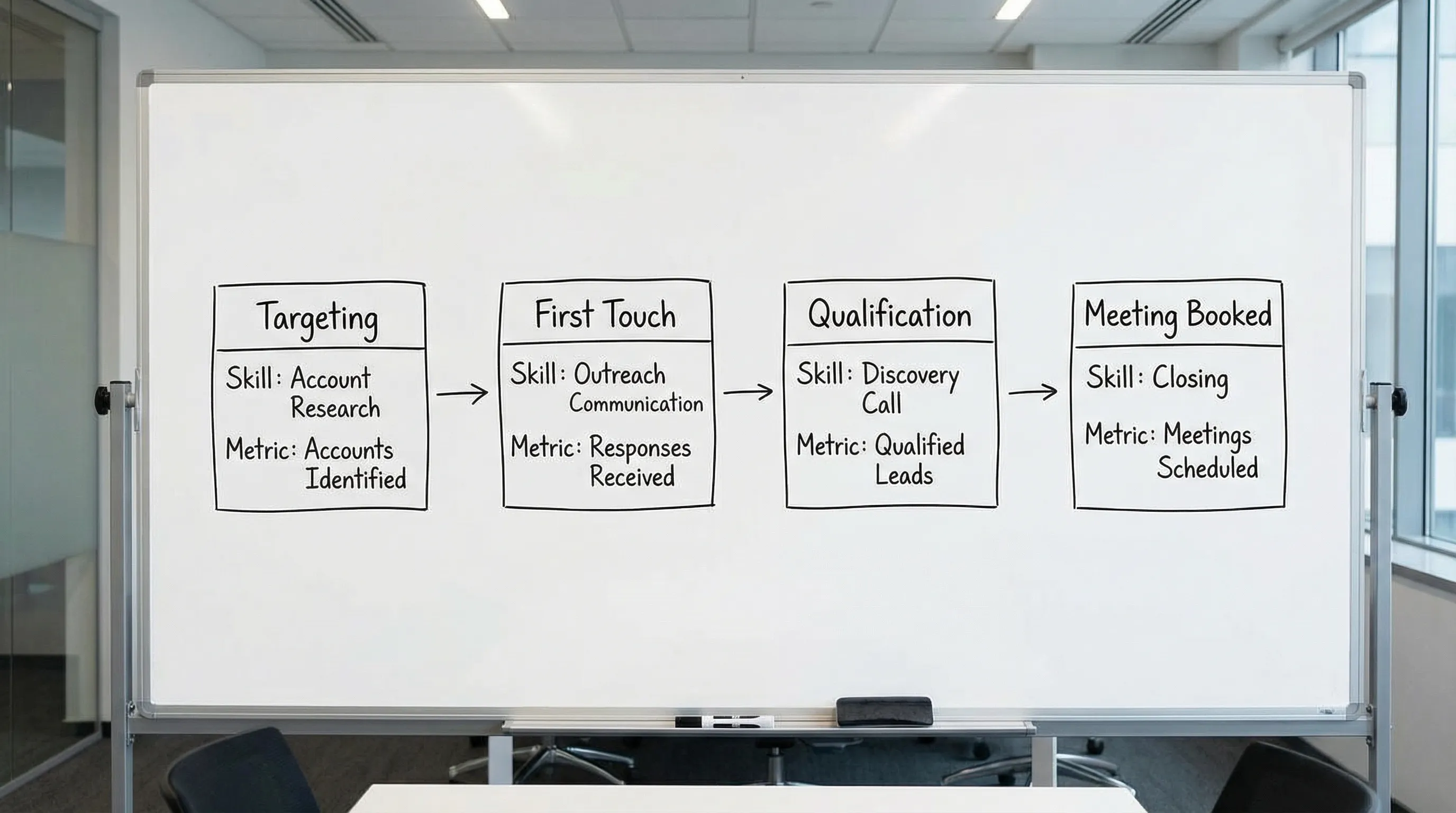
Think of pipeline as a conversion chain. Each skill below is tied to a stage you can measure.
| Pipeline stage | Skill that moves it | What “good” looks like | Leading indicator to watch |
|---|---|---|---|
| Targeting | Signal-based prospect selection | Lists built from clear ICP plus triggers, not generic filters | Reply rate by segment (not overall) |
| First touch | Conversation design (human + AI) | Short, specific, respectful openers that earn a response | Positive reply rate |
| Reply handling | Thread control and momentum | You advance the thread in 2 to 4 messages, no rambling | Time-to-response, drop-off rate |
| Qualification | Evidence-based qualification | You capture fit + intent + proof, not vibes | Qualified conversation rate |
| Booking | Low-friction meeting mechanics | You propose a clear next step and make scheduling easy | Meeting booked rate |
| Handoff | Context packaging | AEs receive the “why now” evidence packet | AE acceptance rate |
| Scaling | Experimentation and governance | You run controlled tests and prevent automation risk | Lift by prompt/version, override rate |
Skill 1: Signal-based targeting (precision beats volume)
In 2026, “spray and pray” is expensive even if the software is cheap, because it costs reputation, deliverability, and focus.
Signal-based targeting means you prioritize prospects using observable reasons they might care now, for example:
- A role change (new VP, new SDR manager)
- A relevant initiative (hiring pattern, territory expansion)
- A tech signal (new tool adoption that creates downstream needs)
- A recent post that reveals priorities
What to practice: build a weekly habit of writing one sentence per prospect that answers “Why them, why now?” If you cannot write it, you do not message them.
Skill 2: Conversation design (not “copywriting”)
Modern outbound is not about crafting a perfect message. It is about designing a sequence of micro-commitments that feels natural on LinkedIn.
Good conversation design includes:
- A reason for outreach (context)
- A credible claim (why you might be right)
- A small question that is easy to answer
- A next step that matches the level of intent
This is also where AI can help, as long as you treat AI as a drafting and variation engine, not as your strategy. Teams that win create a prompt system, test it, then standardize what works.
If you want templates plus guidance on mechanics, Kakiyo has a strong library in LinkedIn outreach that converts.
Skill 3: Thread control (momentum is a skill)
A common 2026 failure mode is “we got replies but couldn’t convert them.” That is usually a thread control problem.
Thread control is the ability to:
- Respond quickly with relevance (speed plus context)
- Ask one tight question at a time
- Prevent the thread from drifting into long explanations
- Recognize when the prospect is not a fit and exit cleanly
What to practice: take 20 real threads and rewrite your second message. Most pipeline is won or lost on message two.
Operational note: teams that treat time-to-first-meaningful-response as a weekly KPI tend to outperform teams tracking only activity. Kakiyo’s view on this shows up across its measurement content, including AI sales metrics to track weekly.
Skill 4: Evidence-based qualification (stop “calendar qualifying”)
In 2026, the strongest reps qualify using evidence that can be audited later. That means you capture:
- Fit: are they in the ICP?
- Intent: do they care and do they want to act?
- Proof: what did they say or do that supports the above?
This matters because it prevents two pipeline killers:
- Low-quality meetings that AEs reject
- “Ghost pipeline” that looks good in CRM but never converts
A practical way to structure qualification in short-form threads is a lightweight framework (BANT is still useful when applied conversationally). For a LinkedIn-friendly approach, see Kakiyo’s guide on using BANT without wasting time.
Skill 5: Meeting mechanics that preserve intent
Booking is not the finish line. Your goal is a held meeting with the right expectations.
High-performing reps do three things consistently:
Set a clear agenda in one sentence
Examples:
- “If helpful, we can compare how teams handle X today and see if Y is realistic in your environment.”
Confirm the “who” early
If the prospect mentions implementation, budget, or timeline, that is often a signal that another stakeholder matters. Ask permission:
- “Should anyone from RevOps or Sales Ops join so we don’t miss constraints?”
Reduce scheduling friction
Offer a concrete next step, then move to scheduling. Keep it simple and buyer-friendly.
Skill 6: Handoff excellence (the evidence packet)
AEs do not need a paragraph about “great call, seems interested.” They need a structured packet that helps them run a better discovery.
A strong handoff includes:
- Why now (trigger and urgency)
- What problem they acknowledged (in their words)
- What success looks like (metric or outcome)
- Known constraints (tools, process, approvals)
- Who else is involved (or likely to be)
If you want to measure whether your handoffs are working, track AE acceptance rate and meeting-to-opportunity conversion. Kakiyo covers this KPI discipline in its SDR KPI guide for 2026.
Skill 7: Experimentation discipline (the rep as a scientist)
Because channels and models change quickly, 2026 pipeline is a continuous testing problem.
The reps who win do not change ten things at once. They run controlled experiments, learn fast, then scale.
What to practice: pick one variable per week (opener, CTA, proof point, qualification question). Keep everything else stable.
If you want a structured sprint, use Kakiyo’s 7-day cold outreach testing plan.
Skill 8: AI supervision and governance (protect brand while scaling)
As AI handles more of the conversation surface area, supervision becomes a core sales skill, not a RevOps afterthought.
Strong reps know how to:
- Write prompts that reflect the company’s positioning and guardrails
- Review conversations for tone drift or claim creep
- Escalate to a human when stakes rise (pricing, legal, competitive landmines)
- Use override control appropriately, not constantly
If you are evaluating what “good governance” looks like for LinkedIn automation, Kakiyo’s guide on automated LinkedIn outreach done safely is a practical baseline.

A quick self-assessment: are your 2026 pipeline skills balanced?
Use this to spot your biggest constraint.
| If you are strong here… | …but weak here… | Your pipeline symptom | Your fix for the next 14 days |
|---|---|---|---|
| Volume and consistency | Targeting precision | Low reply rate, lots of “not relevant” | Add trigger rules and tighten ICP notes |
| Great openers | Thread control | Replies stall after message two | Practice second-message rewrites |
| Friendly conversations | Evidence qualification | Meetings don’t convert, AE rejects | Add fit/intent/proof capture in every thread |
| Lots of booked meetings | Meeting mechanics | No-shows, low urgency | Add agenda + expectation setting |
| Great instincts | Experimentation discipline | Random results, hard to scale | One-variable-per-week testing |
| Heavy AI usage | Governance | Brand risk, inconsistent claims | Add escalation rules and review loops |
Frequently Asked Questions
What are the most important sales representative skills for 2026? The most important skills are signal-based targeting, conversation design, in-thread qualification, meeting mechanics, handoff quality, experimentation, and AI supervision.
How do I improve pipeline quality, not just pipeline volume? Focus on evidence-based qualification (fit, intent, proof), track AE acceptance, and treat qualified conversations as the key leading indicator, not total messages sent.
What skills matter most for LinkedIn-first outbound? Thread control (fast, relevant replies), conversational qualification, and governance (tone, claims, escalation). LinkedIn rewards real dialogue, not rigid sequences.
How should sales reps use AI without sounding like everyone else? Use AI for drafting, variation, and consistency, but anchor it to strong inputs (ICP, triggers, positioning) and supervise outputs with clear guardrails and overrides.
Which metrics best reflect 2026 pipeline health? Beyond reply rate, track qualified conversation rate, meeting booked and held rates, AE acceptance, and time-to-first-meaningful-response. These predict revenue better than raw activity.
Build more qualified pipeline on LinkedIn, without adding more manual work
If your team is doing the right things but struggling to scale them, Kakiyo is designed to help. Kakiyo’s AI manages personalized LinkedIn conversations from first touch through qualification and meeting booking, with features like A/B prompt testing, intelligent scoring, analytics, and human override controls.
Explore how Kakiyo supports an end-to-end LinkedIn pipeline at scale: Kakiyo | AI LinkedIn Conversations That Qualify & Book Meetings.