
 Ilan Asseo
SDR Sales Process: From First Touch to Qualified Meeting
A practical guide to a repeatable SDR motion that converts targeted first touches into auditable qualified meetings, with stage definitions, the evidence.

A repeatable SDR sales process is not “do more outreach.” It is a system that turns targeted first touches into conversation evidence and then into qualified meetings that AEs actually accept. When that system is missing, teams compensate with volume, and pipeline quality gets worse, not better.
This guide breaks down the SDR sales process from first touch to qualified meeting, with stage definitions, the evidence to capture, and the KPIs that tell you where the process is leaking.
Industry evidence: Salesforce Research reports that sales reps spend only 28% of their week actually selling, with the rest consumed by deal management, data entry, and other non-selling work.
Source: Salesforce State of Sales
Start by defining the destination: what counts as a “qualified meeting”?
Most teams think their SDR process is broken, when the real problem is that “qualified meeting” is undefined. If the destination is fuzzy, everything upstream becomes opinion.
A practical definition that works across outbound and inbound is:
Qualified meeting = ICP fit + explicit intent + a clear next step + captured evidence.
That definition is intentionally “auditable.” It forces the SDR to bring proof, not vibes.
If your org uses lifecycle stages like MQL, SAL, and SQL, align your meeting standard to your SQL criteria, so “booked” does not mean “dumped.” (Related: Sales SQL: Definition, Criteria, and Examples, and MQLs and SQLs: Align Definitions, Boost Pipeline Health.)
Minimum evidence to require (so AEs trust the meeting)
You can keep the bar lightweight and still be consistent. Here is a minimum evidence packet many teams standardize:
| Evidence item | What “good” looks like | Where it usually comes from |
|---|---|---|
| Fit | Matches ICP slice (industry, size, region, tech constraints, role/persona) | CRM + enrichment + LinkedIn profile |
| Intent | Prospect indicates a relevant problem, initiative, or curiosity | Reply content, call notes, DM thread |
| Impact or stakes | A reason it matters (cost, risk, goal, deadline, KPI) | Short discovery exchange |
| Next step | Confirmed meeting time, or explicit agreement to meet | Calendar invite + thread proof |
| Notes and context | 3 to 6 bullets that make the AE prepared | SDR summary (with quotes) |
The SDR sales process (end-to-end) in 6 stages
A modern SDR motion is a chain of micro-conversions. Each stage has its own goal, success metric, and “exit criteria.”
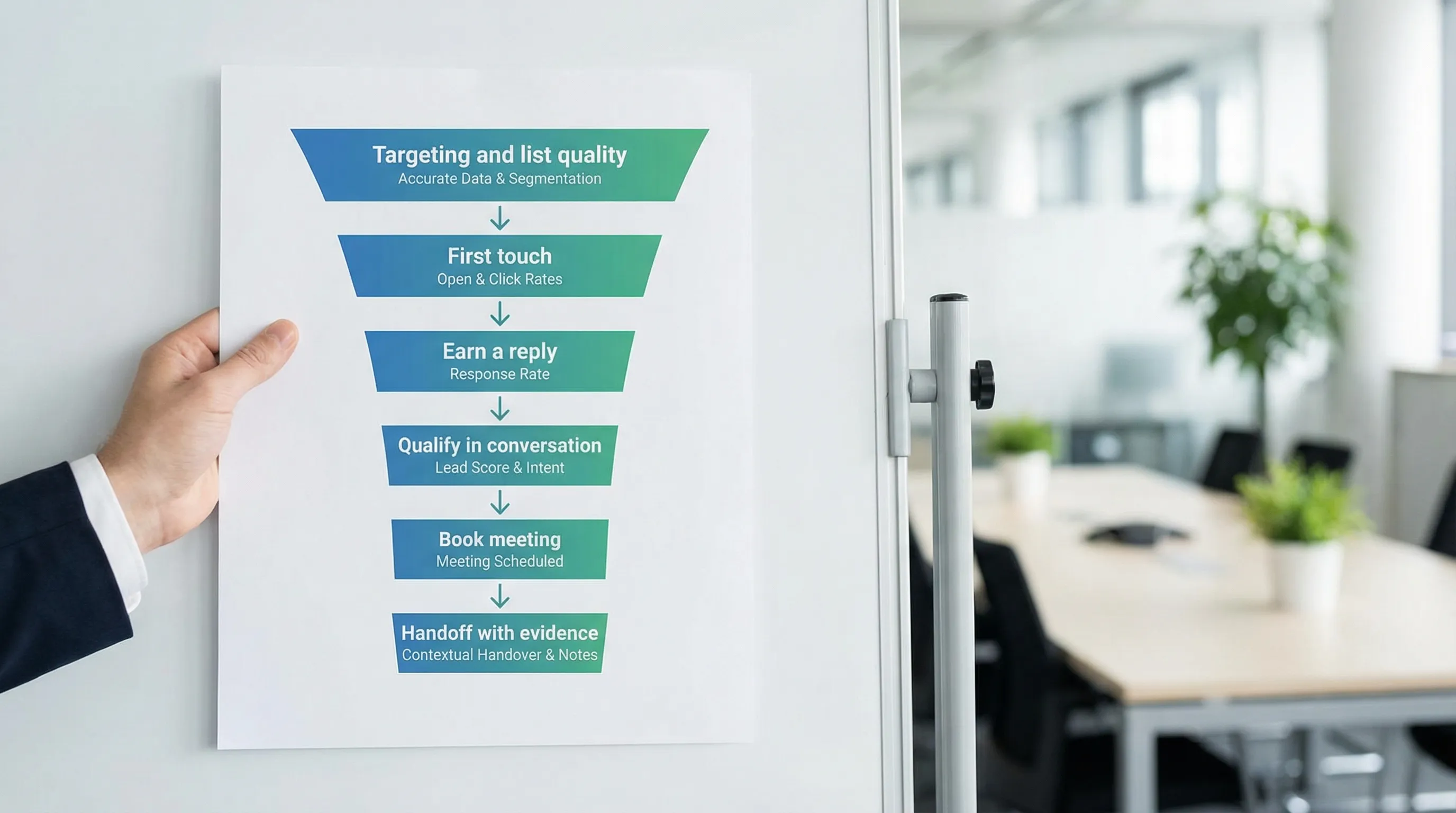
Stage 1: Targeting and list quality (win before the first touch)
Goal: Put the right people in front of the right message.
If targeting is off, everything downstream looks like a copy problem, a rep problem, or a tool problem.
What to standardize:
- ICP slices (not one broad ICP). Example: “VP RevOps at B2B SaaS, 200 to 1,000 employees, Salesforce CRM, hiring SDRs.”
- Trigger signals per slice (funding, new leader, hiring, tool change, outbound expansion, event).
- Disqualifiers (things you do not sell to).
Best practice: treat your list as a product. It should have acceptance criteria, QA, and iteration.
KPIs that matter here: ICP match rate, bounce rate (email), connection acceptance rate (LinkedIn), and percentage of accounts with multiple contacts.
Stage 2: First touch (earn attention, do not pitch)
Goal: Get permission to continue the conversation.
Your first touch is not a mini-demo. It is a relevance test.
A reliable first-touch structure (works in LinkedIn and email) is:
- Context: why this person, why now
- Credibility: one proof point (customer type, result, signal)
- Value hypothesis: what you believe they care about
- Micro-CTA: a small question that is easy to answer
If you need swipeable examples, use your channel-specific playbooks rather than forcing one script everywhere. For LinkedIn, see LinkedIn Outreach Messages That Get Replies. For email, see Cold Email Outreach: A Modern Checklist for Replies and Meetings.
Speed matters for inbound and triggered leads. A classic analysis in Harvard Business Review showed that contacting leads quickly significantly increases the odds of qualification compared with slower follow-up. Even in outbound, speed to follow-up after a reply is one of the easiest “free” lifts.
KPIs that matter here: time-to-first-touch (inbound), first-touch reply rate, connection acceptance rate (LinkedIn).
Stage 3: Reply handling (turn “interest” into a real conversation)
Goal: Convert replies into two-way threads.
Most SDR teams lose momentum here because reply handling is unstructured. A process upgrade is to define reply categories and actions.
| Reply type | What it means | SDR action | What to log |
|---|---|---|---|
| Positive | Open to learning more | Ask 1 qualifying question, then propose times | Problem statement, meeting interest |
| Neutral | Curious but unclear | Share 1 concise proof/value snippet, ask a binary question | Objection/unknown, next question |
| Objection | Not now, not me, not relevant | Handle once, offer an exit, propose re-route | Objection type, owner, timing |
| Negative | Do not contact | Stop, confirm opt-out | Opt-out signal |
This is also where conversation quality diverges from activity volume. Teams that obsess over “reply rate” without measuring “qualified conversation rate” build a process that optimizes for chatter, not pipeline.
KPIs that matter here: response time to replies, positive reply rate, qualified conversation rate.
Stage 4: Qualification (do it in-thread, not as an interrogation)
Goal: Confirm fit and intent, then earn the meeting.
Qualification fails when it becomes a checklist dump. The SDR’s job is to reduce uncertainty with minimal friction.
A simple qualification model that stays “thread-safe” on LinkedIn is:
- Fit: Are they the right kind of account and persona?
- Intent: Is there a real problem or initiative?
- Evidence: Do we have a quote, signal, or behavior we can hand to an AE?
- Next step: Are they willing to take a meeting, and with whom?
You can map this to frameworks like BANT, but the ordering matters. Start with Need (or problem) because Budget and Authority questions are high-friction early.
For practical LinkedIn-friendly prompts, see BANT Sales Framework: Qualify Leads Without Wasting Time.
Examples of low-friction qualifying questions
Use one question at a time, based on what you still do not know:
- Fit: “Are you focused on pipeline generation for outbound right now, or is that owned by another team?”
- Intent: “What prompted you to look into this, manual follow-up workload, meeting quality, or something else?”
- Stakes: “What happens if this stays the same for another quarter?”
- Next step: “If it helps, I can bring a 10-minute walkthrough focused on your current motion. Who besides you should weigh in?”
KPIs that matter here: % of conversations with captured fit, % with captured intent, qualified-to-booked rate.
Stage 5: Booking (remove friction, increase show rate)
Goal: Turn agreement into a held meeting.
Booking is not “send a link.” Booking is a set of mechanics that prevent drops:
- Confirm purpose: “We will cover X, then decide Y.”
- Confirm attendees: single-thread vs buying group
- Confirm time zone
- Reduce prep load: offer a 1-question pre-read instead of a long form
A practical standard is to require that every booked meeting has:
- A calendar invite
- A short agenda (2 to 3 bullets)
- The problem hypothesis that triggered the meeting
KPIs that matter here: booked-to-held rate, reschedule rate, no-show rate.
Stage 6: Handoff (protect the AE’s time with an evidence packet)
Goal: Make the AE’s first 5 minutes better than if the SDR had never existed.
AEs reject meetings for predictable reasons: wrong persona, unclear pain, no urgency, no context, or the SDR booked a “maybe.” A handoff packet prevents that.
A lightweight handoff template:
| Field | Example (format, not content) |
|---|---|
| Why this account | Trigger + ICP slice |
| Prospect’s words | 1 to 2 quotes from the thread/call |
| What they care about | KPI, risk, project |
| What they asked for | Demo, pricing, comparison, timeline |
| Next step confirmed | Date/time, attendees |
| Risks | “May be early,” “needs security review,” “not owner” |
If you want to operationalize this in your CRM, align it to your SQL definition so it is measurable and enforceable. (Related: Qualified Leads: Scoring That Sales Trusts.)
KPIs that matter here: AE acceptance rate, meeting-to-opportunity conversion, AE feedback loop completion rate.
The operating system behind the process: SLAs, fields, and a weekly loop
A process that lives in a doc will decay. A process that lives in SLAs, required fields, and weekly inspection improves.
SLAs to define (so speed and quality are not optional)
At minimum, define SLAs for:
- Speed to first touch (inbound, and “triggered outbound”)
- Speed to first reply follow-up
- How long a conversation can stay idle before a follow-up
- When to stop (opt-out, no intent, wrong persona)
Minimum CRM fields for auditable qualification
You do not need 40 fields. You need the fields that let you measure quality:
- ICP slice (picklist)
- Fit status (yes/no/unknown)
- Intent status (yes/no/unknown)
- Evidence note (short text)
- Next step outcome (booked, nurture, disqualified, re-route)
Where AI fits (and where it should not)
AI helps most when it reduces the highest-volume, lowest-leverage work while keeping humans in control of high-stakes decisions.
In the SDR sales process, AI is typically strong at:
- Scaling personalized first touches from defined ICP slices
- Handling routine reply paths quickly
- Asking consistent, approved qualifying questions
- Capturing structured evidence from conversations
- Scoring conversations so reps prioritize what matters
AI is typically not something you want to run without controls when:
- The prospect is angry, sensitive, or escalated
- Pricing, legal, or compliance topics appear
- The buyer’s context is ambiguous and needs judgment
Example: AI-managed LinkedIn conversations with supervision
LinkedIn is a conversation channel, which makes it a good fit for automation that can manage multi-turn threads safely.
Kakiyo is built specifically for this: it autonomously manages personalized LinkedIn conversations at scale from first touch to qualification to meeting booking, with features like prompt customization, A/B prompt testing, conversation override control, scoring, and analytics.
The key is not “replace the SDR.” The key is to:
- Let AI handle parallel threads and routine steps
- Require evidence for qualification
- Give SDRs and leaders a control surface (override, QA, reporting)
If you are building a governed AI motion, you may also want the broader operating model: Sales and AI: A Practical Team Playbook.
Common failure modes (and how to fix them fast)
Failure mode 1: Activity spikes, pipeline does not
Root cause: you are optimizing for top-of-funnel volume metrics.
Fix: add stage-level conversion metrics (qualified conversation rate, AE acceptance rate) and treat them as primary.
Failure mode 2: “Qualified” means different things to SDRs and AEs
Root cause: no shared exit criteria.
Fix: publish the evidence packet and require it for stage progression.
Failure mode 3: Replies are high, meetings are low
Root cause: your CTA is too big too early, or your qualification question is too heavy.
Fix: switch to micro-CTAs and one-question-at-a-time qualification.
Failure mode 4: Meetings are booked, AEs reject or meetings no-show
Root cause: booking mechanics and handoff are weak.
Fix: enforce agenda + attendees + problem hypothesis on every invite, then track booked-to-held and AE acceptance.
A practical scorecard to manage the SDR sales process
If you review only one table weekly, make it this one.
| Stage | Primary metric | Diagnostic question |
|---|---|---|
| Targeting | ICP match rate | Are we reaching the right accounts and personas? |
| First touch | Acceptance or reply rate (by channel) | Is our message relevant to this slice? |
| Reply handling | Response time to replies | Are we fast enough when intent shows up? |
| Qualification | Qualified conversation rate | Are we earning evidence, or collecting chatter? |
| Booking | Booked-to-held rate | Are we reducing friction and confirming details? |
| Handoff | AE acceptance rate | Do AEs trust the meeting and the notes? |
Putting it into action
If you want this SDR sales process to work in the real world, pick one ICP slice and instrument the stages above before you scale volume. Once you can see where conversations convert, you can safely add automation.
If LinkedIn is a meaningful source of your pipeline, Kakiyo can help you run the process with AI-managed, personalized conversations that qualify and book meetings, while keeping human control through overrides, testing, and analytics. Learn more at Kakiyo.
FAQ
What does a strong SDR or BDR actually own?
A strong SDR or BDR owns early-stage pipeline creation: targeting, first conversations, qualification, and clear handoff. The role is not just about booking meetings, but booking the right meetings.
Which skills matter most in modern sales development?
Prospecting judgment, messaging clarity, qualification discipline, and CRM hygiene matter more than raw call volume. In modern teams, AI literacy and channel fluency also matter.
How should teams evaluate SDR performance?
Use a mix of activity, conversion, and pipeline quality metrics. Strong teams look beyond booked meetings to show rates, qualification accuracy, and accepted pipeline.
How long does it take for a new rep to become productive?
Most reps need a ramp period before they consistently generate qualified pipeline. The fastest ramp comes from clear playbooks, tight feedback loops, and strong qualification criteria.