
 Ilan Asseo
AI Sales in 2026: Use Cases, Risks, and How to Measure ROI
Practical guide to AI sales in 2026: high-leverage use cases, operational risks, and a measurement approach to prove ROI and run pilots.

If you are researching AI sales in 2026, you are probably past the hype stage. Most teams now agree AI can write messages, summarize calls, and score leads. The harder questions are operational: which use cases actually move pipeline, what risks can derail brand and compliance, and how to prove ROI without hand-wavy “time saved” claims.
This guide breaks down the highest-leverage AI sales use cases, the real risks leaders are managing in 2026, and a measurement approach you can use to decide what to scale.
Industry evidence: “Our research suggests that a fifth of current sales-team functions could be automated.” — McKinsey & Company.
Source: McKinsey
What “AI sales” means in 2026 (and why definitions matter)
In 2026, “AI sales” is not one capability. It is typically a mix of three systems that behave very differently in production:
| AI capability | What it does well | Where it fails | Best owner |
|---|---|---|---|
| Generative AI (LLMs) | Drafting messages, summarizing threads, extracting structured fields from unstructured text | Can hallucinate, can sound generic, can drift in tone | Enablement + SDR leaders |
| Predictive AI (scoring models) | Prioritization, routing, forecasting probabilities, ranking accounts and leads | Garbage-in, garbage-out, bias from historical labels, can be ignored by reps | RevOps + Analytics |
| Agentic AI (workflow agents) | Taking actions across steps, managing conversations, following rules, booking meetings | Safety failures are higher impact because it acts, not just suggests | RevOps + Sales leadership (with governance) |
The 2026 shift is that agentic workflows are becoming the default expectation, especially in high-volume channels like LinkedIn and inbound. That raises the bar for measurement and governance.
A practical way to frame it:
- Systems of record (CRM) store outcomes.
- Systems of engagement (email, LinkedIn, calls) create buyer interactions.
- AI sits in the middle, either assisting humans, or autonomously moving work forward.
If you cannot say what outcome the AI is responsible for, you cannot measure ROI or manage risk.
AI sales use cases that are winning in 2026
The best use cases share three traits:
- They reduce cycle time (speed matters more than ever).
- They standardize quality (less variance between reps).
- They produce auditable evidence (why a lead was qualified, why a meeting was booked).
Below are the use cases most teams are scaling in 2026, organized by where they sit in the funnel.
1) Conversation-led outbound at scale (especially LinkedIn)
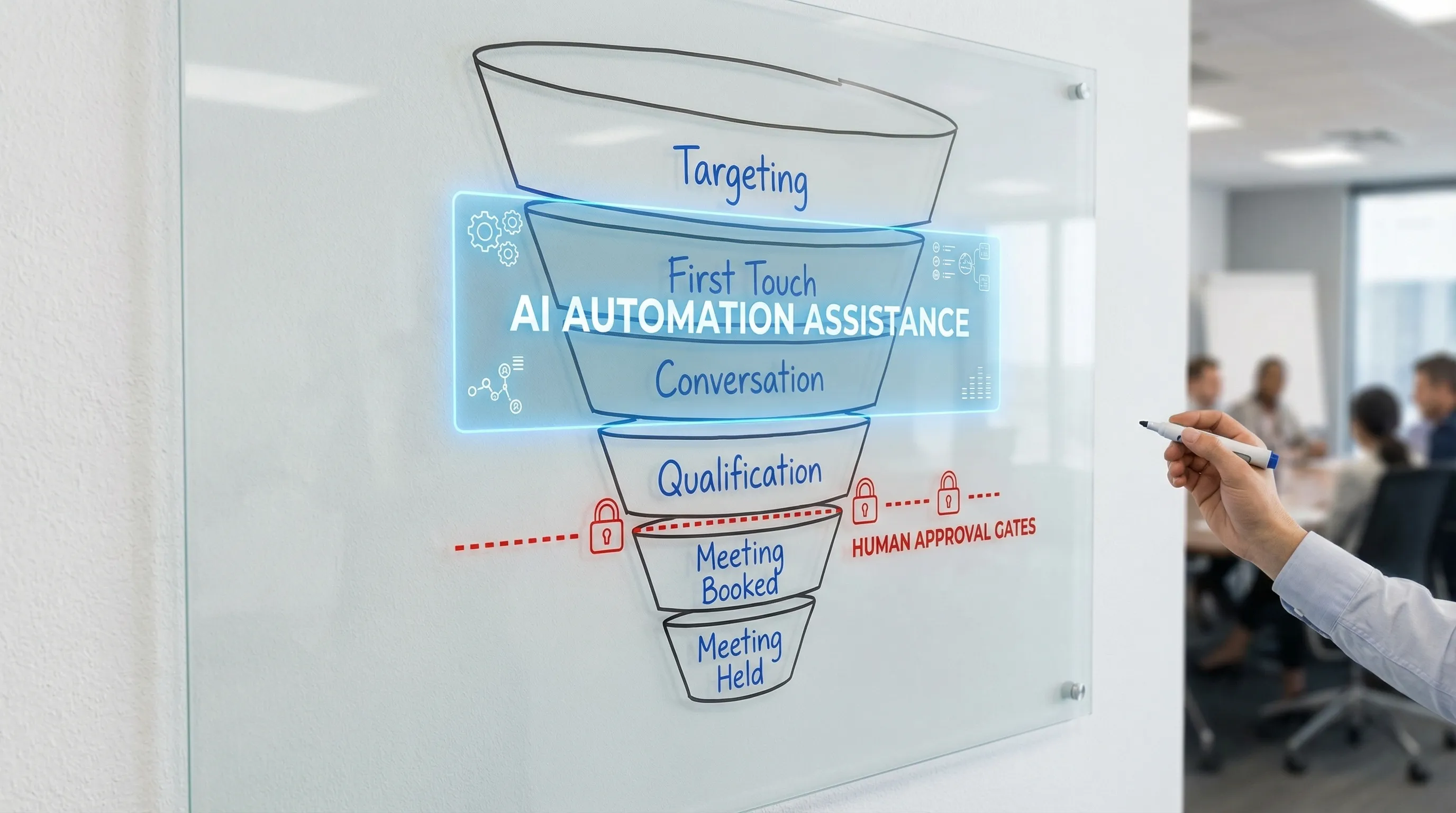
LinkedIn remains a high-signal channel because buyers reply in-thread, context is visible, and micro-conversions are easy to track (connection accepted, reply, qualified conversation, meeting booked, meeting held).
AI is increasingly used to:
- Generate profile-aware first touches that stay within your positioning rules.
- Manage follow-ups based on the buyer’s last message (not a fixed sequencer step).
- Qualify in-thread using a consistent rubric.
- Route, escalate, or book when intent is confirmed.
If you want a LinkedIn-first lens on what “good” looks like, Kakiyo’s guides on LinkedIn outreach that converts and AI for sales prospecting map the motion in detail.
2) Speed-to-lead for inbound and hand-raisers
In 2026, many teams run two lanes:
- A “hot lane” for hand-raisers and high-intent accounts.
- A “warm lane” where AI clarifies fit and intent before a human touches it.
AI improves speed-to-lead by responding immediately, asking 1 to 2 clarifying questions, and collecting evidence for routing. The ROI shows up in:
- Higher contact rates
- Better meeting-held rates (because the meeting is set with clearer context)
3) Qualification that is evidence-based (not just a label)
Teams are moving away from “MQL/SQL as a vibe” to qualification as an evidence packet.
In practice, that means AI helps capture:
- Fit (role, company type, constraints)
- Intent (problem, trigger, active initiative)
- Proof (what the buyer actually said)
- Next step (a committed meeting or clear follow-up)
This is where AI can be genuinely transformational because it standardizes what great reps do naturally.
If your definitions are drifting, start by aligning lifecycle rules. See MQLs and SQLs: Align Definitions, Boost Pipeline Health and the more operational Sales SQL definition guide.
4) Meeting booking and pre-meeting context packaging
Booking is no longer just “get a calendar link clicked.” In 2026, the best teams treat booking as a quality gate:
- Confirm the buyer’s goal for the meeting
- Confirm who needs to attend
- Package context for the AE (so discovery is not a reset)
AI can do the scheduling work, but the ROI often comes from AE acceptance and meeting-held rate, not raw meetings booked.
5) “Conversation intelligence” for async channels
Not all valuable signals happen on calls. In many outbound motions, the richest intent signals are in text threads.
LLMs are increasingly used to:
- Summarize threads into CRM-ready notes
- Extract objections and key constraints
- Tag intent level and urgency
This improves reporting and reduces requalification.
6) Forecasting and prioritization, powered by first-party signals
2026 is a “first-party signal” era. Third-party data still exists, but teams are leaning harder on:
- Conversation signals (replies, questions asked, objections)
- Behavioral signals (site visits, product usage, event attendance)
- Stage transition evidence
The most reliable forecasting improvements come when these signals are standardized, then used to train or calibrate models. If you want a deep dive, see AI sales forecasting methods.
The risks leaders are actively managing in 2026
AI sales risk is not theoretical anymore. It shows up as brand damage, compliance problems, and misleading metrics that cause teams to scale the wrong motion.
Here are the risks that matter most, plus what to monitor.
| Risk | What it looks like in the real world | Mitigation | What to measure weekly |
|---|---|---|---|
| Spam and channel fatigue | Reply rates drop, negative replies rise, connection acceptance falls | Tight ICP slices, pace controls, “earn permission” messaging | Positive reply rate, negative reply rate, accept rate |
| Hallucinated claims | AI invents customer names, features, or outcomes | Approved claims library, forbidden phrases, human override | QA failure rate, override rate |
| Brand voice drift | Messages “sound AI,” overly formal, inconsistent | Templates + tone guardrails, prompt versioning | Message QA score, complaint rate |
| Bad qualification inflation | More “qualified” leads but lower AE acceptance | Evidence-based criteria, disqualifiers, audit samples | AE acceptance rate, meeting-held rate |
| Data privacy and retention | Sensitive data ends up in places it should not | Data minimization, access controls, vendor review | PII incidents, access audit logs |
| Biased scoring and routing | Certain segments get deprioritized unfairly | Segment checks, calibration, explainability | Score calibration by segment |
| Measurement illusions | “Meetings booked” increases, pipeline does not | Track the full conversion ladder | Cost per held meeting, pipeline per held meeting |
Two governance resources worth using as reference points are the NIST AI Risk Management Framework and, if you operate in or sell into the EU, ongoing compliance planning around the EU AI Act.
For sales leaders specifically, the key is to run AI with controlled autonomy: clear rules, escalation triggers, and the ability for humans to override when stakes are high. Kakiyo’s perspective on this split is covered in AI and Sales: Where Humans Stay Essential.
How to measure AI sales ROI (without lying to yourself)
ROI measurement fails for predictable reasons:
- The “before” baseline was never stable.
- Teams measure activity, not outcomes.
- Attribution stops at meetings booked.
- Definitions drift (what counts as qualified changes mid-test).
A clean 2026 approach is to measure ROI at three layers: throughput, quality, and revenue impact.
Layer 1: Throughput (did we create more at-bats?)
Throughput metrics are leading indicators. They answer “did AI create more opportunities for real conversations?”
Examples:
- New conversations started
- Median first-response time
- Conversations per SDR per week
Layer 2: Quality (did we improve buyer and AE outcomes?)
Quality metrics prevent teams from scaling spam.
Examples:
- Positive reply rate (not just reply rate)
- Qualified conversation rate (based on evidence)
- AE acceptance rate
- Meeting-held rate
If you want a concrete weekly scorecard, use (or adapt) the one in AI sales metrics to track weekly.
Layer 3: Revenue impact (did this create profitable pipeline?)
This is where many pilots stop too early. Your ROI model should connect to at least one of:
- Pipeline created (with a consistent source rule)
- Revenue influenced or revenue won
- Gross margin contribution (for true ROI)
A simple ROI equation that works for most B2B teams:
AI Sales ROI (%) = (Incremental gross profit from AI-driven pipeline - Incremental AI costs) / Incremental AI costs × 100
Where “incremental AI costs” includes tool costs plus internal ops time (enablement, RevOps, QA).
A practical ROI model for AI-managed LinkedIn conversations
For conversation-led outbound, ROI becomes measurable when you treat the motion as a conversion ladder.
Here is a model you can use in a spreadsheet. Replace each variable with your numbers.
| Step | Metric | Baseline | With AI | Increment |
|---|---|---|---|---|
| 1 | New conversations/week | B1 | A1 | A1 - B1 |
| 2 | Qualified conversation rate | B2 | A2 | A2 - B2 |
| 3 | Meetings booked/week | B3 | A3 | A3 - B3 |
| 4 | Meeting-held rate | B4 | A4 | A4 - B4 |
| 5 | AE acceptance rate | B5 | A5 | A5 - B5 |
| 6 | Pipeline per accepted meeting | B6 | A6 | A6 - B6 |
From this, you can compute:
- Incremental accepted meetings/week = (A3 × A4 × A5) - (B3 × B4 × B5)
- Incremental pipeline/week = Incremental accepted meetings/week × A6
- Incremental gross profit = Incremental revenue won × gross margin
If you do not have “pipeline per accepted meeting” yet, use a conservative proxy and tighten it as data comes in.
What not to do
- Do not declare ROI based only on “messages sent” or “meetings booked.”
- Do not mix definitions mid-pilot.
- Do not compare a “good week” to a “bad week.” Use at least 2 to 4 weeks of baseline if you can.
How to run a 30-day AI sales pilot in 2026 (the non-chaotic way)
A 30-day pilot is long enough to see leading indicators move, and short enough to avoid getting stuck in tooling debates.
Week 0: Lock the operating rules
- Freeze an ICP slice (one segment, one value hypothesis)
- Define qualification evidence (what must be true to book)
- Define disqualifiers (what must stop the motion)
- Decide autonomy level (draft-only, suggest, or act)
If you need a step-by-step starting point, Kakiyo’s Artificial intelligence for sales: getting started is designed for this.
Week 1 to 2: Start narrow and instrument everything
Focus on one motion where AI can create end-to-end leverage, for example LinkedIn conversation management from first touch to booking.
Instrumentation essentials:
- Unique conversation IDs
- Clear source tagging in CRM
- A place to store the evidence packet (thread summary, intent, next step)
Week 3: Add experimentation (A/B prompts, not just templates)
By week 3, you should have enough volume to test one variable at a time:
- First-touch framing
- Qualification question order
- Booking CTA
This is where platforms that support A/B prompt testing and version control reduce guesswork.
Week 4: Decide scale based on paired metrics
Scale only if both improve:
- A throughput metric (more qualified conversations or accepted meetings)
- A quality metric (AE acceptance, meeting held, negative reply rate)
If throughput rises but quality drops, you are manufacturing busywork.
Where Kakiyo fits (without replacing your whole stack)
Kakiyo is designed for teams that want AI to manage personalized LinkedIn conversations at scale, from first touch through qualification to meeting booking, with controls that keep humans accountable.
Based on the product details provided, Kakiyo supports:
- Autonomous LinkedIn conversations
- AI-driven lead qualification
- Industry-specific templates
- Custom prompt creation and A/B prompt testing
- Intelligent scoring
- Simultaneous conversation management
- Conversation override control
- Centralized real-time dashboard with analytics and reporting
If your 2026 priority is “more conversations, higher qualification quality, and defensible ROI,” that is the core job Kakiyo is built around.
Frequently Asked Questions
What is AI sales in 2026? AI sales in 2026 typically combines generative AI (writing and summarizing), predictive AI (scoring and forecasting), and agentic AI (taking actions in workflows). The key change is more autonomy, which increases the need for governance and ROI measurement.
What are the best AI sales use cases to start with? Start with a narrow, high-signal workflow where outcomes are measurable, such as LinkedIn conversation management, inbound speed-to-lead qualification, or evidence-based lead qualification and routing.
What are the biggest risks of AI sales? The biggest risks are spam and channel fatigue, hallucinated claims, brand voice drift, inflated qualification, privacy issues, biased routing, and misleading metrics that overvalue meetings booked instead of meetings held and pipeline.
How do you measure AI sales ROI accurately? Measure ROI using a conversion ladder from conversations to qualified conversations to accepted meetings to pipeline and revenue. Pair throughput metrics with quality metrics, and compare against a stable baseline with consistent definitions.
Should AI replace SDRs? In most teams, AI replaces low-stakes repetitive work (drafting, follow-up, evidence capture), while humans remain essential for strategy, judgment, trust-building, and high-stakes qualification and negotiation.
Make AI sales measurable, safe, and pipeline-driven
If you want AI to run LinkedIn conversations end-to-end while keeping qualification evidence, scoring, and human override controls, explore Kakiyo. It is built to help SDR teams qualify and book meetings without turning your outbound into spam, and to make ROI visible in a real dashboard, not a slide.