
 Ilan Asseo
Prospectin LinkedIn: Fix These Common Outreach Mistakes
Guide to fixing common LinkedIn prospecting mistakes, from weak personalization and bad sequencing to poor qualification and reply handling.

Most LinkedIn prospecting fails for predictable reasons: outreach looks like a sequence, personalization is cosmetic, and reps optimize for volume instead of measurable conversation quality. The result is the same everywhere, low acceptance, low replies, and meetings that don’t hold.
Fixing it is rarely about “better copy.” It’s about tightening inputs (who you target and why now), improving the first two micro-conversions (acceptance and first reply), and running the conversation like a qualification workflow instead of a pitch.
Industry evidence: “As customers increasingly learn and buy digitally, sales reps become just one of many possible sales channels.” — Cristina Gomez, Managing Vice President, Gartner.
Source: Gartner
What LinkedIn prospecting is supposed to do (in one sentence)
LinkedIn prospecting should earn permission to have a relevant conversation, then convert that conversation into qualification evidence, and only then book a meeting.
If your motion skips the “permission” part, you’ll feel it immediately in reply quality. If it skips the “evidence” part, you’ll feel it later as no-shows, AE rejection, and pipeline that doesn’t progress.
If you want a deeper end-to-end workflow, Kakiyo’s team has a full guide here: LinkedIn Prospecting Playbook: From First Touch to Demo.
Prospectin LinkedIn mistake #1: Targeting is too broad (so your message can’t be specific)
Symptom: You’re saying “we help teams like yours…” because your list includes too many different realities.
Why it hurts: Specificity is a forcing function. If one message needs to fit RevOps, SDR leaders, and VPs of Sales across five industries and three segments, it will end up saying nothing.
Fix: Slice your ICP until you can write one sentence that is true for almost everyone on the list.
A practical slicer that works for most B2B teams:
- Segment (SMB, mid-market, enterprise)
- Role (who owns the pain)
- Motion (inbound-heavy, outbound-heavy, ABM)
- Trigger (hiring, new initiative, tech change, event)
Then write outreach that references the trigger, not your category.
Prospectin LinkedIn mistake #2: Your profile creates doubt before your message is even read
Symptom: Connection acceptance is low even with decent targeting.
Why it hurts: Prospects vet you fast. If your headline is generic, your “About” is vague, or your featured section is empty, you feel risky.
Fix: Treat your profile as the landing page for your outreach.
Minimum viable profile improvements:
- Headline that clearly states who you help and what outcome (not just your job title)
- Featured section with one credible artifact (a customer story, a short guide, a webinar replay)
- About section with a short point of view and one proof point (avoid the life story)
This is even more important if you use any form of automation, because automation increases scrutiny.
Prospectin LinkedIn mistake #3: You pitch in the connection request
Symptom: Low acceptance and occasional negative replies.
Why it hurts: The connection request is not a sales call. It’s a permission step.
Fix: Use a low-friction reason to connect.
A good connection note usually has:
- A real context hook (trigger, shared community, relevant post)
- One line that signals relevance
- No ask
If you need copy patterns, start with the frameworks in LinkedIn Outreach Messages That Get Replies and adapt them per ICP slice.
Prospectin LinkedIn mistake #4: “Personalization” is just a token (and prospects can tell)
Symptom: Your message references their company or a recent post, but the rest is generic.
Why it hurts: Token personalization reads like a mail merge. It doesn’t prove you understand their problem.
Fix: Personalize the reason you’re reaching out, not the greeting.
Better personalization sources:
- A relevant trigger (hiring SDRs, launching a new region, switching CRM, posting about pipeline)
- A role-specific KPI they likely care about (meeting held rate, speed-to-lead, SQL quality)
- A realistic tradeoff they face (volume vs. quality, speed vs. governance)
Personalization should change your value hypothesis, not just your first sentence.
Prospectin LinkedIn mistake #5: You don’t include proof, so you force the buyer to “take a leap”
Symptom: You get polite replies like “sounds interesting” that don’t go anywhere, or you get “what is this?”
Why it hurts: Prospects are pattern matchers. Without proof, they assume you are early, untested, or spammy.
Fix: Add one small credibility marker.
Examples that usually work without feeling heavy:
- “We’re seeing this with a lot of Series B outbound teams running LinkedIn-first.”
- “Quick question based on what you shared about [X].”
- “If helpful, I can share a 3-step checklist we use before booking meetings from LinkedIn.”
Avoid fake social proof. If you cannot say it confidently, don’t say it.
Prospectin LinkedIn mistake #6: Your CTA is too big for the stage
Symptom: You ask for 20 minutes in the first message after acceptance.
Why it hurts: At this point, you have not earned a meeting. You have earned the next message.
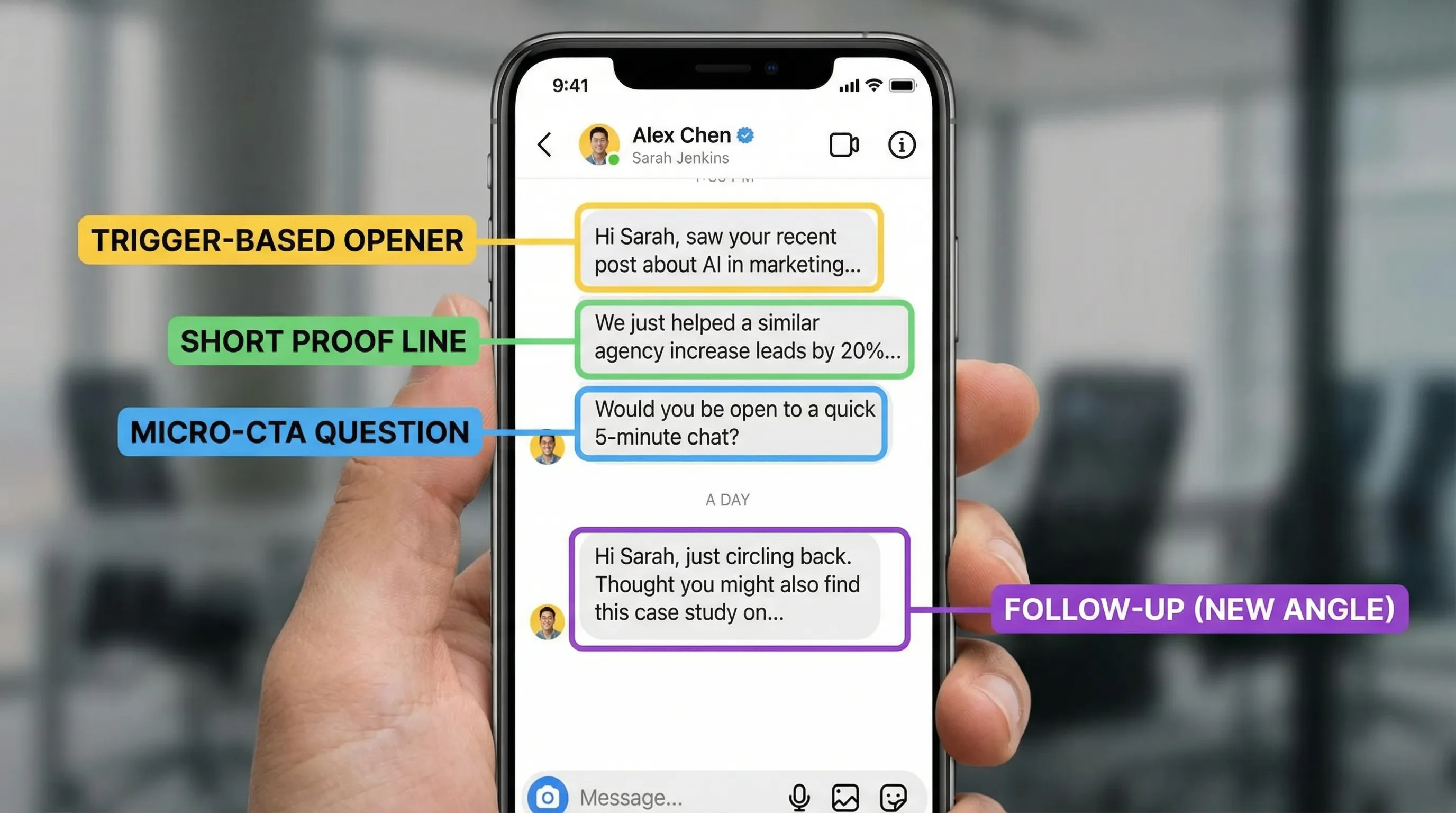
Fix: Use micro-CTAs.
Good micro-CTAs are:
- Specific
- Easy to answer
- Designed to route the conversation (qualified, nurture, or disqualify)
Example micro-CTA styles:
- “Worth comparing notes, or is this not a priority this quarter?”
- “Are you handling LinkedIn outbound with SDRs today, or mostly email?”
- “If I shared a 3-signal checklist, would you want it?”
Notice these do not ask for a meeting. They ask for a response.
Prospectin LinkedIn mistake #7: You ask “discovery” questions that feel like a form
Symptom: Prospects reply once, then ghost when you start qualifying.
Why it hurts: Traditional discovery is high friction in chat. LinkedIn works best with thread-safe qualification, questions that feel natural in DMs.
Fix: Ask one narrow question at a time, and tie it to why you’re asking.
Bad: “How many SDRs do you have, what tools do you use, and what’s your quota?”
Better: “Quick one so I don’t make assumptions, is LinkedIn a core outbound channel for your SDRs right now?”
If you want structured qualification that doesn’t waste time, build it around evidence (fit, intent, next step). Kakiyo’s approach to operational definitions is covered here: Sales SQL: Definition, Criteria, and Examples.
Prospectin LinkedIn mistake #8: Your follow-up timing ignores conversation behavior
Symptom: Prospects accept, then your follow-up cadence feels either desperate (too fast) or forgetful (too slow).
Why it hurts: LinkedIn is a real-time-ish channel. Long gaps kill momentum, but aggressive nudges trigger resistance.
Fix: Use a behavior-based cadence with stop rules.
A practical approach:
- After acceptance, send a short first message quickly while context is fresh
- If they reply, prioritize response speed (minutes to hours, not days)
- If they don’t reply, follow up with a new angle (proof, trigger, or question), not “bumping this”
For a more detailed cadence structure built around micro-conversions, use: LinkedIn Prospecting: A Modern Cadence Guide.
Prospectin LinkedIn mistake #9: You optimize for vanity metrics, not outcomes
Symptom: Your team reports connection volume and messages sent, but can’t explain why meetings are down.
Why it hurts: Activity metrics can rise while quality collapses.
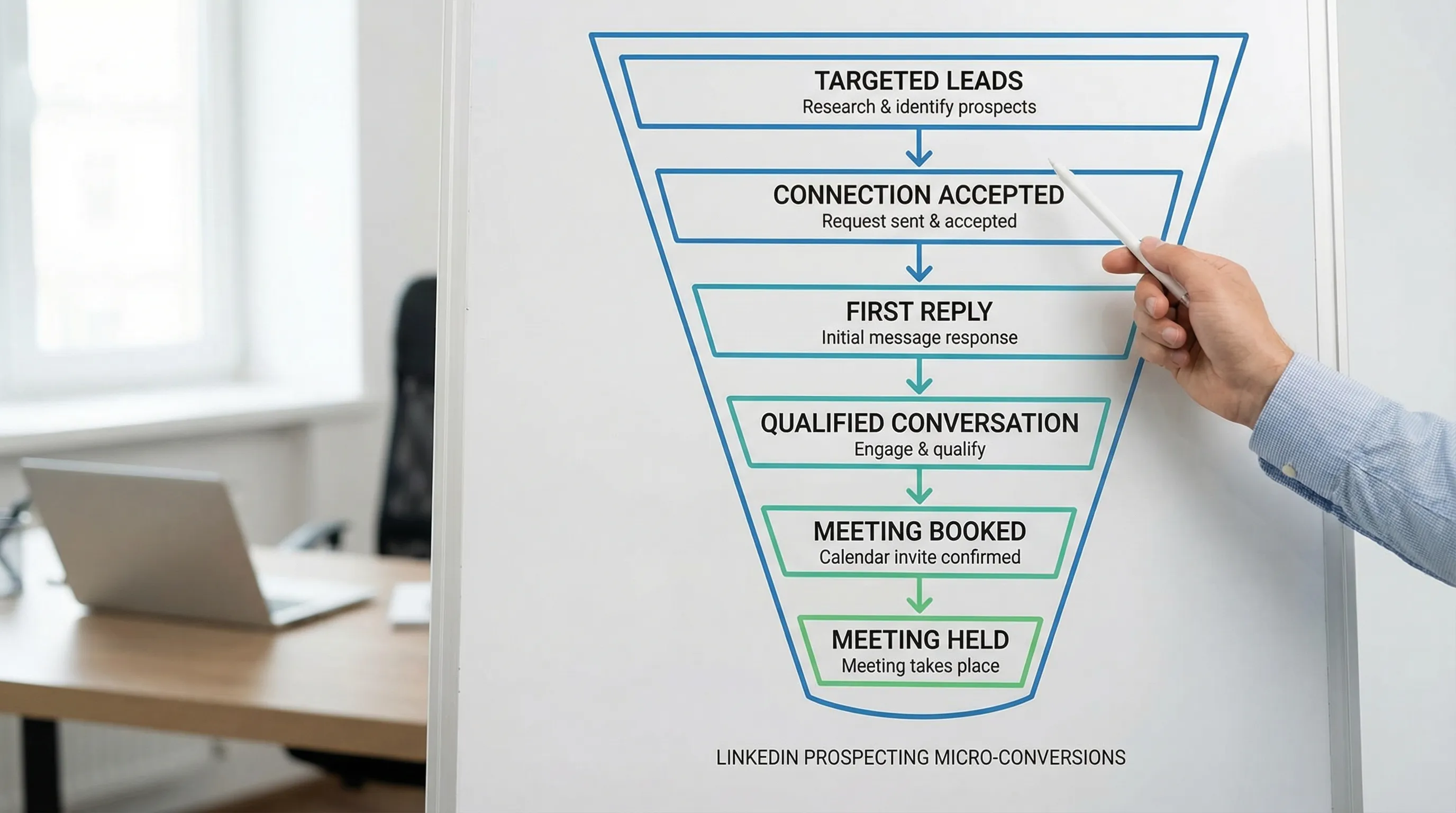
Fix: Track micro-conversions as a funnel.
Here’s a simple diagnostic table you can use in weekly reviews:
| Funnel metric | What it usually means when it’s low | Most common fix |
|---|---|---|
| Connection acceptance rate | Targeting is off, profile trust is low, or connection note is pitchy | Tighten ICP slice, improve profile, remove the ask |
| Reply rate (post-acceptance) | Opener is generic or CTA is too big | Add trigger-based relevance, switch to micro-CTA |
| Positive reply rate | Value hypothesis is wrong for this segment | Create 2–3 segment-specific hypotheses and A/B test |
| Qualified conversation rate | Qualification is unclear or too heavy | Define “qualified,” ask thread-safe questions |
| Meetings booked rate | Booking mechanics are weak, or handoff is unclear | Offer 2 scheduling options, clarify agenda and outcome |
| Meetings held rate | You are booking unqualified meetings or the meeting promise is unclear | Tighten criteria, confirm pain and next step in-thread |
If you want a metric system designed for AI-assisted LinkedIn outbound, this guide is the cleanest reference: AI Sales Metrics: What to Track Weekly.
Prospectin LinkedIn mistake #10: You scale outreach before you have controls
Symptom: Reply quality drops when volume increases, you get more negative signals, and reps lose trust in the channel.
Why it hurts: Without governance, scaling amplifies inconsistency. This is true for humans, and it’s even more true with AI.
Fix: Add guardrails before you add volume.
A lightweight control set that works for most teams:
- Clear do-not-contact rules and tone rules
- “Stop” rules (when to end the thread, when to opt out, when to escalate)
- A single definition of qualified (and what evidence must be captured)
- A/B testing for prompts or message variants (so changes are measurable)
- Human override for edge cases and high-stakes accounts
Kakiyo’s platform is built around exactly these realities: managing autonomous LinkedIn conversations while keeping teams in control with prompt customization, A/B prompt testing, conversation override, and analytics. If you’re considering automation, start with Kakiyo’s safety-first guidance: Automated LinkedIn Outreach: Do It Safely and Effectively.
A fast “fix-first” workflow (so you don’t change 10 things at once)
When Prospectin LinkedIn is underperforming, the fastest path is to fix the earliest broken stage. Don’t rewrite every message and change your targeting in the same week.
Use this order of operations:
1) Fix acceptance before you fix copy
If acceptance is low, your first message almost doesn’t matter because too few people see it.
Focus on:
- ICP slice tightness
- Profile credibility
- Connection note (no pitch, real context)
2) Fix the first message before you fix your whole sequence
If acceptance is fine but replies are low, your opener is the leak.
Focus on:
- One trigger
- One value hypothesis
- One micro-CTA
3) Fix qualification before you push harder for meetings
If you can get replies but meetings don’t happen (or don’t hold), qualification and meeting mechanics are the problem.
Focus on:
- A clear “qualified conversation” definition
- A small set of thread-safe questions
- A crisp meeting outcome (what they get, what you need)
For a repeatable qualification system you can operationalize, see: Lead Qualification: A Simple, Repeatable System.
Where AI helps (and where it usually makes things worse)
AI is a force multiplier. It helps when your motion is already coherent, and it hurts when your inputs are vague.
AI tends to help most with:
- Drafting segment-specific variants fast
- Reply handling and routing when the rules are clear
- Capturing and summarizing qualification evidence consistently
- Running controlled experiments (so you learn what works)
AI tends to make things worse when:
- Your ICP is too broad
- Your “qualification” is undefined
- You’re optimizing for message volume
- You don’t have stop rules or human override
If you want a practical blueprint for deploying AI in LinkedIn conversations without spamming, use: AI SDR: How to Deploy Without Spamming.
If you want to scale Prospectin LinkedIn without breaking trust
The goal isn’t “more messages.” It’s more qualified conversations per hour of SDR time.
That’s the core promise of Kakiyo: an AI platform that manages personalized LinkedIn conversations at scale from first touch through qualification to meeting booking, so SDRs can focus on high-value opportunities.
If you’re already doing LinkedIn outreach and want to tighten quality while increasing throughput, start by standardizing:
- Your ICP slices
- Your definition of qualified
- Your conversation states (open, engaged, qualified, book, nurture, disqualify)
Then consider automation only after those foundations are real. You can explore how Kakiyo supports controlled scaling at kakiyo.com.
FAQ
What makes a LinkedIn or cold outreach sequence effective?
An effective outbound sequence matches the buyer's context, uses short messages, and measures reply quality rather than raw volume. Cadence, targeting, and stop rules matter as much as copy.
How many touches should I use before stopping?
Most teams should stop once intent is clearly absent or once the sequence becomes repetitive. The right stop rule protects deliverability, reply quality, and brand perception.
Should I automate all outreach?
No. Automation should remove repetitive work, not replace judgment. The best systems automate targeting, timing, and admin while keeping messaging and qualification grounded in context.
How do I know whether outreach is working?
Track positive reply rate, meeting quality, and downstream conversion instead of open rates alone. If meetings do not progress, the issue is usually targeting or qualification, not activity volume.