
 Ilan Asseo
AI Sales Tools: What to Buy in 2026
A practical buying framework for sales leaders, RevOps, SDR managers, and founders on choosing AI sales tools in 2026—prioritizing conversion, control.

Buying AI sales tools in 2026 is less about finding “the best AI” and more about buying the right system to turn attention into qualified pipeline with measurable lift. The market is crowded, features overlap, and many products demo well but fail in production because they do not connect to your funnel definitions, data, governance, and team workflows.
This guide is a practical “what to buy” framework for 2026. It is written for sales leaders, RevOps, SDR managers, and founders who need to make a confident purchase decision, run a tight pilot, and avoid tool sprawl.
Industry evidence: “Our research suggests that a fifth of current sales-team functions could be automated.” — McKinsey & Company.
Source: McKinsey
What changed about AI sales tools in 2026
A few shifts have changed what “good” looks like compared with even a year ago:
1) Model capability is less of a differentiator
Foundation models are widely available and increasingly similar for common sales tasks (summaries, drafts, research assistance). What matters now is the product layer: data access, workflow design, controls, and analytics.
2) “Agentic” workflows are the new baseline
Teams expect tools to do more than suggest copy. They expect tools to take action across steps, like starting conversations, following up, qualifying, and booking, while still allowing human oversight.
3) Governance moved from “nice to have” to “buying requirement”
Security reviews, data handling, brand safety, and human-in-the-loop controls are now part of the purchase conversation for most serious teams.
For a broader view of how AI is operationalized across prospecting and qualification (not just messaging), see Kakiyo’s blueprint on AI sales automation from prospecting to qualification.
4) First-party conversation signals are more valuable than ever
With tightening channel dynamics and rising noise, conversation-level signals (acceptance, replies, qualified threads, meetings booked, meetings held) often predict pipeline quality earlier than lagging CRM stages. Kakiyo’s forecasting guide explains why these leading indicators matter for predictability: AI sales forecasting: methods, models, and accuracy.
Start by buying a job-to-be-done, not a tool
Before you compare vendors, get crisp on the job you are actually buying for. In 2026, most teams need a small set of AI capabilities that map to clear funnel outcomes.
Here is a job-to-be-done map you can use to structure your shortlist.
| Job to be done | What “good” looks like in 2026 | What to measure in the first 30 days |
|---|---|---|
| Targeting and list quality | ICP-aligned lists, buying group coverage, recency signals, minimal manual cleanup | ICP coverage rate, bounce rate (email), connection acceptance rate (LinkedIn), time-to-list |
| Personalization at scale | Context that is specific, short, and consistent with your positioning | Reply rate, positive reply rate, “this feels automated” complaints |
| Conversation management | Ability to handle many parallel threads without dropping context | Median response time, follow-up consistency, handoff completeness |
| In-thread qualification | A repeatable way to collect evidence (need, timing, authority) in natural conversation | Qualified conversation rate, precision of qualification, AE acceptance rate |
| Meeting booking | Low-friction scheduling, clean handoff notes, calendar hygiene | Meetings booked, meeting held rate, no-show rate |
| Coaching and QA | Fast review loops, examples of what works, safe experimentation | Ramp time, QA pass rate, rep adoption |
If your internal definitions are fuzzy, fix that first. A lot of tool disappointment is actually “definition debt.” Kakiyo’s guides on lead qualification process and what is a Sales Qualified Lead (SQL) are useful references for tightening stage criteria.
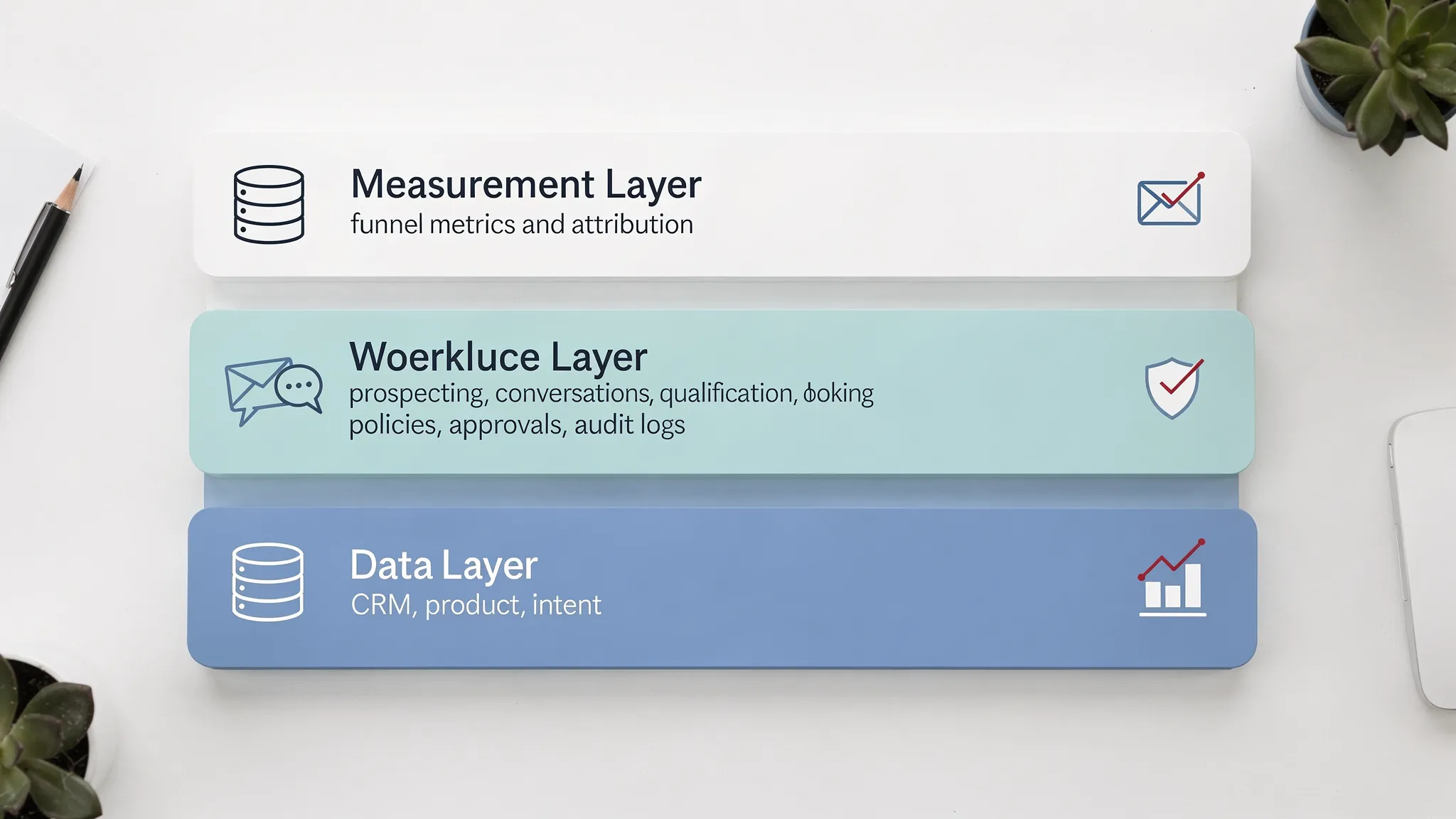
What to prioritize when comparing AI sales tools in 2026
Most teams over-index on “output quality” (does the AI write a good message?) and under-index on the operational features that determine ROI.
1) Evidence capture: can the tool prove why a lead is qualified?
A 2026-grade tool should not only label a lead as “qualified,” it should capture the conversational evidence that supports the decision. This is what reduces friction with AEs and improves forecasting.
Look for:
- Clear qualification criteria you can edit
- A way to store evidence (quotes, fields, tags, snippets)
- A predictable handoff packet to CRM
2) Control surface: can humans steer, override, and audit?
If the tool can take action, you need controls.
Look for:
- Human override for individual conversations
- Guardrails for tone, claims, and prohibited topics
- Auditability (what was sent, when, under which prompt)
- Permissions by role
For LinkedIn in particular, safety matters. If you are scaling conversations, read automated LinkedIn outreach: do it safely and effectively.
3) Experimentation: can you A/B test prompts and flows like a growth team?
AI makes iteration cheap, but only if the product supports structured experiments and clean reporting.
Look for:
- A/B testing on prompts and sequences
- Clear metric attribution at the message, thread, and meeting level
- The ability to roll back quickly
4) Analytics: does reporting map to your funnel, not vanity activity?
Tools often report what is easy (messages sent) instead of what matters (qualified conversations, held meetings, AE-accepted opportunities).
A practical starting point is a micro-conversion funnel similar to what Kakiyo describes in SDR sales: from outreach to booked meetings and the KPI model in sales development representative KPIs that matter.
5) Integration reality: can it live inside your CRM workflow?
In 2026, the “best” tool is often the one that fits the data contracts you already have.
Look for:
- Clean CRM sync (fields, activities, stages)
- Simple routing or handoff triggers
- Exportability for analysis
- Clear ownership (RevOps should not be reverse engineering data)
A buying scorecard you can use (and hand to procurement)
Below is a lightweight scorecard you can use to compare vendors. It focuses on production readiness, not demo polish.
| Category | What to check | Score 1-5 guidance |
|---|---|---|
| Outcome fit | Does it clearly solve your job-to-be-done? | 1 = generic AI assistant, 5 = purpose-built for your motion |
| Data and integrations | CRM fit, enrichment sources, activity capture | 1 = manual exports, 5 = reliable bidirectional sync |
| Controls and safety | Overrides, permissions, guardrails, auditability | 1 = “trust it,” 5 = configurable governance |
| Experimentation | A/B testing, reporting, rollback | 1 = none, 5 = built-in experimentation |
| Measurement | Maps to your funnel, supports attribution | 1 = activity only, 5 = pipeline-quality metrics |
| Adoption and workflow | Fits rep day-to-day, low friction | 1 = extra UI, 5 = clear operational home |
| Total cost to operate | Setup time, admin burden, prompt upkeep | 1 = heavy services, 5 = manageable by your team |
When vendors look close, “total cost to operate” is often the tie-breaker. If a tool needs constant prompt babysitting and manual QA, you are not buying leverage.
What to buy first in 2026 (by team maturity)
Instead of buying everything, buy the next bottleneck in your system.
If you are early-stage (founder-led sales, first SDRs)
Your goal is speed-to-learning and repeatability.
Prioritize tools that:
- Tighten ICP targeting and trigger-based outreach
- Reduce time spent drafting and researching
- Capture conversation learnings so you can refine positioning fast
Avoid over-investing in complex scoring and orchestration until you have stable definitions and enough volume to learn.
If you are scaling SDR output (5 to 30 SDRs)
Your goal is to increase qualified conversations and meetings without turning your team into copywriters and spreadsheet operators.
Prioritize tools that:
- Manage parallel conversations safely
- Standardize qualification inside the thread
- Turn replies into booked meetings with consistent handoffs
- Provide A/B testing and funnel reporting
This is where conversation automation can create real lift, especially in LinkedIn-first motions.
If you are enterprise (multiple segments, strict governance)
Your goal is governance, consistency, and forecastable pipeline.
Prioritize tools that:
- Provide strong controls, auditing, and permissions
- Integrate cleanly with CRM and data warehouse workflows
- Support multi-team rollouts (templates, scoring consistency)
- Produce explainable evidence for qualification decisions
The most common purchasing mistakes (and how to avoid them)
Mistake 1: Buying “better copy” instead of a better system
If your bottleneck is slow follow-up, inconsistent qualification, or weak handoff, a writing assistant will not fix it.
Fix: map your funnel leaks first. If you need a structured approach, Kakiyo’s guide on improving lead to MQL conversion rate with AI is a solid diagnostic.
Mistake 2: Treating qualification as a label, not a process
A lead score without evidence does not earn trust.
Fix: standardize qualification questions and evidence capture. Kakiyo’s BANT sales framework guide shows how to do this conversationally without interrogating buyers.
Mistake 3: Rolling out automation without “pace, policy, and provenance”
Scaling outreach without controls risks brand damage and channel restrictions.
Fix: ensure the tool supports safe automation patterns and you have an operating policy. Start with automated LinkedIn outreach: do it safely and effectively.
Mistake 4: Running pilots that cannot prove ROI
Many pilots fail because they do not define success metrics and holdout logic.
Fix: pick 1 to 2 primary outcomes (for example, qualified conversation rate and meetings held rate), then run a time-boxed test with clean attribution.
A practical 30-day pilot plan for AI sales tools
A good pilot is short, instrumented, and opinionated.
Week 1: Lock definitions and instrumentation
Align on:
- ICP and exclusion rules
- Qualification criteria (what counts as qualified, what does not)
- Your funnel metrics and where they will be recorded
If your team needs a template for operational rigor, Kakiyo’s lead qualification process provides a clear scoring and routing blueprint.
Week 2: Launch a narrow use case
Pick one motion:
- Trigger-based outbound to a specific persona
- Re-activation of stalled threads
- Event-timed outreach
Keep volume manageable so you can QA and learn quickly.
Week 3: Run controlled experiments
Test one variable at a time:
- Opener style
- Qualification question order
- CTA phrasing for scheduling
Measure micro-conversions, not just replies.
Week 4: Decide based on lift and operational burden
Your go/no-go should include:
- Lift on your primary metrics
- Rep adoption and QA burden
- Evidence quality in handoffs
- Any compliance or brand-safety issues
Where Kakiyo fits in a 2026 AI sales stack
Kakiyo is purpose-built for teams that want AI-managed, personalized LinkedIn conversations that move from first touch to qualification to meeting booking, at scale.
Kakiyo is a fit when:
- LinkedIn is a primary outbound channel for your SDRs
- You want autonomous conversation management across many prospects simultaneously
- You care about qualification quality, not just activity volume
- You want structured testing (prompt creation, A/B prompt testing) and measurement
- You need human control options (conversation override) plus centralized visibility (real-time dashboard, analytics)
You can learn more about the product at Kakiyo.
If you are still shaping your LinkedIn-first motion, these related playbooks tend to pair well with a Kakiyo rollout:
- LinkedIn prospecting playbook: from first touch to demo
- AI for sales prospecting: tactics that book meetings
- LinkedIn outreach messages that get replies

The bottom line: buy for conversion, control, and compounding learnings
In 2026, the best AI sales tools are the ones that:
- Improve a specific funnel outcome you can measure
- Capture qualification evidence that sales trusts
- Give you control, governance, and experimentation
- Reduce operational burden as volume grows
If you already know that LinkedIn conversations are a major source of pipeline, the buying decision gets simpler: prioritize a system that can manage those conversations end-to-end, qualify in-thread, and book meetings with clear analytics.
For teams building that motion, Kakiyo’s core promise is exactly that: AI LinkedIn conversations that qualify and book meetings so SDRs can focus on high-value opportunities. Learn more at kakiyo.com.
FAQ
Where does AI actually help in sales?
AI helps most when it reduces repetitive work, surfaces better signals, and improves execution speed. It is strongest in research, qualification support, follow-up, and workflow automation.
What are the limits of AI in sales?
AI still depends on clean inputs, good process design, and human oversight. It can accelerate bad workflows just as easily as good ones.
How should teams evaluate AI sales tools?
Evaluate tools by workflow fit, data quality, implementation friction, and measurable business outcomes. A feature-rich tool is not automatically the right tool for your motion.
Does AI replace SDRs or sales reps?
Usually no. In most teams, AI reshapes the role by taking over repetitive execution while humans stay responsible for judgment, positioning, and relationship depth.