
 Ilan Asseo
LinkedIn Prospecting Strategies for 2026 Pipelines
Practical LinkedIn prospecting strategies for SDR leaders, RevOps, and founders to build conversationally-driven, evidence-based pipelines in 2026.

Pipeline teams in 2026 are living in a paradox: it has never been easier to generate outbound activity, and it has never been harder to earn trust.
Prospects have seen every “quick question” opener. Teams have more automation than ever. LinkedIn has also gotten stricter about behaviors that look like spam. The result is simple: your LinkedIn prospecting strategy has to be designed for conversation quality and measurable pipeline, not just volume.
Below is a practical set of LinkedIn prospecting strategies for 2026 pipelines, written for SDR leaders, RevOps, and founders who want predictable meetings and clean handoffs.
Industry evidence: “As customers increasingly learn and buy digitally, sales reps become just one of many possible sales channels.” — Cristina Gomez, Managing Vice President, Gartner.
Source: Gartner
What’s different about LinkedIn prospecting in 2026
Three shifts matter most:
1) Buyers filter harder, faster
They decide whether you are worth replying to in seconds. That means your profile, credibility, and relevance do more work than your “perfect” first message.
2) Activity is cheap, evidence is expensive
If your reporting still centers on sends, connection requests, and reply rate, you will overproduce low-quality conversations. The 2026 standard is evidence-driven qualification inside the thread: fit, intent, constraints, and a clear next step.
3) AI raises the bar for governance
AI can scale personalization and follow-up. It can also create brand drift and spam at scale if you do not control prompts, safety rules, and escalation. If you want to scale, you need an operating model, not just tools.
If you want a deeper governance-oriented framework, Kakiyo’s guide on AI sales enablement: prompts, plays, governance maps the controls most teams miss.
The 2026 pipeline lens: optimize micro-conversions, not “outreach”
A modern LinkedIn motion is a ladder of micro-conversions. You win by improving each rung, then compounding the lift.
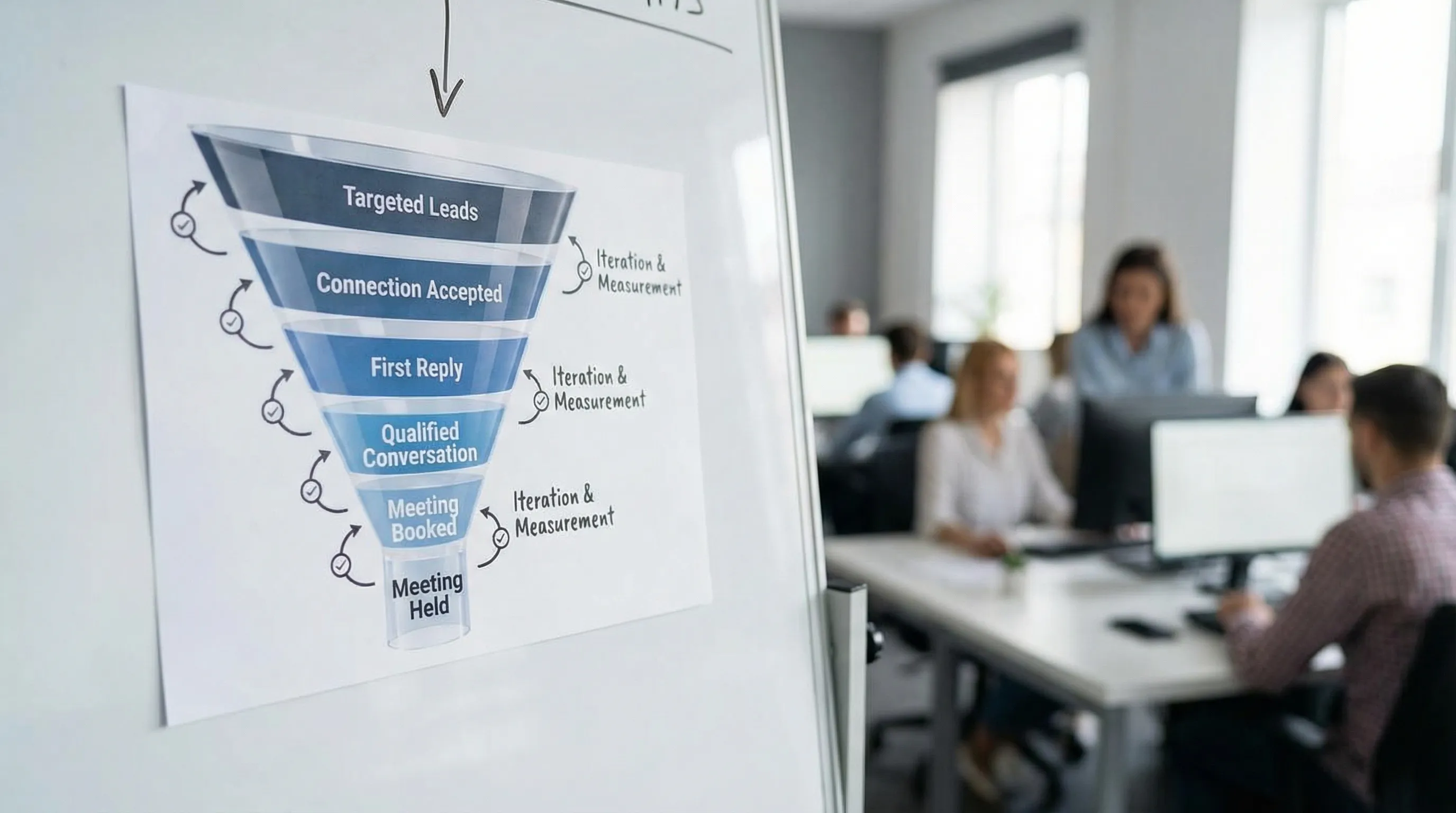
Here is a lightweight scorecard you can use to steer weekly improvements.
| Funnel rung (LinkedIn-first) | What it proves | What to measure (define it clearly) | What to test in 2026 |
|---|---|---|---|
| Targeted | You are aiming at the right people | ICP coverage per segment | ICP slices, triggers, exclusions |
| Connection accepted | Your relevance is plausible | Acceptance rate by segment | Connection note patterns, profile positioning |
| First reply | You earned engagement | Reply rate and positive reply rate | Openers, proof, question quality |
| Qualified conversation | There is real buying signal | Qualified conversation rate | Thread-safe qualification turns |
| Meeting booked | You created a next step | Booked meetings per 100 conversations | CTA mechanics, scheduling friction |
| Meeting held | It was real, not “calendar spam” | Show rate and AE acceptance | Pre-meeting confirmation, handoff packet quality |
Kakiyo expands on the weekly operating rhythm and KPI definitions in AI sales metrics: what to track weekly.
LinkedIn prospecting strategies for 2026 pipelines
Strategy 1: Build ICP slices that are small enough to be true
In 2026, broad ICP definitions create generic outreach, and generic outreach creates platform risk and buyer fatigue.
Instead of “VP Sales at B2B SaaS,” build slices you can actually write for, such as:
- VP Sales at Series B SaaS hiring 3+ AEs
- RevOps leaders migrating CRM or rebuilding lifecycle stages
- SDR managers tasked with improving meeting quality (not just volume)
Each slice should have:
- A plausible pain (what is breaking)
- A trigger (why now)
- A value hypothesis (what outcome you can drive)
- Proof you can reference (customer type, result type, or artifact)
This is also where Sales Navigator becomes a weapon, not a directory. Kakiyo’s walkthrough on using LinkedIn Sales Navigator for prospecting pairs well with this approach.
Strategy 2: Treat your profile like the landing page for your DM
Most teams over-invest in copy and under-invest in the asset prospects check first: your profile.
Make sure three things are instantly clear:
- Who you help (specific buyers)
- What outcome you drive (specific, not “growth”)
- What you do (category clarity)
If your profile reads like a resume, your prospecting has a handicap. In a high-noise year, prospects need “reason to believe” before they reply.
Strategy 3: Lead with a trigger, not a pitch
The highest-performing LinkedIn prospecting motions in 2026 look less like cold outreach and more like professional context.
A trigger can be:
- A role change or promotion
- A hiring signal
- A product launch
- A new region or segment expansion
- A public post that reveals a priority
Your first touch should explain the trigger in one line, then ask a low-friction question.
If you want copy patterns that stay buyer-first, see LinkedIn outreach messages that get replies.
Strategy 4: Design for “permission,” then earn the right to qualify
A common 2026 failure mode is asking qualification questions too early, or asking them in a way that feels like a form.
A better sequence is:
- Earn permission (relevance + respect)
- Get a small “yes” (reply, clarification, or confirmation)
- Ask one thread-safe qualification question
A thread-safe qualification question is short, specific, and easy to answer without sharing sensitive info.
Example patterns (adapt to your ICP):
- “Is the priority this quarter more pipeline volume, or meeting quality and conversion?”
- “Are you running this motion mostly founder-led, or with SDR coverage?”
- “When you say ‘SQL,’ do you mean AE-accepted meetings, or a scoring threshold?”
If you use a formal framework like BANT, do it conversationally. Kakiyo’s guide to BANT sales framework for LinkedIn shows how to avoid sounding like an intake form.
Strategy 5: Use proof that matches the ask
In 2026, prospects respond to proof that is proportional.
- If your ask is a 10-minute chat, proof can be a short artifact (a one-page checklist, a benchmark definition, a before-after workflow).
- If your ask is a demo, proof needs to be stronger (specific outcomes, relevant customers, or clear differentiation).
One practical move: keep a library of “proof snippets” that are safe to share in DMs, such as:
- A 3-bullet teardown of a common mistake
- A short qualification rubric
- A mini scorecard for micro-conversions
This also keeps your team consistent and reduces “message drift” across reps and AI.
Strategy 6: Multi-thread the buying group (without spamming the account)
Single-thread prospecting is fragile. Even when you book meetings, they are easier to cancel if only one person is involved.
In 2026, multi-threading works best when you:
- Start with the most likely conversation owner (often the operator)
- Add adjacent stakeholders only after you have context
- Customize the angle per persona (do not reuse the same pitch)
Treat this as an account conversation, not multiple isolated sequences.
Strategy 7: Replace fixed cadences with behavior-based branching
Linear cadences (step 1, step 2, step 3) break in real conversations.
Behavior-based prospecting means your “next action” depends on what the prospect did:
- If they accept but do not reply, your follow-up should convert acceptance into conversation.
- If they reply with curiosity, your next message should qualify.
- If they reply with a brush-off, your next message should clarify or gracefully exit.
Kakiyo’s LinkedIn prospecting cadence guide breaks down this branching logic in a way most sequencers cannot.
Strategy 8: Instrument qualification so Sales trusts it
A booked meeting is not the same thing as pipeline. In 2026, the teams that win are the ones whose meetings are consistently accepted and convert.
That requires an operational definition of “qualified” that can be audited.
A simple, defensible structure:
- Fit: are they in your ICP?
- Intent: do they have a real problem or priority?
- Evidence: what did they say that proves it?
- Next step: what did you agree to?
- Recency: is it current, not stale?
If your organization still debates MQL versus SQL definitions, align those first, then instrument the thread. These resources help:
Strategy 9: Use AI to scale the middle of the conversation, not just the first line
Most AI outreach use stops at “personalized opener.” That is the easiest part to automate and the least defensible.
Where AI helps the 2026 pipeline most is:
- Managing simultaneous threads without dropping follow-ups
- Keeping tone consistent across a team
- Asking the next best qualification question based on what was said
- Summarizing evidence for a clean handoff
This is also where control matters. If you want to scale without spam risk, you need throttles, stop rules, and override paths. Kakiyo’s playbook on AI SDR deployment without spamming is a strong baseline.
Strategy 10: Build a weekly experimentation loop (and keep it small)
In 2026, “set it and forget it” LinkedIn prospecting decays quickly.
A better operating rhythm is one test per week per ICP slice, measured on micro-conversions.
Examples of clean tests:
- Two openers with the same offer and same audience
- Two proof snippets (checklist vs benchmark)
- Two qualification questions (priority vs constraints)
- Two CTAs (book link vs propose 2 times)
If you want a disciplined sprint structure, Kakiyo’s cold outreach 7-day testing plan maps well to LinkedIn-first motions.
A practical 30-day plan to improve your 2026 LinkedIn pipeline
Week 1: Lock definitions and instrumentation
Decide what “qualified conversation” and “sales accepted meeting” mean in your org, then ensure you can tag conversations accordingly. If you cannot measure it, you cannot improve it.
Week 2: Launch one ICP slice with one value hypothesis
Pick a segment small enough to learn quickly. Build a trigger list, write one primary message pattern, and set behavior-based follow-ups.
Week 3: Add qualification and handoff packaging
Introduce 1 to 2 thread-safe qualification questions and standardize what gets handed to an AE (context, pain, evidence, next step). This is where meeting quality starts to rise.
Week 4: Scale what works, add governance
Only after you have a winner, scale volume. Add safety rules (stop conditions, opt-outs, escalation triggers) and a weekly QA review of conversation quality.
Where Kakiyo fits (if you want to scale without losing control)
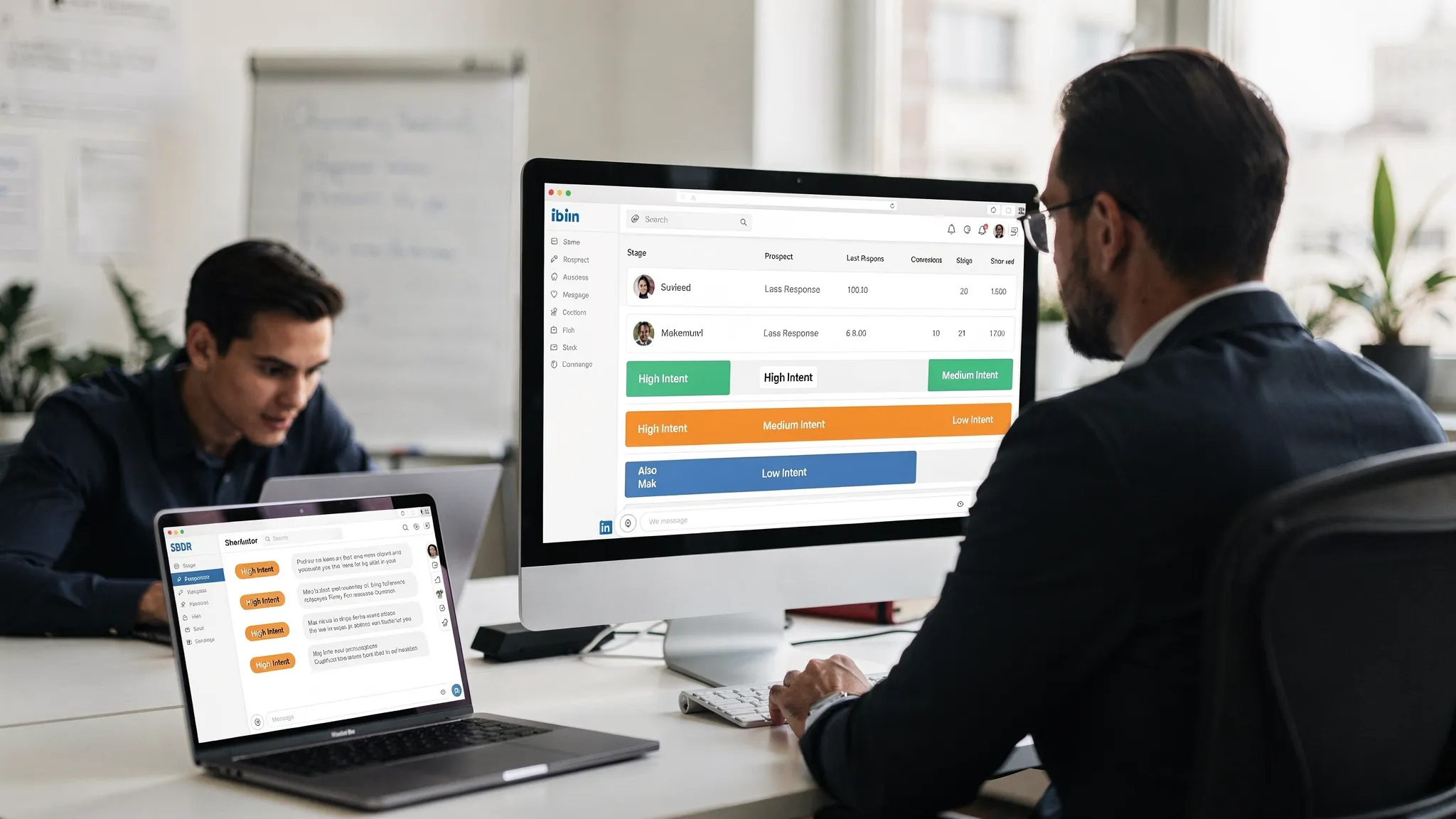
If your team already knows what to say but struggles to manage the volume of threads, follow-ups, qualification, and booking, Kakiyo is built for that specific gap: AI-managed LinkedIn conversations from first touch through qualification to meeting booking, with controls for teams that care about brand safety.
Based on Kakiyo’s published capabilities, teams use it to:
- Run autonomous, personalized LinkedIn conversations at scale
- Apply AI-driven qualification with an intelligent scoring system
- A/B test prompts and standardize industry-specific templates
- Keep humans in control with conversation override
- Monitor performance in a centralized real-time dashboard with analytics
To see the broader operating model behind this approach, read What “seamless AI sales” looks like across your funnel.
FAQ
What makes a LinkedIn or cold outreach sequence effective?
An effective outbound sequence matches the buyer's context, uses short messages, and measures reply quality rather than raw volume. Cadence, targeting, and stop rules matter as much as copy.
How many touches should I use before stopping?
Most teams should stop once intent is clearly absent or once the sequence becomes repetitive. The right stop rule protects deliverability, reply quality, and brand perception.
Should I automate all outreach?
No. Automation should remove repetitive work, not replace judgment. The best systems automate targeting, timing, and admin while keeping messaging and qualification grounded in context.
How do I know whether outreach is working?
Track positive reply rate, meeting quality, and downstream conversion instead of open rates alone. If meetings do not progress, the issue is usually targeting or qualification, not activity volume.